Updates
ACT NOW! Submit your story to ArtLeaks and end the silence on exploitation and censorship! Please see the submission guidelines in the "Artleak Your Case" page
Submitted and current instances of abuse are in the "Cases" section
To find out more about us and how to contribute to our struggles, please go to the "About ArtLeaks" page
Please consult "Further Reading" for some critical texts that relate to our struggles
For more platforms dedicated to cultural workers' rights please see "Related Causes"
For past and upcoming ArtLeaks presentations and initiatives please go to "Public Actions"
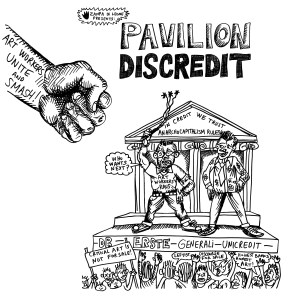
- Zampa di Leone, Pavilion DisCredit, March 2011
This protest letter begins with the particular set of circumstances which brought together an international group of art workers from different positions in the field. Through these exchanges, they decided work collectively to make visible the conditions of inequality and exploitation that they wanted to rescue from slander and gossip – or leave them unquestioned as the sole privilege of institutions.
Namely, we began collaborating as a group of artists, curators, art historians and intellectuals who wanted to publicly bring to light Pavilion UniCredit’s consistent mistreatment of artists, workers and even visitors to their center in Bucharest. This center is devoted to contemporary art and culture and financed by one of the most prominent banks in Europe – UniCredit Tiriac Bank. Yet, we see its mission to provide a space for critical thinking and dialogue compromised – through the management’s repressive maneuvers against those of us who problematized their politics and criticized their engagement with their main sponsor.
Having witnessed and experienced first-hand the exploitations perpetrated by the management, we decided it was our collective duty to openly speak against them, as well as warn those artists, curators and workers collaborating with this center. While we recognized the importance of this space as part of a growing effort to build a much-needed sustainable network for the art scene in Romania and contemporary art in general, we considered institutional critique just as prescient. Our attempts to establish a constructive critical dialogue with the management of Pavilion was consistently met with disregard and silence, unbefitting a space with a self-declared social and political mission channeled through art and culture. Moreover, the Pavilion team has circulated letters to a closed list of supporters that slander some of the artists that dared challenge their prowess on the local and international scene.
In response, we made public a series of instances which demonstrated Pavilion’s problematic relationship with its corporate benefactor. Through these instances we also emphasized how the management privileged this relationship at the disadvantage of artists it claimed to represent, its employees and the general public. For some time, these accounts were disparately published online. Yet we wanted to bring them all together to challenge the clout of this center to control what issues affect its workers. In doing so, we wanted to provide a positive example of collective protest against the appropriation of radical art, culture and theory by institutions entrenched in Power and Capital.
The unfolding of events began in February 2009, when the St. Peterburg-based art collective Chto Delat? was invited to participate in the exhibition “Comrades of Time,” curated by Joanna Sokolowska at Pavilion. The collective asked for a modest fee to present their video work “Angry Sandwhich People” or “In Praise of Dialectics” (2005). They argued that, since the center was financed by UniCredit, and named in honor of the same bank, then the latter should offer more solid support to the artists exhibiting on their premises – at least covering their travel and per diem expenses to view the exhibition. After being informed by the Pavilion management (via the curator) that there were no funds for artists’ compensation of any kind, they agreed to show their video work for free – but on the condition that it would be shown in conjunction with a discussion or intervention on the issue of financial support for the arts from corporate sponsors. The board of Pavilion rejected this proposal, informing Chto Delat? that they could not permit anyone to exhibit an attack on their institution or its main sponsor, even in the form of an artwork within the institution itself. This instance is one of several in which the management of Pavilion foreclosed the opportunity of a productive discussion dealing with the conditions of artist labor, preferring to leave unchallenged the principles of corporate funding.
Chto Delat?’s account of the events can be read here.
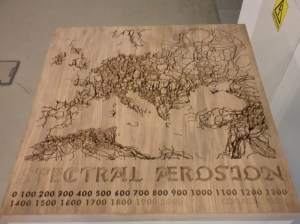
Société Réaliste, Spectral Aerosion, 2010. Jean-Baptiste Naudy removed this work from the Biennale in protest
On the occasion of the Bucharest Biennale 4, entitled Handlung: Producing Possibilities (also run by Pavilion UniCredit) – which opened on May 20th 2010, the concern over artists’ fees and funding arose yet again. French artist, Jean-Baptiste Naudy, part of the collective Société Réaliste, challenged the curator of the biennale, Felix Vogel to explain why some artists were not compensated for their work, even in the form of a symbolic per diem. This exchange took place during an open forum between Vogel, Eugen Rădescu and Răzvan Ion – co-directors of the biennale- and the artists right before the opening. The curator explained that the center had negotiated budgets for each artists with his/her respective embassy or cultural institute – leaving unmentioned UniCredit’s lack of financial support for artists’ production budgets or their labor. Echoing the concerns of many artists participating in the biennale, Naudy questioned the validity of this event to critique the political economy and re-energize social consciousness, when blatant disparities between who gets paid and who doesn’t remain unresolved and unspoken. But what was more upsetting than the lack of preparedness of the organizers to address these prescient concerns, was director Răzvan Ion (who was also the co-director of the Biennale) violent dismissal of Naudy’s intervention. Ion qualified the latter’s statements as inappropriate from an artist living and working the West, killing the discussion right then and there.
Freelance critic Daniel Tucker publicized the heated discussion between the curator, the directors of the biennale and the artists – here.
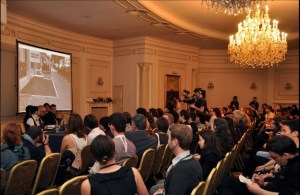
Press Conference for Bucharest Biennale 4, May 2010, held in the most expensive hotel in Bucharest, The Intercontinental
But the condition of artist labor was not the only thorny issue avoided in this manifestation. Before the Biennale began, one of the works scheduled to be installed in the Geology Museum was censored. The work in question, “Tit for Twat” by U.S. artist Kaucyila Brooke dealt with lesbian and inter-racial sexuality, themes which are surely relevant to the nascent civil society in Romania, fraught with homophobia and xenophobia. The director of the Museum in which the work was to be shown qualified it as pornography and refused to display it on the premises. The management of Pavilion and the curator confined themselves to qualifying the ban of the artwork as Stalinist era politics. They did not however, offer to show this work in any other of the 6 venues available for the Biennale, including their own space, which boasts a radical social and political agenda; at the same time, Brooke made it clear she was willing to compromise and have just pieces of the work shown, a suggestion which the management rejected. Surely, since not all of the works in the Biennale contained nudity, some compromise could have been achieved by simply switching works around – which would have allowed for Brooke’s prescient work to be available to the public.
Brooke’s statements regarding the censorship of her work and the center’s passive attitude can be read here.
How can it be, we ask, that during the most important contemporary art event in the country – according to Pavilion’s self-eulogies – concerns over the condition of artists’ labor and censorship be dismissed and reprimanded? Moreover, what is deeply disturbing and worrisome is that the repression is channeled by the leaders of the institution which is supposed to support and show solidarity with its workers with which it shares the responsibility of creating an engaged public in art and culture.
In March 2011, a young curator working as an Assistant Director at Pavilion UniCredit, Simina Neagu, had the initiative of an exhibition called “Just do it. Biopolitical Branding.” As the title clearly suggests, the project deals with the function of branding used as a re-appropriation and resistance strategy by different artist groups in order to counter the aggressive assault upon the public space perpetrated through consumerist semiotics and corporatist propaganda. There were two Romanian art collectives invited to this exhibition, Postspectacle and The Bureau of Melodramatic Research, as a result of the symbolical re-framing they manage to produce through their interventions (by using either overstatement or denunciation in their artistic practice).
First, Postspectacle was asked to estimate a production budget. They sent a text and an image for the catalogue and proposed a 1000 Euro budget that would include production costs and artist fees for the four people involved; they also expressed their intention to enact a performance at the opening of the exhibition (i.e. an action which they did not intend to record or rehearse in front of the Pavilion team). The text they sent announced the imminent “death” of their project when entering an art space which is both funded by a prominent bank and at the same time overstates its leftist political agenda through flamboyant activist statements on every possible occasion (this practice of the Pavilion management led to a new term which is currently in use in the Romanian context: anarcho-corporatist schizophrenia.) Following their proposal the artists were irrevocably excluded from the exhibition under the pretext that they could not be paid the amount they estimated. Although they didn’t present this sum as a final and insurmountable condition, they were being got rid of in an alleged natural and innocent way. Despite asserting in the first place that the sum is flexible according to each proposal, Pavilion consequently imposed a nonnegotiable amount of 200 Euro for both fees and production cost in the case of the Romanian collectives. Postspectacle insisted on participating in spite of the low-cost conditions, so the final kick-out came through an unexpected email from the Director of Pavilion UniCredit, Răzvan Ion – who clearly had the last word in all respects and who, in the course of the events, acted as a spontaneous spokesperson for the curator. This kind of patronizing attitude was even more flagrant because the curator was now, willingly or unwillingly, cast in the role of the woman-subaltern who cannot speak.
The account of the ensuing events which also led to the unfounded violent kick-out of some members of Postspectacle and their friends at the official opening by the Director of Pavilion UniCredit in front of the amazed and confused audience – can be read in artist Valentina Desireri‘s protest letter to UniCredit Bank – here.
The collective Postspectacle also reflected on the revelation of Pavilion’s real politics in front of a wide audience on their website – their entry “Dorato Action” can be accessed here.
The second case of mistreatment operated by Pavilion UniCredit was against the Bureau of Melodramatic Research (BMR).
The aforementioned artists’ proposal to deconstruct and denounce the concept of sustainability as mere corporate branding (brand-washing), animated with the help of artists like the ones involved in this particular exhibition “We Are The Soul of Sustainability”, was met with a great deal of skepticism by the Director of the institution. After some discussions, the concept was nevertheless approved. The installation was ready in due time (i. e. a whole office with furniture from UniCredit Tiriac Bank, decorated with paintings according to the bank’s buy-preferences etc) except for the emergency evacuation plan which was supposed to function as a legend of this patch-office stressing the interconnected banking and art worlds. This plan was brought to the space in the morning of the opening and was mounted on the wall together with the curator. Although he got the digital version one day before, the Director Răzvan Ion verbally attacked the artists at the sight of the A3 evacuation plan which disclosed the amount of 200 Euro promised to BMR for fee and production, as well as the 2400 Euro scholarship the authors of the paintings on the wall had in turn received from UniCredit as part of the same sustainability strategy (scholarships awarded to MA students of the National University of Arts Bucharest, mainly traditional departments such as painting or graphics).
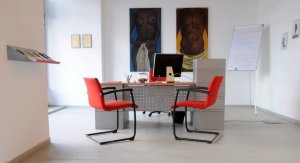
BMR, Soul of Sustainability, installation part of Just Do It. Biopolitical Branding at Pavilion Unicredit, March 2011
The display of the BMR fee was violently censored although the artists hadn’t signed any contract or confidentiality agreement. At the same time, the Director announced the firing of the curator which officially happened a few days after the opening. He threatened he would immediately cancel the exhibition if the collective wouldn’t change the 200 into 1400 euro – the amount he himself calculated based upon numbers he wouldn’t show or explain, stating that all current costs must be added (including the salaries, the energy bills etc). The change was made, the artists din not show up at the opening and the curator was fired, as promised. Subsequently, due to the already mentioned lack of contracting between the two parties (and possibly the public debates around the exposure of the events), the controversial remuneration was never paid.
The Bureau of Melodramatic Research have posted an account of these exchanges on their blog, which can be read here.
Despite the public protest on the part of both artist groups, no official answer was published – the only reaction being a private letter full of lies and speculations, denigrating all the artists involved in the conflict, which was sent by Pavilion to a selected list of contacts. This letter and PostSpectacle’s response to it can be read here.
This case is surely bound with the problematic practices associated with the management of a singular Contemporary Art Center in Bucharest. But the issues we want to raise affect more than just this particular space run by certain individuals – they are intertwined with the politics of who controls the exhibition space and the system of abuse that allows for the legal exploitation of the art workforce on every-which occasion . It is our deeply held belief that these concerns should not be silenced in the backrooms of banks or art institutions – but become the core of a collective protest among art workers against the appropriation of knowledge, art and culture.
Corina L. Apostol, Ph.D student, Rutgers University, NJ, USA
The Bureau of Melodramatic Research, artist collective based in Bucharest, Romania
Valentina Desideri, freelance performer based in Italy and France
Jean-Baptiste Naudy of Société Réaliste, artist collective based in Paris, France
Postspectacle, artist collective based in Bucharest, Romania
Stefan Tiron of Paradis Garaj/Kunsthalle Batiste, artist collective based in Bucharest, Romania
Dmitry Vilensky of Chto Delat?, artist collective based in St. Petersburg, Russia
Raluca Voinea, independent curator and art critic based in Bucharest, Romania
Epilogue
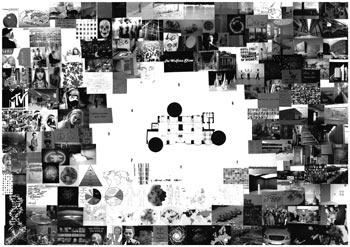
Lia Perjovschi, Statement, 2009
Many of us involved in the local art scene remember the moment when Pavilion UniCredit opened in February 2009 in Bucharest. It was inaugurated by an exciting exhibition curated by artist Lia Perjovschi– Statement. For a brief period Lia held the position of Research Curator at this institution, until she decided to withdraw from the project- soon after the opening of “Statement.” As the artist explains, she decided to end her collaboration with the space as things started to deteriorate in her working relationship with the management – after the Pavilion team had offered her a position and a space for her artist archive (CAA- The Contemporary Art Archive) – which was shortly replaced by their own Pavilion Resources Room. We still believe in the poignant ideas expressed by Lia Perjovschi when she created her Statement of Faith in Pavilion; we also believe the current management has gone a long way to compromise these ideals. As an epilogue to this complicated case, we invited Lia to reflect on the current state of affairs:
“What needs to be criticized is the basis of things:
From a Culture without any perspectives, still entrenched in the past, a Culture of “few resources”
A Culture of competition, of fear of the other…
An Education implemented without empathy, from a patronizing position
An Education done at random, without creativity or imagination
to an Art System frustrated by Unresolved Egos, more recently obsessed
with the market…
to the Impossibility of Dialogue to build Necessary Things: Institutions
Value Systems, Relaxed Attitudes…
We are suffocated by a majority where everyone thinks they are The One – even though
they only copy and desire what belongs to others
I am sorry for every person who was cheated and abandoned
Everyone has useful abilities and I don’t understand why
they can’t simply identify their true qualities for a more
normal society… so that real achievements become possible”
lia
Please also see Stefan Tiron’s reaction to these matters, Just Another Case of Toxic Leadership, September 2011
 ArtLeaks