Updates
ACT NOW! Submit your story to ArtLeaks and end the silence on exploitation and censorship! Please see the submission guidelines in the "Artleak Your Case" page
Submitted and current instances of abuse are in the "Cases" section
To find out more about us and how to contribute to our struggles, please go to the "About ArtLeaks" page
Please consult "Further Reading" for some critical texts that relate to our struggles
For more platforms dedicated to cultural workers' rights please see "Related Causes"
For past and upcoming ArtLeaks presentations and initiatives please go to "Public Actions"
“Post-Peace” exhibition cancelled in Istanbul
In October 2015 I won the Akbank Sanat Curator Competition with an exhibition project which brings together artists from a variety of origins to question how war and peace appear today. The title of the show is “Post-Peace,” a term that is a possible name for our difficult and confusing present. It was planned to open on 1 March 2016 and run until 7 May, 2016 in Akbank Sanat, Istanbul.
The participants are: Anonymous Stateless Immigrants, Ella de Búrca, Anna Dasović, Yazan Khalili, Adrian Melis, Dorian de Rijk, belit sağ, Alexei Taruts, Anika Schwarzlose, Anastasia Yarovenko as well as writers Oxana Timofeeva, Ece Temelkuran and Etel Adnan and participants of the public programme Lyubov Matyunina, Yaşar Adanali, Pınar Öğrenci, Koken Ergun and Jaha Koo.
The project was selected by an international jury consisting of Bassam El Baroni (independent curator and theory tutor at Dutch Art Institute, Arnhem), Paul O’Neill (curator, writer and Director of the Graduate Program at the Center for Curatorial Studies, Bard College, New York), Iris Dressler and Hans D. Christ (directors of the Württembergisch Kunstverein Stuttgart). Developed and coordinated by Basak Senova, the competition is intended to provide support for emerging curators, reinforce interest in curatorial practices, and encourage new projects in the field of contemporary art.
On the 25th February, 2016, a few days before the opening, the exhibition was cancelled by Akbank Sanat. The official explanation letter to myself and the jury states the following reasons: “…over the course of our preparations, Turkey went through a very troubled time. In particular, the tragic incidents in Ankara are very fresh in people’s memories. Turkey is still reeling from their emotional aftershocks and remains in a period of mourning. Therefore, many events, including – but not limited to – exhibitions, concerts, and performances, are being cancelled every day.” I, along with the artists in the show, believe this to be a case of political censorship. I fully recognize the tense political atmosphere in Turkey right now, and the reasons why Akbank Sanat may not wish to be associated with the exhibition. But this is also why it is essential to have open discussions and a place for people to engage with different perspectives on issues relevant in the Turkish context and beyond.
This situation is a very complicated one, and that is why I am currently in discussion with severalinstitutions in Istanbul to host conversations about the ethics and responsibilities of art professionals working in tense political and social environments. I am also proposing to these institutions to co-host events and parts of the exhibition. I believe that turning this unfortunate situation into a critical dialogue is the best and most constructive decision.
More information to follow upon confirmations.
Katia Krupennikova
independent curator
More information about the exhibition:
Post-Peace
2 March — 7 May, 2016
Preview: 1 March
Artists: Anonymous Stateless Immigrants, Ella de Búrca, Anna Dasović, Yazan Khalili, Adrian Melis, Dorian de Rijk, belit sağ, Alexei Taruts, Anika Schwarzlose, Anastasia Yarovenko.
Curator: Katia Krupennikova
Post-Peace brings together artists from a variety of origins to question how war and peace appear today. The works by peers from different parts of the world are united by common expressions of danger, fear, and the feeling of disorientation created by mass media’s multiple versions of reality. This mood is present in the exhibition as an alarm pointing to how much “war” is present in our contemporary “peace.”
“Even the fierceness of war and all the disquietude of men make towards this one end of peace, which every nature desires.” The line, one of the chapter headings of Saint Augustine’s The City of God, expresses a truism for many war planners and politicians: if war is not exactly peace, its end most definitely should be. This idea was expressed most famously in the catchphrase used to describe the First World War, “the War to End All Wars”—a line that was often derided at the time. Field-Marshal Earl Wavell memorably described the Paris Peace Conference as the “Peace to End Peace.” The First World War paved the war for the Second, whose conclusion gave us the “Postwar Era,” defined by the central antagonism of the USA and the USSR, the “Cold War,” with its myriad proxy conflicts and regional wars.
The defeat of the Soviet Union and the triumph of capitalist democracy was meant to usher in a new non-conflictual age, and even an “end of history.” Taking our cue from Wavell’s felicitous phrase, perhaps the best way to describe the contemporary situation, in which the “peace” of global capitalism can only be bought at the price of continuous violence and warfare, is PostPeace. Post-Peace is thus a concept that is used to define the time after the fall of the Berlin Wall, but may also apply to the whole period following the Second World War, with its decades of conflicts and antagonisms.
The concept of “peace” in the Post-Peace era has turned Eurocentric: the killing grounds have recently occupied Latin America, Africa, Asia, and the Eastern part of the Europe, places where former imperial regimes have been collapsing. International conflicts hide themselves behind local civil conflicts. A whole new vocabulary has sprung up to describe the new nature of warfare: preemptive, hybrid, nonconventional, asymmetric. Moreover, wars tend to be located in places that are nearly impossible to access by reliable eyewitnesses and media. Reality is obfuscated behind contradictory reports and calculated lies.
The exhibition Post-Peace is not directly about war, but rather about peace: it does not wish to add to the many representations of violence already circulating in the media. Gathered together in Akbank Sanat the selected artists will rather expose, through a visual conversation, the screen of peace as it functions today.
The public program, entitled How I learned To Start Worrying. Symptoms of Post-Peace was to include: Lyubov Matyunina, Yaşar Adnan Adanali, Pınar Öğrenci, Ece Temelkuran. Jaha Koo, Köken Ergun.
Conclusions of the Trondheim Seminar
The Trondheim Seminar
This paper presents the conclusions of the Trondheim Seminar on transformative art production and coalition-building, curated in September 2015 by Rena Raedle and Vladan Jeremic as guest curators at LevArt.
The seminar “Art Production in Restriction – Possibilities of Transformative Art Production and Coalition-Building” held in Trondheim, Norway brought together artists, writers, critics, and curators who are active in groups that are struggling for better working conditions in the arts and society at large. Throughout the course of two days participants discussed theoretical conceptions of artistic labor and precarity, exchanged local and trans-local experiences in confronting the neoliberal entrepreneurial mode of art production, and strategized ways of transformative and emancipatory art production and organizing.
Since the neoliberal attack on public institutions of art and art education, artistic work has become an entrepreneurial activity within a restrictive framework conditioned by the expanding art market and hegemonic political agendas prescribing the usefulness of art. The division of labor in the creative and knowledge industries has formed huge masses of artists that serve as a ‘reserve army’ for cheap creative labor.
In recent years artists have organized themselves in new ways, developing strategies to push for better labor conditions and secure standards for minimum payment of artistic work. Major discussions dealing with the conditions of artistic production address the precarity that artistic labor has in common with other branches of ‘immaterial’ and reproductive, or ‘invisible’, labor. In this context, artistic work is seen as a model for highly-exploitative working relations in late capitalism. To understand what kind of precarity is at stake one needs to take into account the whole process of production and the position of the artist within it.
Obviously, we should distinguish between the precarity of Thai berry pickers working in the forests of Finland and Norway and the position of artists that, believing in the idea of liberated work, have to labor under precarious conditions. Less obvious, but no less real, are the different levels of precarity due to the social stratification of the art world. This encompasses artists producing pieces for the art market, artists working in art management and administration, and community and non-profit oriented art practices.
In examining these differences and contradictions, with conditions varying considerably between the peripheries and centers of capital, between the global South and North, can the general precarity of art production be seen to function as a common denominator in artists’ struggles for better working conditions? Or, do we need a different political basis for coalition-building that would be realized in a different model of production? How can a different production model support coalition-building? In such a setting, can the autonomy of artistic production become an emancipatory force, or should artists join social movements and political parties of the new left that aim for non-capitalist transformation?
The contributors to the seminar “Art Production in Restriction. Possibilities of Transformative Art Production and Coalition-Building” investigated these and other questions with the aim to come up with a joint paper that contains findings, agreed points and recommendations.
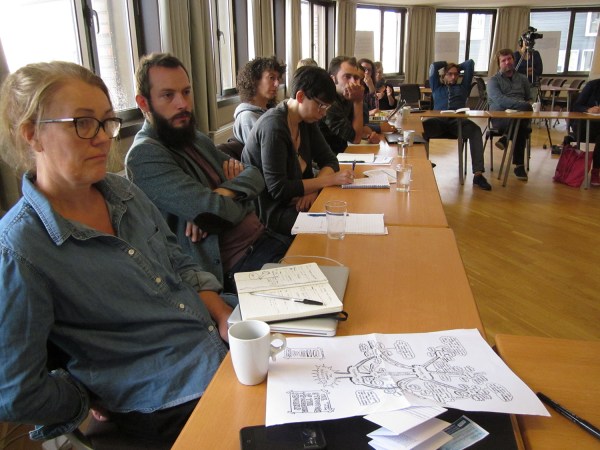
The seminar started with a welcome speech by leading curator Anne-Gro Erikstad on behalf of the inviting institution from Levanger. She briefly introduced the activities and mission of LevArt, a project space for contemporary art of the Levanger Commune. Erikstad stressed the urgency of the seminar themes in the times when neoliberal reforms of cultural policies in Norway have serious negative impacts on artists’ working conditions. After that, the organizers of the seminar, Rena Raedle and Vladan Jeremić, guest curators at LevArt project space, greeted the guests. They explained the proceedings of the seminar with the aid of a drawing they had prepared.
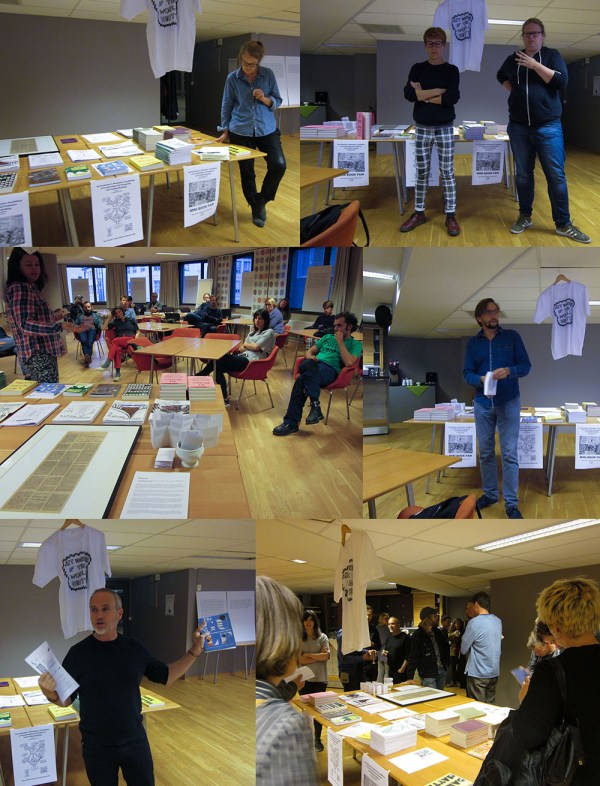
To reserve as much time as possible for exchange and discussion, the seminar was organized in working groups. Relevant papers and materials were shared during the preparation phase and published at the seminar Online Compendium at transformativeartproduction.net. The results of the working groups were presented in public plenary sessions in the afternoon.
In the evenings, a Mini Book Fair was organized that featured publications and artists’ editions dealing with the topics of art and work. Seminar participants and artists and writers from Trondheim presented their publications to the audience: Minna L. Henriksson and Airi Triisberg presented their book “Art Workers – Material Conditions and Labor Struggles in Contemporary Art Practice” covering experiences from Finland, Sweden and Estonia, Kuba Szreder introduced the publication “Joy Forever: The Political Economy of Social Creativity” by Free/Slow University of Warsaw, Gregory Sholette presented his book “Dark Matter: Art and Politics in the Age of Enterprise Culture” and the brand new publication “The Gulf: High Culture/ Hard Labor” about the campaigns and actions of Gulf Labor Coalition. Anne-Gro Erikstad presented Lisa Stålspets artist book “A home for Artists” and Corina L. Apostol presented the ArtLeaks Gazette No.3.
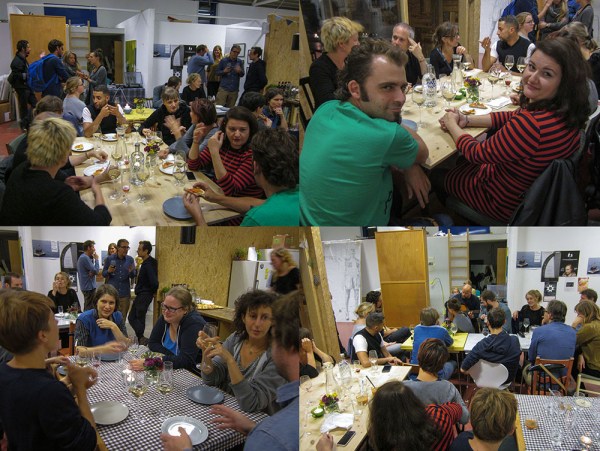
The installation “10 working days”, a re-reading of Peter Weiss’s “Ten Working Theses of an Author in the Divided World” from 1968 and contribution by Florian Schneider’s research group at the Trondheim Art Academy was at display in the seminar premises. With the idea to get a glimpse of translocal history of the place, the first evening an excursion to the Falstad Memorial center of the SS-prison camp at Falstad in Levanger municipality about one hour bus drive north of Trondheim was organized. The last evening the group was kindly hosted for a beautiful dinner served by Heidi-Anett & Lena Katrine alias Kunstkantina and a wonderful never-ending party at Rake Workcommunity at Svartlamon.
Below we will give summaries of the six plenary sessions, where the results of the working groups were presented and discussed. After that follows a conclusion with findings, agreed points and recommendations that were derived from the discussions during the seminar. The textual conclusion is accompanied by the drawing “Contradictions and Transformative Trajectory of Art & Labor”.
Summaries of the Plenary Sessions
Plenary Session 1, 5 September 2015
Working group 1:
Defining (artistic) work: artistic labor / precarious work / unpaid labor / reproductive work / flexible work/ forced labor
Contributors: Marina Vishmidt (presenter), Jesper Alvær, Noah Fischer, Marius Lervåg Aasprong, Danilo Prnjat, Rena Raedle, Gregory Sholette.
The input for the working group on definitions of artistic labor was given by Danilo Prnjat. He reflected the notion of the ‘art worker’ in the context of the avant-garde and posed general questions on participation. In the following discussion, the contradictions in defining artistic labor were drawn up and it was debated what kind of unification and cohesion certain concepts presuppose and what their implications for coalition-building are. There were two aspects looked into, from where artistic labor can be grabbed, the concept of productive and unproductive labor, and the concept of division of labor.
From a capitalist standpoint artistic work is unproductive labor as it partakes in the distribution rather than the production of surplus value. The question was put that if artistic labor is assumed to be productive labor, that means if artists identify as ‘art workers’ and organize as such, do they then just ask for a bigger share of the surplus value produced elsewhere, thus benefiting from exploitation?
A historical comparison with the 60s generation of political or activist artists in the US and West Europe identifying as ‘cultural workers’ shows that their structural position was actually quite elite compared to most workers, and secured in the context of the welfare state compared to today’s competitive (debt) environment. But workers did not become a driving force for large-scale social change. On the contrary contrary, artists are today structurally part of a general condition of precarity. It was argued that the identification with the ‘worker’ today could be an attempt to break with this increasingly exploitative entrepreneurial norm, as a class politics acknowledging the class struggle within and outside of the field of art.
Discussing the second concept, it was stated, that if we want to describe artistic labor from the viewpoint of the division of labor, it is hard to say if artistic labor is mental and manual labor, which makes labor politics of art more complex. The question then could be not how to unite with workers, but how to break with or break the social division of labor that produces art and labor as distinct spaces and categories? So, the urgency is to break with divisions of labor, – not to re-distribute interpretive power, as institutional critique did. It was argued that weinstead need a re-distribution of work – and we can’t fight for workers without addressing our own working conditions. So, if the objective is to dissolve the categories of art/labor, art/life, what do we put in the gap? What kind of gap is it: a terminological, social, ontological, material one? It might be a theoretical gap first of all: does ‘art’ do a certain kind of work that you would just need to find another designation for? Or it might be a material gap: how do you then abolish distinctions which are socially operative?
The implications of these concepts for the artistic practice were then laid out in more concrete terms. It was noted that managerial structures and corporate reward structures pervade the art world just as they pervade the non-profit sphere. That means that the speculative value created by the art CEOs, art middle managers, etc. is disproportionally more rewarded than value created by reproductive labor and care work by the art workers, art lumpenproletariat, etc. There are the class relations within art and the class relation which art reproduces in general, and we need to see what definition of labor is most adequate for art workers in their political practice. Art could be seen here as a tactical space – people using the relative freedom and resources of art as a means of getting somewhere else.
It was proposed that if we aim to dissolve the categories art/labor, art/life, artistic practice could be described as competence, as the term translates well across different fields and can be used as a lever for communication with people outside the art world, albeit it is loaded with neoliberal managerial connotations. Along these lines it was proposed that our competence as artists might then be our ability to steal and re-distribute: to puncture and rupture the walls of art’s bastion of privilege and to steal and re-distribute to the undercommons.
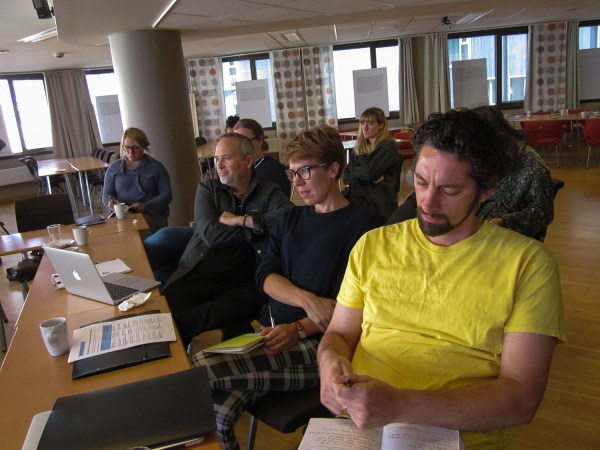
5 September 2015, Plenary session 2
Working group 2:
Situating precarity: Social stratification and increased precarity in the art world /differences in the level of precarity between artistic and non-artistic work
Contributors: Jelena Vesić (presenter), Jochen Becker, Vladan Jeremic, Marita Muukkonen, Jean-Baptiste Naudy, Kuba Szreder, Ivor Stodolsky
The input for the group discussing precarity was given by Kuba Szreder, who presented his concept of radical opportunism as a form of engagement within neoliberal conditions of production in culture.
In the following discussion it was stated that the neoliberal model of capitalist production, in which work is organized in short-term projects with changing employers and employees, brings forward flexible, opportunistic, competitive, short-term working contracts in the greater economy and in the art field.
It was problematized that precarious working conditions in the sense of freelance jobs have become paradigmatic in the cultural field and they are both, chosen and imposed. Therefore it is necessary to differentiate various levels of precarity: for example migrant workers that are deprived of any legal status and flexible and partly self-imposed working relations in project-oriented work.
Furthermore it was stated that opportunistic behavior and clientelistic networking typical for flexible labor conditions create structural exclusion and hinders the political organization of cultural workers. On the other hand, the dialectic between the growth of cultural industries and the growing capacity of self-organization was stressed, which furthers articulation and development of alternative cooperative economic models.
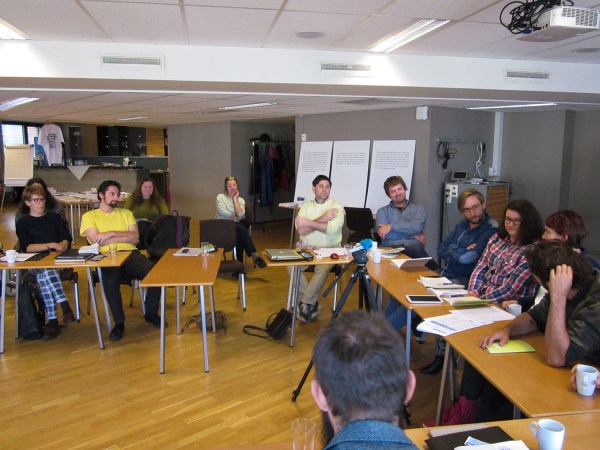
5 September 2015, Plenary Session 3 & discussion
Working group 3:
Valuation of artistic work: problems of quantification of work / Art and economic alternatives
Contributors: Airi Triisberg (presenter), Corina L. Apostol, Sissel M Bergh, Mourad El Garouge, Minna L. Henriksson, Lise Skou, Lise Soskolne, Raluca Voinea
The input for the discussion about valuation of artistic labor was given by Lise Soskolne. She presented the strategy of Working Artists and the Greater Economy (W.A.G.E.), a New York-based activist organization focused on regulating the payment of artist fees by nonprofit art institutions. The organization has developed a certification format for institutions that comply with minimum standards for the remuneration of artistic work, a strategy that relies on the “reputation economy” of the targeted art institutions. Currently W.A.G.E. is working on a complementary individual certification model functioning in direction of a union-like organization of workers.
During the discussion, two general strategies of framing artistic labor were elaborated, that conceptualize artistic labor either as commodity or as social contribution. The first subsumes artistic labor under wage labor, with the possibility to extend the demanded standards of payment to other workers in or even beyond art institutions. The possibility of internationalization of such standards was discussed. Examples of national standardization campaigns and reached agreements in Sweden and Poland were given.
A number of challenges of the “wage labor-strategy” were addressed, especially in a transnational context. The necessity of a relevant transnational counter-power able to pressure employers to meet wage demands and the complexity of standardization of payment within globalized working relations was emphasized. It was criticized that standardization also might imply exclusion of certain groups that cannot meet the established standards.
The critical distinction was made that W.A.G.E. does not subsume artistic labor under wage labor. A foundational principle of W.A.G.E. Certification is the fact that an artist fee is distinctly not a wage for the work of making art and is defined as payment for the work an artist does once they enter into a transactional relationship with an arts organization.
The group discussed the difficulties of framing artistic labor as wage labor, because there seems to be a strong resistance against that in the art field, and a certain desire to think about artistic labor as an exceptional form of labor. The point was made that if artistic work is understood as social contribution and not as a commodity it can serve as a model for the reconfiguration of the concept of labor, that would bring about a different model of economy.
Examples of alternative economies were discussed amongst them cooperatives based on exchange economies and their own currencies from Spain and Greece. It was underlined that alternative economies go together with a certain de-skilling of individual labor. The discussion ended with the open question how the reduction or even termination of division of labor would affect artistic practice within such economies.
Plenary Session 1, 6 September 2015
Working group 4:
Possibilities and difficulties of coalition-building beyond local and international constraints
Contributors: Ivor Stodolsky (presenter), Jochen Becker, Marita Muukkonen, Minna L. Henriksson, Sissel M Bergh, Vladan Jeremic
The input for the group working on possibilities and difficulties of coalition-building beyond local and international constraints was given by Minna Henriksson. She presented a case study about the Mänttä Art Festival in Finland, an annual exhibition project in the Finnish periphery that invited international artists without paying for fees and production. After examining particular problems of this case, general methods of finding common ground for building alliances were debated.
It was stated that for aligning with social movements, art has to locate itself in the wider social field. Starting from the universal common needs people share, more particular interests can be articulated and negotiated in the spirit of solidarity. In a local situation, community building can be achieved through spotting of specific issues, referendums, commoning of resources, building of project groups and collectives. The operaist method of co-research, a research method that intends to erase the border between researcher and the object of research, was proposed as method to find and define common demands.
As a central challenge to the communication between different groups thenecessity of translation between different terminologies and “languages” was emphasized. It was stated that expert terminologies are important but need to be made accessible to communicate with other groups. Local knowledges and languages informed by cultural or social backgrounds need to be reformulated. In this respect it was underlined that art has the advantage of being a more “universal” form of communication. The point was made that the translation / reframing / reformulation of needs or problems into political demands is at the core of political empowerment and representation. Careful reformulation, translation and re-translation is especially important to find common grounds for alliances in trans-local contexts. This means that existing organizations need to develop the capacity to reformulate their problems, demands and political strategies keeping in mind a trans-local approach.
Another important issue of discussion was the need of adequate spaces for gathering and voicing demands. Spaces for meeting were found to be a precondition for finding common grounds and aligning of different groups and movements. In this context the question was raised if the spaces of the art world such as biennials and art fairs, can be at all considered suitable spaces for such purposes. It was stressed that a welcoming public space open to everyone needs to be created. In addition, the fact that one needs to be aware that these spaces are also open to recuperation from other forces was discussed.
In terms of language, the argument was made that for describing international alliances today it is necessary to find alternatives to the words “national” and “global” that stem from the discourse of capitalist market globalization and nation state politics. Instead of “inter-national” or “trans-national” the terms “trans-local” (rooted in more than one situation) or “pre-mondial” were proposed. The term “mondial” could be used for naming a ‘globalization from below’.
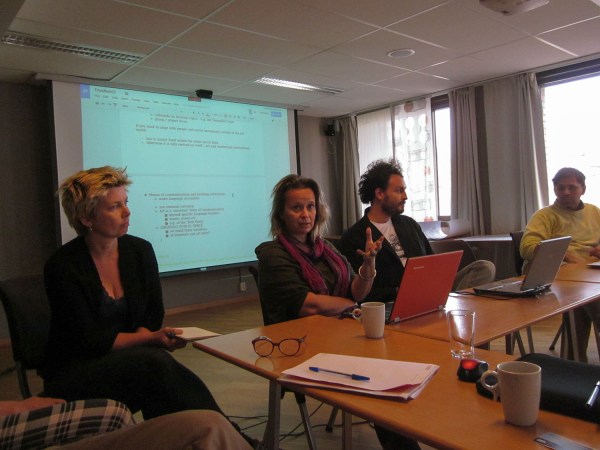
Plenary Session 2, 6 September 2015
Working group 5:
Transformative ways of art production: Artistic contribution as class struggle
Contributors: Raluca Voinea (presenter), Corina L. Apostol, Danilo Prnjat, Jean-Baptiste Naudy, Jelena Vesić, Jesper Alvær, Kuba Szreder, Lise Skou
The input for the group discussing transformative ways of art production was given by Jesper Alvær, who presented examples of his artistic research on art and labor. For the plenary session, the group prepared a collective statement to articulate contradictions and potentials of artistic practice that makes links with subjects positioned outside of the art field.
In the beginning it was stated that the group speaks from the position of artists and cultural workers. The group stressed that the emancipatory force of art can only be realized if art doesn’t exploit people in the interest of art but if art puts itself in the interest of the people. It was underlined that artists can use their privileges and status in a tactical way to support certain causes.
The relation to the institution of art was identified as main contradiction and the group called for the re-appropriation of the definition of social practice, but as well the re-appropriation of the notion of aesthetics from the institutions. The notion of aesthetics needs to be remobilized in a way that can (1) stimulate he imagination of the oppressed to form a liberating force not limited by conventions, (2) that can change the notion of the real, of what is normal and of what is acceptable. Playfulness was proposed as a tactic/strategy to counter rules and expectations.
In the plenum discussion problematized that artistic practice nevertheless remains bound and valued within the institution of art, although rules of the institution can be subverted and institutional space can be used tactically and playfully for non-art purposes and common social or political causes. It was underlined that artists must be aware of their manifold privileges when they join coalitions for social struggles with other groups. The artist can go out on the “playing field” of other social struggles and then return and harvest the value of his/her practice in the institution of art. However, the question of accumulation of cultural capital and funding come up. On the other hand, one can also lose, be blacklisted by either an institution or a movement.
The best meeting place for making coalitions was found to be outside of the art institutions, in the public space, on the streets. This is the “playing field” outside of safe boundaries of art institutions, where artists can show what contribution they have to offer for a common cause.
Plenary Session 3, 6 September 2015
Working group 6:
Aligning with social movements
Contributors: Gregory Sholette (presenter), Airi Triisberg, Lise Soskolne, Marina Vishmidt, Marius Lervåg Aasprong, Mourad El Garouge, Noah Fischer, Rena Raedle
The input for the group discussing alignment with other social movements was given by Noah Fischer. He reported on artists involvement in the Occupy Wall Street movement in 2011. Fischer described forms of organizing that emerged and gave examples of coalitions with social movements that came out from Occupy, such as the Art and Labor Group, Gulf Labor Coalition and G.U.L.F.
It was stated that in recent years a striking growth of coalitions between art and labor and art and justice campaigns can be noted, such as Gulf Labor Coalition, Liberate Tate, Australia, Precarious Workers Brigade, ArtLeaks, Art & Labor or the occurrence of labor strikes at the National Gallery London. It was proposed that theraise of consciousness about the relation between art and labor can be explained through the global economic crises and capital’s turn from generating surplus value based on labor towards pure forms of financialization.
In respect to these coalitions, the advantages and disadvantages of positioning / identifying the artist as artist or as worker were discussed. Both positions were elaborated.
On one side, art can be defended as a special kind of labor, that is useful to non-art political coalitions and social movements. Art helps to get media attention. Furthermore art and culture can generate and expand the collective embodiment of resistance and help to turn it into objective social forces.
The other position sees art as non-special work similar to any other type of precarious work, because it is part of the “social factory” (Mario Tronti), where all aspects of life are fully subordinated to capital. This common condition of precariousness and existential risk encourage the artists to build bridges to organized labor unions outside of the art world. The need to distinguish two positions of the artist in the process of production, either as a wage laborer or as an entrepreneur, was discussed: either as workers that sell their labor or as entrepreneurs that employ others, produce commodities and sell them.
The group concluded that in order to become active outside the prescribed spaces of the art field a certain naïveté is required by the artist. The group argued that to operate within a social movement or any other coalition, the artist needs to take the risk of setting herself/himself aside and to actively forget certain conventions and habits of imminent critique or ever-growing cynicism. The notion of active naïveté by Antonio Negri was proposed to describe this relation towards moments and spaces from where coalitions can arise.
In the plenum, building solidarity was stressed as most important aspect in the process of coalition-building. The problem of patronizing attitudes was addressed. It was stated that solidarity arises from the joint struggle for mutual liberation and that objective class differences don’t need to result in patronization if coalitions are negotiated as partnerships. Within the movement, artists do not need to represent artists-authors, they are members that use their artistic competencies as part of and in solidarity with the movement.
We need to be aware that engagement in social struggles can reveal deepcontradictions: self-exploitation, cooptation by institutions, parties, NGO’s, conservative and reactionary political attitudes, discrepancy between an idealized situation and a concrete political reality.
Conclusion: Findings, Agreed Points and Recommendations for Transformative Art Production and Coalition-Building
1. The Troubles with Artistic Labor
The contradictory character of artistic labor that can be described as both non-work and role model of labor has become paradigmatic for the general position of labor in modern relations of production. Artistic labor plays an important role in social reproduction – amongst many other forms of unpaid labor. To problematize this relation it makes perfect sense that artists redefine their labor as productive labor and, in line with this argument, claim “wage for work”. Even more so since the exploitative entrepreneurial norm artists are subjected to, has become a common norm of general precarious labor conditions. Yet this isn’t the end of the road. It is futile to differentiate artistic labor as manual or mental labor, as productive or unproductive work or as wage-labor or reproductive labor.
Nonetheless, the question remains: how do we break the social division of labor that produces art and labor as distinct spaces and categories? For that we need a re-distribution of work that represents the link through which artists can get involved in a common struggle, addressing their own working conditions. With the abolition of the division of labor, with the dissolution of the categories art / labor, artistic activity and the value of art would undergo a complete re-definition. Thus, the problematization of artistic labor and the material working conditions of artists is an eligible field where common ground needs to be found with other workers / non-workers.
2. Ways of Labor Struggle in the Arts
Artists’ unions and other artists organizations demand the standardization of fees to be implemented by state institutions and non-profit art institutions, based on either legal guarantees or voluntary certification of employing institutions. While the strategy of standardization of wage shows successes within local frameworks, limitations become obvious in transnational working relations of the art world. Standards would have to be relative to local living and working conditions, an institution that could control these standards doesn’t exist and localities or groups that don’t meet a minimum standard would be excluded from every scope of action.
Instead, individual commitment to dignified standards of labor and solidarity with local social struggles through withholding of labor, organized boycott of problematic art manifestations, solidarity or shaming campaigns and direct action against institutions disrespecting labor rights become powerful tools supporting a translocal struggle for transformation of labor on common basis. The symbolic act of withholding of labor from a biennale is a legitimate tool to support the cause of a local community. The effect of such boycott grows proportional to the cultural capital of an artist. More sustainable alliances with groups from outside the art-world require engagement of artists in the wider social field. How and on which common ground these alliances can be build and where is the place of the artist within such coalitions?
3. Recommendations for Alliances and Coalition-Building
Finding common ground, from universal common needs to more particular interests, is the precondition of any alliance. Artists can help in the translation and re-translation, reformulation and reframing of needs and problems that are articulated by different groups. Translation between different terminologies and languages informed by social and cultural backgrounds gains importance in translocal approaches to finding common grounds. Art and culture are also powerful means to create cohesion and to form a collective identity of social movements.
In practice, artists share a common continuum with the general precarious condition of labor. Not only in the art world, opportunistic behavior and clientelistic networking typical for flexible labor conditions create structural exclusion and hinders the political organization of workers. A material distinction of the position of artists in the process of production can be made: There are artists who sell their labor and there are artists-entrepreneurs that employ others to produce commodities and sell them.
Another peculiarity that makes troubles in coalition-building between artists and non-art groups lies in the artists’ relationship towards the institution of art. It needs to be acknowledged that artistic practice stays bound and valued in the institution of art and therefrom a number of contradictions come up, when artists link their practice to the wider social field.
Rules of the institution can be subverted and institutional space can be used tactically for non-art purposes to gain visibility for common causes. Artists can use their privileges and they can re-appropriate the definition of social practice and aesthetics. The notion of aesthetics can be remobilized as a space for imagination and liberating force of the oppressed, that can change the notion of the real.
But the emancipatory force of art can only be realized if art doesn’t exploit social movements in the interest of art but if art becomes a means in the hands of the people. Alliances and coalitions can only become sustainable if solidarity is developed in a struggle for mutual liberation, and not through patronizing attitudes.
Consequently, the best meeting place for making coalitions is definitively the space outside of the institutions, because here it is where artists can show what their contribution to a common cause really is. To engage in social struggles can reveal deep contradictions: discrepancy between ideal and political reality, self-exploitation and cooptation by institutions, parties or NGO’s, confrontation with conservative and reactionary political forces and all forms of repression. For the artist, this might mean to give up certain peculiarities of the arts, such as for example authorship, or maybe an artistic career. And she needs to translate/reframe her/his practice in the light of particular competencies that might be useful for a certain cause.
To be part of a social movement or coalition, the artist needs to take the risk of setting herself/himself aside and to consciously block out certain conventions and habits of the art world, imposing either its imperative of criticality or omnipresent cynicism.
It is a ‘responsible playfulness’ or ‘conscious naiveté’ that allows the artist to be part of a moment and to enter the space from where coalitions towards transformation emerge.
This report was written by Rena Raedle and Vladan Jeremić in Belgrade, December 2015 and reviewed by Airi Triisberg, Corina L Apostol, Gregory Sholette, Lise Soskolne and Katja Praznik.
Contributors to the working groups:
Airi Triisberg (Tallinn), Corina L Apostol (ArtLeaks, Bucharest), Danilo Prnjat (DeMaterijalizacija umetnosti, Belgrade), Gregory Sholette (New York), Ivor Stodolsky (Perpetuum Mobile, Berlin), Jean-Baptiste Naudy (Ateliers Populaires de Paris), Jelena Vesić (Belgrade), Jesper Alvær (Oslo), Jochen Becker (metroZones, Berlin), Kuba Szreder (Warsaw), Lise Skou (Aarhus), Lise Soskolne (W.A.G.E., New York), Marina Vishmidt (London), Marita Muukkonen (Perpetuum Mobile, Helsinki), Marius Lervåg Aasprong (Trondheim), Minna Henriksson (Helsinki), Mourad El Garouge (Ateliers Populaires de Paris), Noah Fischer (Occupy Museums, New York), Raluca Voinea (ArtLeaks, Bucharest), Sissel M Bergh (Trøndelag Bildende Kunstnere, Trondheim).
For more information about the seminar, related papers by the contributors and full documentation of plenary sessions see http://transformativeartproduction.net
The project was led by Anne-Gro Erikstad, project leader and curator at LevArt, project space for contemporary art of the Levanger Commune. Preliminary research for this project was done during a residency of the artists at The Nordic Artists’ Centre.
Financial support for this project/seminar was provided by Arts Council Norway and Nordic Culture Point.
Thank you to everyone who made this happen!
Download this text as a pdf: conclusions_trondheim_seminar_150dpi.pdf
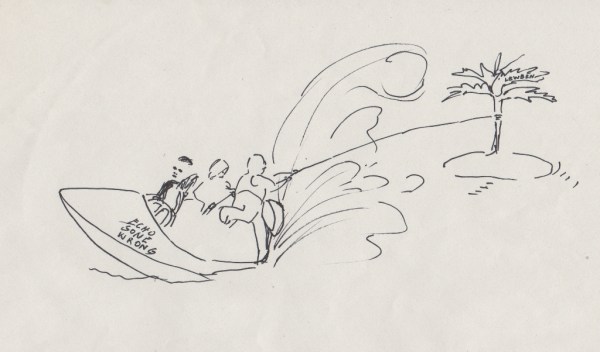
On December 23rd 2015 I have been fired from my position as an editor of Echo Gone Wrong, a magazine I have been working on for 4 years. My work as an editor of EGW ended with my last editorial announcement:
The decision has been made by the founders of the magazine: Neringa Černiauskaitė (editor of Artnews.lt) and Boris Symulevič (director of the Public Enterprise VŠĮ „Artnews.lt”). The official argument was that the direction and the position of the magazine were not appropriate and did not meet the expectations of the founders. Such an ‘argument’ is rather telling. However, it is not all there is to the story.
The event that led to such a culmination was my inquiry about my work contract. As a result of a persistent and systemic negligence from the director, I expressed the need to clarify my duties and rights as well as improve my working conditions. One of the main problems in my work was restricted access to the financial information about the project I was managing. Despite my continuous requests, during all those years I have never been provided with any relevant financial information.
When I was finally presented with my work contract, I learned that for almost two years it has been altered without my consent. Furthermore, as far as the specifics of my work and duties were concerned, its content was completely inadequate. Despite the pressure, I refused to put my signature on it as I needed to deliberate on the legal conditions. As a result, shortly thereafter I received a decision to dismiss me from the editor‘s position.
It is only then that I have found out the actual relation between VŠĮ „Artnews.lt“ and Lewben Art Foundation. In the year 2013 I received the news from a third party, that „Artnews.lt“ has been bought by the Foundation. While I was still in my position this information was denied inside the organisation. Instead, I was told that they were only sponsors of some of the projects unrelated to EGW. As a project manager, I had no legal obligations towards Lewben Art Foundation. Finally, during the legal negotiations on the conditions of my leaving EGW, the director revealed to me that Lewben Art Foundation (founded by the Lewben Group – an international provider of financial, tax, asset, transaction, management consulting, finance and accounting services) is the co-owner of Echo Gone Wrong as part of VŠĮ “Artnews.lt”, an umbrella organisation that also manages Artnews.lt, Artbooks.lt and Kitafotografija.lt. As a head of the project of Echo Gone Wrong, I have never been informed about this fact and it has only been revealed to me post factum. Given the lack of any legal/commercial obligations, I ignored offers to publish Lewben-related sponsored content. Lewben, however, did not initiate my dismissal, at least not to my knowledge.
During the firing procedure, I have been addressed by the director on the behalf of the editor of Artnews.lt, Neringa Černiauskaitė. As a ‘senior’ worker at VŠĮ „Artnews.lt“ (although officially she was a project manager, just as I was), she felt the right to intervene into my editorial work by regularly insisting on the publication of certain material. It must be taken into consideration that Neringa has recently (re)entered the art scene as part of an artist duo Pakui Hardware together with Ugnius Gelguda. As her artist brand quickly acquired significance, there has occurred the need to maintain friendly relationships with art institutions in Lithuania and elsewhere. Neringa went as far as asking me directly not to take an “antagonist” position towards Lithuania’s most important art institutions during the public presentation of the magazine. Despite the obvious conflict of interests between Neringa the artist and Neringa the editor, it has not been recognised as a problem neither by herself nor by the organisation.
Despite (or rather because of) the turn of events, I will continue working in the same direction as I did during my editorial period at the EGW. I would like to invite you to contribute in the same vein to LOCOMOTIVE.press – my new independent project! I am currently working on turning it into a fully functional independent platform dedicated to critical thought across the Baltic region.
Gintarė Matulaitytė
24/01/2016
_______________________________________________________________________
Gintarė Matulaitytė, 2016
On December 25th 2015 http://www.echogonewrong.com homepage featured a post which announced that the Magazine ceases to exist in its current form as its editor Gintarė Matulaitytė is fired from her position. In relation to the fact that during the last several years Echo Gone Wrong became one of the most important platforms covering the contemporary art scene not only in Lithuania but in the whole Baltic region as well, I invited its ex-editor Gintarė to talk about her work, Magazine’s mission and the whole context of the dismissal from her position. We will also touch upon the situation of art criticism and critical thought both in Lithuania and the Baltic region.
Kęstutis Šapoka: I had an ambiguous feeling when during the Christmas time in one of our culture weekly newspapers I saw that our community of critics—or, rather a certain part of it— was engaged in an energetic but also rather overzealous flattery directed toward each other, because at the same time I found out that EGW is restructured because of its critical stance. But let us begin from the very beginning. Could you tell us how EGW was established and how you found yourself in the position of its editor?
Gintarė Matulaitytė: EGW was launched in 2011 by an Artnews.lt editor Neringa Černiauskaitė and PE “Artnews.lt” director Boris Symulevič. I met them in 2010 when, as part of my studies, I was doing my internship at the Vilnius National Art Gallery. I guess they recommended me, because during one of the openings I was approached by Neringa who gave me her card and offered to meet. There was no predetermined plan regarding my duties. In a way I was given the freedom to come up with ideas, and while I was thinking about how to utilise this freedom, I was introduced with the administrative system of Artnews.lt and assigned as an administrator of some of its rubrics. Later I was also assigned to manage kitafotografija.ltproject, but, to be honest, I was not very excited about working with a single area of art. A year later as an Erasmus student I left for Oslo to work in one of the contemporary art galleries—and this was the time when EGW was launched.
Initially its scope was not limited to Baltic region—it was intended to cover the news of the Scandinavian art world as well. In order to be able to apply for Scandinavian funds, business partners were found in this region. However funding application was not successful. It was rather unclear what the purpose of this partnership was, and during the first half of 2012, at the time when I started working with EGW, these Scandinavian connections were finally abandoned. Perhaps, if the Magazine would have taken this direction, it would have had plenty of material to work with because at that time, due to the new opportunities offered by Scandinavian funds, Baltic-Scandinavian projects began to emerge like mushrooms after the rain. However I began to see that relations with our closer neighbours—Latvians and Estonians—promised to be more meaningful because of all the things we had in common.
Despite the fact that I was invited to work with EGW after its establishment, all the contacts and networks were the result of my own initiative and work I have done during my regular visits to Riga, Talinn, Tartu and other cities. Finally, the result of my work with EGW was that in my art history dissertation I chose to expand the geographic boundaries of my research and cover all three Baltic countries.
K. Š.: As far as I remember, the project Artnews.lt was began in 2008 as an independent virtual space for dissemination of information on conceptual art projects as well as art criticism. It is important that the platform was open to the young art critics who could express themselves freely despite a well established subordination. As I understand, by the time you started working with the Magazine, Artnews.lt already had an established format? This was the time when an idea to orient toward the West was born, and, if I’m not mistaken, EGW was in a way an English version of Artnews.lt?
G.M.: The independence of a magazine depends on two things: the independence of its editor and the amount of freedom given—or, rather, left unrestricted—by the financing sources and owners. Did Artnews.lt have an already established format at that time? Perhaps, because its structure did not change at least from the beginning of 2010. The only thing that did change was the coming and going of rubrics. One of the critical—and thus more valuable—rubrics was kriticzeski sabotaž [critical sabotage], however its last entry dates back to 2011.
EGW was never an English version of Artnews.lt. First of all, as soon as I began working with EGW it became clear that there is no point of merely translating the content of Artnews.lt—the majority of these texts would have been completely obscure and irrelevant to the international audience. You would not even need an editor if the Magazine were merely an English version of another publication. A translator and administrator would have sufficed.
K. Š.: As far as I know, for the Baltic region EGW had to become a sort of a “window” to the West, but the latter perhaps had no interest in us, even if we presented ourselves in English? However, during the last year, I noticed an opposite tendency—the Magazine acquired more significance, and the interactions between the critical thought of Latvia, Estonia and Lithuania became more prominent.
G. M.: Whether or not we are interesting to the West perhaps depends on what kind of West and what kind of interest we have in mind. Sometimes I think that we are not interesting to ourselves to begin with. By this I mean that it might seem that things are not worthy of attention because they are happening right here, next door, and they are not contributing to any global tendencies. This is what I would call a provincial thinking. A provincial thinks that she needs to catch up with something—usually the West—without questioning why and how exactly she is supposed to align herself to it.
Perhaps, on an international scale Lithuania or Latvia are not as interesting by themselves, and we are only interesting as a region, as Baltic States. Indeed, as it is well put in the article “The Baltic States – How Many?”, not too long ago, writing separate histories for each of the Baltic States was still considered meaningless—the only thing that differs is just names while the cultural and historic backgrounds remain more or less the same. Has it become more meaningful today? In politics and other spheres international interests are usually common throughout all the three countries. However, these coutries often consider themselves as independent units relating to each other with a competitiveness and suspicion. Perhaps, it is because of ignorance, especially when it comes to the younger generation. Only after a couple of years of work in this region have I noticed that Riga and Tallinn became increasingly frequent targets of business and leisure trips among my acquaintances.
The word “interesting” implies the presence of some sort of an interest. West might have all sorts of interests in Baltic States, however the question is what are our interests in the West?
When I took my position of an editor, it seemed that the aim of the Magazine was to become a platform that allowed for the Baltic culture to participate in an anglophonic discourse, thus becoming heard and represented. But in order to represent themselves, Lithuania, Latvia, and Estonia had to first understand what they are to each other—this is where English language served as the means of communication. At the same time, English language also provided a distance necessary for a critical reflection while writing about oneself to the other, while imagining a foreign addressee who also uses English as a foreign language. Another important aspect is the neighbours’ perspective. It is both homey (because it recognises similar problems) and alien which allows the neighbour to formulate the things she notices without being restrained by her national commitments. As this international dialogue gradually began to intensify, the strict division by countries became meaningless, so all the texts on a homepage of the Magazine became intermixed.
Therefore, the problem of a double locality—i.e., when we duplicate the same local content in English language—was overcome. Indeed, EGW became linked with a particular place, region, and its identity even more than some of the culture press in the regional languages.
K. Š.: I would like to return to the issue of you being fired from your position as an editor. What were the official arguments and what do you think are the real causes?
G. M.: Officially the reasons of my dismissal were formulated as follows: the “direction” and “position” of the Magazine were “inappropriate.” Even though during the firing procedure I was addressed on the behalf of an Artnews.lt editor Neringa Černiauskaitė, she did not participate in the discussions and did not present any arguments herself. I was explained that the arworld circle is small and everyone is dependent on each other, therefore we should all get along in a “friendly” way—we publish a text on some exhibition in a certain gallery, and they give us something in return. However it is rather unclear how this model is supposed to contribute to the quality of the content of the Magazine. A magazine that uses this principle of exchange economy should address its readers with a disclaimer: “Dear readers, the intention of this magazine is not to help you to understand the processes of an art world, it is rather intended for an artworld itself—i.e., for all the artists, curators, galleries, and other institutions—so that they could blow a smoke in your face.”
As far as an editorial work was concerned, our positions were indeed differing. For example, when I was planning to present EGW in the Art Academy of Latvia, the Artnews.lt editor addressed me with a blunt request not to take an “antagonistic position” with respect to the main art institutions of Lithuania.
K. Š.: Recently I myself noticed that Artnews.lt more and more tends to avoid to perform a function of critique; it looks like it was controlled by the invisible hand of a censor, as if it was overtaken by an excessive timidity, which means that the website is gradually turning into a collection of sponsored content, as well as some peculiar and very specific “essayism.” By saying “specific” I do not mean essayism as such, but rather some crafty textual manipulations and simulations, a certain nomenclative pseudo-poetic abracadabra—basically a form of conformism which in a way resembles “critique” but in actuality is devoid of any position or even meaning. This is exactly what I meant when in one of my texts on critique I wrote that lately Artnews.lt tends to be taken over by conformist tendencies. Is your dismissal and a consequential restructuring of EGW related to the “care” of the new financial sponsors and “guidance” of certain institutions?
G. M.: Here it is necessary to clarify what is meant by “financial sponsors.” From the very beginning the financing sources of Artnews.lt were governmental funds, however during my dismissal procedure it was mentioned that Public Establishment (PE) “Artnews.lt” (together with its projects Artnews.lt, Artbooks.lt, kitafotografija.lt, and EGW) is now co-owned by Lewben Art Foundation. It is an art foundation established in 2012 as a social project by “Lewben Group” the goal of which is the promotion of Lithuanian cultural heritage and contemporary art. “Lewben Group” provides its services in property management, tax, law, and finance consultancy. In 2006 this international company established its branch in the Baltic States with an aim to provide its management and trust services for companies.
As an editor of EGW I was not informed about this, and I did not know about an emergence of any kind of new interests. The news that Lewben acquired Artnews.lt reached me in 2013 as a rumour which was eventually denied within the organisation. When I enquired about our links with Lewben, I was told that they are the sponsors of certain PE “Artnews.lt“projects, but EGW was not one of them. I knew that the editor of Artnews.ltand the director of PE “Artnews.lt” were regularly meeting with the representatives of Lewben, but I was never invited to participate at any of those meetings. Once I offered my presence hoping that I could represent the Magazine myself, however I was told that my presence was not necessary. All of that gave an impression that the functioning of EGW was not among the priorities in the plans of Lewben-Artnews.lt. In any case, this had no effect on my work as an editor.
However your remark regarding the disappearance of the function of critique on the Artnews.lt website is spot on. In my view, that, and the fact of Lewben’s involvement in the activity of Artnews.lt are related. However, differently from the usual chain of events when a sponsor dictates the direction, it seems that Artnews.lt magazine, and primarily its editor, chose the direction that simply was parallel to that of Lewben. It is not clear what role did Lewben play in my dismissal. What is clear is that when the information is withheld from a project manager, the conflict, even if a passive one, is bound to happen.
Perhaps, it is not that important whom to contribute with, the important thing is the network which would ensure a certain dependence and, accordingly, all the corresponding regalias. It should not be too surprising that one aspires for this dependence, because it is an essential condition of hierarchy. And such direction was decided not by N. Černiauskaitė as aneditor, but by N. Černiauskaitė as an artist.
K. Š.: You mean that N. Černiauskaitė began a parallel career of an artist which eventually interfered with the critical functions and mission ofArtnews.lt?
G. M.: As a colleague editor, I must say that the editor of Artnews.lt has put herself in a position which is favourable for the conflict of private and public interests. Being an artist-editor implies an obvious risk to be biased with regards to the gallery that represents you, or impartial with regards to the artists and curators who happen to be your friends and colleagues.
It is a much wider problem, and this particular case in only an illustration. Many people are used to (by their own will or because they were forced by circumstances) to pursue different jobs and take different positions at the same time. In the art world it is almost like a rule. Perhaps, nobody will be surprised to find out that an artist writes texts, publishes books, lectures, and makes public addresses. In order to explain the emergence of such complexity of different roles of an artist, a researcher Lina Michelkevičė invokes the notion of “expansion of linguistic formats.”1 Even though in her text the emergence of these artist-roles is associated exclusively with the production and distribution of artistic research, in reality when the production and distribution of artistic research is intermixed with the representation of artist’s interests in general, it becomes a way to establish oneself both in art discourse and in art history.
K. Š.: I agree that this case illustrates much wider tendencies in our systems of art and critique. I recall that several years ago, after EGW published a text critical toward Vilnius Contemporary Art Centre, we witnessed a swift retaliatory reaction by a National Art Gallery employee who suggested that, if you want the Magazine to survive, you should rather “think about where the Magazine is heading” before publishing such texts. It was unclear whether she was representing the interests of her institution or whether she was expressing her personal position. I remember it was funny at the time, but it seems that the joke turned out to be on you?
G. M.: I should clarify: her question was what do I want to achieve by publishing to an international audience an English text that appeals to such local problems. Shortly after that another comment appeared, and this time it was written in a more moderate tone—it even offered to arrange a public discussion on this topic at the National Art Gallery, thus remaining “in our own kitchen,” so to speak. They were unable to see why an international audience would be interested in our local problems. If locally everyone were already used to those rare occasions of critique, then it acquired a totally different significance once it became available internationally. This gesture was regarded as a deliberate intent to damage the image of Lithuanian institution in the eyes of an anglophonic world. I think it comes from the habit to represent ourselves to the foreign countries as super-progressive and non-problematic (“no problem”) people, thereby demonstrating a nice facade.
The aforementioned comment shows how everyone without exceptions are busy maintaining this illusion. And the fact that it is possible to have a situation when the institutional discontent with magazine’s bad work at institutional representation can affect the work of a magazine shows that cultural media is not, or, in this case, should not be an exception. Actually, this comment did not decide anything, it rather demonstrated the approach toward cultural media and critique. However as far as Artnews.lt is concerned, such an approach is apparently a norm, because I was told about “ruined relationships” with institutions and how these relationships will need to be restored after my dismissal.
K. Š.: Did you notice any similar tendencies in Latvia and Estonia?
G. M.: The same problems exist there as well. Indeed, as far as I experienced during my editorial work, the inability to accept criticism is a common thing in the art systems of all three Baltic States, and perhaps it is one of our most accurate common definitive traits. There is simply no space left for critical thought within this art community of tightly bound “friends.” We often claim that an art circle in Lithuania (Latvia, or Estonia) is extremely small, but in my view this by no means should be a reason to justify this sort of interrelation that renders critical thinking impossible; quite the contrary—it is a chance for a much deeper reflection and evaluation to emerge. Friendliness as such is not an obstacle for critical reflection, it is the professional or institutional nature of this friendliness that is an obstacle. It means that we all end up jointly representing the institutions and maintaining their images. In such an atmosphere critique is regarded not as a positive and useful thing but as a force that threatens to destroy this fragile structure.
Notwithstanding, if this kind of interrelation between various institutions does not seem feasible because its grounds and its aims are too abstract and their networks are too complex, then it would be much easier to understand that institutions or projects financed by the same person or source will end up being obliged towards each other.2
Even if there is no deliberate intention to limit the variety of opinions, the situation when a single person, organisation or union (even an unofficial one) owns several projects or institutions, surely does not contribute to the development of critical voices.
Here we might talk about a kind of censorship when certain opinions, instead of being removed from circulation by censors, are not even expressed by writers; it is the conditions that prevent these opinions from being formulated. Thus in my opinion, instead of talking about a crisis of critique, we should be talking about a crisis of critics. They themselves also happen to be curators, art agents, and managers at the same time, and due to these obligations they impoverish themselves as critics.
Editors are complaining that nobody writes and nobody reads. Why would anyone read these texts if they are written not because you have something important to say, but because “you have to”? Not only readers but writers themselves are sick of these texts about artists who themselves, in their turn, are tired “from words, or, rather, from all those textual and analytic explanations and analyses.”3 When critical thought is constantly looking for compromises, it turns into this specific “essayism” that you mentioned. Critique becomes acceptable only if it gives the reader an impression of meaning or even an aesthetic experience. If critique does not perform this function, it becomes unwelcome. It can be nostalgic, irritated, and sad, as long as these are its “themes.” Preferably, all that should be recognised as the themes of an artwork as well, but to be critically disillusioned with an artwork is a no-no. Such nostalgic criticism is more attractive because it gives an opportunity of self-identification for those who are smitten with the feelings of unfulfillment and meaninglessness; a reader is offered something to identify with—yes, this is exactly how I feel. However if critique attempts to break away from this melancholy, if it faces the causes of its discontent, it immediately gets accused of antagonism and unjustified grumbling.4
K. Š.: I surely would agree that during the last couple of years contemporary art system and its critique experience a deep crisis. They are busy forming a space of paradoxical “obligatory global friendliness and prosperity” which “elegantly” eliminates any manifestations of critical and independent thinking. We are left only with a small circle of self-praising “homies.” It is a shame that after being a platform for an independent thought for several years, Artnews.lt turned into another space for empty simulations and indulgence towards power. I would say that by restructuring EGW, Artnews.lt also destroyed itself morally. And it all happened at the time when the need for spaces for critical thought is the most pressing. Paradoxically, this gesture actually only confirms the insights of the critique that the system avoids and loathes so badly…
The conversation has been published at the newly launched Baltic magazine for critical thought Locomotive.press, 12 02 2016, http://www.locomotive.press/2016/02/12/on-compulsory-global-friendliness-an-interview-with-gintare-matulaityte/
- Michelkevičė, L. (2015) “Lingual Discourses in Artistic Research and the Roles of the Talking Artist” In Acta Academiae Artium Vilnensis: Artistic Research: Theory and Practice, Issue 79, p. 61-76
- As far as the situation with the neighbouring countries is concerned, it might be worth to recall the 4th Artishok Biennial (2014) at the Mūkusala Art Salon, Riga. Its aim was to bring our attention to the lack of critical throught. Mūkusala Art Salon which has been established as space where the collections are stored and exhibited, is owned by Latvian businessman and collectioner Janis Zuzans. According to the idea of its curators, 10 original artworks were presented at the Biennial, and 10 different critical texts were written about each artwork. However, as requested by the owner of the gallery, Biennial added 10 more artworks to the exposition. Part of the resulted 100 texts were published in Artterritory.com magazine which is sponsored by the “Mākslas platforma” which in turn is funded by SIA “Alfor”, Latvia’s largest gambling machine retailers owned by Janis Zuzans.
- Gambickaitė, Danutė (2016) “Svajonių džinai ant parodų rūmų grindinio” (“Wish-Fulfilling Genies on the Ground of the Gallery”). In: Artnews.lt[Online]. Retrieved from: http://www.artnews.lt/svajoniu-dzinai-ant-parodu-rumu-grindinio-33136. (Date accessed 13 Jan 2016).
- Čiučelis, Tomas (2015) “The State of Critique in the Times of Acceleration.” In: Echo Gone Wrong [Online]. Retrieved from: http://www.echogonewrong.com/tribune/the-state-of-critique-in-the-times-of-acceleration (Date accessed 14 Jan 2016).
A Public Appeal to the Government of the Republic of Croatia for the dismissal of the minister of culture Zlatko Hasanbegović
The recently established Croatian Government appointed Mr. Zlatko Hasanbegović as minister of culture. Yet he has no experience in the cultural sector and he publicly promotes extreme political views.
He referred to anti-fascism as an empty phrase in a public appearance on national television, six months before his appointment to the position of minister of culture. He was a member of HOP (Croatian Liberation Movement), a militant fascist political organization founded by the leader of the Ustaša regime, which collaborated with the Nazis in World War II. Hasenbegović has denied being a member of HOP, but the webpage documenting his statements is now known to have been redacted. It was recently discovered that he was an external contributor to the magazine NDH (Independ State of Croatia, a Quisling regime run by ustaše), where he published articles praising Nazi values and heroes. In 1996, Hasanbegović wrote at least two articles [1] for the monthly which propagated the work and the political ideas of Ante Pavelić and systematically denied the crimes committed by the fascist Independent State of Croatia. More recently, in 2013 he publicly advocated the rehabilitation of the imam who served in the 13th Waffen Mountain Division of the SS Handschar (part of the Waffen-SS, an armed branch of the German Nazi Party that served alongside the Wehrmacht). Mr. Hasanbegović is also active as a publisher of books that relativize nazism and fascism.
Since Mr. Hasanbegović took up the position of minister of culture, he hasn’t abandoned the values and statements to which he gave voice beforehand. He continues to insult prominent Croatian cultural workers and artists, whom he refers to as “exhibitionists” and “ridiculous street performers”. He has announced that his political programme consists of building a uniform cultural paradigm that will serve to homogenize the nation and eliminate any dissent or opposition concerning the values that he supports. We perceive this as constituting a serious threat to the plurality of cultural and artistic creativity, to the autonomy of the cultural sphere and to freedom of speech.
Immediately after his appointment, a broad coalition of cultural workers and artists in Croatia (kulturnjaci2016.org) made a public appeal to the government of Croatia to dismiss Mr. Hasanbegović, an appeal signed in just a few days by over 3500 prominent artists, cultural workers and citizens. The appeal does not dispute an individual’s right to hold certain positions and political views, rather it is an appeal to voice opposition to the relativization of politics and to support an idea of culture free from ideological misconceptions, conservatism, nationalism and intolerance.
Therefore, we ask you to support us in our efforts to defeat threats to the freedom of creativity and expression and in our demand for the dismissal of Mr. Hasanbegović from the position of minister of culture of the Republic of Croatia.
We, the citizens signed below, cultural workers, believe to be witnessing a moment when the field of culture is threatened and humiliated by the decision of the new Croatian Government to nominate Zlatko Hasanbegović, a scientist who is entirely incompetent to manage the system of cultural institutions and all segments of cultural production and lacks knowledge of all mechanisms of local and international collaborations as well as the use of the European cultural funds, as a person who holds completely unacceptable reactionary ideological positions.
We believe that culture has to be defended from any ideology that in any way introduces a regime marked with bigotry, narrow-mindedness, revisionism and nationalist concepts of cultural politics and production. A culture robbed off the principles of humanism and rolled in the mud of dictatorship is no longer a culture but only a medium for political pragmatism.
How can cultural workers trust the new minister knowing his previous public appearances when he, among other things, accused the third channel of the Croatian Radio of “postmodern neo-Yugoslav deconstruction and dissolution of the Croatian national and cultural identity”?!?
This appeal is not directed against an individual’s right to hold positions and political views, rather it is an appeal to raise voice against the relativizing politics and equivocation and the support to the idea of culture preserved from ideological misconceptions, conservatism, nationalism, intolerance and tribal traditionalism.
This public appeal has been compiled by a group of citizens, cultural works, and artists who believe that for the position of a minister of culture, as well as the entirety of culture, it is far more important to think outside of the national framework, understand the other and the different, respect the antifascist heritage, understand culture and society as a heterogeneous combination of diversity and openness for dialogue and language than to merely write research papers and other works, without underestimating the value thereof.
For all the above state reasons, we think that Zlatko Hasanbegović cannot and should not be the minister of culture and therefore, we demand from the president of the Croatian government, Mr. Tihomir Orešković, to undertake the subsequent steps.
Please show your support for the appeal of Kulturnjaci 2016 by e-mailing your signature and occupation / affiliation to the address kulturnjaci2016@gmail.com
KULTURNJACI 2016
Curator Christine Tohme Denied Passport (Beirut, Lebanon)
Christine Tohme, founder and director of the Lebanese Association for the Plastic Arts, Ashkal Alwan, has been denied a passport renewal by Lebanon’s Directorate of General Security due to a warrant against her, according to a statement from Tohme posted to Facebook by the Lebanese artist Tony Chakar:
Two days ago I applied to the Directorate of General Security for a passport renewal. When I went back to get my passport, I was informed that the renewal was suspended, due to a warrant issued against me.
I have no doubt that this warrant is directly linked to the domain of my work, as a director of the Lebanese Association for the Plastic Arts, Ashkal Alwan. As such, the significance of this action against me cannot be understated, as it affects the domain of other civic workers, as well as mine personally.
Using warrants illegally for obstruction of an administrative procedures, such as renewing passports, strips people of their right to mobility and travel. This is an illegal penalty issued by an administrative security authority, not a judiciary one.
Christine Tohme
Tony Chakar also added: “She is not the only one by the way, but I will refrain from naming others until I know they want to be named.”
A report submitted to the United Nations in March 2015 by the free expression advocacy groups Freemuse, PEN International, and PEN Lebanon criticized the “broad discretionary powers” of censorship held by the Directorate of General Security and concluded that “Lebanon is failing to abide by its international commitments to protect fully the artistic freedoms of its citizens.”
Read more here.
UPDATE
Passport Returned to Curator Christine Tohme After “Arbitrary and Political” Warrant
Curator Christine Tohme’s passport was returned to her on Sunday, January 24, four days after it was taken under circumstances she believes were politically motivated and connected to her work as director of Ashkal Alwan, a leading independent arts center in Beirut.
The Lebanese Directorate of General Security informed Tohme that her passport was being withheld on January 20 after she sought to renew the travel document, which was still valid for one year. The problem, she was told, was a murky warrant issued by Fera’ el Ma’alumat, a domestic security agency (literally, “the Information Branch”). The decision by the security agency to issue a warrant and withhold her passport was in contravention of a July 2014 ruling by the Lebanese Council of Ministers “forbidding the use of these arbitrary and political warrants and considering them null,” according to Tohme. (A January 21 article in the Arabic-language Lebanese publication The Legal Agenda confirms this, adding that Tohme’s ordeal “brings to mind the former abuses of the Lebanese General Security [agency], whose goal is to impose a law of silence.”)
Tohme said that she is in regular contact with members of the Lebanese interior and culture ministries in the course of her work as curator, and that the issuance of a warrant against her by the security apparatus is particularly troubling as it comes without recourse. “If any of my actions violated Lebanese law, I am willing to defend myself before a court of law, in a context that is legal and clear,” she said.
Read more here.
 ArtLeaks