Updates
ACT NOW! Submit your story to ArtLeaks and end the silence on exploitation and censorship! Please see the submission guidelines in the "Artleak Your Case" page
Submitted and current instances of abuse are in the "Cases" section
To find out more about us and how to contribute to our struggles, please go to the "About ArtLeaks" page
Please consult "Further Reading" for some critical texts that relate to our struggles
For more platforms dedicated to cultural workers' rights please see "Related Causes"
For past and upcoming ArtLeaks presentations and initiatives please go to "Public Actions"
Open Call: ArtLeaks Gazette No.4 // Demanding Justice: Social Rights and Radical Art Practices

ArtLeaks Gazette No. 4
Demanding Justice: Social Rights and Radical Art Practices
Today, art workers around the world are struggling to contextualize their practice in a period marked by human rights, labor, and anti-war campaigns, on the background of an ever violent and oppressive global climate. They are trying to reconcile their artworks, texts, exhibitions, projects with a desire to act politically in line with these campaigns by blurring the lines between artistic, non-artistic and political activist types of work. Their strategies have taken the form of nonviolent actions directed at the museum and gallery system, the art market and even at local governments.
The fourth edition of the ArtLeaks Gazette will be focused on theorizing, analyzing and supporting art workers’ campaigns, and with regards to their social (civil, economic and legal) rights, and demands for an increase in art institutions’ responsibilities in upholding these rights. This responsibilities encompass struggles related to representing art workers’ projects with integrity, treating their profession fairly and with respect, and remaining open to debates with art workers. While not all art workers’ campaigns are united by the same specific goals, as contexts and needs differ, they include increasing the representation of art workers’ voices in art institutions and at the state level.
In addition to analyzing concrete practices and campaigns, this issue will engage theoretically with relevant issues related to truth, ethics, social rights, economic democracy, jurisdictions, legislatures and competences, in order to develop a critique of the neoliberal formats that are tremendously spreading across the globe. As the aforementioned issues could be framed differently in various socio-economic and political contexts, we are looking for texts which are able to put in question neoliberal realities and austerity regimes, considering not only overall conditions in the artworld but also local specificities.
We welcome contributions in a variety of narrative forms, from articles, commentaries, and glossary entries, to posters and drawings. The deadline for entries is the 4th of April, 2016. Contributions should be delivered in English, or as an exemption in other languages after negotiations with the editorial council. The editorial council of ArtLeaks takes responsibility for communicating with all authors during the editorial process.
Please contact us with any questions, comments, and submit materials to: artsleaks@gmail.com.
The on-line gazette will be published in English under the Creative Commons attribution noncommercial-share alike and its materials will be offered for translation in any languages to any interested parts.
Limited printed copies will be available. We encourage anyone who would like to support us to print smaller print runs of ALG#4. We will make several PDF formats of the ALG to meet various digital needs, as well as an epub edition. We encourage contributors to be an active part of spreading the ALG by hosting it on their site and forwarding it on to their networks.
Editors: Corina L. Apostol, Vladan Jeremic, Katja Praznik, Airi Triisberg
Highlights of the public presentations and discussions around previous issues of the ALG this year.
We wish all our readers, friends, supporters etc. happy holidays and all the best in 2016!
Hundreds take part in protest performance at Paris’ Louvre Museum over oil sponsorship
Photography by Kristian Buus
Ten arrested inside Louvre Museum at unsanctioned performance action
· Hundreds surround the Louvre’s iconic pyramid in Paris in protest at oil sponsorship of museum
· Performance marks the first international collaboration of growing movement to liberate museums and cultural institutions from ties to fossil fuels
· #FossilFreeCulture
Today at 12pm, hundreds of artists and climate activists staged an unsanctioned protest performance at the Louvre museum in Paris, urging the museum to cancel its sponsorship deals with the oil companies Total and Eni. [1] Outside, in front of the museum’s iconic pyramid, they spelled out the words “Fossil Free Culture” in black umbrellas painted with giant white letters. [2] Despite the city’s ban on protests, artists and activists from around the world called for “a culture beyond fossil fuels, both at the COP and in our cultural institutions,” in solidarity with Indigenous and other communities’ struggles at the frontlines of climate change and oil drilling.
Simultaneously a smaller group of art-activists spilled an oil-like substance in the atrium of the museum–clad in black clothes and holding black umbrellas, the artists walked barefoot in the “oil spill”, leaving footprints on the marble floor as a symbol of fossil fuel corporations’ influence on museums. 10 participants in the unauthorized indoor performance were arrested by French police. They have been informed they may be held for 24 hours.
Beka Economopoulos from New York-based art-activism collective Not An Alternative, one of the organisers of the intervention, said:
“It used to be acceptable for tobacco companies to sponsor cultural institutions. That’s no longer the case. We believe it’s a matter of time before the same is true of fossil fuel companies. When oil companies sponsor the Louvre, the Louvre likewise sponsors those companies–the museum gives these companies cultural capital and their ‘social license to operate’. On the occasion of the UN Climate Summit in Paris, we’re urging the Louvre to stop sponsoring climate chaos.”
Mel Evans, artist and author of “ArtWash: Big Oil and the Arts” was one of those arrested during the inside intervention. From jail she says:
“We made a beautiful performance to challenge Total’s sponsorship of the Louvre and now the police are protecting the interests of the oil companies. With the climate talks in Paris, it’s time for galleries to go fossil free”.
This action marks the first international collaboration between a number of artist-activist groups working to liberate museums and cultural institutions around the world from ties to fossil fuel companies. This new and rapidly growing movement for a #FossilFreeCulture extends the divestment movement into the cultural sphere, calling on cultural institutions to cancel fossil fuel sponsorship contracts, divest financial holdings in the industry, and kick oil executives and climate deniers off their boards. Campaigners argue that fossil fuel companies sponsor museums and galleries in order to cleanse their tarnished brands and gain a “social license” to operate, to keep drilling and mining.
At the protest performance a red line was drawn in front of the umbrellas to call urgent attention to the struggle of frontline Indigenous communities against climate injustice. The Rights of Indigenous People’s and Human Rights are currently on the chopping block of the Paris Climate Accord. [3]
Daniel T’Seleie, from the Dene First Nation, Canada, said:
“In the Arctic, we are seeing severe impacts from global climate change, simultaneously we are defending our traditional homelands and culture from aggressive assaults on sacred and important subsistence use areas, such as the Arctic National Wildlife Refuge. How are we to survive if the fossil fuel industry, companies such as ENI and Total continue to impede our rights? They are committing climate genocide on us, there is no way that we can allow corporations continue to generate a social license to operate by sponsoring our cultural institutions such as the Louvre.” .
The Italian oil giant, Eni, has been widely criticised by environmentalists over its plans to drill in the Arctic [4] and Total was challenged just last year over its decision to purchase a shipment of Arctic oil, shortly after it had publicly declared it had no interest in Arctic oil extraction [5]. Total also has projects in the Canadian tar sands, one of the most carbon-intensive fossil fuels [6].
Ragnhild Freng Dale from Stopp Oljesponsing Av Norsk Kulturliv (Norway) said:
“We know that the COP is not on route to give us the deal we need to stay within a safe limit of global warming. Oil companies like Total and Eni have business plans to keep drilling for more fossil fuels in ever riskier places, when the climate science is clear it needs to stay in the ground to protect current and future generations from runaway climate change. We need to separate our cultural institutions and the climate negotiations from oil companies’ influence.”
For interviews, photos and film footage, email culturaldivestment@gmail.com or call Beka Economopoulos at +1 917 202 5479 or Chris on +44 7743197203. Interviews with indigenous delegates suzanne@no-tar-sands.org +447772694327
[1]
Participating groups included Art Not Oil (UK), BP or not BP? (UK), G.U.L.F. (US), Liberate Tate (UK), Not An Alternative (US), Occupy Museums (US), Platform London (UK), Science Unstained (UK), Shell Out Sounds (UK), UK Tar Sands Network (UKTSN), Stopp Oljesponssing av Norsk Kulturliv (Norway), The Natural History Museum (US) alongside other artists, activists and campaign groups from around the world.
[2] http://www.louvre.fr/en/credits
[3] http://www.theguardian.com/business/2015/nov/12/science-museum-ends-sponsorship-deal-with-shell
Immediate release of artist, poet and curator Ashraf Fayadh
//EN
We, the undersigned, denounce the death penalty verdict that the Saudi Arabian courts have sentenced to artist, poet and curator Ashraf Fayadh, based on the charge of apostasy on November 17th. Not only does the death penalty violate the fundamental principle of human rights, but it contravenes the Saudi Kingdom’s proclaimed policy of openness, moderation, and engagement through dialogue and understanding with the precepts of contemporary societies it comes into contact with everyday. Furthermore, to our great sorrow and outrage, this verdict does not seem very different from those issued and implemented by the extremist fundamentalist movements, on a daily basis, to all those who don’t abide to their convictions. In fact, this verdict issued by a state court extends argument and empowerment to the impunity of the sinister practices of these extremists.
We, the undersigned –writers, artists, curators, poets, intellectuals and academics–, demand the immediate release of Ashraf Fayadh in the defense of justice, freedom and dignity. He incarnates our conscience and our unwavering belief that only freedom, justice and dignity can blunt extremism and terror.
//FR
Nous, soussignés, condamnons fermement le jugement rendu le 17 novembre 2015 par les tribunaux saoudiens prononçant la peine de mort à l’encontre de l’artiste, poète et commissaire d’expositions, Ashraf Fayadh, accusé d’apostasie.
Non seulement la peine de mort constitue une violation du principe fondamental des droits de l’homme, mais elle va à l’encontre de la politique proclamée par les autorités saoudiennes, d’ouverture, de modération, et de dialogue avec les sociétés contemporaines. De plus, force est de constater avec douleur et amertume, que ce verdict ne semble pas très différent de ceux rendus et exécutés quotidiennement par les mouvements extrémistes fondamentaux à l’encontre de tous ceux qui n’obéissent pas à leurs convictions. Cette peine prononcée par un tribunal étatique vient renforcer et consolider l’impunité des pratiques sinistres perpétrées par ces extrémistes.
Nous soussignés, écrivains, artistes, commissaires d’expositions, poètes, intellectuels et académiciens, demandons la mise en liberté immédiate de Ashraf Fayadh au nom des principes de justice, de liberté et de dignité, et ce, partant de notre profonde conviction que seuls ces principes sont susceptibles de combattre l’extrémisme et la terreur.
Sign the petition here.
______________________________________________________________________
Ashraf Fayadh was arrested in August 2013 in his home city of Abha in southwestern Saudi Arabia, after a man he had argued with while watching a soccer game in a cafe reported him to the religious police, his father, Abdul-Satar Fayadh, said in an interview with France 24 Arabic.
The elder Mr. Fayadh said that the charges against his son were based on a personal vendetta and “have no basis in truth.”
Mr. Fayadh was released without charge, but rearrested in January 2014 and accused of blasphemy and of having illicit relationships with women, according to Mr. Coogle of Human Rights Watch.
The first charge was based on the testimony of the man who reported him and of two officers from the religious police who arrested him, and on the contents of a poetry book called “Instructions Within” that Mr. Fayadh had published in 2008, Mr. Coogle said, citing court documents. The second charge was based on photographs found on Mr. Fayadh’s cellphone of him with women.
A court in Abha found him guilty on both charges and sentenced him to four years in prison and 800 blows, Mr. Coogle said.
But that sentence was thrown out on appeal, and Mr. Fayadh was retried in a process that ended last week. He was found guilty on five charges that included spreading atheism, threatening the morals of Saudi society and having illicit relations with women, according to court documents. He was sentenced to death for apostasy.
“This is just another example of the egregious cases that we have seen so many of this year,” said Mr. Coogle, who closely tracks the use of the death penalty in Saudi Arabia.
Read more in the NYTimes.
Media Impact Activist Art Festival Disrupted by Police Intervention (Moscow, Russia)
On Saturday, November 7th, after a political intervention and a police investigation, the festival for activist art Media Impact was kicked out of their venue, the Red Center in Moscow.
At about one o’clock on that day, about 15 activists from the Antidealer movement (an all-Russian public movement to combat drug addiction and alcoholism), together with crews of the TV channels Russia and REN-TV burst into the exhibition space. The activist art festival Media Impact had been taking place in this venue for a week; the weekend in question was dedicated to contemporary art for children.
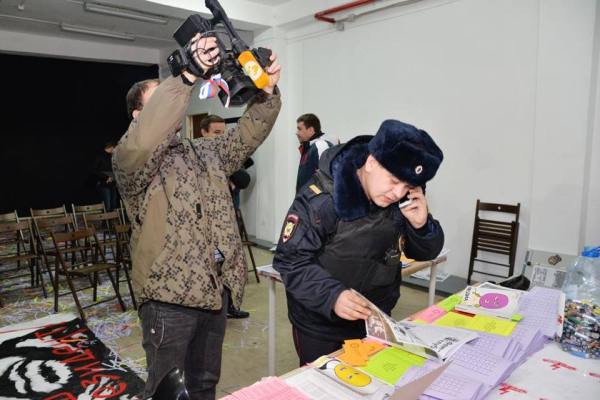
The Antidealer members had already called a police squad, which arrived after some time. Tatiana Volkova spent several hours testifying in the police department Yakimanka. According to the lawyer Dmitry Dinze, representatives of the organization Antidealer wrote that the event included propaganda for drugs (as well as drug addicts), LGBT and anarchism, in a statement to the police about Media Impact.
A few days before the police intervention, member of this organization had visited the festival. They were interested in the section Narcophobia: several men placed themselves in different corners of the exhibition hall, and started asking provocative questions, accusing the festival organizers of engaging in propaganda and violating drug laws. The Media Impact organizers emphasized that no promotion of drug abuse was taking place, and that talking about drug problems is not the promotion thereof. Narcophobia is an initiative of the Foundation Andrew Rylkov in Moscow, the activist art project Zhir, the group Babushka posle pohoron (Grandma after the funeral) from Novosibirsk, and the group Panda-Theater from Berlin. The first presentation of Narcophobia took place in October 2011 also during the Media Impact festival in Moscow. The main goal then was to draw public attention to the issue of spreading drugs and to promote public debate on this issue. Since then, Narcophobia organized several activities related to relevant topics. The slogans of the project are: “No to the war on drug addicts!”; “For the right to life and health!”; “For humane drug policy!”. You can read more about the project here (in Russian): http://narcophobia.ru/
_______________________________________________________________________
The official statement of the “Media Impact” Festival working group regarding the provocation of the “Antidealer” organization
Since its beginning in 2011, Media Impact, International Festival of Activist Art, has been an open space for the exchange of ideas and practices in the field of art and activism. Media Impact hosts lectures, discussions and workshops by a broad range of internationally acknowledged and less known artists, activists and philosophers, as well as cinema clubs, rock’n’roll concerts and children’s program.
Narcophobia was one of the projects presented at the 2015 edition of the festival. It is dedicated to the humanization of narco-politics and eliminating the stigma associated with drug-users in the society. It supports the availability of the treatment of drug-addiction, harm reduction, helping the addicts instead of punishing them.
Antidealer is a public organization dedicated to the reduction of the number of the citizens of Russia using drugs. On the 4th of November its activists took part in the Narcophobia section where they behaved aggressively, but left the discussion very soon. Next time, on the 7th November, the activists of the movement joined the children’s workshops weekend of the festival. This time they were accompanied by the reporters of the two state TV channels – Russia1 and REN-TV, which had previously been invited by the organizers of the festival but preferred to come in the company of the Antidealer group. Led by a member of Parliament, Dmitry Nossov, the representatives of this public organization raided Maria Kalinina’s lecture on contemporary art for children. They accused the organizers of presenting children with illegal information and called the police. On the state channels the organizers were accused of propaganda of LGBT, drugs, extremism and feminism. The statement to the police that they made afterwards listed propaganda of drugs, drugs dealing, anarchism and LBGT.
The next day the owner of the gallery received a call from the police with a warning of checks during the day, so he asked the organizers to leave the room. The program for the whole day was cancelled.
During the visit of the Antidealer members the participating children got suffered moral abuse. They were filmed together with their parents without their permission, and even in spite of their open protests. The next event after the children’s lecture was a conference on democratic psychiatry, among the participants of which were some people with psychiatrical conditions, who were also severely traumatized by the rude behavior of the non-invited participants.
Propaganda of any kind is not the subject of our festival. It is about meeting people, discussing things with them, creating connections and working out problems.
More photos here.
“MediaImpact: International Festival of Activist Art” took place for the 4th time in Moscow, Russia, October 30 – November 7, 2015, at Red Centre, Moscow (Red October). MediaImpact is an open international community seeking to explore, articulate, document, support and develop activist art. The key aspect of its activity is the inclusion of art projects into the actual socio-political practices of today, which includes, among other things, campaigning for the rights of minority groups, release of political prisoners, environmental protection and development of alternatives to existing healthcare systems, as well as standing up against censorship and defamation of cultural figures.
Exciting Opportunities or the Ever Present Potential of Exploitation? Academia Unveiled
In the spring of 2015, the Department of Philosophy and Art History at a well known University in the East of England, UK, recruited a graduate teacher on a zero-hour contract. The position required the successful candidate to research, design, write, and deliver an entire spring term course for 2016. This was advertised as an exciting opportunity for a graduate teacher to prove their worth and ability to deliver a course that they had the freedom of designing.
The job advertisement required a CV, a Cover Letter, and a detailed outline of the proposed module. This was required before candidates were even selected for interviews. To research, design, and outline a detailed plan in draft takes at least two weeks of intensive reading and working out a week by week plan. The time invested in designing the module, and finalizing the application already began to outweigh any potential for paid work. Moreover, candidates handed over their ideas and intellectual property through the carefully chosen reading list and module description.
During the interview, candidates were told that the department made a mistake and that the course advertised was already being taught in the autumn on 2015.
Candidates were asked to come up with an entirely new idea for a module during the interview. With no time to prepare, and under pressure to think quick, the results were drafted rather than thought through.
Further, the interview panel of three lecturers consisted of two that did not teach the relevant discipline. The lecturers who were in charge of the module were not present, leading to a lack in representation of the discipline and a potential one sided approach in the selection process.
Throughout the interview, no mention was made about any paid work that designing this module would involve and questions to the effect were answered vaguely. Upon mentioning that the responsibilities of the post seem to outweigh the job title, it was repeated that this was an exciting opportunity.
The feedback received for unsuccessful candidates included that the ideas for a new module, that they had to conceive during the course of the interview, were not thought through or conceptualized. Queries about the composition of the interview panel and selection process received vague answers. These included that this mirrored the reality in the Academia of candidates being interviewed by non-experts in their field.
The question about payment for preparation time was answered equally evasive referring to a ‘formula’ used by the university to work out payment for time spent researching and designing the module. No further details were disclosed.
The salary offered was more than for a Graduate Teacher Assistant position, however, the vague and evasive way in which queries were dealt with left a lot to be desired. The process seemed to be ensuring that Equal Opportunities were respected, while the interview panel already had a candidate in mind for the position all along. This was reflected in the fact that potential candidates were approached and encouraged to apply, however, the result was mired in ambiguity and half hearted justifications for the selection of candidates.
This manner of recruiting graduates for positions that are in fact jobs for Lecturers, was a less than transparent process. Suspicions arose with the demand to research and design a detailed module, before an interview was even offered. No provisions were made to offer inexperienced graduates support to make an application. Further, the mistake made by the department in regards to the wrong module being advertised led to unnecessary, and unproductive outcomes.
The academia, much like the art world, exploits its workers and demands more than it pays for. Zero hour contracts, of which this position is an example, are a standard way for graduates and academics to seek out a living under precarious working conditions. The workload resulting from a position such as the one outlined here, far outweigh the prestige, experience, and remuneration they promise. GTA’s are continuously overworked and underpaid, and the prospects of a permanent position in the academia, after successfully completing studies, are precious few.
Zero hour contracts are a short term solution. Together with the promise of experience and “an exciting opportunity” to prove one’s ability and worth, these modes of exploitation have become a way to drive the academia forward based on cheap labour and the good will of inexperienced graduates.
If you have witnessed similar cases or have been directly affected by these or similar conditions, speak up and insist on equal pay and equal working conditions!
 ArtLeaks