Updates
ACT NOW! Submit your story to ArtLeaks and end the silence on exploitation and censorship! Please see the submission guidelines in the "Artleak Your Case" page
Submitted and current instances of abuse are in the "Cases" section
To find out more about us and how to contribute to our struggles, please go to the "About ArtLeaks" page
Please consult "Further Reading" for some critical texts that relate to our struggles
For more platforms dedicated to cultural workers' rights please see "Related Causes"
For past and upcoming ArtLeaks presentations and initiatives please go to "Public Actions"
Intervention at the Hungarian Pavilion at Venice Biennale
A group of activists made a blockade at the Hungarian pavilion at the Venice Biennale on Sunday, August 30th.
The group that calls itself #fenceforeurope was demonstrating against the razor-wire ‘fence’ that is under construction by the Hungarian government at the Southern border of Hungary keeping the refugees coming mostly from Syria, Libya and Eritrea away.
Viktor Orban, Hungary’s prime-minister, recently announced that the fence was going to be completed by the 31st of August, and that the government will send a special border patrol to the area.
Sunday’s action appeared in a contemporary art context, and the action itself was partly political, partly artistic. #fenceforeurope used exactly the same instruments that the government did during its campaign against the refugees: street posters and questionnaires that were sent out to millions of Hungarian citizens under the campaign called “National Consultation”. (The government wanted to legitimize its policy with this direct “consultation” but in fact very few people sent the letters back.)
The group also used the Hungarian government’s rhetoric – meanwhile also criticizing the EU’s policies regarding the refugees.
“Our response is clear: we’d like to keep Europe for the Europeans”
An intervention at the 2015 Venice Biennale
At the end of July Viktor Orbán, prime minister of Hungary, announced that Hungary would close its border to Serbia. The 110-mile-long, 13-foot-tall fence, which will physically prevent any movement between the two countries other than through legal checkpoints, will be completed by the 31st August.
We, as Hungarian citizens of Fortress Europe, and also as individuals who genuinely love their privileges, decided that on the day before the official handover of the border-fence we’ll physically block the entrance to the Hungarian Pavilion at the Venice Biennale. In order to help support the separation of our country and our citizens more clearly, on the 30th August we won’t let anybody enter the exhibition space. We’d like a Europe, which is proud of its colonial past and builds its present on this heritage.
We’d like a Europe, which – after centuries of conquests and expansion – now closes its gates before the refugees from the countries she colonized and exploited.
We’d like a Europe, which will define the homo europensis as a race in its own right and which will be led by this race of the unworthy.
We’d like a Europe, which will put join efforts to fulfill this race’s unmerited and exorbitant needs without a care for any other people in the entire world till eternity. Or at least until our resources and the resources of the Earth will run out.
Today Hungary today shows Europe the right way.
Europe sees this and is eager to agree.
Let’s build an isolated, locked Fortress together until we are terminated by the simple law of entropy!
Join to the action, share and spread your ideas with using the #fenceforeurope hashtag!
Art Production in Restriction. Possibilities of Transformative Art Production and Coalition-Building (Trondheim, Norway)
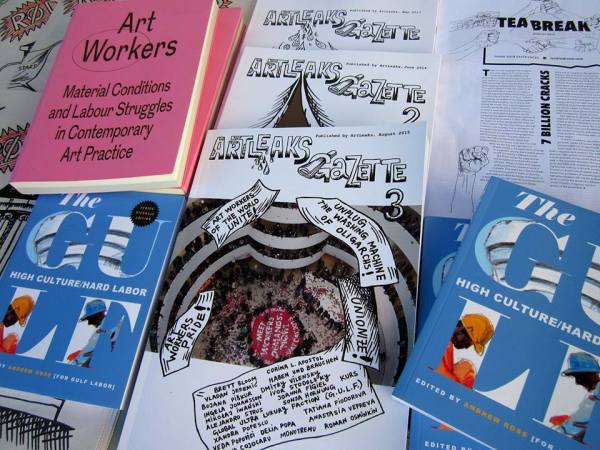
Seminar, 4-7 September 2015
Mini Book Fair, 5-6 September 2015
Nova Kino / Nova Hotell
Cicignons plass
Trondheim, Norway
Since the neoliberal attack on public institutions of art and art education, artistic work has become an entrepreneurial activity within a restrictive framework conditioned by the expanding art market and hegemonic political agendas prescribing the usefulness of art.
The division of labor in the creative and knowledge industries has formed huge masses of artists that serve as a “reserve army” for cheap creative labor.
In recent years artists have organized themselves in new ways, developing strategies to agitate for better labor conditions and certain standards of payment for artistic work.
Major discussions dealing with the conditions of artistic production address the precarity that artistic labor has in common with other branches of “immaterial” and reproductive, or “invisible,” labor. In this context, artistic work is seen as a model for highly-exploitative working relations in late capitalism. To understand what kind of precarity is at stake one needs to take into account the whole process of production and the position of the artist within it.
Obviously, we should distinguish between the precarity of Thai berry pickers working in the forests of Finland and Norway and the position of artists that, believing in the idea of liberated work, have to labor under precarious conditions. Less obvious, but no less real, are the different levels of precarity due to the social stratification of the art world. This encompasses artists producing pieces for the art market, artists working in art management and administration, and community and non-profit-oriented art practices.
In examining these differences and contradictions, with conditions varying considerably between the peripheries and centers of capital, between the global South and North, can the general precarity of art production be seen to function as a common denominator in artists’ struggles for better working conditions? Or, do we need a different political basis for coalition-building that would be realized in a different model of production? How can this different production model support coalition-building? In such a setting, can the autonomy of artistic production become an emancipatory force, or should artists join social movements and political parties of the new left that aim for non-capitalist transformation?
This seminar brings together artists, writers, critics, and curators from Europe and the United States who are active in groups that are struggling for better working conditions in the arts and society at large. The aim of the seminar is to come up with a common method for organizing and coalition-building in the art world and beyond. Read more about the topic of the seminar and find the online compendium of the participating artists, writers, critics, and curators on the seminar webpage at:
http://www.transformativeartproduction.net/
You can register to attend the plenary sessions of the seminar on Saturday and Sunday afternoon. If you are interested, please contact transformativeartproduction@gmail.com before September 3rd.
A Mini Book Fair featuring publications and artists’ editions dealing with the topics of art and work will be open to the public 5&6 September 2015, 18-20h at Nova hotel. On Sunday, the 6th September seminar participants will present their publications to the audience.
Featuring:
Airi Triisberg (Tallinn), Corina L. Apostol (ArtLeaks, Bucharest), Danilo Prnjat (DeMaterijalizacija umetnosti, Belgrade), Gregory Sholette (New York), Ivor Stodolsky (Perpetuum Mobile, Berlin), Jean-Baptiste Naudy (Ateliers Populaires de Paris), Jelena Vesić (Belgrade), Jesper Alvær (Oslo), Jochen Becker (metroZones, Berlin), Kuba Szreder (Warsaw), Lise Skou (Aarhus), Lise Soskolne (W.A.G.E., New York), Marina Vishmidt (London), Marita Muukkonen (Perpetuum Mobile, Helsinki), Marius Lervåg Aasprong (Trondheim), Minna Henriksson (Helsinki), Mourad El Garouge (Ateliers Populaires de Paris), Noah Fischer (Occupy Museums, New York), Raluca Voinea (ArtLeaks, Bucharest), Sissel M Bergh (Trøndelag Bildende Kunstnere, Trondheim)
A REAL WORK OF ART (Oslo, Norway)
A REAL WORK OF ART
2nd – 20th September 2015
RAM Galleri, Kongens gate 3, 0153 Oslo, Norway
Featuring: Corina L. Apostol (ArtLeaks), Federico Geller, Fokus Grupa, Nikolay Oleynikov (Chto Delat?), Iulia Toma
Curated by: Rena Rädle & Vladan Jeremić (ArtLeaks)
Opening program, 2nd September 2015
RAM Gallery, Kongens gate 3, 0153 Oslo, Norway
18h Promotion of the ArtLeaks Gazette #3 and lecture Art Workers Between Precarity and Resistance: A Genealogy by Corina L. Apostol (ArtLeaks).
18:30h Talks by Hilde Tørdal (Norske Billedkunstnere / Norwegian Association of Visual Artists) and curators Rena Rädle & Vladan Jeremić (ArtLeaks).
19h A mise-en-scène of “Circus Melodrama” – a sketch for a theatre fable for cultural workers, with the participation of the audience
19:30h music and drinks
A Real Work of Art – art, work, and solidarity structures
Although we live in a time of creative industries, which implies the emergence of a new proletariat of cultural workers, artistic work is not yet considered ‘real’ work. Artists and art critics alike nurture the utopian idea of artistic practice as a form of liberated, non-alienating work. Nevertheless, platforms like ArtLeaks and other initiatives publish ‘Stories from the Production Line’, to quote the famous title by the dramatist Heiner Müller, highlighting working conditions in the global art system, the corporatization of art financing and the precarious livelihoods of artists, unpaid labour, problematic sponsors – all the problems that now plague the art world.
“A Real Work of Art” is less about the presentation of artworks and more about the organization of art workers. The exhibition’s ‘raw material’ consists of the experiences of artists who have tried to organize themselves into associations promoting improved working conditions for artists. Such initiatives are as old as the labour movement itself, and they can be said to form the backbone of today’s positions and initiatives. The participating artists share important ideas about art and work, organizational structures and solidarity.
The aim of the exhibition is to generate a temporary ‘hot spot’ for these issues – one that can be useful for Norwegian artists and artist organizations who are grappling with cuts in public funding and other factors affecting the conditions for artists today.
Why I am suing La Biennale de Montréal (Montréal, Canada)
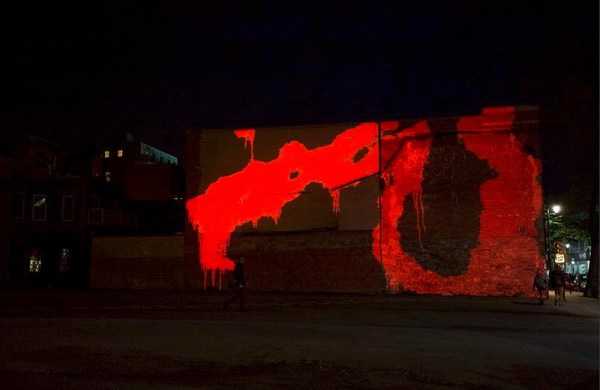
Isabelle Hayeur, “Murs Aveugles” (2014)
On October 22 2014, my site-specific video installation Murs aveugles (Blind Walls) was withdrawn from La Biennale de Montréal. The work had been launched two weeks earlier and was supposed to have been shown until November 23 – as per the contract I had signed with the organization. Since this projection had been designed specifically for the site where it was presented, its withdrawal meant the work has been totally lossed.
After several unsuccessful meetings in view of getting some compensation, I filed a suit at the Small Claims Division of the Civil Division of the Court of Quebec. I was supported in my actions by the Regroupement des artistes en arts visuels du Québec (RAAV), the professional association representing and collectively defending the interests of Quebec artists.
This withdrawal without notice was done the very evening of the official opening of this art event. I first heard about it during the opening, through journalists who wanted to film the work and were wondering why it wasn’t there anymore. This decision was made by the Biennale management; neither the artist, nor the curators were consulted.
This original work was a commission from La Biennale de Montréal: I designed it especially for this art event. I worked on it from the winter of 2014 and I finished it towards the end of the summer. Many tests were made in the presence of the organizers and its content was approved before the beginning of projections.
Murs aveugles was shown on the Esplanade of Saint-Laurent metro station, in partnership with the Quartier des spectacles de Montréal. This public square is a permanent projection site: videos and animations have been featured there for many years already. The work was put together on that square, like a canvas or a mural. The video was fashioned with a template to fit the wall’s shape with its particulars and textures, but also with specific, non-standard video equipment. Relocating it would have been impossible.
The unilateral, hasty decision to withdraw the work was taken following a complaint from the owner of the building on which the video was projected. The lady in question had agreed that these videos be projected onto her wall and had never demanded a right to oversee the content of projections. On the other hand, I was perfectly willing to meet her to try and find a solution.
Following the work’s withdrawal, a week went by before a meeting between the Biennale, the Quartier des spectacles and myself was set up in order to consider alternatives. In a crisis situation, this is much too long. I was being told there was nothing to do, that the projection could not be put back, that it was an unforeseen situation and that the owner refused to meet us to discuss it. I came out of this meeting somewhat perplexed.
Following this, I published a text through my personal newsletter to announce to the public the withdrawal of my work. Without this text, there would have been no official press release, nor any mentions on social networks. On two occasions, in the course of phone conversations with people at the Quartier des spectacles, I was criticized for publishing this text. As for the Biennale, it preferred to put a rather vaguely worded mention on a low-visibility page of its Internet site (to reach it, you have to click on the list of artists, and then on my name). Clearly, hushing up the whole affair was the preferred course of action.
Living outside the city, I had to get to Montréal on many occasions to try to settle the situation as well as to meet journalists. On November 27 2014, coming out of the offices of CIBL community radio station, I passed in front Mrs. Chow’s shop and I entered. I was expecting her not to want to talk with me, but it was quite the opposite. When a meeting had been suggested to her, she just was not available, but another day would have been possible for her. She also told me that a slight alteration to the work would have suited her, something I would have agreed to. To my knowledge, I am the only person to have met her.
Since that time, I have written a letter to the Biennale’s Board members, I have met some of them, the RAAV has circulated a petition to reinstate the projection and has proceeded to send this organization a letter of formal notice; a mediation session was finally set up by the Small Claims Court in July 2015. La Biennale still stubbornly refuses to acknowledge having done any wrong – without giving any reason or acceptable arguments.
Murs aveugles was my fourteenth project of its kind. I have done public works in Canada, but also in the United States and in Europe. The more significant works were commissioned by the Vancouver 2010 Cultural Olympiad, Nuit Blanche Toronto 2011 and Denver International Airport (2012). I have had problems in the past in connection with the presentation of public works, but the organizations settled this type of situation correctly; they always checked beforehand and knew how to manage crisis situations. What I have gone through on account of La Biennale de Montréal is quite unusual. What is an art organization’s role and mandate? La Biennale should have honored its contract by defending the work and the artist.
It is normal for an art presenter to expect an artist to hand in projects in time, to provide images and explanatory texts, and to be available for interviews. In return, an artist can legitimately expect a presenter to give her respect and to make the arrangements needed for her work to be adequately shown.
The work Murs aveugles / Blind Walls may be viewed on the Internet at this address: https://vimeo.com/104032665
La Biennale de Montréal responded to the artist’s intention to sue their institution:
La Biennale de Montréal is a non-profit organization.
In October 2014, La Biennale de Montréal signed a contract with the artist to show four of her works in total.
This exhibition lasted for 10 weeks, from October 8 to January 4, 2015.
The artist has received the amount of 2000$ for the works exhibited which exceeded the minimum fare recommended by CARFAC.
Two weeks after the beginning of the exhibition, the owner of the building on which the work “Murs aveugles” was shown asked that it be removed. This was the decision of the owner of the building, not that of La Biennale de Montréal, and it represents a case of “force majeure.” La Biennale de Montréal cannot be held responsible for it.
Moreover, the right to present a work does not imply an obligation to do so, if the circumstances warrant it.
La Biennale de Montréal has proposed other alternatives to Isabelle Hayeur. Isabelle Hayeur has had more visibility in the media than the other artists.
La Biennale de Montréal has paid Isabelle Hayeur and if someone has suffered damage, it was La Biennale de Montréal, not Isabelle Hayeur. Isabelle Hayeur didn’t suffer any damage to her reputation, therefore her appeal is unfounded.
Finally, this legal action against the biennale is inadmissible, because Ms. Hayeur waived her right to sue by signing the contract, as mentioned in Clause 11.
Christian Bédard, general director of the Regroupement des artistes en arts visuels du Québec (“RAAV”) gave this statement:
For its part the Biennale does not recognize its mistakes and says it was confronted with a case of “force majeure under the Civil Code”, preventing it to respect its contract. La Biennale de Montréal added that the artist was well paid and the contract signed with the artist does not require the organizers to present the work during the 10 weeks. La Biennale de Montréal blames this withdrawal to the owner of the building who “unilaterally and without notice, withdrew their consent to the work of the projection home.”
From the perspective of RAAV, which supports the artist in this case, it is a breach of contract affecting the reputation of the artist, restricting her right to freedom of expression and depriving the visibility of the work, which she was entitled to expect under the contract. This situation seems to have been rather badly managed by the Biennale. The Biennale should defend a work that it had not only controlled but also pre-approved, with the risk of suffering the wrath of the owner and the Quartier des spectacles, which would have been unlikely.
For more information please read:
Boyce, Maryse, “La projection Murs aveugles est suspendue”, BaronMag, October 28, 2014
Clément, Éric, “Biennale de Montréal: une œuvre retirée”, La Presse, October 31, 2014
Fortier, Marco, “L’art qui dérange a-t-il encore sa place?”, Le Devoir, October 31, 2014
Sutton, Benjamin, “Occupy-Themed Light Projection Removed from Montreal Biennale“, Hyperallergic, October 31, 2014
Bédard, Christian, “Cas de censure politique au Quartier des spectacles?”, RAAV, November 5, 2014
MFX, “Le Quartier des spectacles complice de la censure d’une œuvre d’art?”, 99%Media, November 6, 2014
Ledoux, Julie, “Aux frontières de l’espace privé et de la liberté d’expression”, Voir, November 6, 2014
Petrowski, Nathalie, “Le mur, le feu et Mme Chow”, La Presse, November 15, 2014
Clément, Éric, “Biennale de Montréal: bilan positif… mais peut mieux faire”, La Presse, January 7, 2015
Lelarge, Isabelle, “Art et illusions”, ETC Média, February 15 – June 15 , 2015
Delgado, Jérôme, “La Biennale de Montréal menée en cour”, Le Devoir, July 24, 2015
Vadim Sidur’s art smashed by Russian Orthodox activists at the Manege exhibition center (Moscow, Russia)
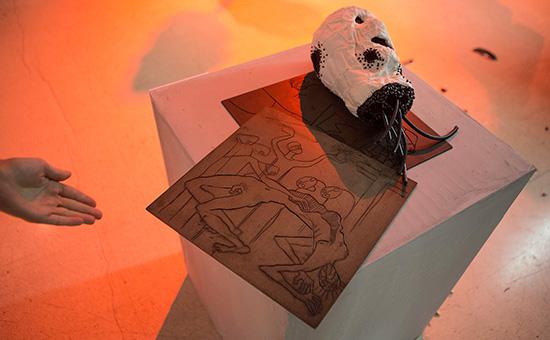
Sidur’s works after the attack on the exhibition. Foto: Kommersant
Russian Orthodox activists destroyed several works by Vadim Sidur, Soviet nonconformist sculptor at an exhibition in central Moscow denouncing the show as “blasphemous”. “Delusional people came to the exhibition who broke several works belonging to the Manege collection, by Vadim Sidur,” said a spokeswoman for the Manege exhibition centre next to the Kremlin walls, Yelena Karneyeva.
She stated that there were “several” attackers, and that “several sculptures are completely smashed.” The works were made of plaster and linoleum. She said that police had come and led away the activists.
Orthodox activist Dmitry Tsorionov, known by the nickname Dmitry Enteo, stated he was at the Manege exhibition centre. He said he was with police and that they were going to close down the exhibition. ”We called the police,” he claimed. “They will close the exhibition for offending believers,” he said.
According to footage from the scene the God’s Will activists, headed by Enteo, came into the exhibition and engaged in a vocal argument with the organizers. They demanded that the exhibition were closed to the public.
Enteo had earlier written a Tweet saying, “Right in the centre of Moscow there is terrible blasphemy, we are going there to liquidate it!” The message gave no more details.
Enteo is one of the most prominent conservative activists. He cites Orthodox values while picketing and heckling at arts events and protests, sometimes with a television camera crew in tow. This year he attempted to stop a gay pride rally in Moscow.
Police closed the exhibition to investigate and began questioning witnesses and activists.
The exhibition called “Sculptures that We Don’t See,” showed works by Soviet sculptors that did not see the light of day during the Soviet period because of their nonconformist nature. The exhibition, which opened to the public on Friday, August 14th, included some works with religious themes.
Sidur died in 1986. A museum in Moscow is now dedicated to his work and his art has been sold at international auction houses such as Sotheby’s. Friday’s attack on his works swiftly prompted condemnation.
“Now Orthodox warriors are smashing a sculpture exhibition in the centre of Moscow. Hail the Russian IS,” Vladimir Varfomoleyev, a journalist at popular Echo of Moscow radio station, wrote in a Tweet.
Read more on Art Daily.
 ArtLeaks