Updates
ACT NOW! Submit your story to ArtLeaks and end the silence on exploitation and censorship! Please see the submission guidelines in the "Artleak Your Case" page
Submitted and current instances of abuse are in the "Cases" section
To find out more about us and how to contribute to our struggles, please go to the "About ArtLeaks" page
Please consult "Further Reading" for some critical texts that relate to our struggles
For more platforms dedicated to cultural workers' rights please see "Related Causes"
For past and upcoming ArtLeaks presentations and initiatives please go to "Public Actions"
Regarding Marika Schmiedt’s request for permission of showing her art installation in Kirchstetten (Austria)
Buffalo, August 6, 2015
Dear Mayor Paul Horsak,
I was just informed that you have denied artist Marika Schmiedt the permission to exhibit her temporary art installation, “Futschikato – Die verschwundenen Roma und Sinti aus Kirchstetten und der “Fall Weinheber““ in your city. It is with great dismay that I read your letter to Schmiedt, especially your reasoning:
“Erinnerung ja, aber es muss auch einmal Schluss sein mit Aufarbeitung und Auseinandersetzung.”
What do you exactly mean when you write: “remembering yes, but there has to be an end to processing and confronting the past”? What kind of memory making of the murder and deportation of Roma and Sinti do you think is adequate? And why do you presume we should put a stop to processing and confronting this history? Lastly, and perhaps most importantly, why do you feel entitled to make such a decision on behalf of your community, and in extension, on behalf of Kirchstetten’s history?
It worries me greatly that as a leader of this Kirchstetten community, you are not supporting an artist’s engagement with the history of National Socialism in the region, especially the discrimination and murder of Roma and Sinti. While it is reasonable to fear that such critical engagement is uncomfortable and conceivably difficult to face, the erasure of that past has catastrophic consequences. As is well known, Roma and Sinti are still the most persecuted and discriminated minority in Europe. Your city has the extraordinary opportunity, if not responsibility, to confront its own past, and to do so in a way that faces even the most humiliating truths, such as the Nazi past of a celebrated poet in town, Josef Weinheber.
I would also like to note that Marika Schmiedt is one of the most important artists in Europe who deals with the history of the Roma holocaust, and whose work has been exhibited widely, including being featured in the prestigious Venice Biennial in 2011. Her work was also included in “Roma Protokoll,” an exhibition in 2011 curated by Suzana Milevska, the recipient of the 2012 Igor Zabel Award for Culture and Theory. In response to Schmiedt’s work, distinguished literary critic and theorist Gayatri Chakravorty Spivak noted that:
“Marika [Schmiedt] has made the subaltern speak, in a certain way for sure, through representation, but much more forcefully. If the subaltern is the group that cannot achieve the state – Antonio Gramsci’s classic definition – the Roma Holocaust didn’t even make it into Hannah Arendt’s insistence that the banality of evil springs from the premises of the state. The Roma Holocaust is not allowed into this widely accepted generalization. That is subalternity, not just not achieving the state, but not even achieving the record of the banality of the evil state.”
Spivak’s words speak volumes here, but most significantly, they comment on Schmiedt’s resistance to accepting the erasure of this history of violence, which has marked many families in your own community. Trauma theorist and historian Dominick LaCapra has suggested that art is a cultural form that “may even be a means of bearing witness to, enacting, and, to some extend, working over and through trauma whether personally experienced, transmitted from inmates or sensed in a larger social and cultural setting.” Even though you speak of the young generation, which you note is not responsible for the atrocities that happened more than seven decades ago, I must disagree with the implication that these generations do not need to learn about this past in a way that is confrontational and that directly involves the urgent problems of our contemporary moment. Europe as a whole still has to confront much of its violent history, especially in regard to Roma and Sinti, and the devastating conditions under which many Roma and Sinti live today. Marika Schmiedt’s installation has the potential of bearing witness to these atrocities and bringing some form of healing to your community and beyond, even if it involves facing painful truths.
I hope that you will reconsider your decision and grant Marika Schmiedt the permission to exhibit this installation in Kirchstetten.
Sincerely,
Dr. Jasmina Tumbas
Assistant Professor
Department of Art
University at BuffaloPS: For more information on Spivak’s discussion of the exhibition “Roma Protokoll,” please consult http://igkultur.at/projekte/romanistan/making-visible.
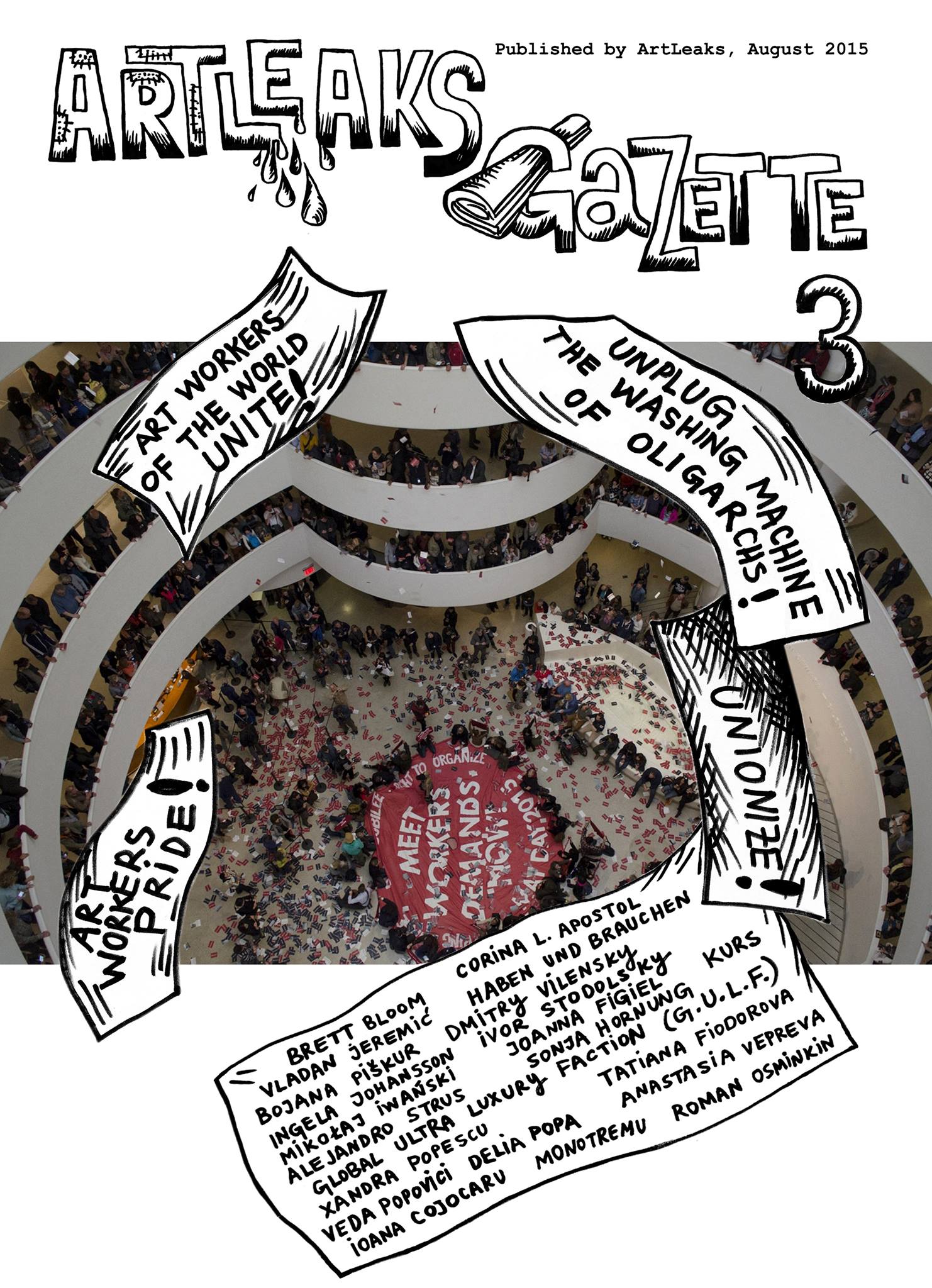
Cover page by the editors, Photo credit: Margaret Singer
We are very happy to announce the release of our latest issue of the ArtLeaks Gazette, entitled Artists Against Precarity and Violence – Resistance Strategies, Unionizing, and Coalition Building in a Time of Global Conflict and Contradiction. This issue unpacks some important questions for the art field today about models of organizations, unionizing, and strategies of resistance for art workers. Our aim is to illuminate new ways of production and coalition building in international and local environments that, unfortunately, are increasingly hostile.
The gazette is freely available to read here:
As a learning tool, this gazette is meant to contribute to the critical debates around censorship, exploitation and abuse highlighted on our online archive since 2011. We hope many of you will use it in your own self-organized schools, seminars, workshops, protest meetings, and join our community to push these issues even further.
Limited printed copies will be available soon. We are calling on those of you who regularly print as a part of your work to help us get the ALG by committing to small print runs of 50-100 copies. We will make several PDF formats of the ALG to meet various digital needs, as well as an epub edition. We encourage our readers to be an active part of spreading the ALG by hosting it on their site and forwarding it on to their networks.
The gazette includes texts by: Corina L. Apostol, Ingela Johansson, Bojana Piškur, Dmitry Vilensky, Mikołaj Iwański and Joanna Figiel, Xandra Popescu with Veda Popovici, Delia Popa and Ioana Cojocaru, Alejandro Strus and Sonja Hornung, Haben und Brauchen, G.U.L.F., and Ivor Stodolsky
Visual works reproduced in the gazette are by: KURS, Anastasia Vepreva and Roman Osminkin, Tatiana Fiodorova, and Monotremu
ArtLeaks Gazette editors: Corina L. Apostol, Brett Alton Bloom and Vladan Jeremić.
Cover page by the editors, Photo credit: Margaret Singer
ArtLeaks is currently working on a new exhibition at RAM Galleri in Oslo, opening on September 2nd, and a seminar at LevArt, Levanger/Trondheim, between September 3rd and 7th. More discussions and workshops will be announced in the near future. If you would like to host one please send us an email.
ArtLeaks contact information: artsleaks@gmail.com // www.art-leaks.org
This is a chronological summary of the events surrounding Suzana Milevska’s case according to information received by ArtLeaks. For more background information please read here, here and here. Milevska is currently free from her contract with the Vienna Academy of Fine Arts. She was not allowed to resign as she requested, nor did she receive any explanation or apology from the Academy or the Erste Foundation.
January 2013
The first open call for Endowed Professorship for Central and South Eastern European Art Histories was advertised by the Academy of Fine Arts Vienna on www.artandeducation.net at the end of January 2013. The position was advertised as a partnership between the Academy of Fine Arts Vienna and the Erste Foundation. The text of the call emphasized the discipline of art history in the title, and interest in the region, as well as knowledge of local languages for first hand research, the period after 1960s and interest in feminist and postcolonial theories. The job was unique opportunity for professionals from the CSEE to come to Vienna, and to both design and teach this very specific course. The call was widely circulated. Suzana Milevska received it and applied, as she thought her CV was fitting to this description, and a short list and interview were mentioned.
April-December 2013
Suzana Milevska was informed in April 2013 that she was selected without any mention of a short list or interviews, etc. The position was the first such chair – it’s an area study within the discipline of art history and with a focus on feminist and postcolonial studies. Since she had BA (from Skopje) and MA (from Prague) in contemporary art history, and her PhD from Goldsmiths in Gender Difference in the Balkans (published) had a strong postcolonial and feminist perspective there were no any critical comments. The contract she signed with the Academy of Fine Arts was a 10 month contract and implied 45 hours of lectures and/or seminars. The course was one semester optional course to which anybody could apply. The first semester there were 44 students enrolled from different years and levels of study (BA, MA, even PhD).
January 2014
In January 2014 the contract with Suzana Milevska was prolonged (the previous contract would have ended in July 2014) until May 2015 after she was asked if she would like to continue teaching. No competition was advertised because everybody agreed that it would not be ethical to mislead the other professors – prospective applicants from the region to apply when it was clear the professors would vote for Suzana Milevska.
August 2014
Suzana Milevska was disinvited from giving the keynote speech at the Ceremony of the Igor Zabel Award for Culture and Theory established by the ERSTE Fondation. Just a couple of months before the event, Milevska was disinvited with a justification that the programme changed (although she thought it was implied that the previous winner delivers this speech in the honor of the new winner, since Piotr Piotrovski delivered such a speech in Warsaw at her award ceremony). This coincided with the big restructuring of the Erste Foundation’s administration and management structure – when the whole line of management-the Directors of the programs including the Culture Program were simply erased. Three people on such high positions were removed without replacement.
December 2014
On 16 December Suzana Milevska asked the Dean of the Academy whether she was eligible to reapply. She received a confident answer from the Rector via the Dean that she was eligible, as was anybody else. The new call was almost exactly the same as the first one, only the duration was changed, and it was advertised as a position for 2 years (which was never the case before). It was not specified if Suzana Milevska as the first (and the only previous professor) had the right to re-apply again, this time or ever again. Suzana Milevska confirmed for ArtLeaks that she was told not to apply with the words “Don’t!” by the Vice Rector Andrea B. Braidt with no mention of any rule, including the 2-year change.
January-February 2015
The Dean Ruth Sonderegger encouraged her to apply, even telling her directly that the ‘Don’t!’ was a kind of mobbing, and so finally she decided to apply. In February Milevska already knew that she was voted unanimously from her professor colleagues. Although they were not supposed to tell her this, some of them were very happy and called her home, even the Dean to congratulate her.
March 2015
The rejection e-mail message from the recruitment agency of the Academy arrived on 17 March and came as a shock to Milevska: it just stated that it was very difficult to make the decision. Strangely the rejection came only a half a day after her enquiry about the results of the competition at the Erste Foundation, because after 3 months of applying and a month after knowing that her application was selected she hadn’t received any answer. In this conversation she was invited to meet with the team to explain to her that Erste Foundation preferred a new professor. When Suzana asked who would be on the team she was told that Erste Foundation curator Christiane Erharter was a part of it (although she hadn’t been before, and was not supposed to be involved in the professorship selection because of her civil partnership with Vice-Rector Andrea B. Braidt, who was responsible for the Professorship on the side of the Academy of Fine Art). Only then Milevska realized that something changed radically after the restructuring of the Erste Foundation: that the Vice-Rector’s partner who was never supposed to be involved in the structure related to the professorship after the firing of the program director of the Culture Program, had suddenly became a member of the team dealing with the professorship. This was a direct conflict of interest.
Suzana Milevska then stopped communicating with the Erste Foundation’s coordinators and curators at that point, and she sent her letter of withdrawal to the Director of the Erste Foundation, Franz Karl Prueller. In his reply he denied any involvement from the Erste Foundation in the decision of the Academy-unfortunately for him it was too late-his employees already slipped and told Milevska bluntly that it was the Foundation that preferred the new professor.
Immediately after the rejection on March 17th Milevska sent a letter of resignation stating Act 11 from her contract (stating that the resignation conditions apply as for Article 23), that in her view would have allowed to her to give her resignation with one month notice. She stated that she cannot understand the rejection decision because she was confident in her application, and that she was never told about the 2-year change rule. The answer that came directly from the Rector was shocking – it stated that the decision was based on the 2-year change rule and stated ‘As you know’ –it was the very same Rector who sent the message that she was eligible just 3 months earlier!
For more information please follow the following links:
First open call to the competition January 2013
First announcements of the selection (ERSTE, Academy of Fine Arts, artandeducation.net)
http://www.erstestiftung.org/blog/suzana-milevska-appointed-for-first-endowed-professorship/
Second announcement for the Extended position (artandeducation, Academy of Fine Arts) May 2014
http://www.erstestiftung.org/blog/endowed-professorship-at-the-academy-of-fine-arts-vienna-extended/
Igor Zabel Award Announcement
Second open call December 2014
Second announcement April 2015
http://www.artandeducation.net/?s=Jelena+Petrovic
Apology letter to the students and the students’ petition “Free Suzana Milevska”
http://www.ipetitions.com/petition/free-suzana-milevska
Freedom Milevska Facebook Group
https://www.facebook.com/profile.php?id=100009243534093&fref=ts
Free Suzana Facebook Event, April 22nd, Schillerpark Vienna
https://www.facebook.com/events/838245462916347/
Apology letter Vis Veritas Obses
https://art-leaks.org/2015/04/16/suzana-milevska-vis-veritas-obses-truth-is-the-hostage-of-force/
Vis Veritas Obses 2
https://art-leaks.org/2015/04/24/suzana-milevska-vis-veritas-obses-2/
Disobedient (Reasons for resignation)
https://art-leaks.org/2015/04/27/suzana-milevska-disobedient-reasons-for-resignation/
UPDATE
Jul 3, 2015 — We’re bitterly disappointed that the refusal of the visit visas for the Georgian group has not been overturned. These are talented performers and theatre makers who would have made a most distinctive contribution to FLARE15, as well as benefiting from being a part of the international community of artists that Flare is bringing together. The fact is that we have been denied the chance to host some great new artists from a country outside the EU, simply because they were unable to prove they have secure financial backgrounds. The removal of the right of appeal for visit visas in 2012 has been interpreted by this Conservative government as removing any chance of considering other ways of assessing what is fair and right in a situation like this.
The amount of support the group attracted, from the government of Georgia and a host of arts organizations in Tblisi to the Arts Council of England and the over 1600 signatories on this petition, proved as much as any financial background information that these are not people set on becoming illegal immigrants.
We are immensely grateful for the wide support that this case attracted, and understand it led to a third review of the facts of the case by the Home Office, which is apparently without precedent.
We are also very pleased that Mareike Wenzel, the group’s Berlin based director will still be joining the 22 other theatre groups and solo artists coming to Flare, and are currently in discussion with her to present a video (possibly Skype) installation based on the piece and the attempt to get it here.
Kevin Egan
_______________________________________________________________________
Together with six young Georgian artists (Ana Chaduneli, Tamar Chaduneli, Tamara Gobronidze, Ana Jikia, Gvantsa Jishkariani and Nata Kipiani) I have been invited to create a performance for FLARE15 Festival, in Manchester, UK. Everything had been arranged – flights were reserved, rehearsals were scheduled, the festival announced the program featuring our performance – which is going to deal with the situation of migrants in Western Europe and particularly in the UK – the only thing missing were the visas for the Georgian artists. I myself am in the privileged situation of being able to travel almost everywhere with my German passport, without having to spend hours at embassies, writing down every personal detail about my life, and of course justifying the numbers on my bank statements. So in the end 1000 Euros were paid as application fee for all visas, the most intimate and ridiculous questions answered in the visa application form, a personal interview at a visa office gone through – including the woman conducting the interview mocking the members of the group for their financial situation – finally all documents were sent to the British Embassy in Ankara (that is why a single application instead of 90 Euro costs 200 Euro if applying from Georgia, sending papers is expensive).
We were all aware of the fact that the UK has very strict visa regulations, but we didn’t expect that our performance would become reality even before entering the UK. In the end all we wanted to do is show a performance at a festival that had invited us.
To make it short – all visas were denied on the sole reason that the artists don’t have enough money in their bank accounts. I am not sure what would be considered a sufficient amount, but I suppose the amount that my bank statement is currently showing surely wouldn’t. Still, no one denied me entry into the UK. But a group of artists that has been officially invited to an international theatre festival in Manchester, instead of a visa, got a note in their passports stating that the person checking their visa application is of the opinion that their application is not genuine, and that the intent behind their visa application is to illegally stay in the UK and possibly apply for social benefits. By saying that, they basically criminalized the artists by suggesting that they must be lying. Quote from refusal letter: “…I am not satisfied that you are a genuine visitor to the UK and will leave the UK at the end of your visit or that you have sufficient funds available to cover your costs whilst in the UK without working or accessing public funds…” So what else can you do to prove that the sole intend of your visit is to do a performance at festival, if even a signed statement from the festival doesn’t seem to be credible from the perspective of the visa office?
The festival’s artistic director has been great and has tried to support us in every way possible, calling and writing to everyone possible in order to change the visa decision. So far it has been without success, as the visa office’s only offer is to either file an official appeal which takes six months to one year, or to reapply. Reapplying would also mean again paying a visa fee of altogether more than 1000 Euros. We already paid that sum for the first application, which of course is non-refundable. Even if we were to reapply, we would again send in the same documentation stating that the festival is taking care of everything including making sure everyone leaves the UK afterwards. How is it possible to run an international art festival and work inter-culturally, if everyone outside the European Union first has to prove that they are rich enough in order to be allowed to participate?
I met this group of artists, when I was teaching them performance, and from this a collaboration developed. This kind of collaboration is normally praised in every leaflet published by the EU: collaborating across borders, inter-culturally, connecting people, raising important questions on current issues, etc. But considering the current visa legislations and procedures these terms simply remain empty shells. It is not possible to actually fill these terms with life, because this is actually not desired. We like to talk about freedom, but artists’ freedom from outside the EU stops at the EU borders. How can I teach students in Georgia, showing them possibilities for their artistic career, when I have to inform them about their limitations all the time? How can I initiate an artistic exchange, if in the end that only means that I can travel somewhere on EU funds but I shouldn’t consider inviting artists back? We are living in hypocritical times, when terms like “freedom” and “choice” are abused, while the powers that be constantly deny the fact that these terms have become stand-ins for “restriction” and “privileged selectiveness”.
To be continued…
Mareike Wenzel
Please sign and share the petition Grant visas to the New Collective from Georgia, so they can perform at the Flare International Festival of New Theatre in Manchester, 13-18 July 2015
For more updates on the case please follow the FB Page Welcome
Artist Volodymyr Kuznetsov has taken legal action against the Mystetskii Arsenal (Kiev, Ukraine)
UPDATES
30/11/2015
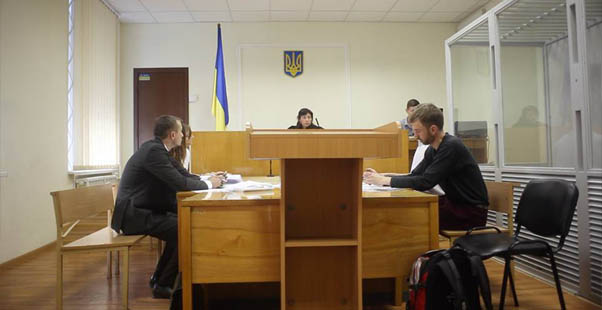
On September 9th the Pechersk District Court made a decision in the civil case initiated by Volodymyr Kuznetsov against the “Mystetskii Arsenal,” regarding the copyright on the artist’s destroyed mural in the institutions. These decisions partially satisfied the artist’s claim, including moral damages he recovered.
The appeal will take place on December 3rd, at 11:30 in Solomenskiy Appeal Court of Kyiv. The court ruled in favor of only a part of the artist’s claims. He was granted 1,000 (one thousand) hryvnas 00 kopiyka (around 50 $) for moral damages. These were awarded because the court ruled that the Arsenal did not give the artist an opportunity to make a photo documentation before destroying his work. The court decision did not mention anything about copyrights damages.
Volodymyr Kuznetsov is further requesting the following:
1.To officially recognize the actions of the State Enterprise “National Cultural Art and Museum Complex “Mystetskyi Arsenal” of painting over the work by Volodymyr Kuznetsov “Koliivshyna. The Last Judgement” as unlawful, and a breach of intellectual property rights of the author.
2.To be awarded 1,000 (one thousand) hryvnas 00 kopiyka in damages and 121,800 (one hundred twenty one thousand eight hundred) hryvnas 00 kopiyka for material damages from the State Enterprise “National Cultural Art and Museum Complex “Mystetskyi Arsenal”.
3.That the State Enterprise “National Cultural Art and Museum Complex “Mystetskyi Arsenal” publish, at their own cost, information about the breach of copyright in regard to Volodymyr Kuznetsov, the grounds for this breach, as well as corresponding apologies in mass media, in particular in Ukrainska Pravda, within a 2 (two) month period starting from the date of the court’s decision.
4.That the State Enterprise “National Cultural Art and Museum Complex “Mystetskyi Arsenal” pay related legal costs.
30/06/2015:
Present at the hearing were the plaintiff (Volodymyr Kuznetsov), the plaintiff’s representative (the lawyer), three representatives of the defendant (Mystetskii Arsenal) and a third person (Natalia Zabolotnaya). The Arsenal representatives objected to the claim: “… the plaintiff kept photos [of the work] and this was consistent with the degree of curtesy which the law requires of us: to provide the plaintiff, as author of the work, the opportunity to take a photo of it. He kept his work, he can further reproduce it, or use it otherwise … one can clearly see the work, what is being discussed in it, and there can be no question about this… “
The defendant’s representative was asked whether he thinks a painted work and a photograph of that work are the object of the same copyright. He explained that it is the same work, but photographed, because there are different media.
The defendant’s representative could not cite clear provisions for organizing exhibitions in the Arsenal to the representative’s plaintiff. In the absence of the possibility to present such protocols, the plaintiff’s representative expressed the wish to have a future conversation with Natalia Zabolotnaya, about the possibility of establishing such provisions.
The hearing was adjourned until September 9, 2015, when additional disclosures will be revealed.
21/05/2015:
At the court hearing, only the plaintiff (Volodymyr Kuznetsov) and his representative (the lawyer) were present. The other people involved in the case did not present themselves before the court, although they had been duly informed. On May 19th, a request was filed by the third party (N. Zabolotnaya) and her representative to postpone examining the details of case to another date. The hearing was then adjourned to June 30.
_________________________________________________________________________
The lawsuit of Volodymyr Kuznetsov against the State Enterprise Mystetskyi Arsenal begins on 21 May 2015 in Kyiv Pechersk District Court. The artist says the action relates to the destruction of the artwork “Koliivshyna. The Last Judgement”. In July 2013, it was painted over with black paint at the order of the Mystetskyi Arsenal’s Director [Nataliya Zabolotna].
Volodymyr Kuznetsov is requesting the following:
1. Recognize the actions of the State Enterprise “National Cultural Art and Museum Complex “Mystetskyi Arsenal” of painting over the work by Volodymyr Kuznetsov “Koliivshyna. The Last Judgement” as unlawful and a breach of intellectual property rights of the author.
2. Recover 1,000 (one thousand) hryvnas 00 kopiyka in damages and 121,800 (one hundred twenty one thousand eight hundred) hryvnas 00 kopiyka for material damages from the State Enterprise “National Cultural Art and Museum Complex “Mystetskyi Arsenal”.
3. Require the State Enterprise “National Cultural Art and Museum Complex “Mystetskyi Arsenal” to publish, at their own cost, information about the breach of copyright in regard to Volodymyr Kuznetsov, the grounds for this breach as well as corresponding apologies in mass media, in particular in Ukrainska Pravda within a 2 (two) month period starting from the date the court decision is enacted.
4. Obligate the State Enterprise “National Cultural Art and Museum Complex “Mystetskyi Arsenal” to pay related legal costs.
|
21.05.2015 12:00 |
Plaintiff: Volodymyr Kuznetsov Oleksandrovych Defender: State Enterprise “National Cultural Art and Museum Complex “Mystetskyi Arsenal”, third party: Nataliya Zabolotna Pylypivna |
on recognition of unlawful actions, compensation of moral damage and payment of compensation for copyright breach |
42A Khreshatyk Str., Kyiv, Kyiv oblast, 1001 |
Civil cases |
“This is not a question of personal relationship or personal attitudes. I accepted the personal apology of the Arsenal’s Head and forgave the insult. However, the thing here is not about apologies, but about addressing the public with a social and political gesture. With this trial, I want to draw public attention to the problem of artist-institution relations and to the legal vulnerability of the workers in the arts and culture when dealing with culture functionaries,” said Kuznetsov.
The artist believes that the trial will initiate positive changes in the cultural field and will help to build fairer and clearer relations with workers in the arts and institutions. “I also want to raise questions about the narrowing interpretation of the notion of censorship in our country, about the lack of legal obligations even in state exhibition spaces, not to mention the private galleries,” Volodymyr Kuznetsov believes. In his opinion, since there is no clear definition of censorship in Ukrainian law, the trial that he initiates will allow to classify future censorship issues more clearly.
Link to the full text in Ukrainian and Russian:
“The Last Judgement” in Pechersk Court or why I am initiating a trial.
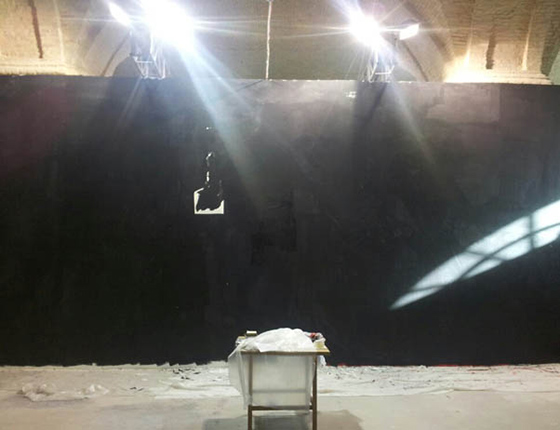
Volodymyr Kuznetsov’s work “KOLIYIVSHCHYNA. JUDGEMENT DAY” after the censorship
© Volodymyr Kuznetsov / Facebook
For more background on this case read Ukrainian Museum Director Destroys Critical Painting Ahead Of President’s Visit.
 ArtLeaks