Updates
ACT NOW! Submit your story to ArtLeaks and end the silence on exploitation and censorship! Please see the submission guidelines in the "Artleak Your Case" page
Submitted and current instances of abuse are in the "Cases" section
To find out more about us and how to contribute to our struggles, please go to the "About ArtLeaks" page
Please consult "Further Reading" for some critical texts that relate to our struggles
For more platforms dedicated to cultural workers' rights please see "Related Causes"
For past and upcoming ArtLeaks presentations and initiatives please go to "Public Actions"
Protest Action Erupts Inside Guggenheim Museum (NYC)
Text by Hrag Vartanian, published on February 23, 2014 for Hyperallergic

A view of the intervention from the floor of the atrium. (image provided by G.U.L.F. aka Global Ultra Luxury Faction)
Last night, over 40 protesters staged an intervention inside the Guggenheim Museum in Manhattan during Saturday night’s pay-what-you-wish admission hours. Unfurling mylar banners, dropping leaflets, chanting words, handing out information to museum visitors, and drawing attention with the use of a baritone bugle, the group worked to highlight the labor conditions on Saadiyat Island in the United Arab Emirates, where Guggenheim Abu Dhabi, a franchise of New York’s Guggenheim, is being built.
Staged in the midst of the museum’s newly opened Futurism exhibition, the intervention, a term used by some members of the group to describe the action, received both applause from visitors who seemed excited by the commotion and reactions of confusion from others unsure what was going on.

Flyers raining down onto the floor of the Guggenheim Museum in Manhattan, while protesters and chant and hold banners over the railings of the museum. (all photos by the author for Hyperallergic unless otherwise noted)
The intervention began at 6:45pm EDT with a bugle call and a loud question: “Who Is Building the Guggenheim Abu Dhabi?” The whole action continued for roughly 20 minutes, during which time security guards appeared to react slowly to the protesters as hundreds of museum visitors captured images and video of the protests.
The participants, who were a diverse groups of artists, professors, students, and activists loosely affiliated with Occupy Museums, Gulf Labor, and various NYU-affiliated groups, timed their protest to take place during the pay-what-you-can hours of the museum, which normally charges $22 admission for adults. When I asked organizers if they purposely chose their action to coincide with the Futurism exhibition and the Carrie Mae Weems retrospective, they told me that they did not but they were delighted for the coincidence since Futurism sought to combine art and politics, while Weems is a champion of those who have been historically excluded from museums.

“This is a new phases of the campaign, we’re moving beyond talk to action, and bringing it home obviously to the Guggenheim,” said Andrew Ross, a NYU professor of sociology, who is involved in the Gulf Labor coalition and the NYU Fair Labor coalition. “There are so many more people involved in this action that were not involved in Gulf Labor until this point. We’re widening the circle of participation and that will have an impact.”
Gulf Labor is a coalition of artists, academics, and activists, who have worked for over a year to ensure that the labor conditions on Saadiyat Island in Abu Dhabi, which will house Guggenheim and Louvre-branded museums and a NYU-affiliated university, do not exploit workers. Many human rights organizations say that the workers who are brought to Saadiyat Island are victimized by the nation’s sponsorship system and face grueling and inhuman conditions on a daily basis.
During our brief conversation, Ross explained how their work raising awareness about workers’ debt, which translates to a type of indentured servitude for migrant workers, is connected to much bigger issues.
“We’re trying to make a connection with chains of debt that are transnational, and in the various locations we’re looking at, Bangladesh, Abu Dhabi, NYU, and the art world, there’s an enormous accumulation of debt in each of these places, and the money is getting extracted by the transnational creditor class,” Ross said. “And artists are more and more [in debt], and in order to practice art, you’re required to take on a big debt burden … so there’s a connection across many continents. Another art world is possible, one that’s more principled and ethical, and that looks out for the human and labor rights of all. Artists should not be asked to exhibit in museums that have were built on the back of abused workers … that’s what it boils down to. When you’re acquired by a museum that does that, that’s unfair. Your complicity is being bought along with the artwork.”

A close up of some of the banners unfurled during the intervention.
The idea of using art as a way to reimagine the world was at the heart of another participant’s passion for the issue. “Art among other things is about doing, living, and imaging a better world,” said artist Nitasha Dhillon of MTL Collective. “Art should not violate human rights, art should not endanger workers lives, and art should not create debt slaves. And definitely not be part of a system that creates debt bondage.”
She sees yesterday’s actions as “a call for solidarity and a call for museums to do the right thing.” She added that “it’s important for museum goers to understand what kind of system they are participating in.”
One college student I spoke to, who originally hailed from China, said she was taking part in this, her first action, because it excited her to think about how art and social justice can work together to help change people’s lives. When I asked her how that interconnectedness changed her perception of art, she replied: “It changes art for the better for me.” She said she’d like to bring these ideas to China when she returns, though she was not clear about how.
One Polish artist who participated with the group dropped one-sided leaflets he printed and brought to the event. The ambiguous pieces of paper featured an eye, a recycling symbol, an EKG, and the words “Human Toy Tool.”
I recorded as much of the intervention as I could on my smartphone and it is posted here:
After guards removed all the remaining banners, the intervention participants slowly left the museum. One man, who was playing the bugle, was temporarily detained by the NYPD, though he was released after a few minutes without providing ID or other personal information.
Guggenheim guards, who were obviously unnerved by the event, yelled at one participant in front of the museum entrance. A few moments later, a guard came out to the street to tell hundreds of people lined up in front of the museum that no one else would be allowed into the building that evening. The crowd was visibly disappointed and many people lingered hoping the museum administration would change their mind.

Museum visitors reading the manifesto tacked to the wall beside the introductory text to the Futurism exhibition.
After the intervention, I encountered artist Amin Husain, who helped lead the chants, and I asked him if he thought it was all a success. “I think it was well-received by the people in the museum. One person told me that they didn’t know that was happening, so public education is really important,” he said. I asked him about the exhibitions themselves and whether he thought people understood what they were saying in that context, and he said he did: “I think the context is really appropriate, because they [the Futurists] talked about restructuring the universe, so clearly the museum is giving that some thought at this moment, and we want to talk about restructuring the universe without fascism and without slave labor.”
The intervention, which was the first by a new coalition that includes Occupy Museums, Gulf Labor, and various New York University-affiliated groups, came about after a month of meetings between the various organizations. The coalition, which was using the acronym G.U.L.F. (Gulf Ultra Luxury Faction) to identify themselves in their informational brochure, hope that this will be the first in a series that builds bridges in their continuing fight for social justice. The next event is scheduled for Wednesday, February 26, 5:15pm EDT, at NYU’s Global Center for Academic & Spiritual Life (GCASL), which is located at 238 Thompson Street, Room 369, in Manhattan’s Greenwich Village.
Hyperallergic reached out to the Guggenheim Museum for comment last night and we have yet to hear back from the organization.

The G.U.L.F. coalition’s manifesto that was placed on the wall of the museum and read by visitors.
These were the words participants were chanting tonight (according to a text provided to Hyperallergic during the intervention):

_______________________________________________________________________
Members of Occupy Museums had this to comment on the protest action:
Today in the Guggenheim, the Global Ultra-Luxury Faction [G.U.L.F.] which includes Occupy Museums joined together to call for labor justice in constructing the Guggenheim Abu Dhabi. The fact that a bunch of institutions including Guggenheim, the Louvre, and NYU are building on a luxury island for the global 1% is a symptom of the increasing wealth inequality and concentration of capital. Art is not a luxury asset! Art should not be build on labor abuse! More info at gulflabor.org
Video Documentation of the Action at Guggenheim Museum February 22, 2014
_______________________________________________________________________
Statement from Director Richard Armstrong in response to the protest:
The Solomon R. Guggenheim Foundation is engaged in ongoing, serious
discussions with our most senior colleagues in Abu Dhabi regarding the
issues of workers’ rights. As global citizens, we share the concerns
about human rights and fair labor practices and continue to be committed
to making progress on these issues. At the same time, it is important to
clarify that the Guggenheim Abu Dhabi is not yet under construction.Richard Armstrong, Director
Solomon R. Guggenheim Museum and Foundation
_______________________________________________________________________
Statement from G.U.L.F. in response to director Richard Amstrong:
Monday, February 24th
On Saturday, the G.U.L.F (Global Ultra Luxury Faction) staged a protest at the Guggenheim Museum in support of the rights of migrant workers in Abu Dhabi.
Earlier today, the Guggenheim director, Richard Armstrong issued a statement pointing out that construction has not begun on the Guggenheim Abu Dhabi. In reality, however, construction on the Saadiyat Island infrastructure has been underway for several years, and the Guggenheim is central to the island’s overall development plan, along with the Louvre and NYU. Moreover, the Guggenheim brand is being used to promote the exclusive, ultra-luxury ambience of the island’s appeal to potential investors and tourists.
An in-depth discussion on Saadiyat Island is scheduled for Wednesday, February 26, 5:15pm EST, at NYU’s Global Center for Academic & Spiritual Life (GCASL), which is located at 238 Thompson Street, Room 369, in Manhattan’s Greenwich Village.
Art is not a Luxury Asset for the Wealthiest Global Citizens.
In the course of the Saturday protest, we were outraged to learn about the inadequate pay of the museum’s security guards. As part of their efforts to keep us and the priceless art on display safe, they are paid a mere ten dollars an hour by one of the wealthiest institutions in New York and indeed globally. In New York City, this is not a living wage, by any estimates. The Guggenheim can and should be paying them more. As the wealth gap widens and the global 1% literally builds exclusive luxury islands, the fates of those left out are bound together. They include both Guggenheim’s NYC museum guards and migrant workers who are constructing the museums on Saadiyat Island.
Museums Should Not be Built on the Backs of Ill-Treated Workers.
We call on the Guggenheim Museum to open its doors to a free public assembly on these issues on Saturday March 1. We look forward to the conversation.
Museums Should Be Raising Labor Standards, Not Lowering Them.
In Solidarity
G.U.L.F.
(global ultra luxury faction)
The Sydney Biennale Case: Open Letters
For more background around the boycott of the biennale please see: Should artists boycott the Sydney Biennale over Transfield links?
19 February 2014
To the Board of Directors of the Biennale of Sydney,
We are a group of artists — Gabrielle de Vietri, Bianca Hester, Charlie Sofo, Nathan Gray, Deborah Kelly, Matt Hinkley, Benjamin Armstrong, Libia Castro, Ólafur Ólafsson, Sasha Huber, Sonia Leber, David Chesworth, Daniel McKewen, Angelica Mesiti, Ahmet Öğüt, Meriç Algün Ringborg, Joseph Griffiths, Sol Archer, Tamas Kaszas, Krisztina Erdei, Nathan Coley, Corin Sworn, Ross Manning, Martin Boyce, Callum Morton, Emily Roysdon, Søren Thilo Funder, Mikhail Karikis — all participants in the 19th Biennale of Sydney.
We are writing to you about our concerns with the Biennale’s sponsorship arrangement with Transfield.1
We would like to begin with an affirmation and recognition of the Biennale staff, other sponsors and donors, and our fellow artists. We maintain the utmost respect for Juliana Engberg’s artistic vision and acknowledge the support and energy that the Biennale staff have put into the creation of our projects and this exhibition. We acknowledge that this issue places the Biennale team in a difficult situation.
However, we want to emphasise that this issue has presented us with an opportunity to become aware of, and to acknowledge, responsibility for our own participation in a chain of connections that links to human suffering; in this case, that is caused by Australia’s policy of mandatory detention.
We trust that you understand the implications of Transfield’s recent move to secure new contracts to take over garrison and welfare services in Australia’s offshore immigration detention centres on Manus Island and in Nauru. We have attached for your information, a document that outlines our understanding of the links between the Biennale, Transfield and Australia’s asylum seeker policy.
We appeal to you to work alongside us to send a message to Transfield, and in turn the Australian Government and the public: that we will not accept the mandatory detention of asylum seekers, because it is ethically indefensible and in breach of human rights; and that, as a network of artists, arts workers and a leading cultural organisation, we do not want to be associated with these practices.
Our current circumstances are complex: public institutions are increasingly reliant on private finance, and less on public funding, and this can create ongoing difficulties. We are aware of these complexities and do not believe that there is one easy answer to the larger situation.
However, in this particular case, we regard our role in the Biennale, under the current sponsorship arrangements, as adding value to the Transfield brand. Participation is an active endorsement, providing cultural capital for Transfield.
In light of all this, we ask the Board: what will you do? We urge you to act in the interests of asylum seekers. As part of this we request the Biennale withdraw from the current sponsorship arrangements with Transfield and seek to develop new ones. This will set an important precedent for Australian and international arts institutions, compelling them to exercise a greater degree of ethical awareness and transparency regarding their funding sources. We are asking you, respectfully, to respond with urgency.
Our interests as artists don’t merely concern our individual moral positions. We are concerned too with the ways cultural institutions deal with urgent social responsibilities. We expect the Biennale to acknowledge the voice of its audience and the artist community that is calling on the institution to act powerfully and immediately for justice by cutting its ties with Transfield.
We believe that artists and artworkers can — and should — create an environment that empowers individuals and groups to act on conscience, opening up other pathways to develop more sustainable, and in turn sustaining, forms of cultural production.
We want to extend this discussion to a range of people and organisations, in order to bring to light the various forces shaping our current situation, and to work towards imagining other possibilities into being. In our current political circumstances we believe this to be one of the most crucial challenges that we are compelled to engage with, and we invite you into this process of engagement.
We look forward to hearing your response and given the urgency of this issue, hope that we can receive it by the end of this week.
Thank you for your consideration.
Sincerely,
Gabrielle de Vietri, Bianca Hester, Charlie Sofo, Nathan Gray, Deborah Kelly, Matt Hinkley, Benjamin Armstrong, Libia Castro, Ólafur Ólafsson, Sasha Huber, Sonia Leber, David Chesworth, Daniel McKewen, Angelica Mesiti, Ahmet Öğüt, Meriç Algün Ringborg, Joseph Griffiths, Sol Archer, Tamas Kaszas, Krisztina Erdei, Nathan Coley, Corin Sworn, Ross Manning, Martin Boyce, Callum Morton, Emily Roysdon, Søren Thilo Funder, Mikhail Karikis, Sara van der Heide, Henna-Riikka Halonen, Ane Hjort Guttu, Hadley+Maxwell, Shannon Te Ao, Yael Bartana
NOTES 1. Please note that in this document we use the name Transfield to refer to three branches of the Transfield brand: Transfield Holdings, Services and Foundation.
_____________________________________________________________________
The Sydney Biennale has issued the following statement in response to the open letter from concerned artists:
Firstly, let us say that we truly empathise with the artists in this situation.
Like them, we are inadvertently caught somewhere between ideology and principle. Both parties are ‘collateral damage’ in a complex argument. Neither wants to see human suffering.
Artists must make a decision according to their own understanding and beliefs. We respect their right to do so.
While being mindful of these valid concerns, it is this Board’s duty to act in the interests of the Biennale and all its stakeholders – our audiences, government partners, staff, benefactors and sponsors, along with all Biennale artists and the broader arts sector.
On the one hand, there are assertions and allegations that are open to debate. On the other, we have a long-term history of selfless philanthropy, which has been the foundation of an event that has served the arts and wider community for the past 40 years.
The Biennale’s ability to effectively contribute to the cessation of bi-partisan government policy is far from black and white. The only certainty is that without our Founding Partner, the Biennale will no longer exist.
Consequently, we unanimously believe that our loyalty to the Belgiorno-Nettis family – and the hundreds of thousands of people who benefit from the Biennale – must override claims over which there is ambiguity.
While we unequivocally state our support and gratitude for our sponsor’s continued patronage, we also extend an invitation to the Working Group to engage with us in dialogue with the purpose of finding an acceptable accommodation.
The Biennale has long been a platform for artists to air their sometimes challenging but important views unfettered and we would like to explore this avenue of expression, rather than see the demise of an important community asset.
_____________________________________________________________________
An open letter to Biennale of Sydney artists from the refugee community
Monday 17th February 2014
Dear Artists,
RISE: Refugees, Survivors and Ex-Detainees, is the first organisation in Australia to be governed entirely by refugees and asylum seekers. RISE consists of over 30 different refugee communities in Australia and exists to enable refugees and asylum seekers to build new lives by providing advice, engaging in community development, enhancing opportunities, and campaigning for refugee rights.
RISE supports a complete boycott of the 19th Sydney Biennale as Transfield, a major sponsor and partner of this event, receives income from the operation of Australia’s deadly offshore internment camps for refugees and asylum seekers.
In 2012, Australian Artist Van Thanh Rudd first called for a boycott of the 18th Sydney Biennale when Transfield Services won a $24.5 million Australian government contract to provide facilities in the Nauru asylum seeker detention camp.
Transfield’s income from these operations (as of February 2014) is over 300 million dollars, and they have now won yet another contract to run “welfare services” on both Nauru and Manus Island. At the same time, there are shocking reports of mistreatment and abuse in these camps including eye-witness accounts from medical staff, welfare officers and other former detention staff.
In addition to organisations such as Amnesty and the United Nations High Commission for Refugees cataloguing these abuses, Pakistani news outlet Dawn recently reported the story of a Hazara asylum seeker whose two siblings died in 2013 on Nauru. The family had fled from Quetta, Pakistan, after their father was shot dead in the local market. The asylum seeker described appalling conditions in the Nauru camp, including being held in overcrowded tents with little privacy and security. The asylum seeker’s brother was stabbed to death and his sister died in his arms from pneumonia due to inadequate treatment. In short, Australia and Transfield have the blood of refugees on their hands.
In 2011, RISE made submission to an Australian parliamentary enquiry predicting that unchecked expansion of Australia’s privatised detention network would lead to a US-style private prison industrial complex where immigration policy would be shaped by corporations who profit from misery. Our predictions have unfortunately come true: a report released in 2013 by the US based Sentencing Project, stated that Australia has the largest private prison population in the world thanks to its asylum seeker policy.
Participation in the Sydney Biennale sponsored by Transfield makes artists partners in a system that silences the voices of refugees and asylum seekers and profits from their misery.
If you believe that refugees are entitled to the right to protection of life, freedom, dignity and respect, we ask that you take a stand and not participate or support this event or any other event that benefits from the dirty profits of Australia’s racist, anti-refugee industry.
You can sign the Petition to the Board of Directors of the Sidney Biennale to cut ties with Transfield here.
Should artists boycott the Sydney Biennale over Transfield links?
via Matthew Kiem for The Conversation
Sydney will host its 19th Biennale from March 21. It’s one of the most significant international art events on the local calendar. But questions have arisen over its connection to Australia’s policy of interning asylum seekers who arrive by boat without a visa.
The Biennale of Sydney’s major sponsor is Transfield, a company which is also a major contractor involved in running detention centres on Nauru and Manus Island. It recently announced plans to take on more work at these centres.
My own awareness of this connection occurred in the context of my work as a Sydney-based academic and tertiary design educator.
After receiving marketing from the Biennale and a suggestion to take my students to the event I was faced with a clear choice: could I support an event funded by profits of mandatory detention, a policy slammed by the UNHCR as inhumane and non-compliant with international law? My answer:emphatically, no.
The news of Transfield’s involvement in the Biennale has been met with shock, disappointment and disgust, and the call for a boycott is gaining traction, as reported in artsHub andExcerpt Magazine recently. Artists and patrons are expressing their intent to boycott on social media, and the Biennale’s Twitter hashtag, #19BOS, is dominated by the issue.
The Biennale responded last week on Twitter and on Facebook, arguing that a boycott would “deny the legitimate voice of BOS artists”. While Transfield delivers profits to shareholders from its detention centre contracts, it is the people, some of whom are indeed artists, detained at Nauru and Manus Island by the Department of Immigration who are truly silenced. The Biennale’s comments have angered refugee advocates.
“Are you insinuating that our voice is illegitimate?” was the response last week to the Biennale from Melbourne-based organisation RISE: Refugees, Survivors & Ex-detainees.
Protest or boycott?
On the question of whether protests by artists, rather than a boycott, would generate a more engaged response, we must learn a lesson from 2012.
During the 18th Biennale of Sydney Melbourne artist Van Thanh Rudd made a protest artwork about the treatment of asylum seekers, as did Sydney artist Jacqueline Drinkall.
Drinkall’s work was staged on Cockatoo Island, the Biennale’s main venue, where, with the help of Occupy Sydney participants, she attempted to burn a $20 note in front of a Transfield logo.
Rudd, located in Melbourne, placed hyper-real sculptural representations of detainees in public spaces. This year he is a strong supporter of the boycott.
Since 2012, Transfield has increased its involvement in detention centre work.
So, for how long will the arts community accept detention-centre funding for a major event such as the Sydney Biennale?
The limits of a boycott
Transfield is an enormous business, involved in many aspects of Australian life, including public transport. Should those calling for a boycott of the Biennale also boycott public transport?
This is a fair question, and speaks to a disturbing fact. The internment-industrial-complex has become so extensive that we are all implicated in it. It is in our superannuation, our trains, our waste management, our art and more.
There is a risk of being immobilised by this totality, an effect, University of Sydney researcher Angela Mitropolous argues, of a system that fosters a constant shifting of risk and blame.
Equally though, Mitropolous suggests that our being implicated is also a source of resistance – provided we choose to rethink our responsibilities and ability to act. In this sense, while I may not be able to give up using public transport, I can resist Transfield through my work in the arts industry, a tactic that social researcher Ann Deslandes has suggested may be effective for many more of us.
In making my own decision I weighed the potential sacrifice and risk on my part for boycotting a major arts event against the conditions faced by those in detention, along with the very real prospect of things getting worse.
For me, the choice was clear. There is no way that I, as an academic, educator, and patron of the arts could use my position to support an event funded by profits made from detention centres.
Each of us has a unique position in this.
I feel particularly for those artists who signed up to the Biennale in good faith and are now confronting a difficult choice. Their decision will be influenced by the level of community support the call to step away receives, pointing to the collective nature of the effort to boycott the Biennale.
This is part of a longer project. We need to build new infrastructures of support for each other, ones that do not rely upon the enforced misery of others. We have to start that process somewhere, and for those of us who work in or participate in the arts sector, there appears to be no better time to do that than right now.
_________________________________________________________________
Transfield is a major sponsor of the Sydney Biennale. The 19th Biennale will be held 21 March – June 9, on Cockatoo Island.

Cockatoo Island, in the Sydney Harbor
Transfield is also the major contractor for the running of the mandatory detention centres on the the islands of Nauru and Manus.
The Biennale’s 2014 theme is “You Imagine What You Desire.”

Manus Island, in Papua New Guinea
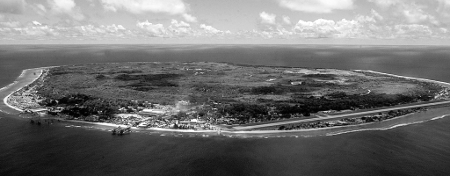
Nauru
Mandatory detention is a system of extrajudicial internment.
Many who have worked inside the internment camps have spoken out about their their complicity and, ultimately, refusal to continue.
How do participating artists feel about their work being funded by profits from running internment camps?
How do audiences feel about the arts being patronised by such a company?
The Biennale arts prize was established in 1973 by Transfield’s founder, Franco Belgiorno-Nettis (1915-2006).
See also: At work inside our detention centres
_______________________________________________________________
Disrupt mandatory detention – Boycott the Biennale
The Separation: A February Story with Blacklisting, Longing for a Biennale and the Unbearable Weight of Belonging
On January 30th, 2014, Nicolaus Schafhausen, the appointed curator of the Bucharest Biennale 6 (BB6), released a public statement that he was withdrawing from the project, stating that : “The curatorial direction of BB6 developed in a direction inconsistent with that of PAVILION – the local organisers in the Romanian capital, Bucharest.” (Răzvan Ion & Eugen Rădescu, are the co-directors of BB6 and the co-directors of PAVILION)
Schafhausen had been appointed in the summer of 2012 and had attended the previous edition of the biennale (BB5) which opened in May 2012 in Bucharest. This current project was to be organised in close cooperation and collaboration with Kunsthalle Wien in Austria, and significant symposia in both Vienna and Bucharest had been planned. Schafhausen also stated that he contacted several sponsors to fund and support BB6, based on the curatorial direction and the theme of “Longing and Belonging.” This theme was to include international artists born in Romania. The curator and his concept had been also officially announced by the organizers of the biennale who supported it.
However, after a year and a half of work, the partnership between PAVILION and Schafhausen /Kunsthalle Wien fell apart, the curator citing that “irreconcilable differences” had emerged, so that “the curator and his partners cannot in good faith continue to support BB6 and PAVILION, and consequently must terminate any further commitments.”
Upon hearing the news, which was announced only via an official statement of withdrawal on the website of Kunsthalle Wien, the artistic community in Romania was left with a series of unanswered questions as to what exactly the “irreconcilable differences” were and in general, the details behind the dissolving of the partnership. In a public note, Raluca Voinea, a curator based in Bucharest, wrote: “I think this decision has a negative impact upon the entire scene in Bucharest, which will be again judged as unserious and unprofessional. I don’t believe he was not warned what he’s getting himself into and he had enough time to figure it out in the meantime. [..] he was not to curate the Vienna biennale but the one in Bucharest, so I expected at least an open letter with explanations if not a press conference addressed to the professional community in Bucharest.” Voinea’s note received many comments from local artists, critics, curators, and gallerists. Artist Cristina David had this to add: “[…] I don’t think as you do, that the entire art scene of Bucharest will be judged as unserious, I do hope that the team of BB6 will be the one that supports the consequences. […] I think people should not do compromises of getting along with all kinds of irregularities, because then they also give credit to the ones that don’t deserve it (BB6 people)”. Mircea Nicolae, artist, also remarked: “Personally, I do not think BB6 internal organisational problems have anything to do with others than Pavilion people themselves. What they have been doing for a while now is well known and publicly available, not in the least on the ArtLeaks page. To start with, maybe we can lay the blame where it belongs, and leave it there for a while. […] I do not believe that the invited curator should have just accepted the problems, even if they menaced to completely alter the project. For one, it seems that Pavilion has a blacklist of local artists. So if you want to work with the local scene you have to make your way around that list, if you can. If the list is extensive and maybe even goes to the point of being exhaustive of the local scene, there might be a problem.”
Right before the announcement of Schafhausen’s withdrawal, PAVILION had published in their newsletter a list of spaces in Romania who they claimed to be in cooperation with: “MNAC Bucharest, Atelier Zerotreizerodoizerodoi, Anaid Art Gallery, Galeriile Artmark, Zorzini Gallery, Andreiana Mihail, Galeria Plan B, Mircea Vulcanescu (Alert Studio), Victoria ArtCenter, Revista ARTA, Revista Zeppelin, Noaptea Alba a Galeriilor, Comunitatea Reforma, Anca Poterasu Gallery, Club-Electroputere Craiova-Bucuresti, Facultatea de Istorie – Universitatea din Bucureşti, Facultatea de Ştiinţe Politice, Administrative şi ale Comunicării, UBB Cluj, Universitatea Nationala de Arte, Universitatea de Arte “George Enescu” Iasi , Facultatea de Stiinte Politice, Universitatea din Bucuresti and many more.” They ended with “A great Biennale is on the way.”
Their next newsletter, after the curator’s statement of withdrawal, announced the “the end of cooperation with Nicolaus Schafhausen, due to incompatibilities and [a] conceptual approach that could generate a reputational risk”. They concluded that the biennial must be implemented in “an ethical manner”. They further called a press conference for Wednesday, February 5th, 2014 to announce the new curator and the concept of BB6 at their space in Bucharest.
On February 3rd, ArtLeaks members in Bucharest spoke with Schafhausen, presenting him with all these facts and statements, and asking him to give a more detailed explanation as to the end of his curatorship. The curator stated that the matter was very complex, and that the prospect of organising the biennale was very attractive to him in the beginning. He added that he wanted to focus on Romania, as here he observed that there was a total withdrawal from the state to support and fund contemporary art projects, and that organisations like PAVILION had been struggling with this lack of resources for a long time. The curator added that it seemed to him very interesting at the time to look into this very diverse and rich artistic community. However, he could not reconcile his concept, which was to focus on Romanian-international artists working abroad, with the demands of the organisers who pushed that international artists from Germany, the Netherlands, the U.K. be part of the selection, so that they would be able to receive funding from foreign foundations, or consulates. He found this pressure extremely uncomfortable, but he declared that he continued on board the project because Răzvan Ion, the co-director of the biennale agreed to back off at the end of November. (this announcement was never made public).
Nevertheless, Schafhausen found the aggressive, demanding tone of the co-directors of the Biennale uncomfortable and grew mistrustful of the partnership and of PAVILION. Schafhausen also disclosed that he had received a list of no-go / black list of artists, spaces and curators, who the PAVILION co-directors told him they strongly do not want to work with in Romania. He also found problematic the aforementioned announcement stating the cooperation between the biennale and the spaces above, which came as a total surprise to him. He stated that he never received any clarification from their side about this announcement, although he asked for one on behalf of himself and his partners. All this made the curator realise that he could not trust the space and continue to work on the biennale in good faith.
The email with the infamous black list was dated November 19th 2013 and was sent to Schafhausen and his colleagues, Rainald Schumacher and Nathalie Hoyos and contained the following list of names, with the mention “please take it in consideration seriously.”
“Raluca Voinea
Corina Apostol
Electroputere/Alexandru Niculescu
Candidatul Președinție/Presidential Candidate (Florin Flueraș and the gang)
Mircea Cantor
Gabriela Vanga
Galeria Sabot (all of them)
Galeria Plan B (all of them)
Vasile Ernu/Critic Atac
Călin Dan
Iosif Kiraly
SubReal
Maria Rus Bojan
Matei Băjenaru
University of Arts Cluj (all professors there)
Melodramatic Reseach Bureau
Anca Mihuleț
Mihnea Mircan
Cosmin Costinaș
Oana Tănase
Ruxandra Balaci
MNAC”
It is worth mentioning that part of the names on this list are ArtLeaks co-founders who in 2011 wrote a protest letter criticising PAVILION in very direct terms. The letter can be read here, as well as the response from the institution.
On February 5th 2014, at the announced BB6 press conference, the co-directors, Răzvan Ion and Eugen Rădescu appointed a pair of young curators, Gergő Horváth and Ștefan Voicu (aged 21 and 25 respectively) to organise the biennale, whose new concept is to be: “Apprehension: Understanding Through Fear of Understanding.” Members of the local press and the artistic community questioned the co-organizers about the reasons why the collaboration with Schafhausen ended. The event was recorded and the debates in Romanian from the conference can be listened to online here. Ion declared that the ending of the partnership with the curator happened “naturally” because of problems related to the fact that his team did not respect deadlines and were conceptually inconsistent, although the PAVILION side was always ready to implement the biennale. During the conference critic Iulia Popovici confronted the co-organizers with the infamous black list of artists, critics, curators, reading it out-loud. As a response Ion and Rădescu declared that while they respect Schafhausen, they doubted that the email was correct or ever existed, and that it may have been modified or that it was pure speculation. Ion added that he was ready to give Popovici a moral lesson, and that she should produce the email in court, to which she responded that she didn’t have to prove anything in court, since this was not a trial, but a press conference where people could ask questions openly. (As previously mentioned, ArtLeaks obtained the email sent to Schafhausen and his colleagues).
Răzvan Ion ended this line of questioning comparing their falling out with Schafhausen with a divorce between two entities. He added that he is confident that they will be ready to produce the biennale even in the short span of 3 months with the new curators. In the Feburary 5th PAVILION press release it had been announced that some of the artists participating in this edition were: Erwin Wurm (AT), Chiara Fumai (IT), János Sugár (HU), Adrian Dan (RO), Dan Beudean (RO), Matei Arnăutu (RO), Zoltán Béla (RO). Bucharest art gallery owner Marian Ivan, also present at the conference, asked what kind of research the new curators did for the project, or if a research indeed existed, and Gergő Horváth stated: “When we did the research [for the biennale] we also researched the local scene and it seemed to us that these artists so much inspired us conceptually, and that they also made sense as a concept with what we came up with.”
Meanwhile, Andreiana Mihail, the owner of the gallery that was among the announced BB6 collaborators, had this to comment on her Facebook page: “I want to be clear: I didn’t sign any partnership/ cooperation with PAVILION, BB123456 or any institutions connected with this event. I just spoke about having some biennale leaflets around in case I will have an exhibition during that time. I don’t want to be mentioned in the context of BB or argue with anyone about my so-called affiliation with this event.”
The story is developing. We welcome further public statements and comments from the artistic community.
Petition: To the organizers and curator of the IV Moscow International Biennale for Young Art
// EN
To The Ministry of Culture of the Russian Federation
The Department of Culture of the City of Moscow
National Centre for Contemporary Arts
Moscow Museum of Modern Art
The Museum of Moscow
Curator D.Elliott
Preparations are underway for the IV Moscow International Biennale for Young Art, the opening of which is scheduled for June 26th, 2014.
The curator of the biennale, David Elliott has chosen the theme of the project based on Martin Luther King’s famous speech, “I Have a Dream.” In the open call for project, the curator claims that today’s world is as precarious, with “many similar examples of inequity and oppression that are still not fully resolved,” “while the compromises of life and politics seem frustratingly weak.” Therefore, Mr. Elliott encourages the young participants in the Biennale to “make things better,” as well as be active, courageous, critical and idealistic enough so that their art reveals “unexpected truths.”
The curator is right, artists, curators and those who are interested in the organization of the Biennale do have dreams!
And one of these dreams is that our work must be paid!
Even Martin Luther King would agree with us.
King’s his famous speech, “I have a Dream,” was delivered on August 28th, 1963 with the occasion of the March for Jobs and Freedom on Washington. Protesters then demanded an end to discrimination and segregation, equal civil and labor rights, and that measures be taken against unemployment.
Also, when Martin Luther King was assassinated in Memphis on April 4th, 1968, he had come to support African-American sanitation workers, who also demanded better working conditions, higher wages and union recognition.
Artists, curators and art workers in general involved in the production of large-scale cultural events in Russian contemporary art, live in precarious economic and social conditions. This particularly affects young artists and curators who do not have the support of galleries, private foundations and other cultural institutions which Biennale counted on. But what kind conditions does the Biennale create for these young professionals, so that they have the ability to dream, if the organizers do not consider the time and labor of its participants worthy of recognition and compensation? Or perhaps, Mr. Elliott is also not receiving any remuneration for his curatorship?
Social and economic inequalities within cultural institutions are only part of larger inequalities in Russian society – this is what the Moscow International Biennale for Young Artists demonstrates for the forth time in a row.
Young, novice participants are seemingly given the possibility to produce a project in an institutional art space in Moscow, but in practice, the reality is that they usually receive a meager production budget, they have to be day and night at the installation, they lack necessary materials and technical equipments, they encounter problems with finding accommodation and staying in Moscow, and difficulties in communicating with the organizers. They are expected to produce their work, install and transport it from their own funds.
This also increases the workload of the supporting staff in Moscow’s cultural institutions, most of whom are working on a small salary. All the while, their working day, seldom limited to only eight hours, means working well into the night and unpaid overtime.
This is what we call exploitation of labor. And we dream that this state of things will not continue any longer.
We encourage all concerned artists, curators, art workers to sign this petition! We are confident that this year, it will make a difference.
Evgeniya Abramova, art worker
Sergey Guskov, journalist, observer at Vedomosti newspaper, art editor at colta.ru
Corina L. Apostol, art historian and curator
Vladan Jeremić, artist, cultural and political worker
Anna Titova, artist
Andrey Shental, journalist
Artyom Volin, artist
Giuliano Vivaldi, translator, blogger
Ilya Dolgov, artist
Maria Chehonadskih, art critic, curator
Anna Tereshkina, artist
Anna Zvyagintseva, artist
Nikita Kadan, artist
Ksenya Gurshtein, art historian
Arseniy Zhilyaev, artist
Elena Ishenko, journalist, editor at AroundArt.ru
Nikolay Alekseev, artist
Oksana Polyakova, art critic
A.K.A. Yana (Yasha, Yakov) Kazhdan, artist
Haim Sokol, artist
Mikaela, artist
Liza Babenko, critic, curator
You can sign the petition on ArtLeaks. Please leave the comment under the petition below. We are going to send the signed petition to the organisers and the curator at the beginning of March 2014.
//RU
Министерству культуры РФ
Департаменту культуры г.Москвы
Государственному центру современного искусства
Московскому музею современного искусства
Музеям Москвы
Куратору Д. Эллиотту
Обращение к организаторам и куратору IV Московской международной биеннале молодого искусства
В Москве продолжается подготовка к IV Московской международной биеннале молодого искусства, открытие которой намечено на 26 июня 2014 года.
Куратор Биеннале Дэвид Эллиот в качестве темы выбрал речь Мартина Лютера Кинга «У меня есть мечта».
В предложенной концепции куратор говорит о сегодняшней эпохе как нестабильной, когда «примеры несправедливости и угнетения не разрешены», а «компромиссы между жизнью и политикой кажутся невразумительными». Поэтому г-н Эллиот призывает молодых участников Биеннале «вложить свои силы в совершенствование мира», а также быть активными, мужественными, рефлексивными и идеалистичными настолько, чтобы их искусство выявило «неожиданные истины».
Куратор прав – у художников, кураторов, и тех, кто привлечен к организации Биеннале, есть мечты! И одна из них – это оплата нашего труда.
Наш труд должен быть оплачен!
И Мартин Лютер Кинг был бы солидарен с нами.
Свою знаменитую речь «У меня есть мечта» он произнес 28 августа 1963 года на Марше на Вашингтон за Рабочие места и Свободу. Участники Марша требовали прекращения дискриминации и сегрегации, равных гражданских и трудовых прав, принятия мер по борьбе с безработицей.
Мартин Лютер Кинг был убит в Мемфисе 4 апреля 1968 года, куда приехал поддержать афро-американских работников санитарно-гигиенической службы, которые требовали улучшения условий труда, повышения заработной платы и признания профсоюза.
Художники, кураторы и те, кто привлечен для подготовки этого масштабного культурного события в современном искусстве России, живут в прекаритетных экономических и социальных условиях. Особенно это затрагивает молодых художников и кураторов, не располагающих поддержкой галерей, частных фондов и других культурных институций на которых Биеннале казалось бы и рассчитано. Но какие условия Биеннале создает для их способности мечтать, если ее организаторы не считают время и труд участников достойным оплаты? Или же работа г-на Эллиота тоже не будет оплачена?
Социальное и экономическое неравенство внутри культурных институций как часть неравенства российского общества – вот, что провозглашает уже четвертый раз подряд Московская международная биеннале молодого искусства.
Молодые, начинающие участники привлечены возможностью реализовать свой проект и получить выставочную площадку в Москве, но на практике каждый раз оказывается, что они получают мизерный бюджет на производство работ, круглосуточное дежурство на монтаже, отсутствие необходимых материалов и технического оборудования, проблемы с размещением и перемещением по Москве, трудности в коммуникации с организаторами. Многие платят за производство работ, монтаж и транспортные расходы из своих личных средств.
Многократно возрастает нагрузка и на сотрудников культурных институций Москвы, большинство которых трудится за небольшую зарплату. Их рабочий день, редко ограниченный восемью часами, заканчивается ночевками на выставочных площадках и неоплаченной сверхурочной работой.
Именно это мы называем эксплуатацией нашего труда. И мы мечтаем, чтобы эта эксплуатация прекратилась!
Мы призываем подписать это обращение всех неравнодушных деятелей культуры и участников процесса. Мы уверены, что это позволит изменить ситуацию уже в этом году.
Евгения Абрамова, творческий работник
Сергей Гуськов, журналист, обозреватель газеты «Ведомости», редактор раздела «Искусство» сайта Colta.ru
Корина Л. Апостол, историк искусства, куратор
Владан Еремич, художник, творческий и политический работник
Анна Титова, художник
Андрей Шенталь, журналист
Артём Волин, художник
Джулиано Вивальди, переводчик, блогер
Илья Долгов, художник
Мария Чехонадских, критик, куратор
Анна Терешкина, художник
Анна Звягинцева, художница
Никита Кадан, художник
Ксения Гурштейн, историк искусства
Арсений Жиляев, художник
Елена Ищенко, журналист, редактор сайта AroundArt.ru
Николай Алексеев, художник
Оксана Полякова, искусствовед
A.K.A. Yana (Yasha, Yakov) Kazhdan, artist
Хаим Сокол, художник
Микаэла, художница
Лиза Бабенко, критик, куратор
Подписать петицию можно, оставив комментарий к ней на сайте АртЛикс. Мы планируем направить подписанный текст петиции организаторам и куратору в начале марта 2014 года.
 ArtLeaks