Updates
ACT NOW! Submit your story to ArtLeaks and end the silence on exploitation and censorship! Please see the submission guidelines in the "Artleak Your Case" page
Submitted and current instances of abuse are in the "Cases" section
To find out more about us and how to contribute to our struggles, please go to the "About ArtLeaks" page
Please consult "Further Reading" for some critical texts that relate to our struggles
For more platforms dedicated to cultural workers' rights please see "Related Causes"
For past and upcoming ArtLeaks presentations and initiatives please go to "Public Actions"

How Art:I:Curate Faked My Artworks To Fund Their Kickstarter
by Luke Turner
This is in response to the recent discovery that ART:I:CURATE has been producing and supplying unauthorised, fake copies of my artworks to fund their Kickstarter campaign. Their actions constitute a serious, unacceptable and unlawful infringement of copyright, as well as a complete breach of trust.
As I believe the email correspondence presented here plainly demonstrates, ART:I:CURATE have been disingenuous and deceitful in their dealings with me. By openly publishing this material here, it is my hope that other artists, curators and art lovers will avoid finding themselves in a similar position, enabling them to make their own judgment as to the trustworthiness of ART:I:CURATE.
I have subsequently also become aware of other accounts of ART:I:CURATE’s unscrupulous behaviour, with a number of fellow arts professionals having had similarly unpleasant dealings with the company. Whilst for now I am concentrating on the facts of my own experience here, I hope that this page will contribute to the the much-needed discussion about the exploitation of artists, curators and interns in the art world, and the potential pitfalls of online art platforms, encouraging others to publish their own first-hand accounts.
In addition, since at the time of writing I’ve been unable to satisfactorily determine the full extent of ART:I:CURATE’s actions, I hope that this page will also serve to alert any other Kickstarter backers who might have received one of these fake prints.
Apologies for the rather long-winded nature of the content of this site—all in the name of thoroughness and transparency—but hopefully there’s enough here to prove engaging and (oddly) entertaining, due to the sheer audacity and barefaced cheek of ART:I:CURATE’s behaviour.
So, here goes…
THE BEGINNING
Back in March 2013, I was invited by ART:I:CURATE to join their newly-launched online art platform. Although the site’s founders have backgrounds in fashion and banking, and not the art world, I had initially been impressed enough with their apparent professionalism. Since I had a couple of good friends whose works were also featured on the site, I duly agreed to join up, contributing the same small online documentation jpeg photos that appear on my own website (which can’t be printed out at any great size).
I also signed a very standard consignment agreement with them on 21st June 2013, in which, needless to say, there was absolutely nothing that permitted them to reproduce my work without my express permission. (It did, however, state that “D/ARTE may arrange promotion and publication of Artworks through means agreed in advance by both parties.“)
On 3rd June 2013, even before I had signed this agreement, ART:I:CURATE had asked me if they could use my image, The Ontic Order (II), on some postcards. Around 50 were to be printed and given away free of charge to some of their “special members”. I had no objection to this, and so provided them with a suitable image file.
At this point, a few alarm bells did start to ring, as they began asking for a massive file many times larger than that needed to produce a postcard. The 7012 pixel file they requested was, in fact, exactly the size needed to make an A2 print. I questioned ART:I:CURATE several times about this, before sending them a more reasonable, but still fairly large, 3000 pixel file. At the time, I had no reason not to trust them, and so I simply put this down to a lack of technical know-how on their part. In retrospect, however, I think it’s clear to see the real motives behind ART:I:CURATE’s requests, and I’ve posted this rather farcical email exchange here for your amusement…
CAUGHT RED-HANDED
Several months passed and, since I’d never received the 10 postcards I’d been promised, I simply forgot about them and assumed it had come to nothing. Then, in November 2013, completely out of the blue, I received an email from a gentleman by the name of Christos, whom I’d never encountered before, which began as follows:
“Dear Luke Turner, I recently acquired one of your prints — Ontic Order (II) — through my support of Articurate…”
“What the…?” I thought to myself. I knew for a fact that Christos had not acquired one of my prints, and so at first assumed that he must have been somewhat confused. I immediately contacted ART:I:CURATE to ask them what was going on, and they assured me that:
“…he has not acquired your print as we are not selling prints (or else you-and we- would know).”
However, as I began to discuss this further with Christos (who, fortunately, turns out to be a really lovely and understanding chap!), the truth of the matter began to emerge. Christos had received a print from ART:I:CURATE, purporting to be a genuine special edition art print of mine. This, however, was in fact a fake, crudely produced with the file I had supplied ART:I:CURATE for the postcard.
Christos had acquired this print through ART:I:CURATE’s Kickstarter page. Here, such prints were being advertised as a “Special edition A2 art print”, included in a number of packages offered in exchange for contributions of between £75 and £1000. Christos himself had paid £350.
In total, ART:I:CURATE’s Kickstarter page reveals that they raised at least £9,825 from 79 people through packages offering “Special edition art prints”. I may never know for certain exactly how many of these packages included the fake prints of my work, although I am hopeful that Kickstarter themselves will assist me further here.
Christos agreed to meet a couple of days later to give me the print. I had been expecting this to be some sort of flimsy poster, but it was, to my horror, a professional looking—though poorly executed—print on heavyweight fine art type paper. (See the photo at the top of this page.) There was no doubt that this was being passed off as the real thing, plain and simple.
Christos also kindly provided me with the original email that ART:I:CURATE had sent him after his Kickstarter payment, in which my print (as well as those of two other artists) was offered, alongside a photo of the original, genuine artwork. I was gobsmacked to see that this email was dated 24th May 2013, which is a full 10 days before ART:I:CURATE first requested the postcard file from me, confirming the full scope of their deceit.
Again, I have copied this Kickstarter email here.
THE AFTERMATH
ART:I:CURATE’s response to all this has been utterly shameful. I have given them every opportunity to try to put things right, but they have completely failed to acknowledge the seriousness of their actions, and have repeatedly refused to provide me with all the information and answers I need in order to attempt to repair the damage they have caused.
There are numerous examples of their ridiculous lack of professionalism evidenced in the email correspondence presented here. At one point, they attempt to fob me off with some nonsense about Kickstarter’s terms of service (which they have clearly breached themselves), disingenuously attempting to assert that the prints were “promotional gifts,” and that “there has been no sale, invoicing or transaction in any relation to your work”—as if this would somehow justify them producing and supplying these unauthorised prints.
Furthermore, they point to the inclusion of the words “Copyright Luke Turner” at the bottom of the prints as in some way legitimising the use of my image. As they should be well aware, this is obviously not how copyright law works, and such an action is effectively tantamount to forging my signature.
ART:I:CURATE even tries to argue that these illegitimate prints have somehow increased the “visibility and value of your work,” and, most preposterously perhaps, they let me know that “it was actually a cost to the company to produce these materials.” You couldn’t make this stuff up.
My most pressing concern now is to find out exactly how many of these unauthorised prints were made, and to account for them all. Pinning ART:I:CURATE down on this matter has been particularly painful, with them originally stating simply that “a few prints were made”, before eventually informing me that they had four in their possession, which they have now posted to me (pictured at the top of this page). However, given ART:I:CURATE’s attitude, I have no reason to take their word for it that these are the only prints in existence. Worryingly, despite my repeated requests, they have refused to confirm or deny whether prints of other sizes were ever made or supplied, which obviously leads me to fear that this may in fact be the case.
In conclusion, given my experience, I would personally advise everyone to give a wide berth to ART:I:CURATE. Frankly, I’ve needed all this like I need a hole in the head, and getting to the bottom of their mess has already taken up far too much of my time. I do think it’s important, however, that I speak out, and I’m very grateful if you’ve managed to read this far. I’d also appreciate it if people could share this page with anyone it may be of relevance to, to try to ensure that this sort of thing is never repeated.
ART:I:CURATE have made it clear to me that they “reserve the right to pursue any damange [sic] to our reputation, should false information be given to our network of backers, members, artists or collectors.”
However, I have absolutely no intention of giving out any false information to destroy their reputation.
They’ve just gone and done that themselves.
Click here to view my email correspondence with ART:I:CURATE
………………………………………………………………………………………………
Original text and email correspondence published on ART:I:CURATE Exposed
Marsiale 2012: Volodymyr Kuznetsov (Kyiv, Ukraine)
Marsiale 2012: a video-work by Volodymyr Kznetsov dedicated to the First Kyiv international biennale ARSENALE 2012: The Best of Time, The Worst of Times – Rebirth and Apocalypse in Contemporary Art, Nataliia Zabolotna Comissioner, David Elliott Artistic Director
Quartering Quarter (St. Petersburg, Russia)
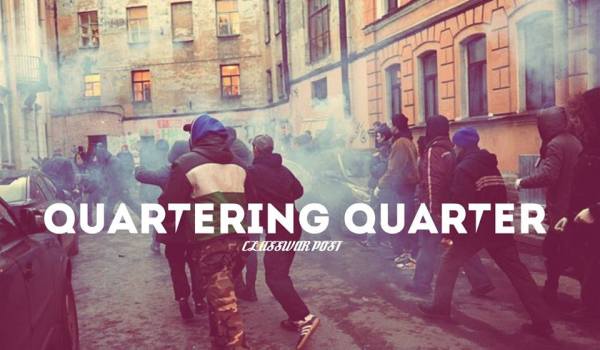
The “quartering” of a free space in Petersburg: a “raider” occupation, the bandit’s provocations, the last stand of the young people, and the arbitrary rule of the police.
The story of the stand-off between the curators of the art-space Quarter and the property’s owners and the new sub-lessees of 18 Pirogov Alley has become well-know throughout Petersburg, and some are even tired of it. Quarter’s group of young curators rented and repaired a half-destroyed mansion and successfully united a mass of creative initiatives and small-scale, non-commercial cultural and entrepreneurial projects under its roof. But it didn’t manage to convince the business big-wigs of its economic efficiency and profitability (and thus, its right to exist). After all, it’s more profitable to rent out a building repaired with the sweat and blood of others as offices than art studios, alternative galleries, and other youth projects. Going into the details of the judicial conflict is not the kind of thing we anarchists are interested in. This time it’s not just us who recognize that laws can be bent to fit any occasion.
On December 24 at approximately noon some bald-headed, leather-jacket-clad persons reminiscent of extras from Criminal Petersburg broke into the Quarter building. These bandit-looking types forcefully dragged everyone present in the building out into the street (with the exception of one person, who locked himself in and was then locked in a hostel on the first floor by the bandits). Some of the residents were beaten, and the intruders threatened to shoot a local dog. They created a pogrom inside, feasted on food from the cafe, and then locked the doors in front of the robbed and humiliated residents. In general, we have here the full bouquet of black corporate “raiding.”
Towards 5:00 PM a crowd of young people, including Quarter residents, regulars, and friends of the businesses that found shelter under Quarter’s roof gathered in front of the property. There were punks and hard-cores, young people from every imaginable subculture, for the most-part the sort who frequent the vegan cafe of the anarchist collective Chiapas (many of them really had just come to eat at the cafe), anarchists and anti-fascists, students, and other young people. Support came from other “residents” (project participants) from Quarter, along with their friends, in other words, those people who had come to hold this place, it’s atmosphere, and its people, dear during this unusual association’s year of existence.
The bandits didn’t keep them waiting long and came running out of the building, initiating a shoving match that escalated into an all-out brawl during which they sprayed several of Quarter’s defenders with tear gas.
In the photographs (see below) you can see that the only person using an airsoft gun is pointing it in the air above the heads of some young people. This is one of the bandits. The bandits also used flares to scare the young people, waiving fire in their faces. The smoke from the flares also served to prevent those filming from establishing who really instigated and was responsible for the fight. The skirmish didn’t last long. The building and the property in front of the building remained in the hands of the bald guys in leather. Here’s a video of fight: http://topspb.tv/news/news29735/
Quarter’s director Roman Krasilnikov pursued a peaceful resolution, striving to keep the conflict from escalating and working to calm those who had gathered. Most of the residents were of the same mindset. Strangely enough, many of these people who had just been thrown out of the projects they had created just wanted to collect their property, the tools and equipment seized by the bandits. The mass of young people thirsted for revenge and the restoration of justice. But the fight began and was finished before the bulk of our forces could gather, and time was not on our side. Some of the more peaceful and law-abiding Quarter supporters called the police to the place of the incident. But the police didn’t hurry to the place of the incident. And when the police did show up, they didn’t hurry to deal with the bandits. The police stood between the activists and the bandits. The bandits, at first cautious, started to feel more and more confident after their conversation with the cops. And with good reason: a line of special forces officers formed behind the backs of Quarter’s defenders, blocking all the exits (Pirogova Alley dead ends at building 18). The Chief of Police of the Admiralty neighborhood informed those gathered that they were to head to Department Number 2 at 58 Sadovaya Street to file either a claim for a violation of their rights or give a report in their defense.
The Chief of Police confused the testimonies and kept insisting that he was in charge. It was pretty funny to see this enormous, bloated guy running about between thin young men, girls a quarter his size, and teenagers who were constantly asking him whether the bandits in the building would be detained. The guy lied loudly and shamelessly and got caught up in his own arguments… He even seemed to be embarrassed by the presence of press and kept insisting that the people inside the building would be detained, too, only later. At about 7 PM a deputy from the regional legislature from the Yabloko party arrived accompanied by a lawyer and some human rights activists. She demanded that the Chief explain why and on what grounds the building was occupied by representatives of one of the parties in conflict, when the legal proceedings that are to decide the fate of the building were not yet settled. In a faltering voice he sputtered something like, “What am I supposed to do, kick these ones out and give everything back to the other ones? Or do you expect us to leave so that they can go back to fighting?”
Towards the end of the evening I could no longer distinguish between the bandits in leather and the plain-clothes cops. They were so alike that they blended together: their facial expressions, their snickering in unison, their threats… Among the police’s misdeeds it’s worth recalling another lie: some of the people who had been maced by the bandits needed medical help, and the cops ordered the victims to head to the hospital at the end of the block and then walked off to fill out some paperwork. When the victims tried to pass the police line, the cops didn’t let them pass and tried to detain them. To the credit of the doctors and the medical assistants the victims were snatched out of the police’s hands and freed. Attempts were made to detain people from the crowd as well but to no avail: the activists didn’t give their own up.
The situation of the besieged activists was becoming more and more absurd. The sighs of anarchists saying “This isn’t Hamburg” were heard above the crowd. One of the activists found a piece of plywood, wrote “I came to a cultural center” on it, and held a solitary picket. 10 guys and girls who were freezing and didn’t want engage in physical confrontations gave up and voluntarily went to the department to fill out some absurd “documents about what happened” (in the hopes of getting out of there sooner). As it turned out later, at the department almost everyone was fingerprinted and photographed with threats and told that the person who fired the airsoft gun must be among their numbers (they police demanded that he be given up). The moral of the story is simple: never believe cops.
Some members of the crowd at Quarter got away from the place of the action safely by promising the cops to head to the department and file a report right away (RIGHT AWAAAAY!). Others snuck off during the commotion. The police’s vigilance waned and their nerves wore thin. They wanted to settle things as quickly as possible. When the majority of the defenders had wandered off, those who remained watched as the bandits were led away. In this video you can see that the bandits are leaving, supposedly under arrest, but they are so clearly at ease that it seems unlikely that they had really been arrested. More likely than not they were let go immediately.
The activist who held the solitary picket and a few of the more steadfast combatants were detained as well. The activist is awaiting trial at the department for petty hooliganism.
Alas, Quarter is no more. It was a friendly place. Young artists, representatives of various subcultures, punks, hipsters, activists, and apolitical bohemians gathered here. It was one of the few places in Petersburg that wasn’t entirely permeated with market-place mold. Some nitwits defend the side of the new owners of the building, pick at imperfections in the dealings of the tasteless curators. Sure, they were in debt, but they had the talent and the resolve to overcome temporary difficulties: think about it, the building was in ruins for many years (and not needed by anyone for as many years). It was made livable and even dignified in a short time by a few dozen people, many of whom positioned their projects as non-commercial, that is, not organized in pursuit of excessive profit. Many decisions regarding the fate of the project were made at general assemblies of “residents.” Anarchists participated in several projects and, to their surprise, found that without any propaganda on their part, Quarter’s residents had embodied in practice the basic principles of free assemblies. When the restaurant-bar and vegan co-op Chiapas opened, the words “hate hipsters, love punks” were scrawled on the door. Later, the tag disappeared. These very same hipsters turned out to be not coddled aesthetes but people drawn to creative pursuits, including the pursuit of social alternatives. It’s too bad they’re not quite ready for radical action, but it’s a matter of time. These young people showed that in this country and in this city, they’re only wanted in the capacity of canon fodder, livestock, and office plankton. As it turns out, all of their effervescent creative energy doesn’t fit into the city landscape of criminal, bourgeois, bureaucratic Petersburg. Some higher-ups decided that this was an inconvenient phenomenon, even hidden in the run-down, back-alleys of Dostoevskii-esque Petersburg. I hope these young people won’t forget and won’t forgive those responsible for their loss.
Danila Dugum
This is a translation of the article originally published in Russian on avtonom.org:
Приводим перевод одной из статей (https://avtonom.org/news/chetvertovanie-svobodnogo-prostranstva-v-pitere-reyderskiy-zahvat-provokacii-banditov), подходящий для англоязычной аудитории.
Photos curtesy of fontanka.ru and avtonom.org
More videos of the skirmish between the Quarter space defenders and the thugs:
_____________________________________________________________________
Open Call: ArtLeaks Gazette No.2 (Deadline April 7th 2014)
(An)Other Art World(s)? Imagination Beyond Fiction
Our first issue of the ArtLeaks Gazette was aimed at bringing critical awareness of the challenges and obstacles of the contemporary art system. While we considered this a necessary initial step in enacting meaningful transformations of this system, we now feel the need to move beyond exposure and breaking the silence into ways of engagement, or what does it mean to be agents of change in the art world today?
The question of engagement is not singular to the art world, as activists and peers continue to grapple with it in the wake of the post-Occupy challenges. Just as activits have re-claimed and organized squares, parks and streets for a life-changing experience, so cultural workers have occupied cultural spaces, have disrupted the business cycles of galleries and auction houses, and have organized alternative schools and conscious-raising workshops. Nonetheless, we all share the frustration that all this is ephemeral, temporary, that as we participate in something magical together, it inevitably comes to an end. While we have been successful at transforming small spaces for short periods of time, there is still much work to do in the way of a long-lasting and depth-reaching transformation of culture and society.
The main question that the second issue of the ArtLeaks Gazette addresses is: What are the conditions and possibilities of alternative art worlds? And because we ask about that which is yet to come, how can we engage and use our imagination, avoiding, at the same time, the traps of utopian thinking? In many ways, these questions are precisely related to the challenge of special and temporal limitations, of the continuity of building more engaged institutions, sustainable socio-political practices, something which we can come back to and extend. It seeks to bring together a host of proposals for practices, platforms, organizations and ask how we can push further beyond their being too local and temporary. One step towards this is recognizing the international character of the resistance, calling for a different way of making a critical art, of running institutions and of doing politics as people translate their aspirations and practices into a new cycle of struggles.
Therefore, we want to ask what process-based, long term paths can be followed to bypass the traditional curated exhibition / festival or gallery representation to allow for more challenging explorations? How do we navigate artistic practice within the rigid established structures in order to allow for positive change and growth? Today’s art world is far from being friendly to cultural workers. Using our own methods, many have identified successful tactics for navigating the existing system – although this system is becoming more and more unable to provide real support for creative production. How can art workers attain fair compensation without continuing to feed this broken system? How can they exercise their voices and power to develop other sustainable platforms and support the creative field? What experimental approaches to art education have been developed and are currently practiced? What new ways of unionizing precarious labor exist and could they be adapted to cultural workers?
We seek contributions that investigate models for communing within the context of art and education; examples of free schools and cooperatives based on skills sharing; analyses of economic relations inside the art academy that lead to precarity and ways to strike against the system of debt and expendable labor; strategies for undoing the highly competitive, individualist, market-driven values that the art system often produces and ways of making room for collective processes; approaches for supporting art practices that remain disconnected from the art market and maintain an explicit critical position; ways of establishing new paradigms for redevelopment that do not displace artists, workers, local residents or industries but build a sustainable community of working people.
Our second issue of the gazette will begin to map these active agents and connect peers that have begun constructing in these directions and already established platforms – in other words we want to step back and look closely at what people are already doing/ have achieved and ways in which to fortify demands and critical structures. Our needs, passions, values and ideologies maybe diverse, however we consider it important to flesh out areas or overlap and dissonance, to map existing resistant communities, other economies and ways of organizing. This issue aims to bring into focus these various systems rather than create a composite, fixed structure, which we hope can lead to a different art world with the potential for collective evolution.
We welcome contributions in a variety of narrative forms, from articles, commentaries, and glossary entries, to posters, drawings and films. The deadline for entries is the April 7th 2014. Contributions should be delivered in English or as an exemption in any language after negotiations with the editorial council. The editorial council of Artleaks takes responsibility of communicating with all authors during the editorial process.
Please contact us with any questions, comments and submit materials to: artsleaks@gmail.com.
We will publish all contributions delivered to us in a separate section. However, we take full responsibility in composing an issue of the gazette in the way we feel it should be done.
The on-line gazette will be published in English under the Creative Commons attribution noncommercial-share alike and its materials will be offered for translation in any languages to any interested parts.
PWB + Future Interns + Ragpickers // All We Want for X-Mas is Pay (Serpentine Gallery, London)
Photograph: Sara Gharsalli
via Libby Page for the Guardian
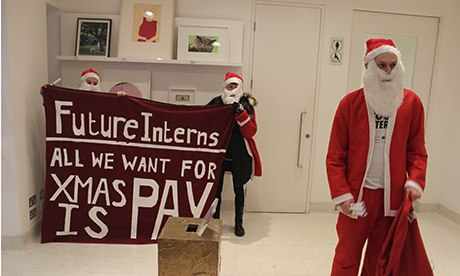
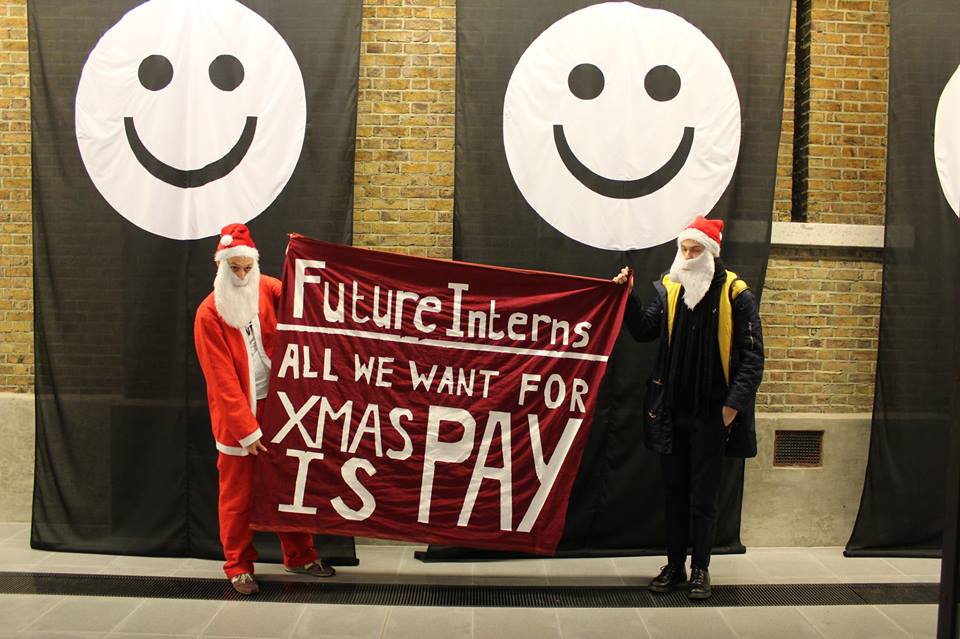
Visitors to the Serpentine Gallery in London were met by an unusual sight at the weekend: students and graduates dressed as Father Christmas, protesting against a gallery advert for unpaid work.
The group of white-bearded protesters held a banner that read: “All we want for xmas is pay.” They handed out scrolls to members of the public, which contained the original advertisement, plus the protesters’ comments about why they felt the role should be paid. One said: “If you contribute to the running of an organisation, you are entitled to national minimum wage.”
Following the protest, the Serpentine Gallery have admitted it is in the wrong, saying: “The points you make are valid and we have listened to your protest. We take our responsibility as employers very seriously, and this advertisement is not in line with our current terms on volunteer placements.” […]
“Since we have been campaigning against unpaid internships, people have been sending us adverts that they have seen,” says Fairooz Aniqa, another member of Future Interns and an organiser of the protest.
“We thought that this was a particularly bad one that seemed like it should be paid because it outlined the role.”
As well as the festive protest, the Precarious Workers Brigade (PWB), who also campaign against unpaid internships, sent a letter to the Serpentine Gallery explaining why they felt the voluntary role advertised warranted the national minimum wage. […]
Photograph: Andrey Shental
via PWB
From: Precarious Workers Brigade <precariousworkersbrigade@aktivix.org>
Date: 13 December 2013 12:55:34 GMT
To: Gwenb@serpentinegallery.org, jpj@serpentinegallery.org, huo@serpentinegallery.org, Rosed@serpentinegallery.org
Subject: Unpaid Volunteer PositionsDear Serpentine Management,
We have recently been made aware that you are advertising 3 month volunteer placements at the Serpentine in the Co-Director’s Office (5 days a week), in the Public Programmes Department (2 days a week) and in the Individual Giving team (3 days a week).
We understand the pressures publicly funded, non-profit arts organisations are under and we salute you for taking the time and effort to mentor and train people wanting to work in the arts sector.
However, we are concerned that by not paying people, only those who can afford to work for free will be able to benefit from volunteering at the Serpentine, gain experience in these areas of work and therefore pursue a career in the sector.
Your adverts request individuals who are “reliable, full of initiative and who can demonstrate a keen interest in being involved in this exciting programme.” They also suggest a certain skill level, such as “Previous experience with artists, or in an arts organisations, or in adult learning programmes desirable.” (Public Programme Volunteer placement).
It is clear that the job requires previous experience and some expertise in the area. While as a charity it is not a legal necessity that you pay what are described as ‘volunteers’ many in the sector have acknowledged the exploitative implications of taking advantage of this legal loophole and not paying young workers who clearly fulfill necessary, vital and in many cases, formerly paid positions within organisations. We know that interns at the Serpentine Gallery put in many hours of work and take on great responsibilities. We know that they also gain great experiences. However allowing only those who can afford to work without compensation to gain such experiences has grave implications for a sector already often accused of elitism and at risk of losing the moderate movements towards diversity in the sector.
We are aware that the Serpentine is an educational charity and therefore would suggest that creating fair, equitable and compensated learning activities would be in keeping with this mandate. Demonstrating unfair employment practices does in fact contradicts your constitution as an educational arts charity.
Along with others, our groups – who include past, current and future interns – have been campaigning for fair pay for interns in the arts sector for many years. As a result many arts institutions – including those much smaller and poorer than the Serpentine – have created policies against unpaid internships.
We strongly encourage the Serpentine to adopt such a policy. Over the coming months we will be engaging in a series of targeted actions at yours and other institutions to encourage the creation of such a policy. We will be examining and exposing pay inequities to the public to ensure that these issues are publicised and addressed. We welcome knowledge of any changes undertaken at your institution to create fairer working and compensation practices for interns.
There’s lots of information out there that might help you develop a new and more equitable approach to working with those who wish to develop a career in the sector. Here are a few links:
Art Council England’s guidelines Internships in the Arts:http://www.artscouncil.org.uk/publication_archive/internships-arts
The Carrotworkers’ Collective’s Counter Guide to Free Labour in the Arts :http://carrotworkers.wordpress.com/counter-internship-guide/
Intern Aware: http://www.internaware.org/about/why-unpaid-internships-are-wrong/
Artquest’s Intern Culture report: http://www.artquest.org.uk/articles/view/intern_cultureAnd: Precarious Workers Brigade precariousworkersbrigade.tumblr.com
We look forward to your response.
Yours truly,
Precarious Workers Brigade
Future Interns#payinterns #futureinterns
Serpentine Gallery’s response to PWB letter and FI action (before and after)
post-protest response:
Date: Mon, 16 Dec 2013 10:57:53 -0000 [10:57:53 UTC]
From:Rose Dempsey <RoseD@serpentinegalleries.org>
To:Precarious Workers Brigade <precariousworkersbrigade@aktivix.org>
Cc:Julia Peyton-Jones <JuliaP@serpentinegalleries.org>, Gwen Barry <gwenb@serpentinegalleries.org>, Hans Ulrich Obrist <huo@serpentinegalleries.org>, Rose Dempsey <RoseD@serpentinegalleries.org>
Subject: RE: Unpaid Volunteer Positions Dear Precarious Workers Brigade,
Thank you for bringing this advertisement to our attention.
The points you make in your letter to us are valid and we have listened to your protest.
We take our responsibility as employers very seriously and this advertisement is not in line with our current terms on Volunteer placements.
We will be addressing the issues you raise immediately.
Yours sincerely,
Rose Dempsey——
pre-protest response:
Date: Fri, 13 Dec 2013 13:38:54 +0000 [12/13/13 13:38:54 UTC]
From:Robertta Marques HR Assistant <hrassistant@serpentinegalleries.org>
To:Precarious Workers Brigade <precariousworkersbrigade@aktivix.org>, Gwen Barry <gwenb@serpentinegalleries.org>, jpj@serpentinegallery.org <jpj@serpentinegallery.org>, Hans Ulrich Obrist <huo@serpentinegalleries.org>, Rose Dempsey <RoseD@serpentinegalleries.org>
Subject: RE: Unpaid Volunteer Positions Dear Precarious Workers Brigade,
Thank you for your email. The Serpentine is a charitable arts organization showcasing arts for everyone free of charge. All volunteers are reimbursed travel and food expenses, volunteer roles require much less commitment than an internship and are not core roles that we would otherwise have in the organisation. Often these roles give people the experience they require as part of their personal development. We often take volunteers without previous experience and skills are presented merely as suggestions to candidates. Alongside open calls, we have been also working closely with Access (http://access-workplacements.org/about-us/) as another way to increase diversity and offer meaningful experiences.
We do not require that those applying for any volunteer roles work 5 days a week it’s an option to work up to 5 days a week , indeed many of the volunteers we have work much less – depending on their study/commitments. The volunteers commitment days are flexible and the schedule will be determined according to volunteers availability. Some Gallery Assistants (undertaking paid roles working in the visitor services team) have taken the opportunity to gain experience within different departments by volunteering on an ad hoc basis to enable them to make decisions about the direction of their future careers. We are open minded about peoples propositions and would look at ways of accommodating any requests – to keep access to these opportunities as open as possible.
As HR Assistant I started at the organization as a volunteer and I am now employed here – following my application for a role. We currently have many employees that started that way. I am glad to answer any other question you might have.
Kind regards,
RoberttaRobertta Marques
HR Assistant
Serpentine Gallery
Direct: 020 7298 7564
Email: roberttam@serpentinegallery.org
via Dalya Alberge for the Independent
The two co-directors of the Serpentine Gallery, a registered charity, were paid at least 45 per cent more last year than in 2011, The Independent has learnt.
Julia Peyton-Jones’s package puts her among the highest-paid directors of any arts institution, despite the Serpentine being relatively small and the sector as a whole being affected by significant funding cuts. Her earnings, including bonus and other benefits, rose by approximately 60 per cent to between £140,000 and £150,000, according to the latest 2012 published accounts.
The figures were revealed by leading arts commentator David Lee, prompting him to launch a devastating attack on the gallery. Mr Lee said that Ms Peyton-Jones is only running “a small gallery in a former tearoom” in Hyde Park, which does not even have its own collection.
Ms Peyton-Jones’s package exceeds the £140,000 paid to National Gallery director Nicholas Penny, who presides over a world class collection and international scholarly exhibitions and approaches that of the Tate’s director, Nicholas Serota, who manages a vast collection on a salary and benefits deal of around £160,000. He declined a 2012 bonus “in view of the pay freeze” at the institution.
The Serpentine’s co-director Hans-Ulrich Obrist, although not listed as a company director in the accounts, also saw his package increase from at least £80,000 to within the range of £120,000 to £130,000 in 2012.
Mr Lee also criticised the Arts Council, which he said had “screamed hourly” in 2011 that it was losing over 30 per cent of its taxpayer subsidy and warning of “hard choices” ahead. Its choice was to abolish grants to some 200 organisations, making many redundant. The Serpentine, however, was awarded special status as a “regularly funded organisation”. The Serpentine gets around £1.2m from the Arts Council, about a fifth of the gallery’s costs.
Here you can read a day in the life of Julia Peyton-Jones courtesy of “How to Spend It” – Obviously hers is a terribly hard job!
You can help keep up the pressure on The Serpentine by sending an email with your concerns about their use of unpaid labour!
Gwen Barry, Head of Human Resources
Gwenb@serpentinegallery.org
Julia Peyton-Jones
Director, Serpentine Gallery
and Co-Director, Exhibitions and Programmes
juliap@serpentinegallery.org
Hans Ulrich Obrist
Co-Director, Exhibitions and Programmes
and Director of International Projects
huo@serpentinegallery.org
Rose Dempsey
Head of Communications
Rosed@serpentinegallery.org
 ArtLeaks