Updates
ACT NOW! Submit your story to ArtLeaks and end the silence on exploitation and censorship! Please see the submission guidelines in the "Artleak Your Case" page
Submitted and current instances of abuse are in the "Cases" section
To find out more about us and how to contribute to our struggles, please go to the "About ArtLeaks" page
Please consult "Further Reading" for some critical texts that relate to our struggles
For more platforms dedicated to cultural workers' rights please see "Related Causes"
For past and upcoming ArtLeaks presentations and initiatives please go to "Public Actions"
Report Back: ArtLeaks Talk and Workshop in Aarhus in the Framework of “Making Social Realities with Books” (Oct-Nov 2013)
Between October 28 and November 1, ArtLeaks co-founder Corina L. Apostol gave a talk and organized a workshop in the framework of the series “Making Social Realities with Books” hosted by the non-profit exhibition space rum 46 and the Jutland Art Academy in Aarhus, Denmark. The series, co-organized with Brett Alton Bloom explores the idea of how libraries, archives, publishing, and distribution are used to create distinct social realities, whether it is in small communities, or entire movements within art practices and related activities.
Before the workshop, we met informally with Brett Bloom, Barbara Katzin and Grete Aagaard form rum46, and the workshop attendees and cooked together a delicious vegetable soup and made bread. It was a great way to build an initial trust with the students and to start getting into their concerns, doubts, hopes for their futures and their artistic goals and challenges they face in achieving them. The students in the workshop were in different stages of their artistic education, some were just beginning to create their first more ambitions projects while some were already exhibiting in group shows. Not all of them hailed from Denmark, as an exchange program allowed students from other Nordic and Baltic countries to attend. The workshop as it was announced was free for anyone who could attend and was interested, and not restricted only to students at the Academy.
The talk on the evening of the 28th served as an introduction to ArtLeaks’ mission and an overview of its activities over the past years, with a particular focus on strategies of online publishing and distribution, using forms of political narration to bring to light conflicts between different actors, institutions and ideologies, and ways of moving from leaking to creating more positive and sustainable models of art institutions and work ethics in the art world. The talk also underlined several useful resources which ArtLeaks offers to the community for free use, such as the Reading List, a section which we update regularly with text that we believe are critical to our discourse, and the No Fee Statement through which we encourage cultural workers to use in order to make visible corporate and publicly funded institutions’ inequitable compensation of their workforce. Outcomes of our previous working assemblies and workshops in Berlin, Moscow and Belgrade last year were presented as well as our last series of workshops and conference in Bucharest, on artistic production, organization and struggle. Our recent ArtLeaks Gazette. was also introduced to the public and copies were distributed to whomever was interested. The discussions after the talk raised issues such as: how do we deal with verifying the claims of those who submit their stories to us and work with groups or individuals using an anonymous identity, what happens after leaking and what are some of the positive changes that ArtLeaks has brought about over the last couple of years, nepotism and corruption in the art communities in Denmark and what role could ArtLeaks play in making a difference.
The ArtLeaks workshop days focused on the historical relationship between art organized labor and social movements in the age of capitalist globalization. We looked at these through the lens of culture, politics, economics and history while examining concrete examples of local struggles, alternative models and international networks. From the beginning participants were encouraged to see the workshop as an opportunity to imagine and develop their own alternative models, list of demands, manifestos, ways of collectivizing artistic labor, new institutional and educational models.
The first meeting was focused on the figure of the art worker in art history, based both on choices to self-identity as a socially engaged artists, and on the way one’s own labor is bound to the production and dissemination of culture. How does the “art worker” constantly reoccurs as a form of artistic subjectivity bound with the historical arc of the political Left? Particularly we looked at a number of 19th and 20th century avant-garde movements, Realism, The Wanderers/Itinerants, Dada, Constructivism, Muralism and Surrealism and their affinities with social movements and the organized Left. The second part of the meeting was focused on recent cases such as the Artist Union in the United States, the Art Workers’ Coalition, associated with the legacy of the New Left movement, and whose legacy continues into the present, inspiring the work of contemporary activists and art workers seeking forms of social and political transformation. We also discussed examples of institutional critique, looking at the critical interventions of artists like Hans Haacke, Fred Wilson, Liberate Tate, the Yes Men, Arts & Labor and Occupy Museums. Workshop participants were prompted to reflect on the precarious and in-between classes position of the art worker on the background of great historical changes since the 19th century and in international perspective. How does this understanding of the art worker enrich our possibility for critical reflection so that we can positively affect society itself?
Another meeting was dedicated to theory and scholarship, looking at how artists’ subjectivity and socio-political problems have been articulated, at the interaction between hegemonic discourses (of the institution, corporation and the state) and those employed by art workers struggling for agency in myriad ways and through various ideas about what this entails. The text we looked at were drawn from: Gustave Courbet/ The Realist Manifesto, Karl Marx and Friedrich Engles / The Communist Manifesto, Walter Benjamin / The Author as Producer, Andrew Hemingway/ Artists on the Left, Documents from the Art Workers’ Coalition Hearings, Political Art Documentation and Distribution: A 1980s Activist Art and Networking Collective, Precarias a la deriva/ Adrift through the circuits of feminized precarious work, Guerrilla Girls/ The Guerilla Girls’ Guide to Behaving Badly (Which You Have to Do Most of the Time in the World as We Know It), Dara Greenwald/ Does Corporate Culture STILL Suck?, Hans Abbing/ Notes on the Exploitation of Artists, Mostafa Heddaya/ When Artspeak Masks Oppression, Haben un Brauchen Manifesto and others. Participants were assigned texts based on their particular interests and encouraged to read them in groups and return to the workshop and report on the readings and offer the group points of discussions which they felt were most relevant and precient. At the end of the meeting we made a big brainstorming sheet together where we tried to organize concepts, events and people and the historical and ideological relationships between them.
The next meeting was focused on the city of Aarhus itself and its cultural communities. Participants were each responsible for choosing a particular institution, spot or community in the city that was particularly relevant to their own practice and to lead the group through the geography of Aarhus articulating specific economical, political and cultural factors that influence the distribution and production of dominant culture and possible challenges and alternatives to it. The city became thus a testing ground for ways in which hegemonic apparatuses and resistance are taking place constantly and we began to imagine how this workshop, and our own practices in general can take sides in these conflicts or make a positive impact. Particular sites which we focused on were: the site of Occupy Aarhus where in 2011 people joined in the street, played music together, shared knowledge and demonstrated against social abuse, consumerism and political leadership; the ARoS Modern and Contemporary Art Museum, and especially the exhibition “Pas de deux royal” which showcased the Danish “creative royal couple“ as artists of a very expensively produced retrospective and catalogue that amounted to a an uncritical repetition of modernism’s forms and aesthetics; the Aarhus Kunsthall, in which some of the participants had already exhibited and which showcased an exhibition closely related to the theme of our workshop, “As We May Think (Or the Next World Library)” that imagined scenarios for organizing and acceding information for constructing knowledge rather than destruction and war; we also entered the monumental Scandinavian Center, which was imagined as a shopping and conference center but was actually almost empty of any retail and the enormous space was underused – we imagined what it would be like to take over this big shell and transform it into a useful building, a homeless shelter, subsidized artists studios, a daycare center for children; finally we also visited the Aarhus Center for Visual Art that functions as a meeting place and forum for artists, offering advice and workshops to better the production and possibilities of the city’s artists. At the end we created a map of the city based on the participants’ testimonies, notes, a sketch for an alternative walking guide to Aarhus’ cultural nodes that they could return to and remains open to new additions and interpretations.
From a focus on local issues and structures we next worked on a specific case of struggle, that of the conflicts surrounding this year’s Istanbul Biennale. The reason for choosing this case which ArtLeaks reported on was because the majority of the students in the workshop had visited the biennale on a school trip during the Gezi Park protest this summer, and they became interested to analyze how the biennale played out behind the scenes and what were the stakes involved beyond the limits of the exhibition. We approached this by first re-enacting the positions and protests articulated by activists, artists, the curators and sponsors of the biennale. The workshop participants were split up in these various positions and were asked to study the statements which ArtLeaks had made public on its site and summarize their main points, concerns and solutions. Each group was then invited to play out these respective positions by staying in character, either defending or challenging the biennale’s organizers decisions, the interventions of the activists, the artists’ participation and questioning the biennale’s role in the city’s own struggles, the opportunities that were missed, the artistic victories that made a difference. It was an intense exchange, through which we shared our own concerns, doubts and hopes about the role of art in society, the role of a biennale in the city and the consequences of our actions on our cohort, community and those who come after us.
The final exercise was one of the most demanding, namely participants were invited to write manifestos, either together or in groups, in which they could choose to focus on any of the issues discussed in our previous meetings and suggest their own vision of a different way of acting, of the artistic process and how they saw this change could be implemented in the future. The manifesto has traditionally been an agitational, radical tool for voicing one’s disagreement of the status quo and proclaim a different path or vision for art and for life. Workshop participants manifestos demands were, in no particular order: the end all commodity production, the end of the idea of a one and only genius artist, that artists should boycott the idea of individual successes and act in collectives, to occupy art academies and make them free and accessible for anyone who is interested, to stop producing decorative art or pretty pictures on the wall and explore other ways of being together through a more constructive art, to act against aesthetics co-opted and sent back to us by sterile consumerism, amplifying social currents and undercurrents that help us transform our cities to the benefit of people, to gather one’s friends and unions and organize against slave labor in sweat shops in China and Thailand, and finally an ironic guide on how to enter the art scene when one is a young artists, revealing a lot of stereotypes, compromises and pretenses that people in the art world like to think they free of, when in fact they are helping reproduce the system which they are criticizing.
All participants manifestos were shared and then discussed with the whole group, including a debate on how their proclamations would be disseminated, how to spread these ideas and make them visible the dominant discourses, how to make allies and imagine sustainable ways through which to develop and make lasting these other practices, to make them more susceptible to collective, democratic decision making and acting. We also discussed the role of affect in these moments, and questioned how to make repeatable the joy, beauty and enthusiasm we feel in these moments of sharing and being together and how repeated social practices, assemblies, can act as improvised, yet powerful institutions we need to push further beyond staying too local and too temporary.
rum46 will help gather and publish this set of manifestos and they will become part of the library associated with the series “Making Social Realities with Books.”
I wish to thank the organizers from rum 46 and the Jutland Art Academy and to all the wonderful and bright group of young artists who took the challenge and committed themselves to our workshop during an intense week in Aarhus.
Corina L. Apostol
All photo documentation by the author.
Dean Kenning: Statement of withdrawal from talk at FlatTimeHouse / Curator/Director’s Response (London, UK)
I was very pleased to be asked to take part in the event Proto-tools at FlatTimeHouse (16-17 Nov) described on the gallery website as ‘part-symposium, part-conversation, part-exhibition’. However I feel I must withdraw due to the non-payment of participants. This is not because I don’t partake in many artistic and teaching activities without being paid, which I do; it is because I believe an Arts Council England funded and otherwise supported arts organisation such as FlatTimeHouse has an obligation to pay all it’s artists and speakers. As I had proposed to speak on the question of art as a resource I feel this issue is relevant to the event.
Firstly, funded galleries and arts organisations should not presume that artists, writers, curators, etc. are either independently wealthy, or have stable academic positions to sustain them. Secondly, and more importantly, such non-payment encourages a reputation economy, which is rampant in the art world but deeply damaging to art. Artists, speakers and organisers of events, when they are not so well known and sought after, are supposed to be grateful to arts institutions for the opportunity to exhibit, perform, curate and speak, and to have their names listed on the institution’s website. Not only is their ‘esteem’ enhanced, but they may make connections (with the ‘right’ people) and thus initiate future possibilities to show work, to curate, write, etc.
The informal networking culture that operates at the heart of the art world’s reputation economy conspires against the ‘vulgar’ discussion of money (except as an abstract theoretical topic of discussion), and so silences those who, while feeling they should not turn down an opportunity, may feel unsupported, unfairly treated, or exploited by galleries which seek to increase their own reputational value by dedicating funding to international name artists, writers and curators. It is not a good career move to criticise those who hold, and potentially enable access to, power.
The policy of selective payment for those working at publicly funded galleries thus reinforces and reproduces art world hierarchies and exclusions, to the benefit of those at the top, through flattery (of power’s ‘generosity’), silence (at its iniquities) and competitive struggle for future visibility (where their should be solidarity and true collaboration). This is therefore a class issue, one which, lacking expression within the dominant system and it’s modes of operation, can become internalised, often painfully so, as personal failure.
FlatTimeHouse, built, supposedly, on the legacy of historical challenges to art’s exclusions, should understand how art as a social resource must begin with the equitable enabling of artistic, curatorial and theoretical production alongside the provision of platforms for visibility and discourse. How are we going to encourage a wider range of people to become artists or art workers if they are not going to get paid?
Regardless of the intentions of those involved, such an arrangement inevitably transforms the use of value of artistic encounter and discussion into the exchange value of art world status, as reputational credit replaces cash payment as the currency which will allow the ‘lucky’ few (the well-off and well-connected tend to be more lucky than others) to rise to the top of the pyramid – and only there unlock the big money.
Dean Kenning
Dean Kenning is an artist and writer based in London.
Dear Dean
My name is Claire Louise Staunton and I am the Curator/Director of Flat Time House. This is an uncomfortable place in which to introduce myself, but I feel such an introduction is necessary since we have never met, spoken on the phone, nor even exchanged an email.
Had we communicated, I could have explained that the symposium of which you write was an externally organised public event. You were invited to participate because the organisers felt an urgent need for a forum in which artists and curators could openly interrogate ideas concerning the tools of art practice and the use value of art, and felt your voice would contribute to this discourse. The organisers/artists approached me to ask if FTHo could host this discussion since their former project space has closed due to a lack of funding and because they feel the intimacy and history of our house is conducive to the group discussion. I was happy to give them the space and time to do so without charge and without the constraints of larger and more inflexible institutions.
Had we communicated, I could have explained to you our funding structure wherein FTHo is neither a regularly funded organisation nor a National Portfolio Organisation. The Arts Council England funds some of our in-house public programming (when we always pay fees and/or production) but none of our overheads, salaries, externally organised events or the pretzels and orange juice that we served our guests over the weekend. The weekend’s symposium was not in any part funded by the Arts Council or any public funding body; rather I volunteered my time and offered our only asset, the house. Moreover, the house is under serious threat of closure (please see Art Newspaper July/Aug 2013 [ http://bit.ly/1f7I2Fl ] due to a lack of secure funding.
Had we communicated, we could have discussed, and no doubt found much agreement on the problem of faceless exploitative organisations in the art world. However, it is my firm conviction that neither we at FTHo, nor the artist-run group that programmed the event, are such organisations. That you did not take the trouble to find out before launching a public attack on us I find deeply upsetting. Your anger comes from real and shared concerns, but your aim is off. We are a very small team of individuals working to a challenging budget who care very deeply about our flexible, autonomous institute, and all of the artists that we invite to work with us.
Perhaps the biggest shame is that you missed a really interesting and intimate exchange of ideas between a group of dedicated artists and curators who met on equal terms.Had we communicated, you might have been happy to come.
Yours sincerely,
Claire Louise Staunton
CuratorFlat Time House210 Bellenden RoadLondon SE15 4BW
Call for Support: The Arrest of Two Young Actors at EMBROS Theater (Athens, Greece)
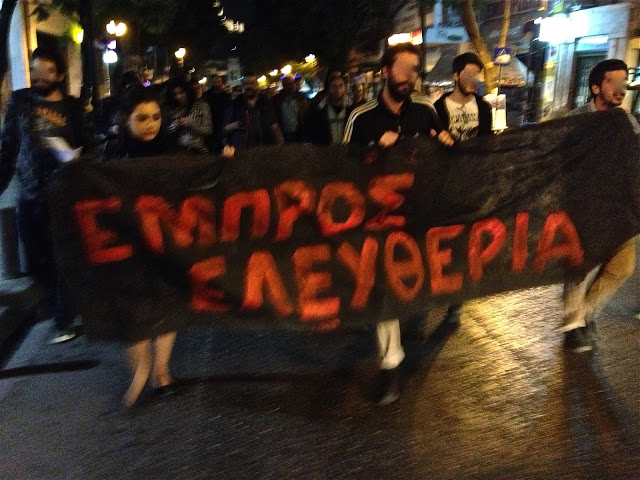
From the Open Assembly of the free self-managed EMBROS Theater after the arrest of two young actors at EMBROS
On October 30 2013, police officers from the Acropolis police station arrested two young actors who were holding rehearsals at the free self-managed EMBROS Theater. The two arrested actors were led to the prosecutor, where they were charged with the breaching of seals, disrupting domestic peace, and repeatedly occupying a public building. They are currently detained, and will be tried on 31/10/2013 with a flagrant process.
For the last two years, EMBROS has been functioning as a non-commodified cultural and social space in the sensitive area of Psyrri, in the center of Athens. The action of today’s arrest is undeniably part of a bigger scheme of a political wipe-out of “lawlessness”, in other words of the freedom of expression, of social solidarity, of self-management and the creation of culture outside the norms of the vulgar market. The attack on EMBROS, a few days after the invasion of social infirmaries, and perhaps a few days before the threatened raid of the occupied ERT public television-radio station, leaves no doubt about the intentions of a government which appears determined to “redeem itself” of all kinds of social solidarity, after having already dismantled state structures.
The Open Assembly of the free self-managed EMBROS Theater moved forward with a night protest, marching together from EMBROS to the Acropolis Police Station, on Thursday October 31 2013, at 12pm noon to the flagrant process “Aftoforo Monomeles Plimmeliodikio Scholis Evelpidon” (Building 2) to show support for the arrested and resistance towards authoritarianism of power.
EMBROS continues its program as scheduled and invites you to actively take part and participate!
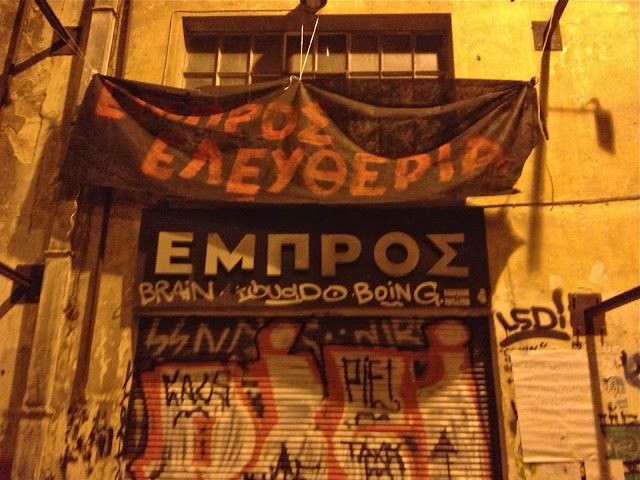
When a government represses the freedom of art and the freedom of expression, it no longer has the right to usurpate the name of democracy, it becomes the expression of totalitarianism that is legitimate to fight. The arrest of the members of EMBROS Theater reveals the intention of an obscurantism incompatible with the right we all have to education and culture. It is a concern of everyone to oppose and save cultural spaces from the mafia enterpises of the privatization and the control of the commodity.Raoul Vanegeim, Philosopher – writer
Dear Reader,
We could have understood if it was a bad example of science fiction, but it’s not. And it’s not a show. Unfortunately, it’s true. Two actors from Embros Theatre in Athens were arrested because they committed the most atrocious of crimes: rehearsing. But maybe it was because this crime is aggravated by others which are even worse, when they become possible: reclaiming public space, practicing commons and believing in culture as a primary right. This authoritarian, illogical, and repressive act of arrest is simply unacceptable. As we are able, from Rome, we would like to RE-ACT! Participants of Embros: What you’re building together is strong, durable and inspiring. We are with you with eyes and heart wide open. This letter is a small gesture of solidarity, but we really want to encourage you guys to never give up.
Teatro Valle Occupato
November 7, 2013,
To whom it may concern,
I am Jenny Marketou (Athens/New York) interdisciplinary artist and educator based inNew York City. As a cultural practitioner during my frequent visits in Athens I had the opportunity to attend several events organized at Embros Theater. I realize that at times of crisis culture is a crucial and active ingredient in the construction and shaping of the contemporary city like Athens and Embros Theater provides a unique global platform which showcases and hosts artistic practices, campaigns, theories, and practicalities that accompany this phenomenon.
Embros Theater has established itself by a diverse self organized group of people who believe in the active role of culture and taking art seriously have transformed Embros Theater to a place making which has become a catalyst in contemporary culture’s current and potential role in the expanding metropolis such as Athens.
It is unethical to prosecute people who have battled to endure this space and who have contributed in creating arts communities, which are invested in the connection between social justice and art with an impact on the viability of the city. With this letter I am asking your profound consideration on this matter and all efforts to prosecute individuals or directed against Embros should be dropped immediately.
I am a fan and supporter of Embros.
Jenny Marketou
Letter in Support of Embros from Arts & Labor Alternative Economies
November 12, 2013, New York
We stand in solidarity with the Embros Theater community and condemn the persecution of the two performers arrested for rehearsing in the theater on October 31, 2013. All charges brought against these individuals should be dropped and their court cases should be dismissed. [1]
The work that is currently being done at Embros embodies some of the most fundamental aspects of fostering a creative and responsive cultural space in which alternatives to the current system can be explored [2]. In this time of urgency and economic crisis around the world, Embros is forging new directions that should be enthusiastically supported and celebrated by the local and national government rather than aggressively repressed and threatened.
Culture is a basic sign of being alive, a space of reflection and growth, and most importantly it is the place where the processes that define democracy such as freedom of speech, expression, and criticality, is apparent in more ways than a set of law books can ever describe. Governments from Russia to China, United States and Europe [3] seek to crush within its citizens the freedom of cultural expression. It has become apparent that the democratic, life-expressing aspects of art are being systematically repressed and commodified into pure spectacle and entertainment by these governments, institutional bureaucrats, and their capitalist cohorts. We will not stand-by as they reduce culture to an admission fee, VIP bonus, or something you can buy at the gift shop. We wish to dance, to perform, to visualize, to speak, all without being restricted by the amount of money we have or the so-called credentials and permits that these institutions have invented. Because for us, this is true freedom, this is true a democracy that no currency can equate.
Embros helps to provide much needed free and open community space that brings people from all walks of life together to learn, engage, and create. Therefore, we ask artists and communities around the world to look closely and continue to follow these events as you would a canary in a coal mine, so that we may provide support for artists and cultural spaces when similar events that arise. Furthermore, these instances should provide a lens to reflect on the situation in our cities and to better understand the mechanisms of cultural control, repression, cooptation, and exploitation so that we can continue, through this solidarity network, to expose and ultimately overcome this political, economic, and cultural crises that has become the marker of our times.
Arts and Labor Alternative Economies
Maria Juliana Byck, Emily Baierl, Antonio Serna and Laurel Ptak
www.whatdowedonow.info
www.artsandlabor.org/alternative-economies[ photo above: Arts & Labor March in Solidarity with Quebec Students (March Against Anti-Protest Laws) and Protesting the Arrest of Takeshi Miyakawa (‘I (heart) NY’ light artist) May 22, 2012. Photo by: Stacy Lanyon]

– – –
[1] Communique from Embros on the Arrest of 2 performers. October 30, 2013
www.embrostheater.blogspot.gr/2013/10/blog-post_31.html
[2] On October 19, 2013, as part of ‘What Do We Do Now?’ the first annual Alternatives Fair in New York City, we invited members of Embros Theater to participate in an international panel on autonomous spaces along with members from other autonomous spaces in Mexico. Through this panel we hoped to learn how autonomously run cultural spaces function to provide a more horizontal way to operate while remaining inclusive to all members in the community. From this exchange we learned how Embros’ organizing by way of a weekly general assembly has become a dynamic and invaluable community-run space in which creativity and innovation is encouraged to thrive.
‘What Do We Do Now? Alternative Fair’ was organized by Alternative Economies, a subgroup of OWS Arts and Labor. Alternative Economies working group explores alternative methods of sustaining the livelihood of artists, art-workers, and other communities interested in alternatives to the current system. We view the concept of labor through the lenses of time, choice, and value, and we research the ways that ideas like the commons, solidarity economies, precarious worker centers, and participatory budgeting can nurture more sustainable art worlds. Believing that vibrant creative communities come from the bottom up, we encourage relationships based on mutual aid rather than competition, and we advocate for cultural institutions rooted in a framework of social, economic, and environmental justice.
[3] Links to similar crack down on autonomous cultural spaces and artists:
– ZAM is Culture, Eviction of ZAM by Milan Police, May 2013
http://bureaux.petitemort.org/2013/05/zam-e-cultura/
-Footage of Police Eviction of ZAM w/ minute by minute account, May 2013
http://bureaux.petitemort.org/2013/05/zona-autonoma-milano-eviction-today
– Missing Pussy Riot Inmate Turns Up at a Tuberculosis Hospital, Nov 14, 2013
http://www.rollingstone.com/music/news/missing-pussy-riot-inmate-turns-up-at-a-tuberculosis-hospital-20131114
– Extreme show of force by of Swiss police at Basel, May 2013
http://bureaux.petitemort.org/2013/06/artists-activists-make-art-come-alive
– “Art Makes Money” Communique from ‘Basel Will Be Occupied’ after the Art Basel raid:
http://bureaux.petitemort.org/2013/06/communique-art-makes-money
–NY Police Arrest of artist in Brooklyn for Decorating the Street “I (heart)nyc” bags, May 2012
http://bureaux.petitemort.org/2012/05/ny-goes-hard-on-street-art/
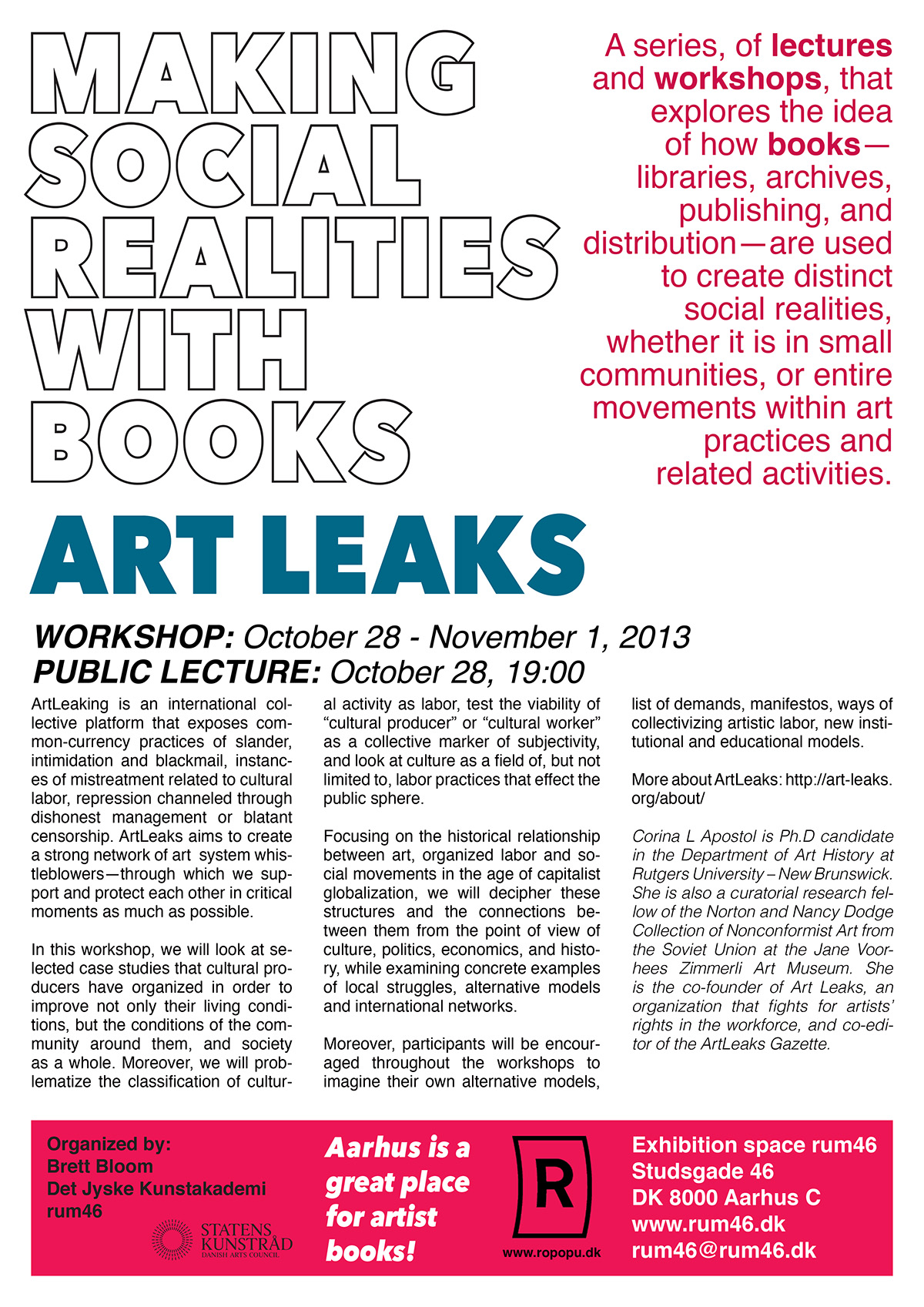
Making Social Realities With Books is a series, of lectures and workshops, that explores the idea of how books—libraries, archives, publishing, and distribution—are used to create distinct social realities, whether it is in small communities, or entire movements within art practices and related activities.
About Art Leaks:
ArtLeaking is an international collective platform that exposes common-currency practices of slander, intimidation and blackmail, instances of mistreatment related to cultural labor, repression channeled through dishonest management or blatant censorship. ArtLeaks aims to create a strong network of art system whistleblowers—through which we support and protect each other in critical moments as much as possible.
In this workshop, we will look at selected case studies that cultural producers have organized in order to improve not only their living conditions, but the conditions of the community around them, and society as a whole. Moreover, we will problematize the classification of cultural activity as labor, test the viability of “cultural producer” or “cultural worker” as a collective marker of subjectivity, and look at culture as a field of, but not limited to, labor practices that effect the public sphere.
Focusing on the historical relationship between art, organized labor and social movements in the age of capitalist globalization, we will decipher these structures and the connections between them from the point of view of culture, politics, economics, and history, while examining concrete examples of local struggles, alternative models and international networks.
Moreover, participants will be encouraged throughout the workshops to imagine their own alternative models, list of demands, manifestos, ways of collectivizing artistic labor, new institutional and educational models.
Corina L Apostol is Ph.D candidate in the Department of Art History at Rutgers University – New Brunswick. She is also a curatorial research fellow of the Norton and Nancy Dodge Collection of Nonconformist Art from the Soviet Union at the Jane Voorhees Zimmerli Art Museum. She is the co-founder of Art Leaks, an organization that fights for artists’ rights in the workforce, and co-editor of the ArtLeaks Gazette.
This series was co-organized with Brett Alton Bloom/ Det Jyske Kunstakademi/The Jutland Art Academy and rum46. Together we have helped organize a loose network of artist book publishers and supporters in Aarhus called RoPoPu (Room for Potential Publishing) that can be found here: www.ropopu.dk.
Centre for Contemporary Art Ujazdowski Castle: Workers’ Protest Letters cont’d (Warsaw, Poland)
For more background on this case please see: Centre for Contemporary Art Ujazdowski Castle: Workers’ Protest Letters and Open Letter to the Workers and Publics of CCA Ujazdowski Castle from the Winter Holiday Camp Working Group
____________________________________________________________
Warsaw, September 25, 2013
Janusz Byszewski,
Head of the 667th Company Branch of the
Independent Self-governing Trade Union Solidarność
Centre for Contemporary Art Ujazdowski Castle
Jazdów 2, 00-467 Warsaw
Dear Sir,
In your letter dated September 16, 2013 you presented a number of accusations concerning the way the CCA is managed. I have the impression that some of them are the result of misunderstandings, quite possibly pertaining to the troubles with communication which you previously mentioned. I shall try to address the majority of the issues you noted, however, I am aware that resolving this matter would require a longer time, as well as meetings and discussions which, I hope, would eventually lead to an understanding and agreement.
As far as I understand, your primary concern is the financial situation of the CCA. Indeed, having analyzed the budget after the first six months of my work we came to the conclusion that our expected revenue is 25 % lower, a situation in which a correction in planning was in order. As you know, the CCA has always relied on various sources of funding, including public funding, partners representing other countries (embassies and culture institutions), private sponsors as well as parties relying on the commercial use of our premises. The current drop of income results from a broader range of phenomena pertaining to the economic crisis. The decisions I made in this situation are dictated by reason and do not endanger the functioning of the institution: some projects have been scaled down, others were rescheduled for the following year, while the CCA still has many tasks on its hands until the end of this year.
A different set of problems you have addressed is the issue of communication and the related matter of a lack of information regarding our plans. I would like to note that, since the beginning of this year, we have held six meetings with curators, all of which concerned the plans for 2014. The program was prepared with the curators. Those of you involved in respective projects have already commenced work on them. We will, however, work on the communication system. I hereby declare my intention to propose specific solutions which would permanently improve communication with the Team.
I agree with you as far as the need for the evaluation of the projects is concerned: both the Green Jazdów project, as well as other activities pursued by the CCA. As is known, no official practice of this sort has been pursued to this date: we have been using factors such as attendance or reviews, whereas I think it would be useful to create more comprehensive mechanisms of evaluation. We all know that the task is not a simple one, as it concerns the delicate matter of cultural projects, many of which involve experimentation, but I would be glad to work towards developing an evaluation system.
You also address issues related to employment. Indeed, the CCA has recently welcomed a few new faces, mostly young people. However, they need to learn a lot and gain experience before they can be entrusted with real responsibility. In the meantime they work under the supervision of myself, deputy directors, and other more experienced staff members. I admit that the number of people coming and going is relatively large, but I can only say that, to a certain extent, it is related to the high expectations I have of my co-workers. Nonetheless I am confident that the CCA team will grow to permanently include valuable individuals who will soon be able to carry out even the most difficult tasks.
Certain difficulties, stemming from changes in employment structure, are characteristic of the processes taking place in institutions and necessitate defining new positions and tasks, as well as changes in the structure of the CCA departments. In the near future we shall discuss with you the matter of the Organizational Regulations, and it is my hope that introducing it will have a positive impact on the organization of work at the CCA.
On this occasion, I would like to note that the fact the supplemental payroll fund was depleted is also related to our extensive activity connected to programming, which calls for collaboration with many individuals, including artists, as well as persons directly involved in carrying out artistic projects.
One of the departments in which – as you noted – these difficulties have been particularly manifest is the department of Promotion and Fundraising, which practically did not exist before. Introducing new individuals to work which, above all, requires extensive contacts, takes time. At this moment I am absolutely optimistic as far as the development of this department is concerned. The recently hired persons tackle their tasks very well. At the same time, Lara Facco, whom you also mentioned, is, on the one hand, assisting us in the reorganization of the department, and on the other, works on communicating the actions of the CCA internationally. This work will result in greater recognition of our institution in Europe and, in consequence, facilitate our collaboration with partners abroad as well as improve our chances for securing sponsorship among international corporations. Simply put, it is an investment which will pay off.
It is by no means my intention to marginalize the role of education in the work of the CCA, to the contrary, I believe it to be one of the fundamental tasks of this institution. Apart from two educational departments at the CCA operating on a regular basis, a whole number of other initiatives falls within this category. These include conferences, lectures, publications, and guided tours. The actual costs incurred by the institution with respect to education are far greater than the running costs of both of the aforementioned departments.
In conclusion, I would like briefly to address the matter of the costs of the BBPP [British British Polish Polish] exhibition. Being a very extensive exhibition, it occupies a space typically used by three separate exhibitions. Its cost was initially estimated at c.a. 800.000 zloty, yet we expected a greater involvement on the part of the British as well as other sources of funding. Unfortunately, we failed to secure all the expected funds and I was forced to take the decision to increase funding of the exhibition on the part of the CCA. As I already noted in the beginning, this fact involved the difficult decision to cancel or scale down certain other projects this year.
As I have already mentioned, I am ready for further talks. It is my hope that together we can develop a plan which will be a solution to the present situation of the CCA. Having taken all of your comments seriously, I hope for a constructive dialog.
Pursuant to today’s conversation, we will propose a list of matters to be discussed and agree on a date for a meeting upon your return, after October 6 this year.
Yours sincerely,
Fabio Cavallucci
To the attention:
Mr. Bogdan Zdrojewski
Minister of Culture and National Heritage
Mr. Zenon Butkiewicz
Director of the Department for National Cultural Institutions
Minister of Culture and National Heritage
____________________________________________________________
Warsaw, October 4, 2013
667th Company Branch of the Independent
Self-governing Trade Union Solidarność
at the Center for Contemporary Art
Ujazdowski Castle
Jazdów 2, 00-467 Warsaw
Mr. Fabio Cavallucci
Director
CCA Ujazdowski Castle
Dear Sir,
We would like to thank you for your reply to our letter of September 16. At the same time we would like to express our deep disappointment over its content.
We hoped that our note would make you aware that the CCA found itself in serious crisis – a crisis of funding, leadership, trust, as well as programming. Whereas you refer to this ongoing crisis at the CCA as a “misunderstanding” and downplay its causes, suggesting they lie in “troubles with communication”. There are currently no troubles with communication at the CCA whatsoever, as there is no communication between you and the staff. On many occasions you made decisions against the judgment of the whole programming team. You frequently demonstrated your disregard for the opinion, effort, time, and competence of the CCA staff, claiming that the employees of our institution are primarily concerned with causing you trouble and hindering your march towards… what precisely? Thus far you failed to “communicate” to us even the final program for the end of 2013, not to mention 2014.
“Misunderstanding” is out of the question – we perfectly understand your strategy of management of the CCA and this is precisely why we do not agree with it. These methods must change. Regrettably, it is impossible to consider your letter as a harbinger of such change.
You expressed your hope that “together we can develop a plan which will be a solution to the present situation of the CCA”. We are cannot share this hope any longer. In your response, as well as in your statements for the media, you denied the fact that any conflict existed at the CCA, suggesting that the problem of discontent concerns a handful of individuals, mostly curators, whose projects were cancelled or rescheduled. We also know that you have already received the memorandum from the All-Poland Alliance of Trade Unions (OPZZ), whose members expressed solidarity with our situation and put forward their own – very long – list of objections and charges concerning the methods of management and working conditions you created. We hope that this document made you aware that the problem does not concern a mere handful of “frustrated individuals”. The members of the Alliance of Trade Unions and Solidarność constitute the majority of the CCA staff – and their number would have been even higher if the employees on “precarious contracts”, whom you hired, could join a trade union. You should open your eyes to the fact that the discontent is widespread – a fact which you would have known if you had been in contact with your team, instead of treating it as a “pool of human resources” at your disposal.
As long as you deny the existence of the conflict, there is no way we can resolve it together. How does one resolve a conflict that allegedly does not exist? As long as you do not accept the fact that we are in crisis, there is no way it can be overcome.
Your first reaction to the outburst of an open conflict at the CCA was not a dialog with the staff, instead you chose to call a PR expert, Mr. Max Fuzowski from the company Business & Culture, for help. Let us consider this gesture symptomatic of your present attitude. Instead of working on solving the problems at the CCA, you focused on developing a strategy of improving your public image. If you intend to communicate with the staff through a hired PR person, we can assure you: this is not the way! We will never communicate this way.
We urge you to cease excusing the financial problems of the CCA with the global financial crisis. We cannot reach an agreement as long as you use such arguments. We would also like to once again stress with respect to this year’s budget that the CCA has not received such high funding from the Ministry of Culture and National Heritage in years. Our problems do not result from the global crisis, but from the lack of a clear development strategy for the coming years, lack of realistic and thought-out methods of programming, and from the chaotic employment policy (stemming from the inability to create the promised new organizational structure over the last three years) as well as ill-considered expenses.
We are thus unable to treat your letter as a satisfactory answer to our objections and concerns. You have declared that you are ready to engage in a dialog. We would be glad to commence it, on the condition that you will address the issues we mentioned, this time seriously.
Head of the 667th Company Branch of the
Independent Self-governing Trade Union Solidarność
Janusz Byszewski
To the attention:
Mr. Bogdan Zdrojewski
Minister of Culture and National Heritage
Mr. Zenon Butkiewicz
Director of the Department for National Cultural Institutions
Minister of Culture and National Heritage
____________________________________________________________
Demands of the staff of the CCA Ujazdowski Castle. October 8, 2013.
WE DEMAND!
- That the financial situation of the CCA and its strategy of financial management be presented in a clear manner.
- That fair working conditions, as defined by the Labor Code, be returned to the CCA, and that the staff members are treated with proper respect rather than as “implements”.
- That the CCA abandon its extremely centralized methods of management and organization as they are not successful in an institution which has the ambition to create vital culture.
- That the artists who contribute to the CCA program be paid fees.
- That the organizational chaos which has existed at the institution for three years, and which results from an unclear division of tasks and means, cease.
- That the strenuous coming and going of the staff be stopped by putting an end to unjustified dismissals and the hiring of new staff without clearly appointed duties. This makes it impossible to create an effective team.
- That the institution no longer be run with the use of repression, orders, and threats. These should be abandoned for the sake of a culture of dialog, participation, and genuine involvement.
- That the messages created by the CCA be communicated professionally and honestly, allowing for critical debate. We demand clear messages addressed to the public and the media instead of a propaganda of success created with “information noise”.
- That exhibitions and other art projects be planned in advance, allowing for effective fundraising, promotion, and implementation.
- That the CCA return to its democratic decision-making processes and professional debate over programming, as well as evaluating its projects within the board of curators.
- That different art media and genres, as well as the different fields of the CCA’s activity be treated equally, in compliance with the interdisciplinary program of this institution.
 ArtLeaks