Updates
ACT NOW! Submit your story to ArtLeaks and end the silence on exploitation and censorship! Please see the submission guidelines in the "Artleak Your Case" page
Submitted and current instances of abuse are in the "Cases" section
To find out more about us and how to contribute to our struggles, please go to the "About ArtLeaks" page
Please consult "Further Reading" for some critical texts that relate to our struggles
For more platforms dedicated to cultural workers' rights please see "Related Causes"
For past and upcoming ArtLeaks presentations and initiatives please go to "Public Actions"
Parasites and Prophets (25-26 October 2013, tranzit.ro / Bucureşti)
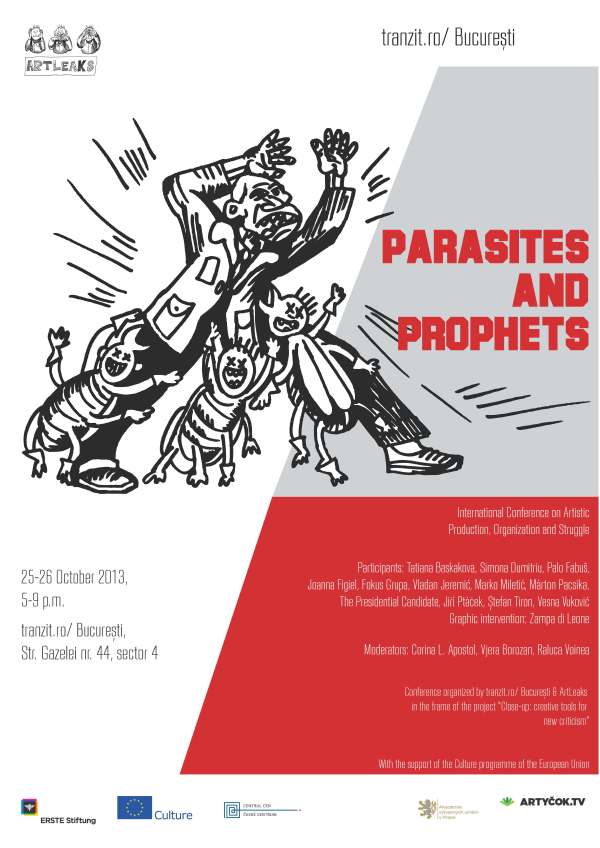
Parasites and Prophets
International Conference on Artistic Production, Organization and Struggle
25-26 October 2013, 5-9 pm
tranzit.ro/ Bucureşti, Str. Gazelei nr. 44, sector 4
Participants: Tatiana Baskakova, Simona Dumitriu, Palo Fabuš, Joanna Figiel, Fokus Grupa (Iva Kovač, Elvis Krstulović), Vladan Jeremić, Marko Miletić, Márton Pacsika, The Presidential Candidate (Florin Flueraş, Ion Dumitrescu), Jiří Ptáček, Ştefan Tiron, Vesna Vuković
Graphic intervention: Zampa di Leone
Moderators: Corina L. Apostol, Vjera Borozan, Raluca Voinea
Artists today:
- the State instrumentalizes them;
- the corporations employ them to whitewash their image;
- galleries and collectors look at them as at a hen with golden eggs;
- the wider public expects to be entertained by them;
- the activists wait their helping hand in saving the world;
- the cultural institutions legitimize their very existence through them, under the more noble mission of emancipation and education;
- their colleagues rely on their inexhaustible humour, intelligence and creativity;
- they themselves are most often struggling for survival.
We are using the word “artist” here in a very general sense; “cultural worker” is lately replacing the much-tainted-by-Romantic-mythology “artist”. To change the word is not enough though. To change the perception upon them as a group which contributes to society, that is a task which first needs self-awareness. Then it needs organization and affirmation.
The conference “Parasites and Prophets” aims to initiate a dialogue among the cultural workers community in Bucharest and their peers from Europe, mostly in the former East, about precarious working conditions, unpaid project work, economic situation and incomes, public funding, collaboration, solidarity, labour struggles. How to fight against precarious conditions in contexts where labour struggles are more difficult to localize? Which tactics and models of organizing already exist? How can they be enacted and expanded collectively and publicly?
The public programme of the two days, Friday, 25th and Saturday, 26th of October 2013, from 5 in the afternoon till 9 in the evening comprises short presentations by the participants, discussions, references to the local context of Bucharest and to the artists’ struggle in a wider climate of social unrest and accumulated political demands, collective drawing, informal exchange and optimistic projections for the near future.
More information on the event and participants you can find on the websites: http://ro.tranzit.org/ and https://art-leaks.org/ or by emailing at: corina.lucia.apostol@gmail.com or raluca.voinea@tranzit.org, or by phone: 0728503012.
FB Event RSVP: https://www.facebook.com/events/363090490491833/
Participant Bios
Corina L Apostol is Ph.D candidate in the Department of Art History at Rutgers University – New Brunswick. She is also a curatorial research fellow of the Norton and Nancy Dodge Collection of Nonconformist Art from the Soviet Union at the Jane Voorhees Zimmerli Art Museum. She is the co-founder of Art Leaks and co-editor of the ArtLeaks Gazette.
Tatiana Baskakova is a London-based Russian artist working experimentally on the possibility of political critique in contemporary art practice, with emphasis on context and performance as a key but not the only media. In 2011 she performed Invigilator’s Revolt while working as a gallery assistant in a major Moscow art institution, trying to organise a trade union for gallery workers and being fired for “sabotage” as a part of it. In 2013 she made a celebratory lecture about V.I. Lenin in the European Bank of Reconstruction and Development in London. Baskakova takes part in anonymous institutional critique groups that organise and campaign against unpaid gallery labour. She received her BA in Art Practice and MA in Art and Politics from Goldsmiths College University of London.
Vjera Borozan graduated from the department of art history at the Philosophical faculty of Charles University in Prague. She has taught at the Faculty of Fine Arts in Brno and at the Academy of Arts, Design and Architecture in Prague. Until recently she collaborated with the initiative tranzit.cz. She is the director of the online platform Artyčok.TV and an independent curator active in many other areas of the contemporary art scene. Lives in Prague.
Simona Dumitriu is a curator, teacher and artist. She also researches on Romanian contemporary art history. She is the initiator (in 2011) and member of Platforma space in Bucharest – a space used for exhibitions and workshops, but also as a meeting place for interdisciplinary, social or political initiatives. Between 2009-20013 she taught at the National University of the Arts in Bucharest. In her practice and research, she in interested in: mixing and working at the intersection between curatorial, teaching and artistic practice; archival science and theory as applied to visual arts; discourse analysis and research based performances; methodologies of art education and education as art; queer theory applied to contemporary art, to feminism and to other political issues.
Palo Fabuš received his Bc in applied informatics at the Faculty of Informatics, Masaryk University in Brno, and MA from the Department of Media Studies and Journalism FSS MU Brno, currently a PhD candidate at Sociology Dept. of Charles University in Prague. In 2004-2005 he was the editor-in-chief of IM6 magazine. Curator of Zoom festival (2005, 2006). He worked as an editor of Literární noviny (2005-2008). Co-founded Jlbjlt in 2007. He taught Social Media course at the Department of Media Studies and Journalism FSS MU Brno and gave guest lectures at FF MU Brno, FaVU Brno, FIT VUT Brno, FAMU Prague, and AVU Prague. Since 2009 Palo is an editor of Umělec magazine; since 2011 its editor-in-chief.
Joanna Figiel is a doctoral candidate at the Centre for Culture Policy Management, City University London and Research Associate in the Hybrid Publishing Lab, at the Innovations-Inkubator Leuphana Universitat. Her research focuses on labour issues, precarity and policy within the creative and cultural sectors. She completed her MA at the Centre for Cultural Studies, Goldsmiths. She is a member of the editorial collective of ephemera.
Fokus Grupa (Iva Kovač, Elvis Krstulović) is an artist collective based in Rijeka and Zagreb, Croatia. Their practice is collaborative and interdisciplinary, and they work across art, design and curating. Their artistic strategies take political shape, without becoming a representational form of ‘political art’. Fokus Grupa concentrate on the relations between art and its public manifestations, in terms of working culture, aesthetics, and social and economic exchange values. Their work investigates the inherent power structures of the art-system. To this effect, they explore its economic, spatial and legal implementations. The collective tries to expand the boundaries of their artwork, using printed matter, films and installations, works on paper, discussions, workshops and texts.
Rena Rädle & Vladan Jeremić are a Belgrade-based artists, cultural and political workers making interventions and installations that combine documentary video, photography and drawing. They have been collaborating together since 2002. The political economy of the city and social struggles in the context of production of urban space are in the focus of their research. Their projects “The Housing Question”, “Under the Bridge”, “The Housing Agenda”, “On Use Value of Art”, “Belleville” and “Gazela” support movements of Roma precarious workers and migrant workers in Europe in order to consolidate potentialities for social transformation. Their recent exhibitions include: Self Made Urbanism Rome, NGBK, Berlin; Places of memory – Fields of vision, Contemporary Art Center of Thessaloniki; O2, Red House, Sofia; Absolute Democracy, Rotor, Graz; Oktobar XXX, 15th Pančevo Biennial, Serbia; The Housing Agenda, Cable Factory Gallery, Helsinki and La mason Folie Wazemmes, Lille; Moving Forwards, Counting Backwards, MUAC, Mexico City. Jeremić & Rädle were initiators of the project Call the Witness – 2nd Roma Pavilion at the 54th Venice Biennial and are co-authors of artworks within the collective Chto Delat? Their artworks are in the collection of the Thessaloniki State Museum of Contemporary Art, MUDAM, Luxemburg, Van Abbemuseum, Eindhoven and Museum Reina Sofia, Madrid.
Marko Miletić is a cultural worker, and a member of the Kontekst collective. He is a student at the Department of Art History of the Faculty of Philosophy, University of Belgrade. From 2007 to 2010, he worked on the Kontekst gallery project; Since 2011 he has been part of the editorial board of the Lice Ulice magazine. In his work, he addresses the formation of space for critical and political action in the field of contemporary art and culture by discussing questions of cultural politics and production as well as researching links between cultural production and urbanism. His recent projects include among others: Encounters – Future of European Integrations, Political Economy and Culture: Left Critical Perspectives, a three-day conference, 25 – 29. September, 2012, Belgrade/Serbia; The importance of the student protests in the 1930ies in Yugoslavia, audio-visual installation in public space, upcoming, October 2012, Urbanfestival, Zagreb/Croatia; Kontekst, struggle for autonomous space, 2011 – ongoing; From Creative Work to Creative City, a two-day seminar in the frame of 52nd October Salon, November 2011.
Márton Pacsika is an emerging curator based in Budapest. He was a co-founder and curator of the Demo Gallery, Budapest (2010-2012), and is currently a board member of the Studio of Young Artist’s Association and of the Labor Gallery committee. His main fields of research include twentieth-century Hungarian Progressivism, cultural policy, and socially engaged art.
Jiří Ptáček lives in Prague and is an independent curator and art critic. Throughout his career he has collaborated with several galleries and art magazines working in the field of contemporary art. He worked as an editor-in-chief of Umelec magazine, international art magazine published in Prague (2003-2006), curator of NoD Gallery in Prague (2007-2008) and Gallery of Young Artists in Brno (2011). Between 2009 and 2011 he acted as a pedagogue of Video Studio at Faculty of Fine Arts in Brno. In summer 2012 he became a new curator of Fotograf Gallery in Prague. He is one of constituent members of Ateliér Бања Лука, an international iniciative of young artist and curators focusing on models of a collaborative practice. Last two years he also runs a flat “community gallery” Zutý Mánes in České Budějovice (together with an artist Michal Vavrečka).
The Romanian Presidential Candidacy (Florin Flueraş, Ion Dumitrescu) is based in Bucharest, the main initiators being Ion Dumitrescu and Florin Flueraș. Part of Postspectacle practice, with campaign rallies already having been held in Bucharest, Vienna, Oslo, Sao Paolo.
Ştefan Tiron Performance/Cultural Hacking: Preliminary report on the past and present use of psychotronic weapons of mass destruction in Romania (with Alexandra Croitoru) 2007, selling of Surveillance Technology from the East to the West at Sigint 2009 in Koln, Germany, Presidential Candidacy National Day at Afi Palace Bucharest 2011, Brancusiologist at Gate of Kiss (colab with Manuel Pelmus and Brynjar Åbel Bandlien) CNDB/Bucharest, Chez Bushwick/NY, Oslo/ Dramatikkens Hus, undercover Fundraising for Romanian Presidential Candidature at dOCUMENTA 13 in 2012 (with Ion Dumitrescu). Since 2013, member of the new Comission for Public Monuments at the Romanian ministry of culture. Curatorial practice: In 2005 invites members from different peer2peer subcultures to curate several events at the Galeria Nouă Bucharest (otaku, industrial/noise/distro, dark deviant art , horror buffs, gaming/LAN party/dc++). Between 2006-2013 he co-organized a Cozzzmonautica series of sleep-over events about DIY Space Exploration, space art, Cosmology&ideology, science friction, sound art in Arad Natural History Museum, Oradea University, WestGermany/Berlin, private homes and galleries. Current 2013 edition Timișoara/Simultan/TamTam “New Jobs in Outer Space.” TW: @TironStefan
Vesna Vuković is a translator, curator and researcher, member of Zagreb-based collective [BLOK], associate and periodic lecturer at the Academy of Fine Arts Zagreb. She writes and publishes here and there.Vukovic’s work is dedicated to the art in public space and its relation to the politics of public domain. Her curatorial practice explores in-between-spaces of generation, production and representation of contemporary art, as a form of expanded exhibition, as well as spatial organization of the public sphere. Projects and exhibitions, as curator: UrbanFestival, an annual series of interventions in public spaces, Zagreb, 2001–2009; If you meet them on the streets, join…, series of interventions in public spaces, Zagreb, 2008; Money etc, Gallery Miroslav Kraljević, Zagreb, 2010. Publications, as editor: Save as…city.doc, Frakcija magazine 30/31, 2004; Politics of Space, UrbanFestival catalogue, 2006; Operation:City – manual for living in neo-liberal reality, 2008, How we regret…, UrbanFestival catalogue, 2008, Removed from the Crowd. Unexpected Encounters I, 2011.
Raluca Voinea is an art critic and curator based in Bucharest. She is co-director of the tranzit.ro Association, founded in 2012 together with Matei Bejenaru, Livia Pancu, Lia Perjovschi and Attila Tordai-S., an institution which is part of the tranzit.org network. She is also involved in several other curatorial or editorial collectives from Romania (E-cart.ro, IDEA arts + society, Long April). With E-cart.ro she has developed since 2009 a Department for Art in Public Space, a programme of discursive events and artistic productions. She was one of the four curators (with Markus Bader, Oliver Baurhenn and Kuba Szreder) of the international project The KNOT. Linking the existing with the imaginary, developed in the public space of Berlin, Warsaw and Bucharest in 2010.
The collective Zampa di Leone (founded 2000) focuses its activities and its comic narrative against right wing and liberal political practice and contemporary art production that takes a vassal’s role in the society of the crisis of the liberal capitalist culture. Mapping the art scenes all around the world and particularly in Serbia, Germany, Croatia and Turkey, and deconstructing the controversial gentrification processes, Zampa digs its claws into the wonderland of contemporary culture. For more than 10 years Zampa di Leone provides awesome opportunity for everyone to join Zampa di Leone World Movement and to ZAMP IT UP with crazy beats from the synchronized peripheries. A number of critical actions, interruptions and sabotages of exhibition openings at large art events (like the Istanbul Biennial 2009 for example or many artistic actions against non-transparency of the management of the Museum of Contemporary Art in Belgrade) and other museums were carried out by the collective Zampa di Leone from 2000 until today.
Organizational team: Corina L. Apostol, Raluca Voinea, Edi Constantin, Angelica Iacob
Special thanks to: Adriana & Silviu Apostol, Simion Constantin & team, Misa Janeckova, Cristian Voinea, Biroul Melodramatic, Vlad Morariu,Dmitry Vilensky, Société Réaliste
Conference organized by tranzit.ro/ Bucureşti & ArtLeaks in the frame of the project “Close-up: creative tools for new criticism.”
With the support of the Culture programme of the European Union
Partners: Academy of Fine Arts in Prague, Artycok.tv, Czech Centre Bucharest
Main partner of tranzit.ro: ERSTE Foundation
//RO
Vă invităm la conferința internațională
PARAZIŢI ȘI PROFEȚI
Producție culturală, organizare şi luptă
25-26 Octombrie 2013, orele 17:00-21:00
tranzit.ro/ Bucureşti, Str. Gazelei nr. 44, sector 4
Participanți: Tatiana Baskakova, Simona Dumitriu, Palo Fabuš, Joanna Figiel, Fokus Grupa (Iva Kovač, Elvis Krstulović), Vladan Jeremić, Marko Miletić, Márton Pacsika, Candidatul la Preşedinție (Florin Flueraş, Ion Dumitrescu), Jiří Ptáček, Ştefan Tiron, Vesna Vuković
Intervenții grafice: Zampa di Leone
Moderatoare: Corina L. Apostol, Vjera Borozan, Raluca Voinea
Situația artiştilor astăzi:
– statul îi instrumentalizează;
– corporațiile se folosesc de ei ca să-şi spele imaginea publică;
– galeriile şi colecționarii se uită la ei ca la găina cu ouăle de aur;
– publicul asteaptă să fie delectați de ei;
– activiştii aşteaptă ajutorul lor pentru a salva lumea;
– instituțiile culturale îşi legitimeaza existența prin ei sub pretextul nobilei misiuni de emancipare şi educare;
– colegii lor se bazează pe umorul, inteligența şi creativitatea lor;
– în cele mai multe cazuri ei înşişi se luptă pentru supraviețuire.
Cuvântul „artist” este folosit aici într-un sens foarte general; termenul de „muncitor cultural” a început în ultimul timp să-l înlocuiască pe cel de „artist”, mult prea alienat de mitologia romantică. Însă nu este suficient să schimbam terminologia. Ceea ce trebuie să schimbăm este percepția publică asupra lor, ca un grup care contribuie la dezvoltarea societății – o sarcină care necesită conștiință de sine, organizare şi afirmare.
Conferința “Paraziți și profeți” are ca scop inițierea unui dialog între muncitorii culturali din Bucureşti şi colegii lor din Europa, în special din Europa de Est, despre condiții de lucru precare, muncă artistică neplătită, condiții economice şi venituri, fonduri publice, colaborare, solidaritate, luptă. Cum putem lupta împotriva condițiilor de viață precare în contexte în care aceste eforturi sunt greu de localizat? Ce tactici şi modele de organizare există deja? Cum pot fi ele reactivate şi dezvoltate atât colectiv cât şi public?
Programul public al celor două zile, vineri, 25 şi sâmbătă 26 octombrie de la 17:00 la 21:00 va cuprinde prezentări ale participanților, dezbateri, trimiteri la contextul local din Bucuresti şi la luptele artistice în contextul mai larg al mişcărilor sociale şi al cerințelor politice acumulate, desen colectiv, discuții informale şi predicții optimiste pentru viitorul apropriat.
Pentru mai multe informații despre eveniment şi participanți puteți consulta site-urile http://ro.tranzit.org/ şi https://art-leaks.org/ sau prin email:
corina.lucia.apostol@gmail.com sau raluca.voinea@tranzit.org, sau la telefon 0728503012.
Organizare: Corina L. Apostol, Raluca Voinea, Edi Constantin, Angelica Iacob
Mulțumiri: Adriana & Silviu Apostol, Simion Constantin & team, Misa Janeckova, Cristian Voinea, Bureau for Melodramatic Research, Vlad Morariu, Dmitry Vilensky, Société Réaliste
Conferință organizată de tranzit.ro/ Bucureşti şi ArtLeaks în cadrul proiectului
“Close-up: creative tools for new criticism.”
Cu sprijinul programului Cultura al Uniunii Europene
Parteneri: Academia de Arte Frumoase din Praga, Artycok.tv, Centrul Ceh Bucureşti
Partener principal al tranzit.ro: ERSTE Foundation
Open Letters to Suzanne Lacy, Nato Thompson, Catherine J. Morris, Brooklyn Museum, Creative Time
October 16, 2013
Dear Suzanne Lacy, Nato Thompson, Catherine J. Morris and volunteers and staff of Brooklyn Museum and Creative Time,
We are artists, scholars, activists, feminists, wage laborers and mothers performing in Between the Door and the Street. While there are many merits to this piece, and we are hopeful about the public conversations we will engage in, we raise issue with the lack of payment for performers and the lack of childcare options for participating mothers.
As feminists, we believe not paying the 350 women participants perpetuates labor inequality, devalues women’s time and assumes that all women in this piece are financially able to volunteer time, energy, emotional and political content for free. We believe that assuming and relying on free/unpaid contributions of our time for your project continues to perpetuate a standard of capitalist economy that systematically underpays and disenfranchises us, and devalues our time, our bodies, our energies, our histories and our intellects through tactics such as “professionalization.” “volunteerism” and more. This is a mainstream standard that has never worked for us, and does not serve us now. A culture of “volunteerism” assumes that all participants have the means to volunteer and perpetuates the very real reality of poverty and scarcity for many artists and activists. Compensating us would address, in a small but important way, the material realities and economic oppressions impacting many of our lives.
As women who come from different socio-economic and racial backgrounds, we understand that not all activism can or should be paid. However, we do think that the arts community has an imperative to try harder to set a better standard of compensating women for their labor, and for practicing solidarity economies that support women’s participation instead of exploiting them. Additionally, we feel that poor public framing of the unpaid “volunteerism” and time commitments required for Between the Door and the Street create a high barrier to entry. Most of the women participating are non-profit professionals, or women attached to high-visibility non-profits discussing the prompt questions of: “who will take care of the nannies children?” but can the “nanny” bring her own children to this event and participate in an equitable manner, given that she will not be paid, and there will be no childcare? We think not.
We are familiar with, and respectful of Suzanne Lacy’s art, and it is in the spirit of compassionate solidarity and loving community engagement,that we are bringing up these issues. We believe that art and artists benefit from honest critique and that a piece such as Between the Door and the Street that aims to open up space to talk about feminism and women’s work must take on these issues.
Respectfully yours,
Leina Bocar ( performer )
artist, activist, member of Occupy Sunset Park and Arts and Labor
Anonymous performer 1
Anonymous participant 2
* We are in no way attempting to speak on behalf of the other women performers or for their organizations. We are respectfully signing as individuals.
_________________________________________________________
Supporters, signing in solidarity,
1. W.A.G.E. (Working Artists in the Greater Economy)
2. Laurel Ptak, curator, member of Arts and Labor
3. Marisa Holmes, activist, filmmaker, Occupy Wall Street
4. Andrew Ross, Professor of Social and Cultural Analysis, New York University
5. Julieta Salgado, activist, sociologist, Brooklyn College
6. Saar Shemesh, artist, activist, Free Cooper Union
7. Sarah Quinter, artist, activist, Occupy Sandy
8. Zoltan Gluck, Doctoral student, Anthropology, CUNY Graduate Center
9. Kressent Pottenger, activist, Murphy Institute for Labor studies, CUNY, member of Arts and Labor
10. Mike Andrews, Occupy Wall Street, Strike Debt, Copy Editor e-flux
11. Katherine Ramos, activist, mother
12. Noah Fischer, artist, activist
13. Samantha Demby, social justice activist
14. Matthew Tinker, activist, All in the Red
15. George Caffentzis, Emeritus Professor of Philosophy, University of Southern Maine
16. Peter Walsh, Intern Labor Rights, member of Arts and Labor
17. Hector Agredano, CCNY Instructor
18. Elena Schowlsky-Fitch, Public health educator, community activist, Occupy Sunset Park, mother
19. Rachel Higgins, artist, activist, member of Arts and Labor
20. Steve McFarland, Doctoral Candidate, CUNY Graduate Center
21. Sarah Newgaard, CUNY Hunter College alumni
22. Darrah Martin, Free University, Postdoctoral Fellow, Columbia University
23. Lauren Suchman
24. Igor Rodriguez Calderon, Doctoral Candidate, Cultural Anthropology, CUNY Graduate Center
25. Jerry Goralnick, activist, actor, War Resisters League, The Living Theatre, Strike Debt
26. Emily Baierl
27. Rob Robinson, housing justice activist, Take Back the Land, NESRI
28. Helen Panagiotopoulous, CUNY Graduate Center
29. Brad Young, Doctoral student, Political Science, CUNY Graduate Center
30. Amy Starecheski, Columbia University
31. Susan Jahod, professor at UMASS Amherst , Rethinking Marxism Collective
_________________________________________________________
Creative Time and the Brooklyn Museum appreciate the concerns voiced in the open letter. In fact, Suzanne Lacy’s Between the Door and the Street deals with issues of gender justice, including labor, head on. The participants are social activists who were invited to use the project as a platform to advance their work and strengthen their networks through conversations that give voice to restaurant workers, nannies, reproductive-rights proponents, and numerous others. Like much political activism, this project is built upon volunteerism. And as with so much of Lacy’s work, its goal is to promote the cause of social justice.
Creative Time and the Museum have long histories of supporting artists and providing forums for open dialogue around these and other issues. We look forward to continuing the conversation.
_________________________________________________________
Creative Time and Brooklyn Museum Respond to Open Letter
Creative Time and the Brooklyn Museum take seriously the issue of paying artists for their labor. Click here to see Creative Time and the Brooklyn Museum’s response to the open letter, and click here to go to Nato Thompson’s Facebook page, where the issue is being actively discussed.
_________________________________________________________
Sue Yellin: My thoughts on “between the Door and the Street” and volunteerism
I volunteered for this project initially because someone in our theater group had been hired to produce it.. sound idea, bringing all these people together, letting the public in to interact ,why not give a few hours to the cause…after a flurry of instruction emails and reminders of the briefing taking place the week before the event, I thought about all the work which had already gone on. Last Saturday at our briefing I thought “wow what a lot of staff, papers, instructions” but I was still in the game. I reacted when one of the organizers said that they had no money for day-care for the women who were participating(gee maybe if they took the money which was being spent on stuff, paper, badges, etc they could hire some day care people..) On Sunday I was told by the producer that she was told they’d run out of money and could she volunteer her time, which she rightly turned down..
ArtLeaks Workshops – Part III – with Dmitry Vilensky: Education and Its Discontents (tranzit.ro, Bucharest)
ArtLeaks Workshops Part III: Education and Its Discontents
18th of October, from 5 pm – with Corina L. Apostol and Dmitry Vilensky (Chto Delat?)
tranzit.ro/ Bucureşti, Str. Gazelei nr. 44, sector 4
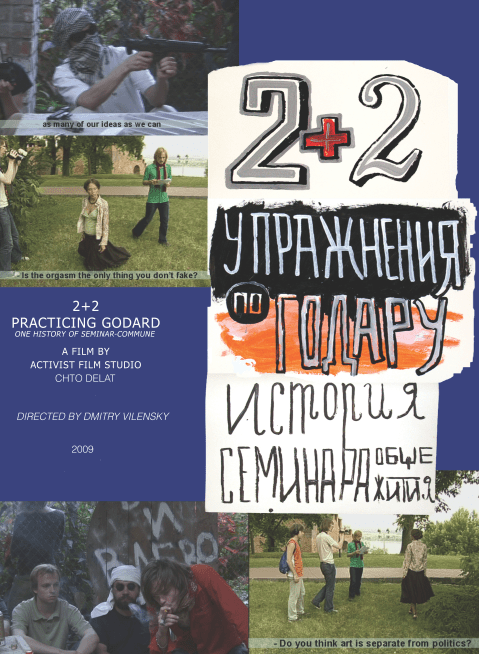
The conflicts and struggles in the field of creative education are at the core of determining what kind of subjectivities will shape the culture(s) of future generations. It is therefore very important to analyze what is currently at the stake in these specific fields of educational processes and how they are linked with what is happening outside academies and universities. We will discuss possible emancipatory approaches to education that are possible today, which resist pressing commercial demands for flexible and “creative” subjectivities. Can we imagine an alternative system of values based of a different meaning of progress? As part of the workshop we will also be screening the film “2+2 Practicing Godard” (2009) directed by Dmitry Vilensky, which tells the story of a police raid on an educational seminar in Nizhny Novgorod, Russia.
Dmitry Vilensky is an artist, writer, activist and founding member of Chto Delat?/What is to be done?, a platform initiated in 2003 by a collective of artists, critics, philosophers, and writers with the goal of merging political theory, art, and activism. Vilensky works mainly within a framework of interdisciplinary collective practices in film, photography, text, installation and interventions in the public sphere. He is also an editor of the Chto Delat? newspaper. Vilensky is one of the co-founders of ArtLeaks in 2011 and co-editor of the ArtLeaks Gazette. He lives and works in St. Petersburg.
The ArtLeaks workshops are free and open to the public.
For more information you can contact us at: raluca.voinea@tranzit.org and corina.lucia.apostol@gmail.com / phone: 031 482271.
The ArtLeaks Workshops take place in September and October 2013 in Bucharest. In these workshops we analyze how cultural producers have organized in the past and the present to improve not only their living conditions, but also political, social, and economic frames at large. Moreover, we problematize the classification of cultural activity as labor, test the viability of “cultural producer” or “cultural worker” as a collective marker of subjectivity, and look at culture as a field of but not limited to labor practices that affect society.
Participants are encouraged throughout the workshops to imagine their own alternative models, list of demands, manifestos, ways in which artistic labor can be collectivized, new institutional models.
//RO
Atelierele ArtLeaks
Partea a III-a: Modele Alternative de Educație Artisticǎ
Vineri, 18 Octombrie, orele 17:00 – cu Corina L. Apostol și Dmitry Vilensky (Chto Delat?)
tranzit.ro/ Bucureşti, Str. Gazelei nr. 44, sector 4
Conflictele și luptele din domeniul educației artistice sunt fundamentale pentru formarea subiectivităților care vor determina cultura generațiilor viitoare. Este foarte important deci să analizăm mizele proceselor educaționale în legatură cu practici din afara academiilor şi universitătilor. Vom discuta despre posibile metode de emancipare prin educație astăzi, care rezistă cererii comerciale pentru așa-zisele subiectivități “flexibile şi creative”. Ne putem imagina un sistem alternativ de valori, bazat pe o altă semnificație a conceptului de progres?
În cadrul acestui atelier vom viziona și discuta filmul “2+2 Godard și Practica” (2009) regizat de Dmitry Vilensky care aduce în prim plan un seminar educațional întrerupt de un raid al poliției în orașul Nizhny Novgorod din Rusia.
Dmitry Vilensky este artist, scriitor si membru fondator al platformei Chto Delat? care a fost inițiată în 2003 de un colectiv de artisti, critici, filozofi şi scriitori cu scopul de a combina teoria, arta şi activismul. Vilensky lucrează în cadrul unor practici colective interdisciplinare din domeniul filmului, fotografiei, instalației şi a intervențiilor în spațiul public. Este de asemenea editor al gazetei Chto Delat?. Vilensky este membru fondator al platformei ArtLeaks şi co-editor al gazetei ArtLeaks. Lucrează şi locuieste în St. Petersburg.
Participarea la ateliere este liberă. Informații suplimentare puteți obține scriind la adresele de email: raluca.voinea@tranzit.org şi corina.lucia.apostol@gmail.com sau la telefon: 031 482271.
Atelierele ArtLeaks
Septembrie & octombrie 2013
În cursul acestor ateliere analizăm diferite modele folosite în trecut şi în prezent de producătorii culturali pentru a se organiza, prin care aceştia încearcă să îmbunătățească nu doar propriile lor condiții de trai, dar şi cadrele sociale, economice şi politice mai largi. Aducem în discuție clasificarea activității culturale drept muncă, testăm viabilitatea „producătorilor culturali” sau „muncitorilor culturali” drept indicatori colectivi de subiectivitate şi privim cultura ca pe un domeniu care ține de (dar nu se limitează la) practicile lucrative care influențează societatea.
Important este să creăm conexiuni între aceste bătălii, iar metodologic să legăm analiza culturală de cea politică şi economică. Una dintre temele majore ale acestor întâlniri o constituie relația istorică dintre artă, munca organizată şi mişcările sociale în era globalizării capitaliste; pentru a descifra aceste structuri şi legăturile dintre ele vom analiza o varietate de exemple ale unor lupte locale, modele alternative şi rețele internaționale.
Participanții sunt încurajați ca în timpul atelierelor să-şi imagineze propriile modele alternative, liste de revendicări, manifeste, feluri în care munca artistică poate fi revendicată colectiv, noi modele instituționale.
via Kurizambutto // Javier Pulido Gándara (artist, Mexico City) and Mariana Aguirre (art historian based in Guadalajara)
Kurizambutto has emerged as a gallery which playfully explores today’s means of communication, institutional critique, the reproduction of aesthetic effects, and various elements and vices related to art. Above all, it aims to reveal the neo-conceptual mannerism which shapes “the contemporary” and how it is ruled by the market, the elites, and its peripheral fauna. It is a simple and open provocation against the channels through which art is legitimized and sold. A biting commentary about how art today is produced, justified, legitimized, sold and consumed. A series of simulations.
Kurizambutto was a Facebook page that functioned from 18 January to 9 July 2013 – it engaged in radical art criticism of the Mexican art world, its figures and corrupt practices. It ruthlessly poked fun at Mexican contemporary artists and institutions by using the figure of the on-line troll as inspiration. The main institution that was mocked was Kurimanzutto, the gallery which represents Gabriel Orozco.
It was shut down by a Mexican lawyer, Alberto Bremermann, due to alleged copyright infringement. Other than the fact that appropriation, or the use of other images to create new works of art has been a common practice in art since at least the 80s (Sherrie Levine, anyone?), neither of the page’s managers have made money from the page itself.
Is this how things are run in Mexico? Lawyers help others shut down on-line criticism? Isn’t it interesting that all this happens while the art world gushes about Mexico City’s rise as a contemporary art hotspot?
The first image that was taken down due to ‘copyright infringement’ compared a work by Gabriel Orozco to one by Goya.
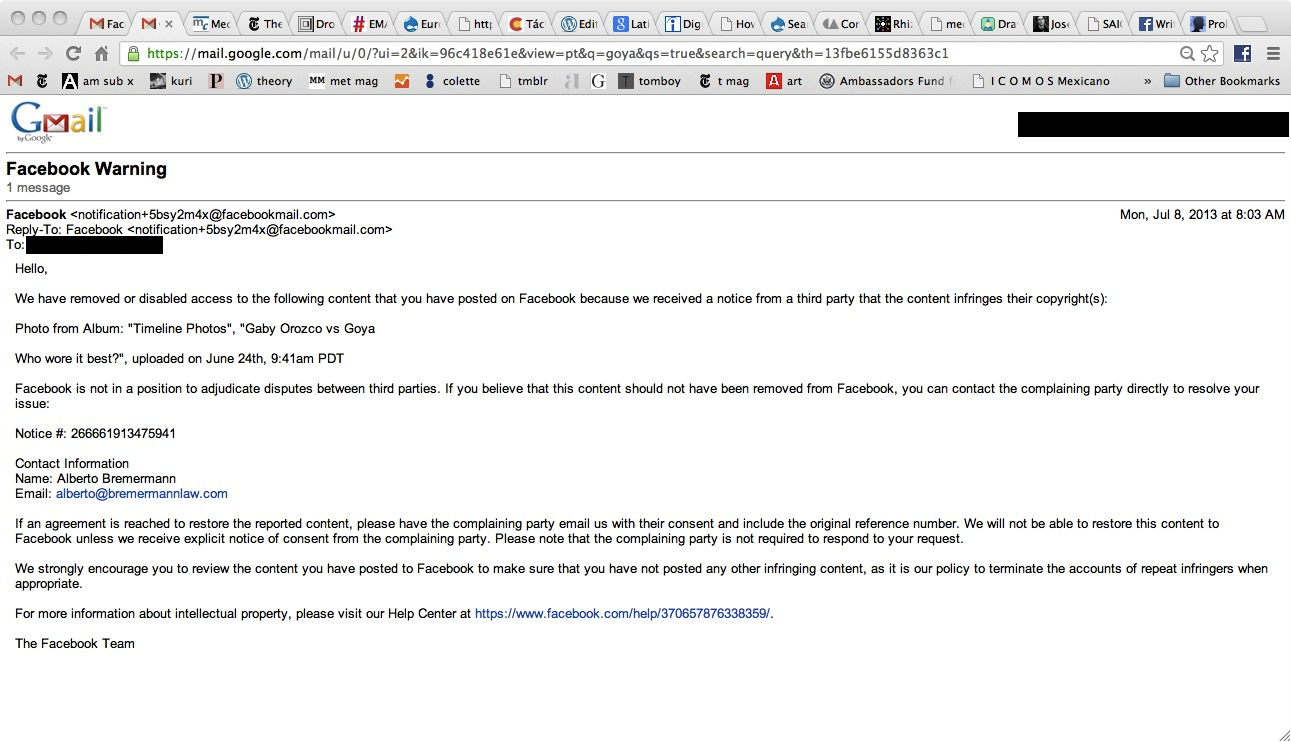
The page was shut down the next day and cannot be recovered unless the lawyer Bremermann decides to reactivate it.
The following timeline explains Kurizambutto’s life and development, which was full of sarcastic jokes, trolling, and pranks.
The History of Kurizambutto
November 2012: An artist based in Mexico City creates a ‘mock’ Facebook profile named Grabiel Orozco, a parody of Mexico’s most famous living artist.
G-R-A-B-I-E-L, not G-a-b-r-i-e-l! (Please note the extra ‘R’)
The profile accrued about 900 friends. No images of works by the real Gabriel are uploaded. Despite the different spellings and the found images that are uploaded, even famous Mexican artists and curators fell for the prank.
GRabiel Orozco revealed what everyone knows – the Mexican art scene functions through nepotism; people were seduced by this ‘closeness’ to power, money and glamour.
17 January: Kurimanzutto (Orozco’s gallery) denounces the profile as fake. The profile is reported and taken down by Facebook.
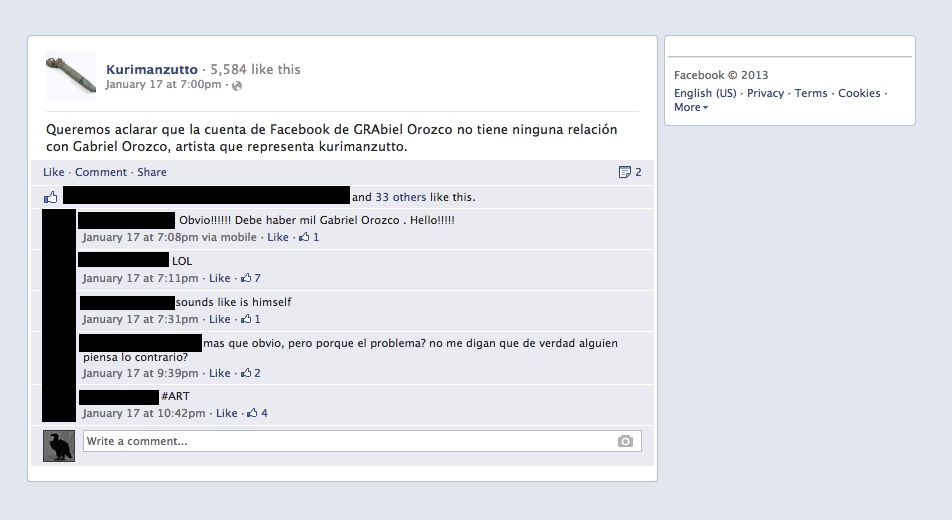
[We would like to clarify that GRAbiel Orozco’s facebook account has no relation to Gabriel Orozco, the artist represented by kurimanzutto.]
18 January: An art historian joins the project. Kurizambutto (a name that mocks the Orozco’s gallery, Kurimanzutto) is created as a Facebook page. Regardless, many posts and images are reported and blocked.
Originally, the project functions as an anonymous page. They are accused of trolling, copyright infringement, cowardice.
April 2013: Kurizambutto’s exhibit in Mexico City at an independent arts space is cancelled with no warning or excuse. Kurizambutto’s website is shut down at Wix due to accusations of alleged copyright infringement.
No images of art were included, only of found images which were SIMILAR to real artists’ works. No real artist’s names were used in the page.

[Dear kurizambutto, As a follower of the thread Someone erased my site! How can I get it back? Please, here is Paola’s last answer.
Paola wrote: This is the note we received due to which your site was eliminated with no possibility of being restored. We also ask you to abstain from creating similar sites at Wix. You compromise our company’s reputation. As you can see below, Facebook eliminated some photos you used, since those were reported as well.]
June 18: The page’s managers admit they are Kurizambutto on the page itself. (Their names had been leaked as early as February!)
July 8: An image is taken down due to copyright infringement. It was a side by side comparison of a work by Gabriel Orozco with one by Goya.
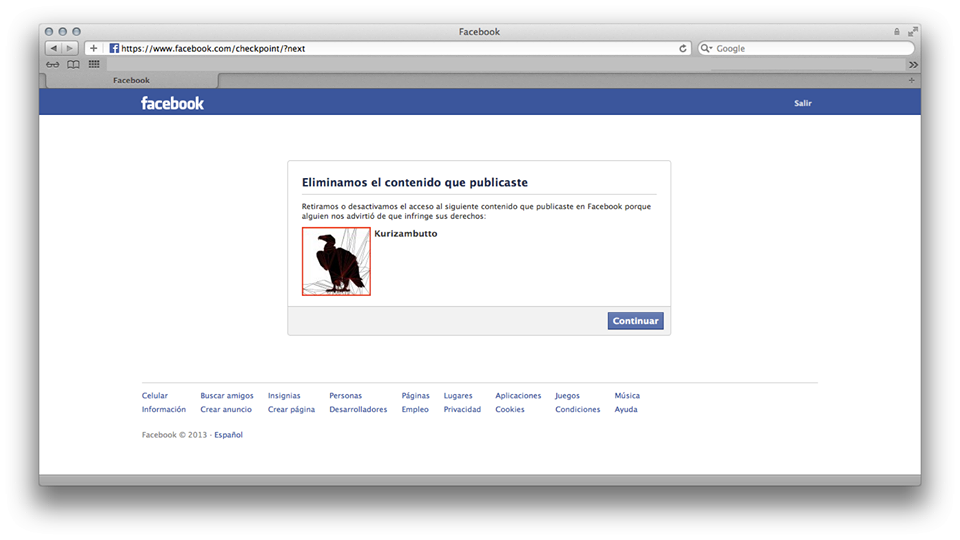
The accusing lawyer is Alberto Bremermann, specialized in art law and copyright.

July 9: Kurizambutto’s page is blocked by Facebook due to an alleged copyright violation.
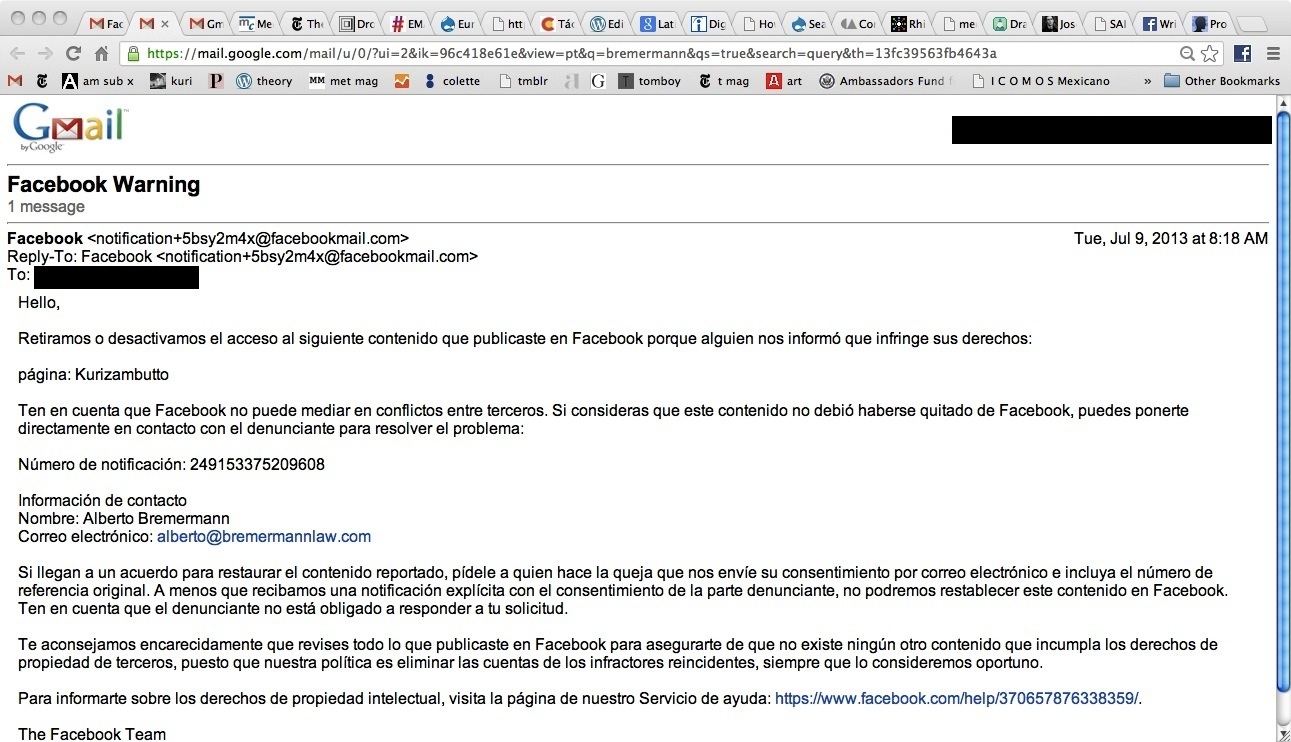
The page can only be recovered if he agrees to re-activate it. A new page is opened, Kurizambutto BACK
July 18: Kurizambutto BACK, the replacement page, closes for good. The project was supposed to last six months to begin with; it is accessible to everyone but no more content is added.
None of the administrators has profited financially from either page. Is Alberto Bremermann using copyright as an excuse to censor a project he and his friends dislike??? If there are some copyright issues, how come he has yet to contact the administrators?
We ask that you spread the news that a net art project was shut down by the lawyer Alberto Bremermann for no reason other than he disliked the content.
You can see his LinkedIn credentials here
Links:
Kurizambutto BACK (replacement page)
https://www.facebook.com/pages/Kurizambutto-BACK/159280534259347
http://kurizambutto.tumblr.com/
https://twitter.com/kurizambutto
Coppel, Eugenia, “Arte que se mofa del arte.”
http://www.informador.com.mx/cultura/2013/471226/6/arte-que-se-mofa-del-arte.htm
Toscano, Javier, “Políticas locales de la crítica de arte. El caso kurizambutto.”
Nuñez, Andrea, “Kurizambutto, no te creemos nada!” (interview)
Open Letter to the Workers and Publics of CCA Ujazdowski Castle from the Winter Holiday Camp Working Group (Warsaw, Poland)
//EN
Winter Holiday Camp is an artistic experiment in institutional democracy open to the collaboration of children and adults alike, including every worker of CCA Ujazdowski Castle and its visiting public. With its initial stages already begun last Spring, and scheduled to unfold during Winter 2013, it is now one of the projects favored for cancellation by CCA director Fabio Cavalucci due to the museum’s financial crisis. This suggestion was presented in Cavalucci’s letter to the Ministry of Culture, which was sent in the beginning of September.
The Working Group of Winter Holiday Camp is a collective of artists and activists from a diverse array of countries. We don’t exist singularly, but rather form a node in a series of networks that straddles political and artistic spheres. We stand in solidarity with Janusz Byszewski and the union of workers (KZ NSZZ Solidarność nr 677 w Centrum Sztuki Współczesnej Zamek Ujazdowski) that published a letter on September 25th on the website of Obywatelskie Forum Sztuki Współczesnej and informed Gazeta Wyborcza about critical situation in their institution – expressing concerns about the current managerial process of the CCA [“Katastrofa finansowa Centrum Sztuki Współczesnej”; September 25th]. We recognize that these concerns of precarity and non-democratic decision-making are endemic of global labor trends: cut-throat corporate models that dominate institutional functioning. Through our art practice, we plan to enact a holiday from the stresses and inevitable conflict of undemocratic systems during the period of Winter Holiday Camp. Despite the initial withdrawal of support from the Director, we have not wavered in our commitment to Winter Holiday Camp or to the staff of CCA with whom we have already begun to work extensively over the past several months; in light of the current labor struggle, we now see our work as even more necessary. The following is an explication of the project’s relevance to the CCA’s political situation and a declaration of our current aims and proposed actions:
The primary goal of Winter Holiday Camp is to form a deeper understanding of the cultural institution and to transform it playfully–working with children as our guides into the future, in search of real solutions to satisfy the shifting fantasies and expectations of a society in transition. Our goals will be bolstered by two primary areas of research: firstly, to grasp the position of the CCA within the larger cultural-political context of a rapidly changing Europe and a global crisis of late-stage capitalism breached by trans-local social uprisings; and further, to understand the internal structure–hidden values and points of conflict–of this specific institution.
Originally a solo project of Pawel Althamer, Winter Holiday Camp will build from the pedagogical practice developed by Janusz Korczak, who worked with children as “little citizens” with full rights, respect and agency. Korczak’s work with children contained an ethical imperative that all people be included in horizontal decision-making processes that affect their lives and livelihoods. This visionary and functional model of democracy resonates with the democratic tools adopted and developed by the recent social movements, including general assemblies, non-hierarchical working groups and collective propositions.
Inspired by the implementation of institutional horizontality within the Berlin Biennale 7, Pawel Althamer made the critical decision to open this project to collaborative practice. He invited Artur Zmijewski, who in turn invited Occupy Museums member Noah Fischer, leading to the formation of a “working group” of artists and activists from Poland, as well as from New York City, New Orleans, Berlin, Mexico City, Madrid, Budapest and Buenos Aires, united in Warsaw to share full authorship over the project and offer participation to CCA staff. (A first document of shared authorship between CCA and the working group, which shares all copyright with CCA workers, can be viewed at Winterholidaycamp.org). The current Working Group of Winter Holiday Camp includes members Paweł Althamer, Raquel Gomez Amborosio, Tal Beery, Imani Jacqueline Brown, Antonio Calleja-Lopez, Maureen Connor, Gabriella Csoszó, Noah Fischer, Federico Geller, Zuzanna Ratajczyk, Dorota Sajewska, Igor Stokfiszewski, Joulia Strauss, Paula Strugińska, Martyna Sztaba, Zofia Waślicka, Katarzyna Wąs and Artur Żmijewski.
We understand that the labor struggle currently embroiling within CCA is not isolated to this particular institution, the city of Warsaw, or Poland. Today, the public sphere is internationally “occupied” by the private interests and values of hypercompetition, leading to funding cuts, museum closures, and market-oriented programming in countries such as the Netherlands that until recently seemed immune to these most toxic effects of neoliberalism. While the economic crisis is blamed for these cuts at CCA, we feel that the deeper crisis is found in the persistent double-think of supporting reckless and undemocratic trends in the private sphere where crashes are frequent, leading to the inevitable slashing of the public’s cultural resources to avoid a system breakdown.
Decision-making power in the culture industry, as in politics, rests in the hands of a powerful few–the 1% “CEOs” of culture. Whatever the mission of the institutions–from education programs to provoking experimental thought and cultural exchange–these decision-makers are increasingly measured and rewarded solely within the metric of “growth”– in profit, size and numbers over quality and criticality.
Winter Holiday Camp was cancelled when the exhibition British British Polish Polish, according to Fabio Cavalucci, “unfortunately failed to obtain all the planned measures and had to decide more funding from the exhibition center.” This exhibition features some of the world’s highest grossing artists, including Damien Hirst, and its privileging over other projects illuminates the museum’s function according to market-oriented logic, namely, as stated by Cavalucci himself, that “the right to distribute the images are [a] promotional tool [that…] adds value to the work and makes it easier to sell.” However, in the same letter to a coalition of protesting artists, Fabio notes that, “today the market system exposes all the constraints and difficulties that it faces. I do not think [it] will survive the data and you will need to create a new support system for art.” The democratic experiment of Winter Holiday Camp was created to model this possible new support system.
After months of planning, including multiple research trips to Warsaw where workers were interviewed extensively, Winter Holiday Camp proposed a program that would give a real holidays to workers, creating time for reflection and resolution, interaction and experimentation. It would be a holiday from an institutional culture of hyperproduction, where one event after another is quickly promoted, exhibited, and packed away to the private market like a cultural assembly line. Counter to this model we would host assemblies, introducing tools that encourage open dialogue, ask questions and probe answers: What kind of institutions do we need? How can art help us to build a more sustainable existence? How can we support alternative practices and models that exist outside of the market? During our latest research sessions we listened to the stories of workers and learned of the existence of a massive archive of unrealized and brilliant projects in the last years: a true hidden treasure of the institution. We would work to make this hidden value visible; to put it into cultural circulation via archives and, perhaps, even implementation.
Thus, in light of the cancellation of Winter Holiday Camp, but with continued dedication to our practice and the relationships we have built, we propose the following next steps, which we will carry out in solidarity with the staff of CCA, regardless of the project’s official re-instatement:
1. We offer to continue together with CCA employees open and transparent process of institutional transformation – focused on better relations inside the institution, non violent processes of collective decision making – and on better relations with people who also create the institution of culture, but are not formally connected with it: artists and viewers.
2. We offer the tool of public general assemblies to have staff-wide and public-wide discussions about the future of the institution. Those of us present in Warsaw will join with CCA workers in assemblies, and if the conditions are made possible for us to continue in Warsaw, we will implement a lasting program of assemblies.
3. We offer to build an archive of the unrealized projects of CCA and of the historical struggle of its workers as the beginnings of a progressive institution-in-resistance.
4. We offer the continued use of our artist/activist networks for the dissemination of the messages of the Solidarity union and CCA workers.
We will see you at the assemblies!
In solidarity,
Winter Holiday Camp
//PL
List solidarności z pracownikami CSW
Zimowe Wakacje/Winter Holiday Camp to eksperyment artystyczny, którego celem jest próba demokratyzacji instytucji – otwarty na współpracę z wszystkimi pracownikami Centrum Sztuki Współczesnej Zamek Ujazdowski w Warszawie, jego publicznością i z artystami. Prace nad przygotowaniem projektu rozpoczęły się wiosną 2013 roku, natomiast jego realizacja miała nastąpić zimą 2013 roku w Zamku Ujazdowskim. Dziś wiemy, że zostanie on zapewne odwołany przez dyrektora CSW Fabio Cavalucciego w związku z kryzysem finansowym w tej instytucji. W liście wysłanym na początku września do Ministra Kultury dyrektor CSW uznał Zimowe Wakacje/Winter Holiday Camp za jeden z czterech projektów, które można odwołać bez szkody dla programu instytucji.
Grupa robocza Zimowe Wakacje/Winter Holiday Camp to kolektyw artystów i aktywistów z kilku krajów. Nie jesteśmy sami, stanowimy część większej społeczności, która angażuje się zarówno w działania polityczne jak i artystyczne.
Wyrażamy solidarność z Januszem Byszewskim i członkami związku zawodowego NSZZ Solidarność w Centrum Sztuki Współczesnej Zamek Ujazdowski, którzy 25 września 2013 roku opublikowali na stronie Obywatelskiego Forum Sztuki Współczesnej list otwarty do dyrektora CSW oraz przekazali go mediom, informując Gazetę Wyborczą o chaotycznym i autorytarnym sposobie zarządzania instytucją przez Fabio Cavalucciego [artykuł: „Katastrofa finansowa Centrum Sztuki Współczesnej”, GW 25.09.13].
Uważamy, że niedemokratyczne sposoby podejmowania decyzji są częścią globalnych procesów widocznych w instytucjach, które zostały w dużej części zdominowane przez wyniszczające modele korporacyjne. Projekt Zimowe Wakacje/Winter Holiday Camp miał być swego rodzaju odpoczynkiem dla pracowników CSW od stresów i konfliktów, nieuniknionych w niedemokratycznych systemach zarządzania. Wycofanie poparcia dyrektora dla naszego projektu nie zmieniło naszego zaangażowania w relacje z pracownikami CSW, z którymi zaczęliśmy rozmowy kilka miesięcy temu. Uważamy, że w sytuacji obecnego konfliktu między pracownikami a dyrekcją CSW nasze działania mogą być tym bardziej potrzebne. Poniżej wyjaśniamy związki naszego projektu z sytuacją w CSW, nasze cele, a także proponujemy działania, jakie chcielibyśmy podjąć.
Naszym głównym celem jest dobre zrozumienie funkcjonowania instytucji kultury i możliwości jej transformacji. Chcemy zaprosić do udziału w projekcie dzieci, aby były naszymi przewodnikami ku przyszłości. Chcemy wspólnie z nimi szukać realnych rozwiązań odpowiadających oczekiwaniom zmieniającego się społeczeństwa. Nasze cele zamierzamy realizować poprzez następujące aktywności:
– zdefiniowanie pozycji CSW w kontekście zmieniającej się Europy i globalnego kryzysu kapitalizmu, na który reagują ruchy społeczne i aktywiści w wielu krajach;
– zrozumienie wewnętrznej struktury instytucji CSW, poznanie jej niewykorzystanych możliwości i źródeł konfliktu.
Zimowe Wakacje zostały zainicjowane jako indywidualny projekt Pawła Althamera, zrodzony z inspiracji praktyką pedagogiczną Janusza Korczaka, który traktował dzieci jak „małych obywateli”, z pełnym szacunkiem i przysługującymi im prawami. Korczak w pracy z dziećmi opierał się na przeświadczeniu, że wszyscy ludzie powinni uczestniczyć w równościowym procesie podejmowania decyzji, które mają wpływ na sposób i warunki ich życia. Ten wizjonerski i funkcjonalny model demokracji jest bliski rozwijanym przez nowe ruchy społeczne demokratycznym narzędziom współdziałania, takim jak otwarte zgromadzenia, niehierarchiczne grupy robocze i kolektywnie formułowane propozycje zmian.
Doświadczenie demokratyzacji instytucji Kunstwerke podczas 7. Berlin Biennale zainspirowało Pawła Althamera by otworzyć projekt Zimowych Wakacji na działania wspólnotowe. Razem z Arturem Żmijewskim zaprosili Noah Fishera z aktywistami Occupy Museum, czego rezultatem było zawiązanie się grupy roboczej artystów i działaczy społecznych z Polski, Nowego Jorku, Nowego Orleanu, Berlina, Meksyku, Madrytu, Budapesztu i Buenos Aires. Członkowie grupy spotkali się w Warszawie i jako osoby wspólnie tworzące projekt, zaproponowali pracownikom CSW kolektywną pracę nad jego realizacją.
Wiemy, że sytuacja, jaka ma miejsce w CSW, walka prowadzona przez jej pracowników, to nie odosobnione starania, które dzieją się tylko w Warszawie czy w Polsce. Dzisiaj sfera publiczna jest polem nadmiernej rywalizacji ekonomicznej i walki o władzę. Kultura natomiast staje się środkiem cynicznego zabiegania o rozgłos, reprezentację władzy, lub partykularne interesy partii politycznych. Instytucje kultury często opierają się na logice eksploatacji pracowników, odbierając im w ten sposób twórczą wolność, a bywa, że są zarządzane w sposób autorytarny.
Za cięcia budżetowe w CSW dyrekcja tej instytucji wini kryzys ekonomiczny na świecie. My natomiast uważamy, że poważniejszym kryzysem jest uparte uczestnictwo w nieustannym konkursie na ilość produkowanych wydarzeń kulturalnych i wystaw, bez liczenia się z możliwościami pracowników i z faktycznie posiadanym budżetem.
Władza podejmowania decyzji w przemyśle kultury, podobnie jak w polityce, spoczywa w rękach garstki ludzi – jednego procenta wszystkich ludzi kultury. Rzecz w tym, by to zmienić i by decyzje o kształcie instytucji kultury, ich ustroju i celach, były podejmowane nie autorytarnie lecz demokratycznie. Celem projektu Zimowe Wakacje/Winter Holiday Camp jest działanie w kierunku takiej zmiany.
Po kilku miesiącach planowania i spotkań roboczych, podczas których prowadziliśmy wywiady z pracownikami CSW, zaproponowaliśmy ramę działania, które umożliwiłoby faktyczne wakacje dla pracowników, dając im wolny czas na refleksję, rozmowy i stworzenie na nowo instytucji, w której pracują. Miałyby to być wakacje od zinstytucjonalizowanej kultury nadprodukcji, w której jedno wydarzenie goni następne, wszystko jest błyskawicznie promowane, wystawiane i odsyłane na rynek komercyjny, jakby to była taśma produkcyjna fabryki sztuki.
Zamiast tak wyprofilowanej produkcji, chcemy najpierw praktykować otwartą, równościową debatę na temat instytucji, jakich potrzebujemy; na temat sztuki, która może pomóc w kreowaniu stabilnego świata; na temat wzmacniania alternatywnych praktyk kulturowych i modeli sztuki istniejących poza sferą komercyjną.
Podczas naszych rozmów z pracownikami CSW słuchaliśmy ich historii i odkrywaliśmy jak wiele mieli w ostatnich latach dobrych pomysłów, które nie zostały zrealizowane. Kreatywność pracowników CSW to ukryty skarb tej instytucji i świadectwo jej niewykorzystanego potencjału.
Niezależnie od prawdopodobnego odwołania projektu Zimowe Wakacje/Winter Holiday Camp, dzięki naszemu zaangażowaniu w relacje, jakie nawiązaliśmy z pracownikami CSW, możemy zaproponować następujące działania:
– kontynuowanie wspólnie z pracownikami CSW publicznego i przejrzystego procesu transformacji instytucji, który koncentrować się będzie na odzyskaniu zaufania wewnątrz niej, na nieprzemocowym procesie wspólnotowego, równościowego podejmowania decyzji oraz na włączeniu w te działania ludzi, którzy także tworzą instytucję kultury, ale nie są z nią formalnie związani: artystów i publiczności; może się to odbywać w drodze otwartych spotkań i zgromadzeń;
– użycie artystycznych i aktywistycznych sieci kontaktów do rozpowszechniania informacji o reakcji pracowników CSW na sytuację w ich instytucji, a także o zachodzącym w tej instytucji procesie transformacji;
– stworzenie archiwum działań pracowniczych w CSW na rzecz zmiany instytucjonalnej, w której chcemy wziąć aktywny udział.
Do zobaczenia na zgromadzeniach!
Grupa robocza realizująca projekt Zimowe Wakacje/Winter Holiday Camp:
Paweł Althamer, Raquel Gomez Amborosio, Tal Beery, Imani Jacqueline Brown, Antonio Calleja-Lopez, Maureen Connor, Gabriella Csoszó, Noah Fischer, Federico Geller, Zuzanna Ratajczyk, Dorota Sajewska, Igor Stokfiszewski, Joulia Strauss, Paula Strugińska, Martyna Sztaba, Zofia Waślicka, Katarzyna Wąs, Artur Żmijewski
 ArtLeaks