Updates
ACT NOW! Submit your story to ArtLeaks and end the silence on exploitation and censorship! Please see the submission guidelines in the "Artleak Your Case" page
Submitted and current instances of abuse are in the "Cases" section
To find out more about us and how to contribute to our struggles, please go to the "About ArtLeaks" page
Please consult "Further Reading" for some critical texts that relate to our struggles
For more platforms dedicated to cultural workers' rights please see "Related Causes"
For past and upcoming ArtLeaks presentations and initiatives please go to "Public Actions"
via Ben Davis & Sara Roffino (ArtInfo)
The world is watching Turkey’s wave of protests, currently in the news as police storm Taksim Square. The country-wide popular movement began over the development of a park, but has come to channel much larger issues about free speech, the costs of the country’s breakneck development, and the alliance of the government with corporate interests. Many Turkish artists have participated enthusiastically — and, indeed, recent protests in the Turkish art world foreshadowed the turmoil currently roiling the country.
The official opening of the 13th Istanbul Biennial is still three months away, but preliminary programming and performances have been spurring protests for over a month already. Sponsored by Koç Holding — the largest conglomerate in Turkey with businesses in construction and energy among other industries — the biennial has become a target of the same discontent over urbanization and financial inequality that has brought thousands of protestors into the streets over the past few weeks. (A video of one of the earlier protests, dated March 22, 2013, is embedded below.)
The public program of the biennial, titled “Public Alchemy,” began in February with events designed to examine “the ways in which publicness can be reclaimed as an artistic and political tool in the context of global financial imperialism,” according to the biennial’s website. Protesters, however, have been targeting the events over its sponsorship by Koç Holding, bringing up issues very much tied to the same anxieties over ruthless development that sparked the Gezi Park movement.
On May 10, activists wearing Koç banners and the names of gentrifying neighborhoods on their shirts laid down in the middle of a performance by Brussels-based artist duo Vermeir & Heiremans. The protesters were escorted out by security in a manner they described as “rough,” while one audience member trained a video camera on biennial co-curator Fulya Erdemci.
Biennial organizers have not minced words in denouncing the activists. The day following the incident, Erdemci and her co-curator Andrea Phillips released a statement implying that the protest was an act of “psychological violence, harassment, and violation of individual rights.”
Earlier this week, with Turkey’s dramatic protests drawing attention to these issues, over 100 individuals working in the Turkish art world publicly issued a statement (which can be seen on the website ArtLeaks). A preamble explains:
We wrote the following text on May 25th, 2013. With the beginning of the protests at Gezi Park, our priorities shifted and we decided to postpone its circulation. Today, especially after “last week”’s experiences, when we rethink what happened on May 10th, we are even more convinced of the urgency of this letter.
The letter goes on to condemn the curators’ response to the action:
Whilst pretending to have a “public” discourse, this applied intolerance towards critical and different voices, the violence towards protesters, and the attempt of detaining a platform member because he was video recording the activity, and calling the police and taking him to police station and making charges against him cannot be an acceptable attitude.
The authoritative, judgmental and uncommunicative attitude of the 13th Istanbul Biennial towards different voices of the public is highly in contradiction with its claims to “activate social engagement and public fora to generate a possibility for rethinking the concept of publicness”.
We would kindly and urgently invite you to change this authoritarian reflex and rethink the proposed process (structure) of the 13th Istanbul Biennial.
In response, Fulya Erdemci has issued a new statement on the Biennial press site, responding to the open letter by apologizing for the treatment of protesters and stating her solidarity for the protests in the Taksim Square, but also clarifying her side of the disputed events:
1) Due to the negative experience of the protests on March 22 at the “Public Alchemy” programme at the Istanbul Technical University Maçka campus, which obstructed the presentations of Eren Erdem and Adbusters (as well as university classes and exams), we took an incorrect attitude at our third event, for which we apologize.
2) The protest on May 10 took place during the lecture-performance of Katleen Vermeir and Ronny Heiremans, who were intending to offer a critique of the multifaceted and complex relation between art and capital, and it disrupted the audience’s experience of the performance. The protestors were removed from the venue so that the artist duo could resume their performance.
3) The police have become involved not because of the protests, but due to a personal provocation and harassment and both parties have filed complaints against each other. No complaint has been filed in regard to the protest or against the protestors. The video recording that is the subject of the complaint is not of the performance or the protest during the event, but rather a continuous, targeted filming of Fulya Erdemci for one hour and fifteen minutes. The complaint was filed by Erdemci after the declaration that this recording would be used in a video work without Erdemci’s consent. The other party has filed complaints against Erdemci on two accounts.
We understand the concerns of some members of the art community who have reacted to this incident. We want to assume responsibility for transforming the action-and-reaction process and would like this incident to lead us all into a space of reflection and discussion. Therefore, we invite all interested parties to a peaceful and constructive discussion at the Gezi Park Democracy Workshops, where we can reflect on and talk about this and other urgent matters.
With the images of protesters facing off with riot police now filling the news, this is sure to seem a side note. But it is also an indication about how the grievances over public space and corporate development underlying the protests are an issue that runs through every sector of Turkish society, and are not likely to go away.
Video of protests at the 13th Istanbul Biennial:
The 13th Istanbul Biennial was protested by ArtHack, Bağımsız Sanatçılar, Bağımsız Üniversite Öğrencileri, Emek Gençliği, Gündoğusu Sanat ve Düşün Topluluğu, Güney Kültür Sanat ve Edebiyat Dergisi, Homur Mizah ve Karikatür Grubu, Halkevleri, Kamusal Sanat Laboratuvarı, Kent Hareketleri, Öğrenci Kolektifleri, Red Fotoğraf, Sosyalist Demokrasi Partisi at IstanbulTechnical University, Istanbul.
Evgenia Abramova // “Manager” v.s.”Girl”
Evgenia Abramova continues to research the working conditions of art workers in Moscow.
Introduction
The research project “The Labor Conditions of Art Workers in Contemporary Art Institutions in Moscow: Manager v.s. Girl,” is a continuation of “On Art Workers’ Labor Conditions (Moscow)” which was based on the work of the May Congress for Art Workers (2010-2012), as well as other individual and collective activist initiatives.
The project “On Art Workers’ Labor Conditions (Moscow)” addressed these issues from the point of view of a group of actors in contemporary art who enjoyed the privilege of visibility, that is to speak publicly and be acknowledged; the study analyzed the working conditions of these art workers (artists, curators, critics), in relation to their employers and customers.
At the same time, we noted that those who are working in the lower levels of the existing institutional hierarchy were excluded from this public sphere: that is, those employees of contemporary art institutions involved in the organization of events and exhibitions which are informally referred to as the “Girls.” Their working conditions are rarely discussed publicly, and very few people are interested in this topic, except the workers themselves, their employers and customers. At the same time, the “Girls” do most of the work in the organization of exhibitions, educational programs and publishing.
Our latest research project had two objectives: to make the voices of those who had been excluded heard, and to make the women-workers in contemporary art institutions aware of the problems of precarious employment (precarity), of the previous activities of the May Congress of Art Workers and of the support resource “The Labor of Art Workers: Legal Aspects,” co-organized with the Center for Social and Labor Rights in 2012. Therefore, the interview questions looked into the conditions of these women’s labor and also explored how they could be improved.

Photograph by Katerina Beloglazova
We organized six interviews with women-workers in public institutions (museums, exhibition centers) and private ones (foundations and galleries) in Moscow. The selection criteria were: that the interviewees had to be employed in contemporary art institutions, their duties had to include exhibition organization and they could not have subordinates. In addition, we excluded those who served as curators and PR-managers.
We searched for respondents through our colleagues, as employee information was difficult to find on the websites of art institutions; either this information was missing, or there was no clear identification of who is responsible for what in these spaces. In addition, not all these employees attend public events or are registered on social networks.
We sent out 12 requests for participation. Four of them were never answered, one responded that the issue of working conditions was not relevant to her and she didn’t have time for an interview, and in another case the women-worker responded that there were no employees matching our criteria for interviews in the institution.
We conducted the interviews in March and April 2013 in coffee-shops or at the workplace, and each of them lasted anywhere from 40 minutes to over an hour. Interview questions explored areas related to education, working in the institutions (contract, wages, taxes, social security, working hours and duties), professional development and work ethics.
We prioritized the safety of the respondents during the interviews, as we believed no one should lose their job for participating in our research study. For example, when discussing the publication of this material, it became clear that anonymity was necessary. Moreover, even those who in the beginning were ready to make their names and their place of employment public, eventually changed their minds. Therefore, details from the interviews referring directly to the workplace were removed, but in general most of the responses were not modified significantly.
At the same time, we have to note that the choice of anonymity dictated by the aforementioned constraints within the public sphere, made the project on the whole look conformist. On the one hand, anonymity testifies to the absence of the usual language used to describe everyday working conditions and on the other hand to the lack of resources for building and developing such a language by the researcher and respondents; all this despite the fact that our research was in line with the work of feminists, leftist activists and non-profit organizations dedicated to the protection of labor rights.
The researchers’ position in the course of the project also changed. Initially, the study was planned as a joint effort between male and female participants, but in the end the main aspects of the projects (and the most time-consuming) were done by the women only. The respondents were also all women. Therefore, even though the initial focus on the project was on general issues related to working conditions in contemporary art institutions, by the end, many issues related to gender discrimination also surfaced.
The Labor of Women Workers in Contemporary Art Institutions in Moscow
I don’t know what to call it- ‘manager’, probably
In contemporary art institutions and even among the women-workers themselves, there is no common terminology for the position they hold. The position is sometimes referred to as “manager,” “employee in the exhibition department,” “gallery coordinator,” “assistant,” “receptionist, secretary, hostess,” or “junior researcher.” As one of the interviewees explained, “In Russian there is no glossary of terms referring to specialization in the gallery business. In English you can use “gallery people, gallery staff,” and it’s OK. If you were to say in Russian “Ask the gallery personnel” – it would sound very strange – the same with saying “gallery manager” or “Ask our managers.”
In our opinion, the fact that there is no commonly accepted designation for these positions is evidence of several problems. First, that this position is not recognized as a profession, one which could be standardized according to a set of skills and knowledge that can be taught or learned. Moreover, it is difficult to define the parameters of this labor, such as the time necessary for implementation, as well as what the appropriate payment might be. As a result, this type of labor has a low public profile, low pay and virtually unlimited duties, a situation akin to an around the clock schedule and a short career ladder. Furthermore, this labor is done mostly by young women, whose professional opportunities are largely conditioned by gender stereotypes.
I wanted to get experience in this field
All women-employees involved in organizational work in art institutions were specialists with higher education. Four of them graduated from the Department of Art History at the Moscow State University, one from the Philological Department in a regional university and only one currently works according to her specialty – “Management.” However, most of them did not use the knowledge they acquired in university. Currently, universities which offer courses in exhibition practice do not prepare graduates for the actual requirements and practices in contemporary art institutions. In turn, new educational programs at other institutions (for example, “Management in the Cultural Field” at the Moscow School of Economics and Social Sciences) are not attractive for those searching for a professional education. None of the interviewees considered the prospect of professional development, such as getting a second higher degree in cultural projects management.
Therefore, contemporary art institutions often replace the role of higher education by offering specialized training for their staff while performing their duties. This involves acquiring organizational skills as well as knowledge of the history of contemporary art in Russia and internationally.
For example, the job of one interviewee working in a gallery was to “learn to write exhibition texts.” Another, who had knowledge of Russian contemporary art history stated that the gallery where she worked “took part in all the important art events in the 1990s, and that’s very cool.” An employee of state institutions expected to “enhance my knowledge and get some working experience.” According to her “All this came true.” “In the process, I got to know many interesting people, with whom it would be interesting to work in the future, to implement something” – declared an employee of a foundation.
However, when institutions control the teaching process, they also dictate the conditions: the presence or absence of a contract, the list of duties, the amount and methods of payment, the work schedule, taxes, etc. That is, the “manager” – the one who performs the duties – has to follow the instructions of the employer, and is not considered a colleague as those employees involved in the development of the institution, who collectively determine its policies and receive adequate compensation for their work. Thus, with a higher degree in the humanities, a graduate can get a job as a “manager” and acquire the status of a low-skilled and low-paid “girl,” responsible for indefinite range of duties, working in an around the clock schedule, and at the same time denied social benefits.
You can never say ‘It’s not my responsibility’
Paradoxically, even though employers and institutions assume their “managers” don’t have professional knowledge and skills, they expect them to have knowledge and skills in broad areas, ranging from writing texts and press releases to cleaning the premises. To the question “What are your work duties?” the women-workers responded “Everything.” In the case of galleries, “everything” refers to “building exhibition plans, supervising the setting-up and breaking down of exhibition, organizing shipments, applying to international art fairs and visiting them, sales operations, hotel reservations,” as well as “creating posters and invitations, newsletters, organizing artist talks, cleaning the premises.” In the case of foundations, this implies “everything from project planning to production phases,” including “various agreements and insurances, cost estimates.” Finally, the employees of state institutions work on “coordination, documentation, artists’ contracts, press releases and writing conceptual texts.” As one of the interviewees remarked, “If you are responsible for a project, you have to see it from head to finish.”
The employees themselves believe that it is not possible to standardize their duties, nor to draw an official, precise contract. In their current contracts, their responsibilities are described abstractly and do not correspond to the actual duties that they perform. One of the women-workers at a foundation stated that: “In the process of organizing an exhibition it is very difficult to restrict my responsibilities, because when you work the way we do, you can never say ‘It’s not my responsibility.’ That is, you have to do what it takes to organize the exhibition well.”
At the same time, the women-workers clearly separated those duties which pertained to their profession from what they believed were tasks they shouldn’t be responsible for. For example, a woman working in a gallery told us how her employer – a man – asked her to look for “household items,” “where you can buy some medicine or to report on where there are traffic jams.” Another woman working in a foundation had to clean up “the exhibition space before the opening, because the cleaning lady was not there, and the opening was in an hour”; in another instance, “I had to meet an artist at the airport, and take him to the artist’s studio.” Another of them goes to the store to buy coffee “when the office runs out of it.” And she also takes “friendly requests” from her work colleagues: “print things when someone does not have time to do it; write some text for somebody, translate from English into Russian and from Russian into English, make calls for someone or help collect documents for visas.”
According to an employee of a state institution, even though she is not forced to do so, she still has to proofread contracts, despite not having the necessary legal knowledge. “Over the past six months, I had to draw up many documents, which I formulated myself, and I spent a lot on time on this task.” She also serves as a courier, designs posters and makes labels, translates texts. This is an unusual duty, as it is the responsibility of other employees of the institution – in this case, the designer. “Currently there is a system of memos through which we contact the designer, and he will not do anything unless the project comes with the correct papers – and so, if the matter is urgent we have to make the design ourselves,” – she explained.
Similarly, all employees are themselves responsible for an art event to go as planned, and in the best way possible. Otherwise “If you don’t do what is needed, then the exhibition cannot develop properly.”
At the same time, women who worked in state institutions admitted that other employees were not assigned duties according to the same logic. “It is strange for us, as coordinators to be assigned to do all these different things, like Superman, while others who have more specific duties reply: “That’s not part of my job, I will not do it,” when you ask them to do something. They somehow are more aware of their value. We don’t have this privilege,” remarked one of the women.
From morning until evening, non-stop calls, letters
The unlimited range of job responsibilities translates into endless workdays for these women. And yet, in the statements they gave for our project, we found that there are two co-existing models according to which they organize their lives. The first one, an eight hour work day and leisure time, the second – when their free time is not separate from their work time, as both are subject to the logic of professional interest.
Thus, as one employee at a state institutions stated, “We are art workers, that is in our free time, on the one hand, we work, on the other, it is our own free time because it coincides with our personal interests. And the two are so intertwined that it is impossible to separate them: I am doing this for work, as opposed to I am doing this for myself. If you are interested, then you’re keen to be involved as much as possible, and this is very intimately connected with your personal life.”
Therefore, it is difficult for these women to distinguish between work and leisure, while their responsibilities are numerous and not restricted to a certain field, nor to an employer. And even they themselves are unable to control their working schedule. Nevertheless, the 8-hour working day model (according to the Russian Federation Labor Code) protects them from exhausting, round-the-clock work.
Photograph by Katerina Beloglazova
All the interviewees worked overtime, including weekends and night shifts. “At least four times [a week] to be exact,” – a coordinator of a state institution replied and “almost every day” replied one working for a foundation. “On the eve of a project you can be delayed at work every-day, and it is not always possible to leave work at seven,” said the coordinator of a private foundation.
A gallery employee works seven days a week and takes a day off sometimes: “From morning until evening there are non-stop calls, letters to answer.” However, not all gallery employees have such a tough schedule. One of them said she leaves early “a couple of times a week” if opportunity presents itself, while another declared that she sometimes does other work while on the job. According to her: “It is important to add that in my spare time, that is when there is no installation or emergency to attend to, I do a lot of personal errands at work. For example, I study or do some outside work, though this rarely happens; and it is up to me how I plan my day. And sometimes I work overtime because I didn’t get to a task during the day and I need to finish it.”
Overtime is not taken into account and is not paid, but sometimes the employers may compensate for this with additional holiday time or a premium at the end of a project.
However, if work time and free time are conflated into “professional time” that organizes these women’s leisure, it is difficult to determine what a holiday really is for them. Exhibition coordinators also go to exhibitions, attend lectures on art, go to the theater, learn foreign languages, travel and sleep.
However, it is sometimes possible to simply rest on vacation, using of the rules of the Russian Federation Labor Code. An employee of a foundation developed a special skill for this: “I have learned to relax while on vacation. I used to not be able to let go of work issues, but now I am trying my best to distance myself from them,” she said.
What I really miss is having an independent life in Moscow
How to pay for a manager’s job with abstractly defined duties and a non-standard schedule? Does this job offer these women not only professional knowledge and skills, but also financial independence? The salary to expenses ratio shows that “project managers” are low-paid positions, which means that these women have to get support from their families or are forced to look for additional sources of income.
The salary depends on the type of the institution and on the financial means of the employer (or owner). The least well paid are employees of state institutions. Their salaries are determined by a pay-scale: while the basic salary is seven thousand rubles (220 US Dollars), they also receive bonuses and premiums (including a 13th salary). However, they do not know the amount of additional payment, and they are paid irregularly, according to the whims of their employers. A junior fellow at a state institution receives 20.000 rubles (630 US Dollars). As one of the interviewees explained: “I don’t keep track of my financial history, simply because I do not understand it, and I don’t understand on what it depends exactly. Sometimes you work really hard and get nothing in return.”
Private galleries offer similar compensation, and sometimes more than state institutions – up to 25.000 rubles (790 US Dollars), 20.000 for the training period, but without any prospect of a salary raise. However, unlike the case of state institutions this amount is fixed and the women are aware of it before they begin working. Any possible bonuses, the criteria for payment and amounts depend entirely on the employer. Gallery directors who have about the same responsibilities as their coordinators, receive anywhere between 50.000 to 80.000 rubles (1600 – 2500 US Dollars).
Compared to state institutions and private galleries, women working for private foundation receive the highest salaries – from 40.000 to 60.000 rubles (1250 – 1900 US Dollars). They also receive bonuses equal to half of their salary, but the criteria for their social benefits are not clear. Women who work for foundations expect to get salary raises over time, but for this they have to work harder and better.
Both private and state institutions pay salaries on time. None of the women experienced salary delays, regardless if they had a contract or not. (Salary data was correlated with different employment lengths at a given institution. The longest employment period was at a state institution – one year and nine months. The shortest – 6 months at a gallery)
Having a contract or not, is also partly dependent on the type of institution and the financial resources of the employer (owner). Four out of six interviewees worked with a contract: one of the foundations, one of the galleries and one of the state institutions. A woman working for another gallery did not have a contract, but as she stated “I work without one, as the matter of getting a contract hasn’t yet been resolved.” Another women working for a gallery refused to answer the question, explaining that she didn’t know if she had the right to discuss it without her employer’s permission.
Having a contract means that these institutions pay income taxes, make contributions to the Pension Fund and the Social Insurance Fund, as thus fulfill their social obligations to its employees. In the cases in which they work without a contract, the employer deprives the women workers of social benefits, not only in the present, but also in the future, no matter how little money is involved.
For the women themselves, paying taxes and making contributions to pension funds are not a priority. Nevertheless, they feel anxious about their retirement. Two employees of the galleries (one of them worked without a contract) said they tried not to think about retiring “because it is scary [to think about it].” “I think about it once every six months and cry a lot.” remarked another woman. She also added that all of her revenues from previous jobs were “under the table” even though at work they had promised her a “clean” salary for over five years. “At the same time, I do not believe in this state, nor in pensions.” But for those who work with a contract, their prospects will be the same as those of their grandparents, because: “There is a small difference whether I work or I don’t.” according to a gallery employee.
Photograph by Katerina Beloglazova
As for living costs, all the women we interviewed were between 25 and 30 years old, five of them were not married, six of them did not have children and none of them had a family to support. All had enough money to buy food and clothes, and most of them rented apartments in Moscow (four out of six). Rent was the biggest expense, and according to one of the women with a salary of 25.000 rubles (800 US Dollars), “it is not enough to get by.”
The majority of the women (four out of six) found themselves in various stages of financial dependence on their parents, while only two had financial autonomy, which in the case of one of them was possible because of her relatively high salary (50.000 rubles/ 1600 US Dollars) and in the case of the other – thanks to savings. But even with the financial help of her relatives, a woman working for a state institution had to “work on the side” to earn a living: “to write texts, teach drawing classes for children, design posters, translate.” She even helped established artists to produce their works, and from this she “earned a certain percentages.” But those are one time, incidental part time jobs paid in cash. “The main thing I miss is an independent life in Moscow,” concluded woman working for one of the foundations.
Only a woman can deal with so much organizational work
What perceptions do women-managers working in contemporary art have of themselves? We observed that they are dealing with a patriarchal model, in which young women have a subordinate role both at work and in the family.
“As a rule, women are more sociable, thoughtful, careful and pleasant” and they “provide comfort,” said one of the women. Another suggested that women “are more complacent and effective.” “Only a woman can deal with so much organizational work,” said a third.
“Many, though not all of us, see ourselves as becoming wives and mothers, and they don’t think that they will work all our lives in a museum. That is, they see this as a temporary job and expect that their future husbands will take care of us eventually,” added another.
Moreover, as one of the interviewees noted, “On the one hand, there are the gender stereotypes according to which men are paid more than women. On the other, the leadership of the institution finds it easier to work with women-assistants.”
“It’s pretty though work in stressful situations. Older men would prefer something more peaceful. In our line of work we have responsibilities, but there is little room for initiative, or if you do have space for initiative, then there is little room for self-fulfillment or assertion, which one needs after a certain age, like after forty,” concluded one of the women-workers.
In general, the women-workers experienced professional segregation in the field of contemporary art (uneven distribution of workers’ groups in the industry). According to them, in the humanities sector as a whole, women are dominant, a trend which confirms their experiences in university. In their view, in contemporary art, women are mostly “providing services,” while men either have leadership positions, or are artists, or technicians.
But when it comes to their own professional development, women see themselves coming from a model of gender equality, where they work alongside men without any professional segregation. “Everything depends on the person in the first place,” said one of them. But she also added that if it were not for the support of her family, she would have to look for a better paid job.
Three other women-workers believe that their professional growth depends only on themselves, and not on their gender: they just have to show more personal initiative and take on more responsibilities. However, they are not planning on becoming curators: “I have no professional ambitions, I am not going to become a curator and I don’t think that my work will lead to any creative development. But it may lead to a position in management of more complex, large-scale projects,” said one of them.
Two other women plan on becoming curators and gaining greater autonomy in decision making than they currently have as project managers. However, one of them believes she will get more experience and a professional status under the guidance of a male curator, for whom she currently works as an assistant. Another woman has been relying on the help and support of her employer during the two years of being in an administrative position at a gallery: she expects either to find a better paying job or go work for a foundation with a broader range of responsibilities.
At the same time, one of the interviewees said that “in art, there is practically no such thing as a career ladder.” She added that transitioning to a new job does not always bring better wages, and even when you become director of a gallery, the range of responsibilities is about the same. Another woman is planning to write a Ph.D. dissertation, but according to her: “the situation with my work is so terrible, I simply don’t manage to do my research.”
Thus, in some cases we have the situation of the “sticky floor,” a metaphor which became a theoretical term for describing labor of women. Our use of the expression invokes women’s limited occupational mobility in different professions, while the expression “glass ceiling” refers to the restrictions they encounter in attaining leadership positions (top management, government leaders etc.). The problems associated with the “sticky floor” include low pay, low professional and social status and a short career ladder. The situation of the so-called “managers” in contemporary art institutions by and large meet these conditions. In short form, it finds its expression in the commonly used “girls” which refers to women working in the (lower) starting positions in the institutional hierarchy.
You promised us a girl
Being a “girl” is a sign of subjugation, oppression, exploitation and humiliation. It refers to an eternal child, non-adult, dependent, disposable and replaceable by another. Any woman can be called “a girl” – they can be used and discarded by those in higher position in the gender, institutional and professional hierarchies. “Girl” therefore refers to a woman whose professionalism will never be recognized.
Despite the fact that these women are rarely referred to as “girls” directly at work, this term is very commonly used in casual conversations. Other informal terms include “kiddo” and “Cinderella.” “This is how my director, a man who is older than me and has a superior position, calls me. He says it habitually. And this is his usual attitude towards me: I am small, naive, emotional” explained a woman who is nick-named “kiddo.” Another one was called “Cinderella.” This referred to the time when she volunteered to come to work at an installation from 8 AM commuting from the other end of town; the curator, a woman, said that “the smallest people in the art business are always the holiest.” “Basically, she wasn’t saying anything that was not true, but it was the first time in months when I almost burst into tears,” she said.
“You promised to give us a girl to take us through the art fair.” – heard a woman who was handling clients for her employer. “I do not take notice of it because it is not my problem.” she said trying to explain her reaction. But it was not always like that. According to her: “We used to struggle with this. We protested that we are not “girls” but “gallery employees.” And this term [girl] had a “belittling” effect. “We used to care more, but now I personally do not.” she said. “This is not a malicious offense,” added the women referred to as “Cinderella,” explaining that in her situation, her employer supported her by making a remark to the curator in question. “I would like that this word [girl] would never be used and that we would be on equal terms. But what can I do? I cannot even imagine saying: “Don’t call me that” – another woman-worker said describing her situation.
At the same time, the term “girls” does not have a negative connotation in all cases. This is how women working for a foundation called each other during the job. Another woman said she never experienced this type of treatment and, consequently, did not pay attention to the problem.
Conclusion
Despite the fact that, according to research, the situation of part-time workers in contemporary art institutions should more stable in comparison to that of artists, freelance curators or critics, nonetheless, labor relations are unilaterally determined by the employers. Art workers today do not have a say in the terms of their employment, but they do have some bargaining power in normalizing the conditions of their labor. In the case of women “managers” they are the ones who do all the preparatory work for exhibitions, educational programs, and publishing in institutions. They have extensive knowledge in many different areas, including technology, and use them inventively. All in all, it depends on them wether a cultural event in Moscow will happen or not.
We envisioned our project to be an insight into their working conditions, that could generate more discussions and even help formulate demands in collaboration with a small and scattered, but nonetheless existing working group of left-wing activists and feminists, and with the support of public organizations dedicated to the protection of labor rights.
The author would like to thank all those who supported her with advice and recommendations: Dilyara Valeeva, Sergey Guskov, Valentin Dyakonov, Ekaterina Lazareva, Gleb Napreenko and Nadia Plungian.
Translation of the text from Russian by Corina L. Apostol. This research study was originally published on colta.ru
The Artists’ Revolution & “art but fair”
On 19 February 2013, the musical theater producer Johannes Maria Schatz created, on impulse, a Facebook page called “The saddest and most outrageous examples of artists’ fees and audition experiences”; it immediately whipped up a veritable storm amongst artists. Within hours, the page had several hundred “likes”; after two and a half months there are now over 9,000. Artists of all disciplines started to share their own experiences, bringing to light hair-raising and degrading conditions under which artists are forced to work. For the majority of artists, it is well-nigh impossible to earn a living in their chosen profession, despite having undergone years of study and being highly qualified. The first media reports on this “Artists’ Wailing Wall” appeared in the Berliner Zeitung and the Frankfurter Rundschau.
The Facebook page received high-profile support on 11 March 2013, when the Austrian mezzo-soprano Elisabeth Kulman dared to openly denounce unfair practices in the cultural “super-league”, which had previously only been whispered off the record. She criticised in particular the abolition (without any substitution) of rehearsal fees by the Salzburg Festival under director Alexander Pereira for opera productions requiring several weeks’ rehearsal; scheduling jammed together with no regard for singers’ physical capacity; and management incompetence and corruption. Ever since she called artists to the “Revolution” on 16 March 2013, the media has pounced on this hot topic (it was covered by, amongst others, Opernnetz, Salzburger Nachrichten, Die Welt, Wiener Zeitung, Süddeutsche Zeitung, Profil, Kurier, Artsjournalblog “Slipped Disc”, ORF, BR, WDR and NDR).
Elisabeth Kulman’s public criticism was supported by fellow singers including Laura Aikin, Marlis Petersen, Markus Brück, Thomas Moser, Jonas Kaufmann and Simon Keenlyside. Eminent international agent Dr Germinal Hilbert, directors Barrie Kosky, Sir Peter Jonas and Ioan Holender, numerous journalists and psychiatrist Dr Déirdre Mahkorn, head of Germany’s first “stage fright ambulance”, agreed that “this diseased system is harming artists”. A wide-ranging and lively discussion is now under way which is making the huge need for action more than obvious.
The team around Johannes Maria Schatz and Elisabeth Kulman is pursuing the following goals with this “Artists’ Revolution”:
- to connect all artists with one another and to bring about solidarity amongst them;
- to bring the public’s attention to the grievances we face and to bring light to the professional image of artists;
- to raise awareness about the significance and unique worth of the arts and the artists;
- to bring all parties involved in the cultural milieu – artists, presenters, artistic administrators, agents, pedagogues, cultural politicians, etc. – to the negotiation table and to look, collectively and through a constructive dialogue, for measures to improve upon and to correct the situation.
An on-line discussion board for all professionals who share the aim of reforming the sector, particularly the opera industry, is already in its beginning stages (OpernReform.com).
Simultaneously, the “Golden Rules for the Artistic Milieu” are being formulated, which in connection with the guidelines of the “art but fair” seal of approval, which are to be self-imposed by presenters, should guarantee the existence and observance of respectful practices in the arts.
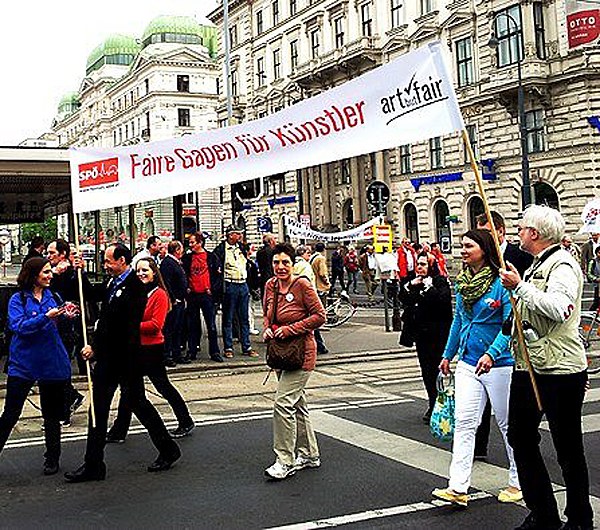
The logo of the “art but fair” movement was unveiled to the public on 1 May 2013, and on the same day, artists marched through the streets of Vienna in favour of “Fair pay for artists”.
For more information please see: http://artbutfair.org
via Anti Istanbul Biennial 2013
A declaration to the Public by Kamusal Direniş Platformu (Kent Hareketleri, Açıkalan Sanat Kolektifi, Kamusal Sanat Laboratuvarı, Homur Mizah ve Karikatür Grubu, Öğrenci Kolektifleri, ArtHack, Gündoğusu Sanat ve Düşün Topluluğu, Red Fotoğraf, Independent Artists, Independent University Students)
Under the management of AKP Goverment, there is an ideologic attack that mainly targets the social transformation; besides it also provides income areas to capital groups by looting natural sources, annihilating the culture and turning the city names to brands. The gated communities and residences which are built upon the former quarters of the exiled poor show us this transformation is a gentrification project. On the other hand, while natural areas, historic and cultural buildings are usurped; malls, luxury hotels, plazas are being constructed instead.
______________________________________________
We wrote the following text on May 25th, 2013. With the beginning of the protests at Gezi Park, our priorities shifted and we decided to postpone its circulation. Today, especially after “last week’s“ experiences, when we rethink what happened on May 10th, we are even more convinced of the urgency of this letter.
We the undersigned, who are all working in the field of art, condemn the reaction of The Istanbul Foundation for Culture and Arts (IKSV) and 13th Istanbul Biennial curatorial team, to the protest that was performed by Public/Common Resistance Platform members at the “Public Capital” event on May 10th 2013.
The protest was organized and performed by a group of activists wearing T-shirts printed with the names of forcibly gentrifying neighborhoods in Istanbul; at short intervals, one would stand up from the crowd and drape him/ herself on the floor in the middle of the room using a piece of cloth printed with the logos of related companies. The performance was finished by IKSV team lifting the protesters up roughly and carrying them off from the venue.
Whilst pretending to have a “public” discourse , this applied intolerance towards critical and different voices, the violence towards protesters, and the attempt of detaining a platform member because he was video recording the activity, and calling the police and taking him to police station and making charges against him cannot be an acceptable attitude.
The authoritative, judgmental and uncommunicative attitude of the 13th Istanbul Biennial towards different voices of the public is highly in contradiction with its claims to “activate social engagement and public fora to generate a possibility for rethinking the concept of “publicness”.
We would kindly and urgently invite you to change this authoritarian reflex and rethink the proposed process (structure) of the 13th Istanbul Biennial.
Please reply to imzaliyorum@gmail.com if you like to join us.
Sincerely,
Ahmet Öğüt, Ahmet Şenkart, Ali Asker Bal, Ali Cabbar, Ali İbrahim Öcal, Ali Mete Sancaktaroğlu, Ani Setyan, Arzu Başaran, Arzu Yayıntaş, Asena Hayal, Asena Günal, Aslı Çetinkaya, Atalay Yeni, Atilla Atala, Aylin Kuryel, Aysel Miman, Azra Deniz Okyay, Barış Acar, Barış Mengütay, Barış Seyitvan, Banu Cennetoğlu, Berk Demirbaş, Bubi, Burak Karacan, Burçak Konukman, Burçin Başar, Canan Beykal, Ceren Oykut, Çiler Belen, Demet Yalçınkaya, Deniz Erbaş, Deniz Gökduman, Deniz Gül, Deniz Ilgaz, Deniz M. Örnek, Deniz Pireci, Derya Aydoğdu, Didem Erk, Didem Özbek, Dilara Hançer Sebah, Dino Dinçer Şirin, Eda Gecikmez, Ege Berensel, Elif Zeynep Karagöz, Emine Corduk, Emre Zeytinoğlu, Endam Acar, Erdağ Aksel, Erden Kosova, Erinç Seymen, Esat Başak, Evrensel Belgin, Evrim Altuğ, Evrim Kavcar, Fatoş Karadağ, Ferhat Özgür, Feyyaz Yaman, Fırat Arapoğlu, Foto Akbaba, Fulya Çalışkan, Fulya Çetin, Füsun Turcan Elmasoğlu, Gonca Sezer, Gözde Kazaz, Gül Bolulu, Gülçin Aksoy, Günay Demir, Hakan Akçura, Hakan Kamışoğlu, Hatice Arıcı, Itır Demir, İbrahim Koç, İlhan Sayın, İlke Yılmaz, İnci Furni, İnsel İnal, Kardelen Fincancı, Komet Gürkan Çoşkun, Lara Fresko, Leyla Sakpınar, Lütfiye Bozdağ, Mahmut Koyuncu, Malik Bulut, Murat Morova, Murat Seçkin, Nalan Yırtmaç, Nejat Satı, Neriman Polat, Nihan Tahtaişleyen, Nilbar Güreş, Nur Ataibiş, Nurcan Gündoğan, Nur Gürel, Onur Ceritoğlu, Onur Gülfidan, Onur Kaçmaz, Osman Bozkurt, Oya Kasap, Özcan Yaman, Özge Açıkkol, Özgür Atlagan, Özgür Çimen, Raziye Kubat, Saadet Sorgunlu, Sakine Çil, Selen Usanmaz, Selin Kocagöncü, Sema Efe, Serpil Odabaşı, Seçil Yersel, Seçkin Aydın, Sevil Tunaboylu, Sevinç Altan, Seydi Murat Koç, Suat Öğüt, Sylvia Kouvali, Şefik Özcan, Şehmus Atasever, Tahir Ün, T. Melih Görgün, Ulaş Başar Gezgin, Uluç Ali Kılıç, Ümit Turgay Durgun, Vahit Tuna, Yahya Mete Madra, Yasemin Özcan, Yasemin Nur, Yavuz Parlar, Yeşim Ağaoğlu, Yeşim Şahin, Yeşim Us, Zeynep Yasa, Zeyno Pekünlü
______________________________________________
The 13th Istanbul Biennial Public Programme co-curators Andrea Phillips and Fulya Erdemci’s statement on the protests of the 2nd and 3rd Public Programme Events
The 13th Istanbul Biennial Public Programme events were disrupted for the second time by the same group of protestors.
At the artists’ performance by Vermeir & Heiremans on May 10 at the Taksim Marmara Hotel as part of the 13th Istanbul Biennial Public Programme, a group of protestors disrupted the performance by repeatedly entering the stage and lying on the floor covered in a banner. They were taken outside the conference room by the Biennial production team so that the performance could continue. During the hour long performance, Niyazi Selçuk, who was among the audience, persistently filmed Fulya Erdemci, the co-curator, Istanbul Biennial Director and their guest.
At the end of the performance, Fulya Erdemci asked Niyazi Selçuk not to use the footage of herself without her permission. Niyazi Selçuk said that he regarded this as a threat and he could use the footage in any manner he wanted. When Fulya Erdemci and her guest stated that this was a violation of their personal individual rights and they would file a complaint to prevent the unauthorized use of this footage, Selçuk responded he wanted to file a complaint against them in return. Both parties filed complaints about the other and legal proceedings were initiated. No complaint was filed against the protestors.
Reflections on what happened
The actions of the protestors at this performance questioning the relationship of art and capital can be discussed and considered in the framework of the relation between art and activism to the extent that they do not entail violence or vandalism. However, can Niyazi Selçuk persistently filming Fulya Erdemci for over an hour be regarded as a protest or activism? If this is to be regarded as a protest method, what is the aim of this protest? Is it possible to bring a political issue to the agenda through psychological violence, harassment and violation of individual rights? When protesting ceases to be a means and becomes an end in itself, what does it actually aim for?
How can political thought and action define and respond to the boundaries between activism, vandalism and opportunism?
The aim of the Biennial and Public Programme is to open up the idea of a real public sphere to all kinds of different voices, even conflicting ideas, in which people can talk without fear and without obstructing one another. Impeding such platforms only reproduces the methods that obstruct freedom of expression. We think that talking, listening and trying to understand each other is the only way to enable social, political and artistic change.
http://bienal.iksv.org/en/archive/newsarchive/p/1/728
______________________________________________
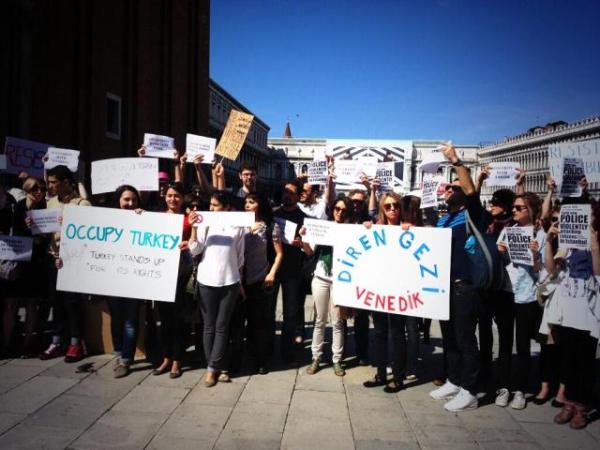
Protesters at a solidarity rally in Venice during the Venice Biennale included Turkish pavilion artist Ali Kazma, Turkish pavilion curator Emre Baykal, curator Beral Madra, Istanbul biennial curator Fulya Erdemci, Witte de With director Defne Ayas, and others.
Support for the protesters in Turkey also came from Venice, from those attending the opening week of the Venice Biennial. It is worth noting that the theme of Ali Kazma’s project for the Turkish pavilion is titled appropriately “Resistance.”
Fulya Erdemci, curator of the upcoming 13th Istanbul Biennial, made the following announcement about the protests:
Istanbul is rising! The events that started upon the tearing the trees and burning down the watch tents in Gezi Park (where became the focus and symbol of resistance against the violent urban transformation) by the police forces have triggered an exponentially growing resistance movement. As the violence exercised by the police is getting wilder, the masses are pouring down the streets against the repressive governance of the State. I wholeheartedly support the resistance that hundreds of protesters were seriously injured and condemn the violence exercise by the police. Against the barbarians altogether!,
Fulya Erdemci, 13th Istanbul Biennial
http://artkurio.com/2013/06/03/resistance-from-venice-biennial/
 ArtLeaks