Updates
ACT NOW! Submit your story to ArtLeaks and end the silence on exploitation and censorship! Please see the submission guidelines in the "Artleak Your Case" page
Submitted and current instances of abuse are in the "Cases" section
To find out more about us and how to contribute to our struggles, please go to the "About ArtLeaks" page
Please consult "Further Reading" for some critical texts that relate to our struggles
For more platforms dedicated to cultural workers' rights please see "Related Causes"
For past and upcoming ArtLeaks presentations and initiatives please go to "Public Actions"
Here we publish the full version of Evgenia Abramova’s research project “On Art Workers’ Labor Conditions” (Moscow) originally published in Russian on Polit.ru (September 2012) and excerpted in the ArtLeaks Gazette (May 2013). Translation from Russian by Corina L. Apostol with editing assistance by Jasmina Tumbas. Next we published the continuation of Abramova’s project “Manager” v.s. “Girl.”
1. The structure of the project
1.1. Purpose and Objectives
The main purpose of this project is to investigate the working conditions of art workers in Moscow. In Russia, this aspect of contemporary art has largely been ignored, as debates in the field usually focused on either aesthetic considerations or market analysis. This began to change only in 2009-2010, thanks to the efforts of several groups (the so-called “Voronezh group” – Maria Chehonadskih, Arseny Zhilyaev, Elizabeta Bobryashova, Mikhail Lylov, the platform Chto Delat?/ What is to be done?, the “Forward” Socialist Movement and others). These groups were among the first who began to seriously discuss problems related to artistic labor. They organized the First and Second May Congress for Art Workers together with other activist and artistic groups in Moscow between 2010 and 2012. During these public events, participants argued at length about problems related to precarious employment in the art world. In line with these initiatives, the project “On Art Workers’ Labor Conditions,” implemented with the support of the website Polit.Ru, was launched in 2009.
The objectives of this project were to collect, publish and analyze evidence related to the working conditions of art workers in contemporary art. Such information has rarely been publicized in the media and was never consolidated in a single resource. (1) At the same time, art workers’ problems and urgencies are still intensely discussed in private. The first systematic attempt to bring these voices together was initiated by the May Congress in 2010 in Moscow (in the section “Personal testimonies of art workers”).
The theoretical framework of this project was informed by recent studies and debates on the economic, social and political changes during late capitalism, as influenced by globalization and new information and communication technologies. Under these conditions, labor became understood as “immaterial,” “affective,” “creative,” and most importantly “unstable.” The concept of the “precarity” emerged, together with attempts to describe and explain how the stable conditions of employment of the Fordist era changed towards low paid work and unstable employment in the post-Fordist period. “Precarity” marked the emergence of a new labor model based on the exploitation of intellectual, communicative and affective abilities of workers.
At the same time, “precarity” as a concept marked the emergence of a new political subject, “the precariat,” which incorporated various social groups united by “precarious conditions” but these communities also had the potentiality to constitute a new political force (or class) and to generate events that would transform the existing economic and social relations, as well as change the prevailing mode of production.
1.2 Methodology
The methodology of the project was based on qualitative sociological research, namely gathering “oral histories.” This strategy had the advantage of selecting case studies instead of using a general model; illustrating labor conditions with biographical details; and varying the questions instead of just repeating those included in a rigid questionnaire. Furthermore, the gathered testimonies could be published. (2)
The criteria for selecting the interviewees were the following:
- the place of residence at the time of the interview was Moscow (the urban space, which those living and working in the city had in common)
- interviewees were under 35 years old (the standard age-limit denoting a “young art worker” – in this project, the age limit was not intended to define the “view and lifestyle of a generation”)
- having a professional interest in contemporary art (as stated by the interviewees themselves or those who classify their artistic activities within the framework of contemporary art) (3)
- participation in the programs of various institutions related to contemporary art
Additionally, the interviewees’ places of employment had to be different (one interviewee per institution), in order to gather as much information as possible from diverse institutions. This condition was broken only twice: the artist Rostan Tavasiev and the director Ilya Volf, who both collaborated/worked with/in “Aidan Gallery.”
Interviewees were selected through personal contacts and the Internet. During the period between May 2010 and May 2011, 15 interviews were conducted, each lasting from 2.5 hours to 4 hours (with breaks). (4) The interviews took place in Moscow in coffee shops or at the interviewees’ place of employment, and posed questions about living and working in Moscow, level of education, social benefits, participation in collectives and academic/professional organizations, as well as the role of traditional and new media in artistic practice.
1.3. Key Terms
During the project two key terms were used: “art worker” and “labor conditions.”
The term “art worker” refers to the relationship between art/creativity and work (with an emphasis on labor/working conditions), defining “art workers” as both the subjects of rights and social-labor relations (as defined in the Russian legislation). (5) The use of this term implies that aesthetic concerns are not primary to the project.
However, we did not discuss with the interviewees whether they considered themselves “art workers,” nor how they understood this term. Two of the interviewees used the term “art worker” (Valentin Dyakonov, Sasha Auerbach), but in the sense of not contesting this terminology, rather than identifying with it. Another person who took part in several art projects (Ilya Budraitskis) refused to give an interview, a decision motivated by the fact that he did not consider himself an “art worker.”
The selection of the two aforementioned terms also took into consideration the language particularities of those who are part of the contemporary art scene in Moscow. Therefore, we did not use the adjectives “creative” (it has a negative connotation), “cultural” (it is wider than “creative”), and “precarity” (it is not commonly used).
As for the term “labor (working) conditions,” it refers to the different types of employment (unemployment/stable employment), the different types of work (producing texts, objects, performances, events), payment (non-payment/official payment), forms of labor and social relations (the presence of absence of a contract), and social benefits (or lack thereof).
Additionally, in order to produce this study, a basic “working model” was conceived, which shaped the structure of the questions and answers. Generally, this model was based on the political demand: “Any type of work must be paid!,” which was discussed during the May Congress in Moscow. However, this demand was not reflected in all of the interviews, the main purpose of which was to provide longer descriptions of art workers’ working conditions; for labor practices are deeply immersed in everyday experiences, where the borders between official rules and informality are volatile, depending on numerous factors, ranging from ethical to legal concerns.
1.4. The necessity of public exposure and its limits
The project “On Art Workers’ Labor Conditions” was based on the idea that working conditions in post-Soviet Russia do not only need to be normalized/regulated, but also be exposed publicly, i.e., engaged in a process of normalization through exposure. It was also considered necessary to define, collect and publish various cases of non-payment or delay of fees/wages, to document the lack of formal contracts or agreements, long working hours, etc. Based on this evidence, further research can be conducted and art workers’ labor conditions may be improved.
A significant part of all the interviews revealed the aforementioned evidence: the interviewees spoke openly about their working conditions, described their collaborations with various institutions, and elaborated on the challenges they faced in realizing artistic projects.
However, the necessity to expose these facts also meant that some information had to be withheld for publication: such as names of institutions, organizations, and individuals, along with payment amounts. (6) Time and again, the interviewees and the author of this research had problems with questions “about money”: in some cases these were seen as unethical, despite the participants’ willingness to openly discuss their working conditions. As a result, so as not to suppress the texts from publication altogether, we could not present all relevant evidences about art workers’ conditions. Also, the structure of the interviews had some limitations: the published text had to have a coherent narrative structure. Therefore, it was not possible to preserve all the characteristics of spoken language. The questions and answers followed a linear temporal sequence: from education to the last place of employment (last project).
Exposure also brought other challenges to the project. The interviews featured art workers who are public figures. One can find information about them on the Internet and in the mass media, and their names are well-known among those involved in contemporary art. However, when it comes to working conditions of art workers, this project did not include the experiences of those who were not public figures. Thereby, only the statements of those who are actively engaged in “art work” in some form or another, or are themselves employers or customers, were recorded. All others were excluded as a consequence.
Related to this, the following question arose: Is it possible to record and publish interviews with individuals referred to as “girls” (“devochki”)? The term “devochki” designates those who perform many different duties for galleries and museums, while working long hours for low wages and who lack social security; they usually work without a contract and their employers ignore professional ethics. Taking into account the concept of “immaterial labor” and different forms of precarious employment, these women can also be said to be performing “art work.” However, in the framework of this project, the answer to the aforementioned question was “no.” The labor market in contemporary art in Moscow is so small that any public statement made by the “devochki,” expressing dissatisfaction with their working conditions, would result not only in losing their jobs but also damaging their professional reputations.
2. The labor conditions of art workers
The interviews had two entry points: 1) the moment when the interviewee moved to Moscow and 2) when s/he began working in an institution/ on an artistic project in the city. On the one hand, these entry points helped construct a chronological narrative; on the other, they were closely related to precarious employment, the very subject of this study, which is directly tied to the city and its institutions.
By answering questions about living and labor conditions and describing daily experiences, these interviews also bore witness to daily existence in a disciplinary society, where the subjectivity of the worker is shaped by social institutions. According to the interviews, art workers moving from high-school to university and then searching for ways to make a living, do not have the ability to emancipate themselves or to resist or evade the dominant power practices.
The structure of the interviews excluded repeated references to groups and institutions and as a result, each interviewee was presented individually, separate from the others. Art workers were thus represented in a one-to-one relationship with institutions, regardless of whether they were members of professional or unofficial groups or communities. Therefore, the project did not reflect solidarity practices between art workers.
It is important to remember that narratives such as this one are artificial constructions, and if each interviewee had described his/her own experiences directly, their texts (evidence) would have been much more consistent and would have included details about interactions with other art workers, as well as instances of solidarity. It is also possible that they would have presented themselves as active subjects, and/or autonomous from social and art institutions.
2.1. Working and living in Moscow
In the interviews, Moscow is represented as a local and transit point, as opposed to a global city. These characteristics directly inform opportunities for art workers to find a job and place to live in Moscow.
Art workers admitted that it was easier to find a job in fields related to contemporary art in Moscow, especially when compared to other cities in Russia, where there are few and far between institutions for contemporary art (Chehonadskih), or as opposed to Europe, where there are too many (Yaichnikova, Kravtsova, Mahacheva). (7)
After completing specialized courses in Europe, art workers usually returned to Russia (Moscow), as they found the competition here much lower; they were more likely to make a name for themselves as artists (Makhacheva) and apply their knowledge as critics and curators (Yaichnikova, Kravtsova). Also, it was easier to find a second job in Moscow in order to have enough time and money to participate in the contemporary art scene (Mustafin, Zhilyaev). In other cities in Russia, having a second job while at the same time being involved in contemporary art, is simply not possible, and therefore it seems as though moving to Moscow is a necessity (Chehonadskih, Zhilyaev).
At the same time, the interviewees thought that professional development opportunities are blocked in Moscow, as opposed to global cities, which foster them. On an imaginary map of contemporary art, Moscow would be a periphery or a very local place, where there are constant shortages of almost everything: education, public and private institutions, artists, critics, collectors, funds, employment and housing. Thus, Moscow is also a city that art workers want to leave (at least temporarily) for places with better conditions for contemporary art (Chehonadskih, Kravtsova, Dyakonov, Svetlyakov, Mahacheva, Parshikov, Zhilyaev, Auerbach, Yaichnikova).
It is a challenge for art workers based in Moscow to find a place to live. It becomes necessary for them to rent an apartment: both for those who moved here from other Russian cities (Chehonadskih, Zhilyaev, Mustafin, Maslyaev, Oleynikov), as well as those who grew up in Moscow (Tavasiev, Dyakonov, Parshikov, Kravtsova, Yaichnikova, Zaitseva, Auerbach, Svetlyakov, Mahacheva). For the latter, the necessity of finding an apartment is related to the need to live separately from their parents and have an independent income. Living together with one’s parents is considered inappropriate for the art workers’ age or simply viewed as something temporary (Auerbach, Yaichnikova).
Housing costs are associated with the constant threat of evictions and random increases in rent, depending on the whims of landlords. These are the most significant expenditures for art workers, which take away more than half of their income. If an art worker loses his/her housing, then he/she has to spend more time and money to find a new place to move into (Chehonadskih, Zhilyaev, Maslyaev). In these cases, art workers move from one acquaintance to another because they do not have enough money to rent their own apartment (Zhilyaev, Chehonadskih).
Homelessness and frequent job changes turn art workers into extremely mobile subjects. They travel from one part of Moscow to another, and from the city where they were born to the city where they have to work. Moscow therefore becomes a transit point for art workers, where the disadvantages of unreliable housing may turn into advantages, in comparison with the situation in Europe where the housing market is over-regulated (Yaichnikova).
2.2. The Artistic Profession: From Education to Work
Art workers described their interest in contemporary art as a break from previous educational or professional training. Most of them were educated in the humanities, social sciences or life sciences, did not work in a specialty field, or worked only for a short time after graduation (Parshikov, Zaitseva, Zhilyaev, Mahacheva, Maslyaev). In some cases the “transition” to contemporary art meant not only a rejection of one’s prior professional experience or education, but also moving to another city/country and being separated from family and friends (Chehonadskih, Zhilyaev, Oleynikov, Mustafin, Yaichnikova).
Choosing contemporary art as one’s main field of specialization means opposing classic and conventional models. A common grievance in the interviews was related to the conservative model of art history, which is still predominant in Russian universities. Art workers, who defended their final thesis in contemporary art (the second half of the 20th century to the present), encountered resistance from the academic community (Parshikov, Yaichnikova).
Moreover, art workers do not regard the introduction of contemporary art courses in leading Russian Universities (Moscow State University, Russian State University for Humanities, Higher School of Economics) and new educational art institutions in Moscow (The Institute of Contemporary Art, Rodchenko Moscow School of Photography and Multimedia) as a suitable equivalent for “higher education.” They call into question the official status of these educational institutions, the professionalism of the instructors, the offerings of the curriculum, the level of critical thinking, as well as the connections of local institutions with foreign establishments for contemporary art and the art market in general. Given these conditions, a finishing diploma from abroad or even from the “old system” is rated higher than training offered by new educational institutions in Russia (Auerbach).
Primarily, art workers perceive contemporary art as a separate branch of art, which operates according to different laws and requires different skills, from critical thinking to organizational abilities. In other words, the correlation between “being educated in a field” and “working in that field” does not hold. For example, after finishing one’s studies as an “art critic,” one can become a “curator”, a “critic,” an “artist’ or an “art manager.” Using the Russian terminology in the sphere of education and work, we may say that contemporary art is akin to “continuing education,” “advanced training” or “re-training,” which always requires an extra effort. As a result, art workers are engaged in self-education and training in various courses and internships in Russia and abroad, while producing their own art projects.
2.3. Contemporary Art Institutions
Most art workers interviewed here began their careers in the second part of the 1990s or early 2000s in Moscow, when social practices within contemporary art had been already legitimated. Initially, commercial galleries, non-profits, professional publications, new state museums and contemporary art centers and departments, as well as commercial “creative clusters,” emerged as democratic spaces that had the potential of establishing new and more open relationships between art and society, in contrast to official cultural institutions. (8) One of the turning points in this joint cultural production could have been to fairly compensate each and every one who is engaged in it, while maintaining horizontal instead of hierarchical relationships, and demanding emancipatory production conditions integral to critical contemporary art praxis in general.
However, as evinced by this project, most of the aforementioned institutions, which gained status and credibility by the 2000s, have established a system of labor practices that can hardly be called democratic. They rarely organize non-commercial or critical projects, or do so very sporadically, and seldom advertise open competitions for grants, fellowships, and residencies. Moreover, these institutions almost never carry out educational or research projects, and poorly regulate contractual relationships with art workers, catering mostly to the commercial interests of various sponsors (Chehonadskih, Maslyaev, Zhilyaev, Zaitseva, Kravtsova, Dyakonov, Parshikov, Yaichnikova, Auerbach, Svetlyakov).
In addition, most private, for-profit contemporary art institutions (galleries, professional publications) function as small to medium-size businesses; therefore, they have an unstable income and are constantly challenged by rising costs and small profits (Volf, Chehonadskih, Dyakonov). In turn, state institutions are allotted modest, but dependable national or regional budgets; nevertheless, they also have to seek out additional sponsors and are faced with difficulties because of excessive bureaucracy (Yaichnikova, Maslyaev, Svetlyakov). Non-commercial, private foundations centered on establishing private collections have better means of production compared to galleries and state institutions (Parshikov, Zaitseva). As for “creative clusters,” they are first and foremost focused on leasing real estate; according to this logic, contemporary art projects should be conducive to the commercial success of the owners (Chehonadskih, Zhilyaev).
The main problems art workers face – when dealing with institutions for contemporary art in Russia – are irregular employment and low salaries/honorariums for their work. Moreover, there are usually no contracts in place that would ensure the rights and obligations of the parties involved, the terms of remuneration or social benefits. When these institutions do offer a contract, art workers typically do not have any bargaining power to assert their rights; may not be experienced enough to change the conditions of the contract; or simply do not have time for it (all the interviewees).
Artists, who work with galleries and/or participate in other institutions’ projects, are perhaps in an even more difficult situation: Their labor (work) is not budgeted as part of the project and is therefore not compensated (Oleynikov), while the infrequent sales generally do not cover costs of production or living expenses (Makhacheva); moreover, given the lack of sales, art works frequently end up in the recycling bin (Zhilyaev, Auerbach).
Because of all these factors, generally accepted interrelationships between art workers and institutions were never established in Moscow. For example, galleries may or may not sign contracts with artists to sell their works (Tavasiev, Auerbach). Or they can pay production fees, organize an exhibition and buy some of the works, but do not sell any art works (Zhilyaev). Or they provide studio space but seize the art works to cover their expenses (Oleynikov). Or they can offer participation in an exhibition but cannot pay production costs (Oleynikov). Few artists can support themselves by selling their works or wining grants or prizes (Tavasiev, Auerbach).
As a result, art workers play a subordinate role in institutional relations: they are not only unfairly compensated for the labor, but they also cannot independently implement their projects, as institutions dictate the conditions of production (Yaichnikova, Chehonadskih).
At the same time, there are attempts to foster art workers’ autonomy from contemporary art institutions. However, this autonomy is based on resources (free time, finances, management) provided by other institutions, which are not dedicated to contemporary art. In other words, to realize their artistic projects, art workers must find different jobs, as teachers or designers for example (Zhilyaev, Mustafin), or receive financial assistance from their relatives (Oleynikov, Chehonadskih).
2.4. Art and labor
When describing their activities in interviews, art workers drew clear distinction between artistic practices and labor (work). If it were not for this distinction, they would not be able to act as a self-entrepreneur that is to create their own subjectivity, which is based on blurring of this distinction. Defending the autonomy of art, they do not consider themselves as “workers” per se; that is, those who are subject to external constraints of employer/client relationships and are in control of they own work power, bear the risks of irregular, unstable employment, and are responsible for their own professional development, as well as health and pension benefits. Art workers either refuse to consider art as just work (Tavasiev) or demand recognition of their artistic practices as a form of work (Zhilyaev, Oleynikov, Mahacheva). Curators also separate different types of artistic activity, such as creating concepts, the selection of artists and works, or writing managerial texts from organizing and producing exhibitions (Parshikov, Yaichnikova, Maslyaev, Svetlyakov). Critics consider that “artistic” texts are different from those written for a sum of money (Kravtsova, Dyakonov).
Therefore, art workers are not inclined to subsume artistic practices into what they call labor (work). This distinguishes them from non-art workers who talk about the possibility of “making art-management decisions” (Volf).
Whom do art workers define themselves against? For example, from office workers who work five days a week, follow labor regulations and receive regular salaries (Oleynikov, Chehonadskih); and even from craftsmen who usually do professional work for a fee and follow the demands of their clients (Auerbach); also from factory workers (Oleynikov, Auerbach). In comparison with other workers, it is said that art workers have a privileged status, even if their labor is only partially recognized or protected (Oleynikov).
The emphasis on the boundary between art and labor is indicative of the fact that art workers consider their practices based on independent, intellectual, educational and research-oriented interests, as well as driven by self-realization and “naked enthusiasm” (Tavasiev, Chehonadskih, Svetlyakov, Dyakonov, Mahacheva, Zhilyaev). For them, art is not a utilitarian activity or a monetary value and should be protected from subsumption into commercial exchange on market.
However, it is important that art workers meaningfully blur the line between art and labor. If the state and employers/clients do this, and neither recognize art workers’ labor, nor guarantee that they will be adequately remunerated, it means that art workers are exploited under neo-liberal conditions (Oleynikov, Zhilyaev, Chehonadskih). If art workers demand the acknowledgement of their creative activity as labor, then they are able to fight against exploitation and to uphold the right to work and be fairly compensated. (Chehonadskih, Oleynikov).
2.5. Social Benefits
Within the field of contemporary art in Russia, art workers are deprived of most social benefits, such as: seniority, vacation time, temporary disability benefits, and pension. This is due to unstable employment, lack of formal contracts, and “black” and “grey” salaries/honorariums. Neither the state nor private organizations are able to provide art workers with long-term social benefits.
This situation is exacerbated by the fact that art workers are generally disinterested in social benefits. They have to constantly search for jobs and are frequently not remunerated for their labor; therefore, the question of social benefits takes a back seat or even becomes irrelevant. Moreover, art workers commonly do not know how to apply for social benefits, or by whom and when these guarantees will be provided for them.
According to the Russian legislation, there are two types of contracts: labor (employment agreement) and commercial contracts. The first one includes several social benefits: seniority, vacation time, temporary disability benefits, and pension. The second one includes only pension.
However, art workers who are employed on a temporary basis do not consider the social benefits associated with a labor contract as “social rights.” In many cases officially guaranteed benefits are awarded only after individual negotiations with an employee.
Calculating the length of employment, which is necessary for any worker in Russia, has mostly become a relic for art workers. Sometimes only employers, and not art workers, provide workbooks that mark the length of one’s employment (Parshikov). Vacation time has lost its status as the right for leisure and the art worker has to petition the employer for the date and duration of his/her leave (Zaitseva). As for temporary disability benefits, art workers rarely enjoy these; instead, they have to go to private clinics if they do not have health insurance already (Tavasiev, Parshikov). But in general, art workers cannot afford to get sick at all, not only because illness threatens the realization of their projects, but also because they could potentially lose money for not finishing their works.
In the case of commercial contracts, art workers may only rely on pension payments when they reach retirement age (the amounts depend on the size of remunerations and taxes). Still, for art workers pensions do not represent a guarantee and they are mostly associated with the deterioration of living conditions and fear of poverty. Art workers imagine they will not receive pension from the state once they reach retirement age, or if they do, the pension will be so miserable as to make it impossible to live on. Some elderly members of art workers’ families are also facing these challenges (Tavasiev, Yaichnikova).
Therefore, the “work – remuneration – tax – pension” logic is not applicable for art workers. Deprived of social benefits, art workers hold mostly pessimistic views of their future: 1) to continue working after retirement age (Oleynikov, Mustafin); 2) dying before reaching retirement; 3) relying on financial support from their children; or 4) moving to a place where living costs are minimal (Mustafin).
2.6. Artistic and academic/professional organizations
Art workers consider that artistic and academic/professional organizations (including international ones) are commercial entities that provide various types of paid services or benefits, such as discounts at museums or shops (Mahacheva, Yaichnikova). (9) Therefore, being part of organizations is similar to consumption, where membership fees function as product prices.
At the same time, these organizations have a socializing function; by becoming a member, one is not only part of society as an art worker, but the professional organization can represent an art worker before the state (Mahacheva).
However, much like commercial and public organizations, artistic and academic ones are not built on self-organization and do not act on that basis. More often than not, their management is alienated from the members and they usually do not promote the interests and rights of art workers. In the future, art workers imagine creating a different system of representation, like a trade union or a new type of organization (Chehonadskih, Auerbach). (10)
2.7. Traditional and new media
In art workers’ practices, traditional media (print and television) and new media (blogs, social networks) play several roles. Firstly, they have a utilitarian role: to send, receive, and respond to information about events. For this to function properly, it is imperative to convey the essential points of the announcement and allow room for comments, a process analogous to having an electronic calendar (Parshikov, Mustafin).
The second function lies in raising awareness about contemporary art within the general public, which is interested in the subject to various degrees. By and large, knowledge about contemporary art is not widespread and it is the art workers’ task to make it more prevalent (Kravtsova, Yaichnikova, Dyakonov, Chehonadskih). Art workers are at the same time critical of media politics, which may co-opt this knowledge for commercial gains (Kravtsova, Cheonadskih, Dyakonov).
Thirdly, media are means of presenting art workers’ opinions and positions. If they cannot achieve this through traditional media, then they use social networks or blogs (Kravtsova). Art workers do not consider it a necessity to have a presence in the media, but they sometimes feel guilty for not having a personal website (Mahacheva). As a response to this pressure, art workers have different strategies so as to not completely reject media as form of communication and presentation. They express distrust of media and see it as a threat to artistic practice and knowledge (Tavasiev), and in some cases even avoid publishing in academic journals, or refuse to engage in discussions within social networks (Svetlyakov, Mahacheva).
3. Conclusion
Since the first interviews (25 April 2010) and until now (30 September 2012), art workers’ labor conditions have not improved much. Therefore, it is important to reiterate some general demands made by art workers’ in the interviews that were addressed to the general public, as well as to institutions for contemporary art.
These demands aim to normalize and formalize working relations between employers/clients and art workers through contracts, which should include mandatory remuneration (advance, payment of their labor and its results) and provide social benefits. This should be an extension of a system of open competitions (grants, residences, prizes). The fulfillment of these basic demands creates opportunities for the implementation of non-commercial, critical projects in contemporary art (Chehonadskih, Zhilyaev, Oleynikov, Kravtsova, Dyakonov, Mahacheva, Auerbach, Yaichnikova, Mustafin, Parshikov).
Notes
(1) See Bikbov Alexander. The economics and politics of critical judgment / Neprikosnovennyj Zapas (Emergency Ration). №5(67). 2009. Steiner Arseny. Young artists / ArtChronika. 01.07.2010. Chehonadskih Maria. Lost in Translation: the precarity in theory and in practice / Hudozhestvenyi Journal (The Moscow Art Journal). №79/80. 2010.
(3) In Russia, there was no sociological research (either qualitative or quantitative) conducted on the labor conditions of art workers. This is perhaps due to the small size of the market for contemporary art. In addition, contemporary art is not a priority in state cultural policy (See Vladimir Putin, The construction of justice. Social policy for Russia. / putin2012.ru. 13.02.2012). Because of the rising popularity of “cultural industries” and the development of these industries, there will probably be more sociological researches in this area in the future.
(4) Initially, this project was supposed to present a wider range of interviewees, beyond just those who are interested in contemporary art, and therefore the term “art world” was used (A. Danto, R. J. Yanal, H. S. Becker). Due to the lack of time, we could not accomplish this goal.
(5) The list of art workers who were interviewed within this project (in chronological order): Nikolay Oleynikov, artist; Rostan Tavasiev, artist; Maria Chehonadskih, art critic, curator; Sasha Auerbach, artist; Kirill Svetlyakov, art critic, curator; Arseniy Zhilyaev, artist, curator; Valentin Dyakonov, art critic; Ilya Volf, Chief Operating Officer of art gallery; Maria Kravtsova, art critic; Anna Zaitseva, curator; Taus Mahacheva, artist; Denis Mustafin, artist; Andrey Parshikov, curator, art critic; Alexey Maslyaev, curator; Elena Yaichnikova, curator, art critic.
(6) The Legislation on Culture № 3612-1 stipulates that “art workers” are those who create or interpret cultural values according to their own creative activities, as an integral part of their lives; art workers should be recognized as such regardless of whether or not they work under official agreements or they are part of a larger professional association. In addition, national law provides that art workers are also those adhering to the World Copyright Convention, the Berne Convention for the protection of literary and artistic works, and the Rome Convention for the protection of artists, including performers, phonogram producers and broadcasters.
(7) In terms of publishing the interviews, the interviewees had editing rights to the final text. The reason why some information was elided or added was not specifically discussed. In only one case, we did not publish the name of an institution so as not to arouse the attention of the authorities.
(8) Art workers’ names were added in brackets at the end of topics/paragraphs, which were discussed or mentioned in interviews with those particular art workers.
(9) The institutions referred to in the interviews are: commercial galleries (Aidan, XL, Regina, GMG, Panopticon Inutero), non-profit foundations (Sovremenyi Gorod (Contemporary City), The Art Foundation “Moscow Biennale,” TSUM Art Foundation, Stella Art Foundation), professional publications (ArtChronika, Hudozhestvenyi Journal (The Art Journal), Dekorativnoe Iskusstvo (Decorative Arts), Novyj Mir Iskusstva (The New World of Art), The culture section of the newspaper “Kommersant,” the art section of the website “OpenSpace.ru”); the New National Museum (MMSI), the Department of Contemporary Art (GTG), the Center for Contemporary Art (NCCA); and the commercial “creative clusters” (Vinzavod, Proekt Fabrika, ArtStrelka).
(10) In the interviews, the following creative and professional associations were mentioned: the Association of Art Critics (AIS), the International Association of Art Critics (AICA), the Union of Russian Artists, and Artistic Union of Russian Artists.
Evgenia Abramova is an independent researcher and activist; graduated from Moscow State University with a MA in Philosophy. Research interests: urban studies (the development of the cultural worker’s labor conditions in post-Soviet cities); cultural and visual studies (artistic and activist practices in public spaces, mass- and social-media).
QR Codes for Syria
via Róza El-hassan
I call museums, galleries and the Venice Biennale to distribute the QR codes of non violent Syrian pages in form of wall paintings on the sides of the pavilions, on bags, objects and websites.
I call the public to support pro-democracy movement and end of violence in Syria.
February 2011: an anti-regime graffiti was found on the wall of a school in Daraa. Nobody knows who made it. Next day some children from the school are accused of being the ones who made the drawings. They were detained and tortured. Non-violent uprisings start in March 2011. The government does not fulfill people’s demands of a democratic change in the system. Six hundred days of bombing follow, hundreds of thousands of people are detained, seventy thousand people are killed, twelve thousand die under torture. Seventy thousand people dead. Millions of houses destroyed or damaged.
Following a war crime, it usually takes less than ten minutes for a drawing or montage to appear online. The methods of expressions are fast: pencils, brushes, cameras and computers are running hot. The expression of Syrian art is immediate and strong.
Please save my child – a painting. Please save my husband – a blog entry. Please save my friend – a drawing. We love freedom. We love life. The kiss by Klimt painted on wall of a destroyed house by Tammam Azzaz. And other works in Saraqeb like the light and elegant Arabic graffiti with a message for an ultimate will for a better future.
These messages are appropriately expressed with urgency. Hundreds of groups and individuals publish them daily on internet. Some of the messages are hidden behind abstract QR codes created with all the subversive tools of critical expression. Art is rich and splendorous in times of change.
I call museums and the Venice Biennale to distribute the QR codes of non violent Syrian pages in form of wall paintings on the sides of the pavilions, on bags, objects and websites.
QR codes are simultaneously efficient ways to access these realms with the help of a mobile phone and an internet connection. You take a picture with your mobile and another picture appears. No language and text is in-between. The choice to activate it or not is within the viewer. It is up to each to decide if she or he wants to see the hidden reality behind the structure.
Finally however, we would like to ask you to pay special attention to one particular website: the one belonging to the Syrian cartoonist Akram Raslan. He lives in Hama, Syria, but was arrested by the Syrian regime on October 2, 2012. Nobody knows of his fate, not even his family. His case stands for hundreds of people who disappeared since March 2011, since the beginning of the Syrian revolution in detainment centers. We call for release of all imprisoned civilians.
Róza El-Hassan
Shadi Alshhadeh – Syrian Voices
2013 February, Budapest © copyright at the authors
To download QR codes for Syria, print and place in public spaces go here.
The project is developed and maintained with the collaboration of CIMAM International Committee for Museums and Collections of Modern Art.
Enough is enough! (Ludwig Museum, Budapest, Hungary)
More than 30 artists occupied the Ludwig Museum on Thursday, May 9th 2013, to demand complete transparency in the selection process for a new director and the institution’s autonomy from right-wing ruling party Fidesz. The Ludwig’s current director, Barnabás Bencsik, endorsed by the Ludwig Foundation for his outstanding work, is competing against Fidesz-backed Júlia Fabényi for the position. Read more here.
via Összefogás a kortárs művészetért
PRESS RELEASE
Enough is enough!
Ludwig Museum Budapest, 10 May 2013, 1 pm
From this day on, United for Contemporary Art keeps the building of the Ludwig Museum open 24 hours a day. We are present, and we will work here, hold forums here, and sleep here, until our demands have been granted.
We have come to this decision as the State Secretariat for Culture of the Ministry of Human Resources has ceased to operate as a competent maintainer and resource manager. For months, it has not been capable of appointing a professionally competent and responsible new leadership to the museum. To this day, it has not made available the withheld part of the bursary granted to independent performing art groups in 2012, despite repeated promises.
The examples of the Ludwig and the independents are symptomatic of the system’s malfunctioning. The functioning of Hungarian public administration lacks transparency and, for this reason, does not serve the needs of its citizens.
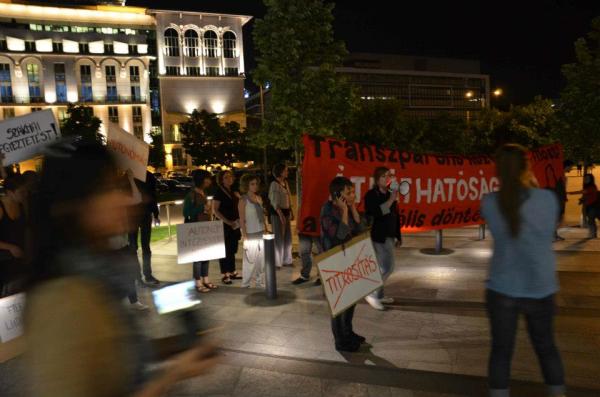
Enough is enough!
Events leading to today’s press conference:
We awaited Mr Zoltán Balog, Minister of Human Resources, until 11 am on 10 May 2013, to negotiate our professional demands and to call for transparency in cultural decisions. Minister Balog did not attend the forum, nor did he react to our invitation in any way. We consider the practice of cultural decision-makers overriding the professional scene and refusing dialogue to be unacceptable.
United for Contemporary Art continues to await the Minister’s appearance at the Ludwig Museum, and for his worthy reaction to our demands!
What do we demand?
– Transparency in cultural governance!
– Institutional and professional autonomy!
– Cessation of resource withdrawal, compensation for abstract resources, and consideration for public interest and public benefit with respect to the distribution of support!
– Undertaking responsibility, and consideration for professionality in cultural decisions!
– Dialogue between Hungarian culture and the decision-makers of cultural policy!
– The dissolution of concealment with respect to the tender for director of the Ludwig Museum, and a new, transparent tender, facilitating social and professional control, dialogue, and debate!
Whom do we await?
All those, who are unsatisfied with processes that are not transparent on the cultural scene, and who take a stand behind cultural autonomy with their presence, and all those, who, as citizens, are unsatisfied with state autocracy, and demand an open relationship based on dialogue with the current leaders of the state!
Those who have already joined and continue their work here during the coming days:
– This afternoon Humán Platform will hold their current plenary assembly
– Saturday morning, the Association of the Independent Performing Arts (FESZ) will hold its regular general assembly before the Ludwig
– Monday morning: Art and Activism seminar
– Tuesday morning: tranzit. hu working discussion
– Wednesday: Fotokontakt – Photography and Activism workshop
Further programmes are currently under planning stages.
When and where?
At the Ludwig Museum, from today, 24 hours a day, until our demands have been granted.
Let’s be present together!
Enough is enough!
United for Contemporary Art (FB)
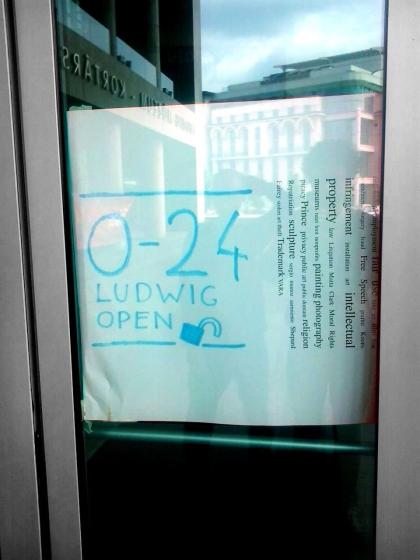
UPDATE
On May 22nd, the occupiers at the Museum Ludwig in Budapest, have decided to leave the building.
They proceeded to continue the protest in front of the Ministry of Human Resources. They said that they still consider the Ministry to be acting without consultation with the cultural sector. They have also pointed out that the decision-making processes are still not transparent at all. However, the Ministry is still contradicting this information in the media.
As a reminder, the group’s Facebook page states that this past may 9th they invited the Minister, Zoltán Balog to publicly discuss, amongst other things, said lack of transparency. The minister sent a ‘counter-invite’ to ‘provide information’. This response was deemed unacceptable and in the interest of public / open dialogue, the group started the occupation of the Museum Ludwig, providing 24 hour access to the building.
In the protest in front of the Ministry today, the group has demanded, again, transparency in culture, securing the autonomy of its institutions, a stop to the cuts and compensation to financial support that was already taken away.
Regarding the currently vacant director position of the Museum Ludwig, the Hungarian site artPortal has been informed that representatives of the Ludwig Stiftung and the Minister Zoltan Balog had a meeting. There, Júlia Fabényi’s project proposal was presented. Based on this information, it is likely that the Ministry will soon name Fabényi as Museum Ludwig’s new director.
Unite for Contemporary Art (Budapest, Hungary)
via Budapest Times
More than 30 artists occupied the Ludwig Museum on Thursday to demand complete transparency in the selection process for a new director and the institution’s autonomy from right-wing ruling party Fidesz. The Ludwig’s current director, Barnabás Bencsik, endorsed by the Ludwig Foundation for his outstanding work, is competing against Fidesz-backed Júlia Fabényi for the position. The protesters entered the museum with signs saying “Forum – collaboration for contemporary art”, “Free Ludwig” and “Professional coordination”. News website index.hu said they want to hold forums about recent changes in Hungarian visual arts.
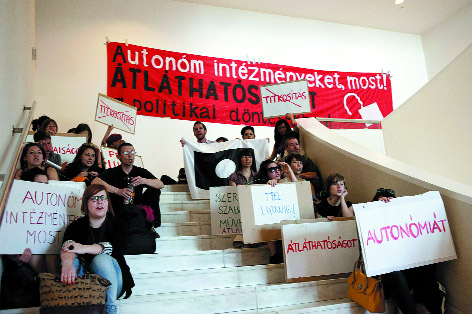
Prime Minister Viktor Orbán’s right-wing government is crushing artistic freedom in Hungary, according to renowned orchestral conductor Ádám Fischer and other leading figures of Central European cultural life.
The art of politics
“It is practically written into the new Hungarian Constitution that works reflecting a Christian-nationalist ideology will be given priority when state subsidies are disbursed,” the signatories wrote this week in a swingeing critique of the Fidesz government’s cultural policy. Past controversial cultural decisions include the awarding of antisemitic writer Ferenc Szaniszló with the Tancsics Prize – the top state award for journalism – which he later returned due to strong domestic and foreign pressure, and the replacing of the National Theatre’s respected director Róbert Alföldi, despite popular protest, with Attila Vidnyánszky, a more nationalist director corresponding better with Fidesz’s state ideology. At the end of 2010 Fischer himself resigned as music director of the Hungarian State Opera in protest against the controversial media law. The letter was circulated on Monday by the Austrian branch of international writers’ club PEN. Among the 16 signatories are pianist András Schiff, director Árpád Shilling, director of the Viennese Burgtheater Matthias Hartmann, and Dietmar Schwartz of Deutsche Oper, the largest of Berlin’s three opera houses. They criticise new powers granted to the Hungarian Art Academy (MMA), a forum of Hungarian artists and intellectuals.
Politics in plays
“The MMA was founded as a national-conservative private association of artists,” they wrote. “However, with the ruling party’s adoption of relevant legislation, the Basic Law now pronounces the MMA the public body that decides on the distribution of public funds. This means that a closed circle of conservative artists now have the right to play a key role in the distribution of state aid, incomes, scholarships and state awards.” The letter continues: “The fact that the government of an EU member state attempts to trammel the arts in the twenty-first century is a serious violation of the basic principles of a liberal-minded democracy. It is unacceptable that artists in Hungary who do not rhyme, write or paint as the system pleases can have their livelihoods threatened.” The artists called on their peers from Europe and around the world to join their protest against what is happening. They called on the government to remove the laws giving special status to the MMA, and to end the “extraordinary influence of narrow-minded ideologues” on Hungarian artistic life.
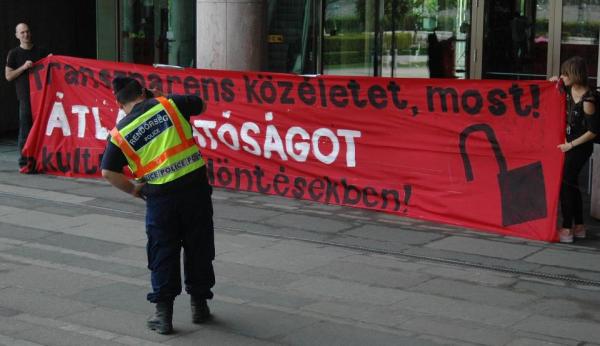
via Unite for Contemporary Art
PRESS RELEASE
9th May 2013
Unite for Contemporary Art
We demand complete transparency in the running and adjudication of professional competitions in the art world!
The lack of transparency and culture of secrecy surrounding the current competition for the post of director of the Ludwig Museum – Museum of Contemporary Art Budapest is unacceptable!
The anti-democratic practices afflicting education and society in the last two years have now reached the art world, including: the merger of the Hungarian National Gallery and the Museum of Fine Arts without proper consultation with art professionals, the appointment of the director of the Műcsarnok Kunsthalle without a competition, the unjustified elevation of the Hungarian Academy of Arts (MMA) to a position of institutional dominance holding sway over public funds, and most recently, the lack of transparency in the Ludwig Museum competition.
These developments are making it impossible for contemporary art to function and force us to come together and make a stand. It is for this reason that we are holding a Fact Finding Forum (9th May 5pm – midnight) where we aim to debate the problems of the institutional system of the art world and the reasons for its dysfunctionality, along with exclusionary practices in the distribution of public funding for the arts.
A week ago, on 2nd May 2013, the Free Artists group sent a letter to the Minister of Human Resources, Zoltán Balog, demanding the lifting of the secrecy regarding the decision making process and competition for the post of director of the Ludwig Museum, to which they have yet to receive a reply.
Unite for Contemporary Art demands transparency in decision-making processes and the immediate release of the minutes of the professional committee of the competition for director of the Ludwig Museum!
The action is not directed against particular persons and does not take sides for or against either candidate.
We invite the Minister of Human Resources, Zoltán Balog, to come to the Ludwig Museum at 12pm on 10 May 2013. Roll back the secrecy! Listen to the opinions of a professional forum of activists, contemporary artists and art professionals!
Our demands:
Professional agreement! Institutional and professional autonomy! Professionalism and transparency in decision making in the cultural field!
###
To support this initiative please go to Unite for Contemporary Art and Autonomy for the Arts in Hungary
ArtLeaks Gazette Now Online!
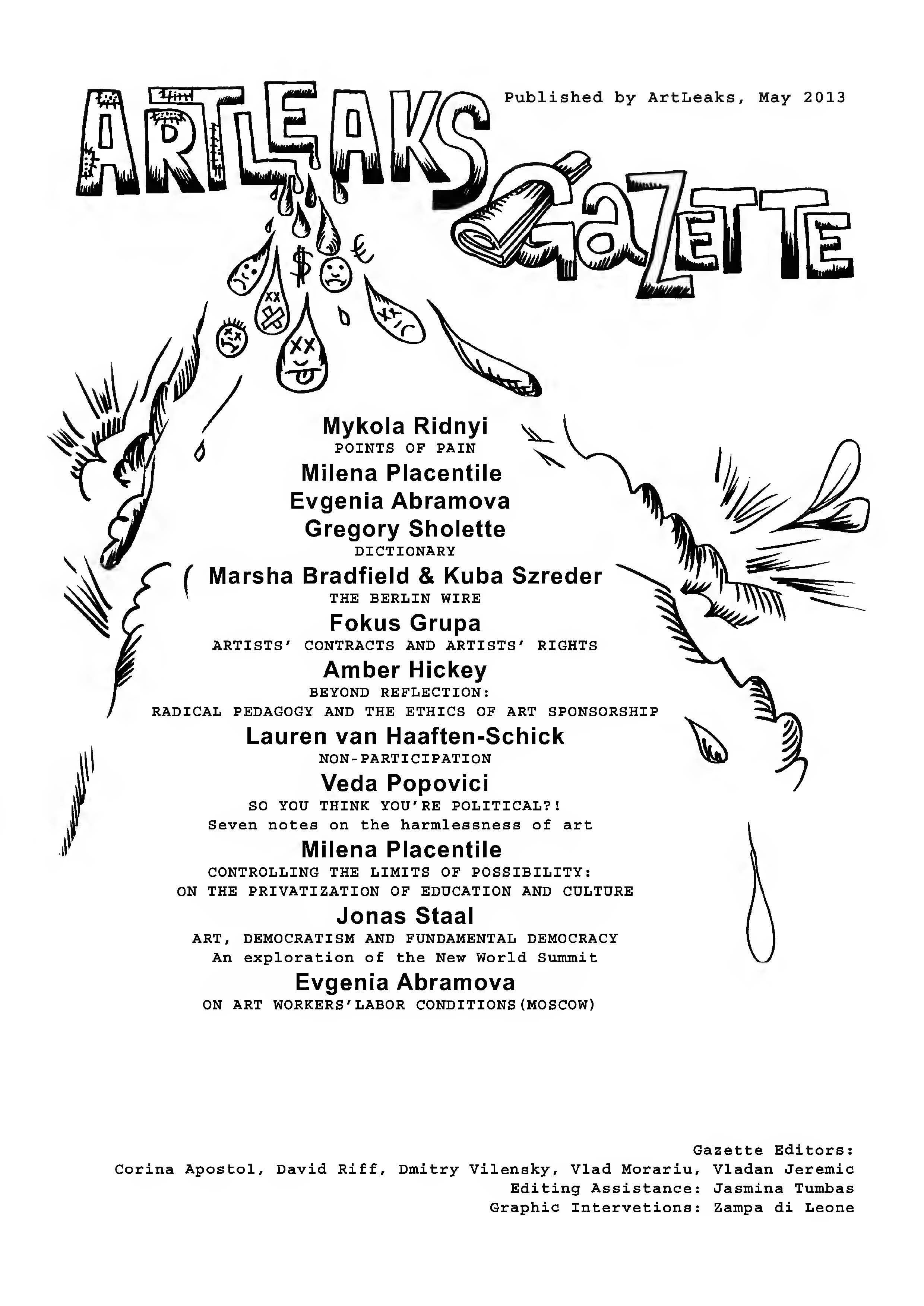
Corina Apostol, Vladan Jeremić, Vlad Morariu, David Riff & Dmitry Vilensky
Breaking the Silence: Towards Justice, Solidarity and Mobilization
Milena Placentile
Controlling the Limits of Possibility: On the Privatization of Education and Culture
Jonas Staal
Art, Democratism and Fundamental Democracy: An Exploration of the New World Summit
Evgenia Abramova
On Art Workers’ Labor Conditions (Moscow)
Dictionary
Evgenia Abramova: Art Workers and Labor Conditions
Milena Placentile: What is Neoliberalism?
Veda Popovici
So You Think You’re Political ?! Seven Notes on the Harmlessness of Art
Mykola Ridnyi
Amber Hickey
Beyond Reflecction: Art Pedagogy and the Ethics of Art Sponsorship
Fokus Grupa
Artists’ Contracts and Artists’ Rights
Marsha Bradfield & Kuba Szreder (members of Critical Practice)
Lauren van Haaften-Schick
###
You can also download the full issue of the ArtLeaks Gazette here.
###
As stated in our Open Call for the gazette, in addition to the final version of the publication, in this section we publish the remainder of submissions which were delivered to us by the deadline, with the exception of those that the authors did not wish to have published here.
Ana Sol Alderete, On One’s Videoperformance in Petersburg & Campo de Marte
Anja Cuhalev, Can Art Act as a Form of Democracy?
Stephan Groß, FREE TRADE text & graphic
Christian Heck, noparts & noimage
Marc Herbst, It’s Midnight
Astrid Jahns, The Seven Deadly Sins
Patricia Reed, Labour Poster
###
 ArtLeaks