Updates
ACT NOW! Submit your story to ArtLeaks and end the silence on exploitation and censorship! Please see the submission guidelines in the "Artleak Your Case" page
Submitted and current instances of abuse are in the "Cases" section
To find out more about us and how to contribute to our struggles, please go to the "About ArtLeaks" page
Please consult "Further Reading" for some critical texts that relate to our struggles
For more platforms dedicated to cultural workers' rights please see "Related Causes"
For past and upcoming ArtLeaks presentations and initiatives please go to "Public Actions"
The antidemocratic makeover of the cultural scene in Hungary
via NEMMA/ Autonomy for Art in Hungary!
Please share and publicize!
Recent legislative steps in Hungary point towards the authoritarian transformation of the institutional structures and funding system of cultural life, by giving an ultra conservative artist group close to the right-wing government, the Hungarian Academy of Arts, an unassailable position of power. As a result of these decisions, the government has endangered the long term autonomy, professionalism and democratic procedures of Hungarian contemporary art.
The government established the Hungarian Academy of Arts (MMA) as the preeminent authority in the field of arts through the new constitution or Fundamental Law, which came into force on 1 January, 2012. The Academy, which was originally founded as a private association in 1992, is made up of artists strongly loyal towards the government. In order to be accepted as a member, the Academy requires a commitment to the nation, a certain “national feeling.” In 2011 the Hungarian Academy of Arts was transformed into a public body, in a process lacking the minimum of transparency, and was provided straight off with a considerable amount of funding and its own a grandiose headquarters. In November the government further extended the cultural political role of the Hungarian Academy of Arts, endowing the organization with unprecedented power, including exclusive right of decision making over the contemporary cultural infrastructure – and a gigantic budget at the expense of the whole of the Hungarian cultural scene.
According to the announcement of the Ministry, the Academy will have the right to be involved in the committees deciding about important state awards, and next year the entire system of public cultural funding and subsidies will be reviewed in a process involving the president of the Hungarian Academy of Arts. This funding system, which up till now has been operated through advisory boards made up of representatives of the respective artistic fields – including the National Cultural Fund, the organization with the most comprehensive activity in the field of distributing state support on a professional basis – is in danger of being centralized and subordinated to a particular interest group, an ideologically based community.
The Hungarian Academy of Arts, according to their stated intentions, would take over several state tasks and responsibilities in the field of culture, thus for example they would participate in the selection of directors of cultural institutions and museums, and even encroach on how professional organizations work. From 1 January 2013 the Műcsarnok (Kunsthalle) Budapest, which is the most significant venue and symbolic space for contemporary art in Hungary, will become the property of the Hungarian Academy of Arts. The Hungarian Academy of Arts will also have the right to define the principles and professional concepts of the art policy of the institution. Following this announcement, the present director of Műcsarnok has resigned.
The legal background of the Hungarian Academy of Arts may guarantee its legitimacy in legal terms, it does not however make up for its lack of professional legitimacy. The upgrading and extending of the role of the Hungarian Academy of Arts in cultural policy, including raising its budget without any public and professional consultation, have taken place in an antidemocratic way, excluding professional organizations and forums. Together with the general, dramatic financial restrictions in all fields of culture, these processes will result in the mutilation of the possibility of maintaining a diverse artistic environment in Hungary.
With these measures, the Hungarian government, through the Ministry of Human Resources, have given over the right to make the most important cultural decisions to a society of artists that avows and commits itself to conservative values and national culture, that also opposes the rejection of state and the church control, and rejects a contemporary culture that stands for the autonomy of art and believes in the critical social role of art. It has become evident that the political executive power intends to control contemporary culture in a direct way with the help of legal regulations and put an end to it’s still existing plurality.
Board of the Hungarian section of the International Association of Art Critics (AICA)
contact: nemma@autistici.org or aicahu@freemail.hu
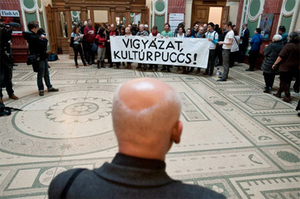
‘Attention: Cultural coup!’ – demonstration by Free Artists in the Kunsthalle Budapest on December 28, 2012 (Photo: Dániel Kováts)
See also: A Short History of MMA (Hungarian Academy of Arts)
Open Letter from Copenhagen Art Workers Coalition
via Copenhagen Art Workers Coalition
We are a group of artists practicing and living in Denmark. We share a deep sympathy for the views and concerns of the Occupy movement. We therefore feel compelled to inform you of a hypocritical situation unfolding here in Denmark right now. We know that the NYC General Assembly, Arts and Culture working group share our concern. There are a number of international artists who are directly affiliated with a Gallery V1, Copenhagen, who would probably also like to know what’s going on. Gallery V1 in Copenhagen, presents works by artists such as: Jenny Holzer, Barbara Kruger, Shepard Fairey, Faile, Banksy, Steve Powers, Kenny Scharf… the list is long. We know and respect your work and therefore feel it is fair to bring these matters of concern to your attention.
The gallery V1 celebrates its 10 year anniversary this weekend in Copenhagen. (link to the party and the names of artists) Peter Funch, co-owner of the gallery, has worked on commission for the advertising agency Mensch and for Danske Bank (the biggest bank in Denmark) on a major advertisement campaign. He is also showing his works at an exhibition at V1, which opens today. Peter Funch is house curator at Gallery V1. He lives and works in New York City. As a film maker, Peter Funch has worked in the interest of the Bank, aiding in the glossing over of the bank’s image. The campaign portrays the Occupy movement – the United States’ most publicly recognized non-electoral political movement – as a mute bandit that only knows how to throw rocks – spinning images of ubiquitous unrest into a new marketing campaign. These are the images by Peter Funch.
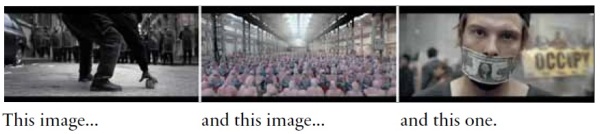
link to the campaign TV commercial:
http://www.youtube.com/watch?v=n-pZj_cPBvw
link to Peter Funch’s porfolio:
http://peterfunch.com/index.php?/ongoing/commisions/
The slogan for the campaign goes: A new normal demands New Standards. The images made for this campaign are to be seen everywhere in Denmark these days. The images show activists in Greece protesting, an activist throwing a stone at policemen, icebergs melting away, a lesbian couple kissing, Chinese workers slaving away in a huge factory and a paraolympic athlete running. It is obvious that this bank wants to communicate to the public that it takes the global challenge seriously, and that it is making an active effort to ease the frustration of those who might question multi-billion dollar bail-outs and subsequent austerity measures.
That Danske Bank needs artists to greenwash their image comes as no surprise – what is new about this campaign is its boldness. It is a display of arrogance against, not only citizens of Denmark, but all progressive social movements today, anywhere, in any country. It is an attempt to absorb the frustration and critique against the way banks operate – a reasonable critique rooted in a fair and common frustration over social injustice, and the bailouts that heighten inequality and oppression.It is clear to us that the purpose of the campaign – New normal – in effect, tries to appease frustration over a sudden cancellation and breach of an agreement between the bank and the state of Denmark. Citizens of Denmark are becoming increasingly disgruntled that Danske Bank has gone back on its promise and strong- armed the Danish former secretary of business and minister of justice, Lene Espersen, to legitimize a deal breaker, also called bank package 2. The explanation put forth is asstupid as it would be to emphasize that the number 2 comes after the number 1. The public is told that this requires no further explanation, that no one has gone back on their promise, that it was the only way to move forward – 2 comes after 1, an explanation that follows the Thatcherian logic; There is no alternative.
What is true, on the other hand, is that in order for austerity agreements to be upheld, and receive the necessary political support, Danske Bank pledged some of it’s financial gains to the state in years to come, figured to 4 billion dollars over the next ten years. This was a false promise to the state and it’s citizens. It has become clear that the purpose of the campaign – A new normal demands New Standards – is meant to appease frustration over this sudden breach of agreement. In lieu of this, Danske Bank new that an advertising campaign had to be launched in order to greenwash the scandal, and so they called on the ad-agency Mensch and the artist Peter Funch from Gallery V1. Danske bank has very openly made it their mission to run the campaign abroad as well. We ask for your help to notify the artists who have been exhibiting at V1 in the past to take this into consideration if they were to be contacted by the gallery again. We need your help in reaching out to the artists who are currently exhibiting at Gallery V1 in Copenhagen. There will be an opening tonight celebrating a 10 year anniversary of V1. We would encourage the artists currently showing to demand their works be taken down. We will also kindly ask people who have been invited to make other plans for the night and go to an opening somewhere else, with this message:
If Peter Funch has invited you to his gallery then please do the right thing and decline – say no! By declining you would actively be showing your disdain for business a usual. We hope that you will act on this knowledge and signal to the world that you will have no affiliation with gallery V1 in the future as long as Peter Funch is co-owner and acting curator at the gallery, as long as he earns his living by making vulgar corporate propaganda for Danske Bank at the cost of social movements. We ask you to support us in our on- and offline outburst against Danske Bank and the advertisement companies that work for them.
Thank you for your cooperation. Yours sincerely,
COPENHAGEN ART WORKERS COALITION
COPENHAGEN ART WORKERS HAS BEEN FORMED AS AN OPEN COALITION THAT WONT KISS ASS OR COMPLY TO PRESSURE FROM ANY CORPORATE ENTITY OR INSTITUTION. AS OF YET, WE CAN AND CANNOT SPEAK ON THE BEHALF OF OTHERS NOR DO WE REPRESENT ANY OF THE ARTISTS AFFILIATED WITH V1 GALLERY. WE FEEL IT IS NECESSARY TO BRING THIS MESSAGE TO OTHER ARTISTS, BECAUSE IT IS A MATTER OF CONCERN TO ALL ARTISTS EVERYWHERE.
UPDATE
Recent statement by V1 Gallery and Peter Funch
Peter Funch has shot the stills for the new Danske Bank add campaign.
Peter Funch had no creative influence on the subject matter of the campaign.
Mensch created the campaign and the videos was shot by Martin Werner.
Peter Funch works as a commercial photographer and as an artist.
Peter Funch owns 25% of V1 Gallery.
Peter Funch is an artist working with V1 gallery.
V1 Gallery is an independent platform for contemporary art.
V1 Gallery does not like or endorse the new add campaign for Danske Bank.
V1 Gallery is a client at Danske Bank.
V1 Gallery would like Danske Bank to rethink and act in a responsible way.
We hope to see you tonight.
Jesper Elg, Peter Funch , Mikkel Grønnebæk
Hindsight is always 20/20: Jakarta Biennale 2011
The Jakarta Biennale is the Southeast Asian Region’s oldest biennale and is organized through the Dewan Kesenian Jakarta / DKJ (Jakarta Arts Council) which has its roots in self-organizing efforts by Indonesian academy-affiliated artists. The case being presented here is the account of Eileen Legaspi-Ramirez, guest curator for Jakarta Biennale 14: Maximum City, hired by DKJ at the invitation of the Indonesian curators Ilham Khoiri, Bambang Sarini Widjanarko, and Seno Joko Suyono.
I’d been forewarned. But a fatal mix of naivete and hubris propelled me into the abyss that was the Jakarta Biennale 2011. A year before I was asked to come on board as guest curator in a curatorial team made up of three Jakarta-based curators plus myself, I was already getting wind of snide live and cyber remarks about the Jakarta Arts Council (JAC)-selected curators being ‘mere journalists’. But since I had come to know two of these ‘mere journalists’ well enough through an international art journalism workshop we all attended in 2009, I felt a great deal of sympathy about how they were being dismissed so summarily. That along with the prospect of showing Filipino art abroad, and my own growing skepticism over trash-talking in the curatorial scene, plus the fact that this was after all, touted as the oldest Biennale in the region (surely they had a headstart in the learning department?) factored into my signing on. But that was then and this is now.
Three quarters of a year has passed since Jakarta Biennale 2011 opened at the Galeri Nasional, among other main sites. The Biennale closed in mid-January 2012. And yet to date (Christmas carols brought on by the -ber months are already airing in Manila), there remain Biennale loose ends spanning all the do-nots of a basic curatorial checklist (unreturned works, shoddily edited catalogue, unreleased artists’ fees—and these are just the ones I have confirmation of). A month coming into Jakarta for the installation period, I was told via mobile that major funding had been pulled out and that the organization behind the event was in crisis. But there was no decision from the Jakarta end to call it quits. Instead, I was asked to brief the artists I’d had a direct hand in inviting—to tell them for instance that artists’ fees were no longer forthcoming, that I should instruct the Norway-based Filipino artist to not send on his hefty fork collection as it was too expensive a shipping item, and so on. I asked every single one of these artists if they were still willing to participate given all this, and it heartened me no end that they were still ready to charge on. Yet the plot thickens.
We were a ruddy group that set off to get at least our parts of the Biennale going—we knew it would be difficult. We girded ourselves up and went for it. But nightmare of all nightmares—shipped works not coming out of customs even as the opening was 24 hours away, this on top of logistics and installation teams ill-prepared to handle the large number of technical requirements (this latter one was at least something we anticipated). The Filipino artists who came with me bravely improvised and did splendidly. But what truly pushed me to the brink was that, on the evening of the Biennale opening at the Galeri Nasional, I was informed by one of the Filipino artists that other artists were, in fact, given their artists’ fees. Unwittingly or not, organizers then were playing off artists against each other. That sent me on a downward spiral that the friendships with my fellow journalist-curators did not recover from. By the time we left Jakarta, I had to practically beg for the artists’ fees, at least those certainly due those who came all the way to see what an organizational mess this all was. I look back and think at how I could have helped ease or avoid the cumulative mishaps but the only thing I can be sure of at this point is perhaps speaking and reading Bahasa could’ve at least alerted me to get into damage control way way sooner.
Onward to the present. Emails from Jakarta Biennale organizers come far and few between now. I’ve turned to picking up news indirectly about resignations, threatened uprisings within the Jakarta Arts Council, people falling ill, and such. At least two Filipino works are still in shipment limbo (one thankfully hosted temporarily by the Philippine embassy in Jakarta); Norway-based Filipino artist Jet Pascua’s fork collection remains unshipped as the Jakarta Arts Council budget allegedly won’t allow sending them on; and there is no word about where the crate containing Bangkok-based, Varsha Nair’s work currently sits. Just last week, the revised Biennale catalogue (now only, but at least, in pdf) was sent out by a resigned Biennale coordinator, bless her soul. The document itself remains problematic given that proposed edits (at least from my end) went ignored. No one is really happy nor appeased at this point. I know I’ll continue to pillory myself for this till the Alzheimer’s takes over. I shudder at the prospect of Jakarta Biennale 2013 looming in the horizon. Surely, business cannot just go on as usual without redressing these countless aches.
Given that this is only my side of the story and 200 plus artists and Biennale workers were involved, the true body count needs to be attempted at least.
Eileen Legaspi-Ramirez
Photos of works in the Jakarta Biennale 2011 curtesy of Eileen Legaspi-Ramirez
The Voice of the Streets Shouts Against Censorship
via Project ИСПРАВЛЯЙ! УГАРАЙ! (Ispravlyai! Ugarai!)*
A statement addressed to the participants in the exhibition “The voice of the streets” [Petersburg, Russia]
On November 17th, 2012, the artistic-political project “Исправляй!Угарай!” (Ispravlyai! Ugarai!) was subjected to political censorship when taking part in the exhibition”The voice of the streets.” The management of the Loft-Project “ЭТАЖИ” (Etazhi) demanded the removal of one of the works dealing with the marriage of church and state.
Under these circumstances , we officially refused to continue our participation in this exhibition and removed the remaining works. We believe it is hypocritical to flirt with street that and at the same time engage in political censorship. If the the owners of the loft are afraid of losing their space and censor any statement referencing the current government, then they should openly declare that the Loft Project “Etazhi” is a shopping and entertainment complex and not a space for art.
Moreover, this is not an isolated situation among cultural spaces in the city – recently the Rizzordi Art Foundation motivated its refusal to support a previously agreed upon exhibition entitled “Icons,” by citing “the unfavorable situation in the city,” and thus playing up to the most reactionary attitudes in the city. We believe that this state of constant censorship may have been normal in the Middle Ages or in the time of Goebbels, but not in 2012 and in one of the most progressive cultural centers in the world – Petersburg – this is pure nonsense and absurdity, indicative of a turn towards the Dark Ages and neo-totalitarianism. And it also relates to the emergence of these supposed “cultural institutions,” which young cultural producers had always considered independent and open-minded.
This statement is primarily addressed to Svetlana Polynkova, deputy director of the Loft Project Etazhi, and to the entire management of the loft. It does not apply to the the collective Public Post or other people who worked on this exhibition and tried to show street art without making it more “soft” than it is.
In solidarity with the project Ispravlyai! Ugarai!, the Resistance Movement named after Petr Alexeev (DSPA) also removed their works from the exhibition. Also, the Laboratory of Poetic Actionism ( Laboratoriya Poeticheskovo Aktsionizma) and the art group “Bez Aftora” will remove their works in the near future.
We encourage other artists participating in this exhibition to also show their solidarity, join our call and remove their works.
Project Ispravlyai! Ugarai!
The works of Ispravlyai! Ugarai! which were taken down from the exhibition. The organizers had demanded that the collective remove the work on the left, depicting Vladimir Putin and Dmitry Medvedev in an Orthodox icon
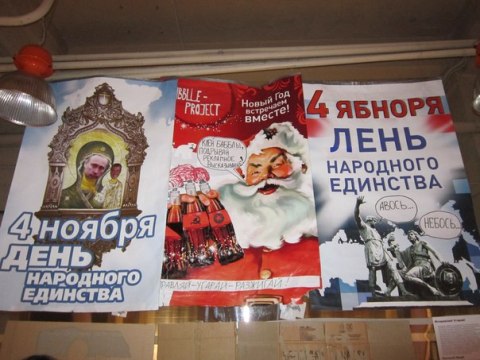
via DSPA (The Resistance Movement named after Petr Alexeev)
Activists of the artistic cell of the DSPA took down their works from the exhibition “The voice of the streets” as a gesture of solidarity with the the collective “Is pravlayi! Ugarai!” whose own works were subjective to censorship by the administration of the Loft-Project “Etazhi.” DSPA initially agreed to take part in the exhibition of protest street-art “The voice of the streets.” The exhibition was prepared for several months in advance – especially for this occasion the activists produced a big panel entitled ” Break away. Get up. Rise up. ” (Утрись.Вставай.Поднимайся)
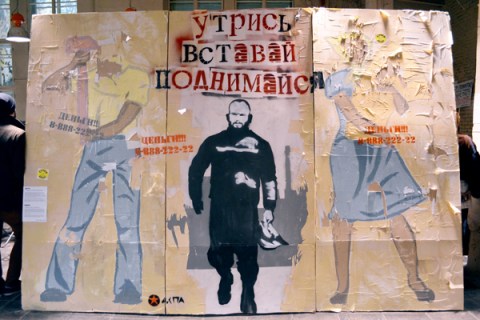
Break Away. Get Up. Rise up
Our statement for this work read:
In the last 20 years of bourgeois-rule in Russia, not only the history of the first state of workers and peasants was half-forgotten, half-erased and soiled, but the very notion of the working class. It has practically disappeared from public consciousness. Generally speaking, the existence of the working class is denied, turning a blind eye to the obvious fact that there are people constantly producing the material wealth around us. Only in Petersburg alone, there are about 300 thousands industrial workers. In Russia they number millions and around the world billions. We are convinced that once the mighty fist of the working class will rise, it will smash the yoke of Putinism into dust, as well as the police batons surrounding it and the whole system of exploitation of man by man.
This graffiti was produced by activists of the Artistic Cell of the DSPA. The last words in the statement quote the opening chorus of the famous “Worker’s Marseillaise.”
The work hung on display for around a week until the censorship incident happened: the managers of the Loft Project “Etazhi,” where the exhibition is taking place, gave the organizers an ultimatum demanding that they remove one of the works of the collective Ispravlyai! Ugarai!, which depicted Putin and Medvedev. The organizers agreed, stating that “this is too much, explicitly anti-religious motivation” and took down the work. Ispravlyai! Ugarai! reacted against the censorship, released a special statement and decided to stop taking part in the exhibition.
The Artistic Cell of the DSPA supports the statement of the collective Ispravlyai! Ugarai! and in solidarity with them also terminated their participation in the exhibition. On Sunday night the activists went into the loft, waited until the end of the workshop taking place there and removed their works.
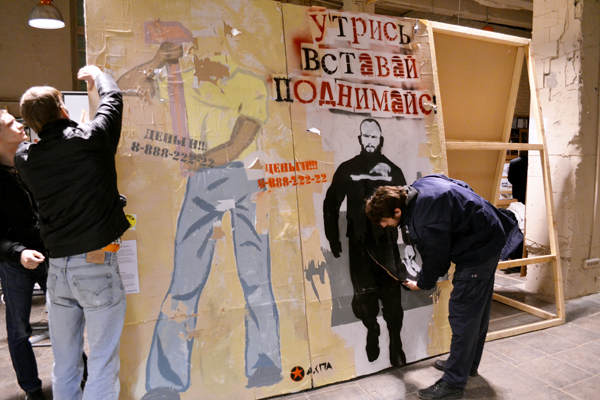
And helped a representative of “Ispravlayi” to also take down their work.
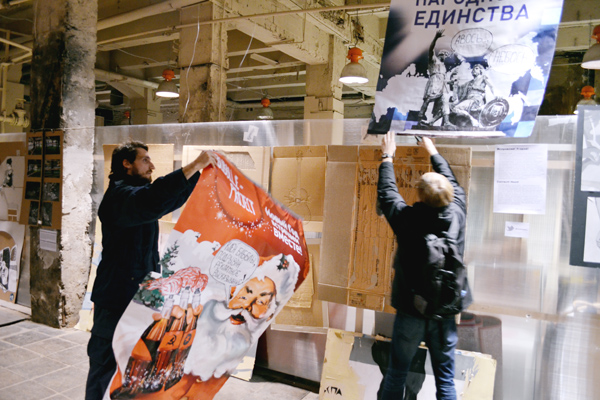
The Laboratory of Poetic Actionism (Laboratoriya Poeticheskovo Aktsionizma) and the art group “Bez Aftora” (Without an author) also reacted in support of “Ispravlyai,” declaring that they would also remove their works in the near future.
Video-report of the artists taking down their works from the exhibition “The voice of the streets” at the Loft-Project “Etazhi.” (in Russian)
via The Laboratory of Poetic Actionism
What could be our position, when artists, just like we are, were censored and moreover, when we are not allowed to remove works from the exhibition (by virtue of a so-called mythical contract, which did not prevent the censorship of the installation from taking place anyway)? Only solidarity.
During the installation of the exhibition I asked the curator if they had produced our labels, and as it turned out, they were ready but “were being moderated” in the “upper floors” of the Loft-Project “Etazhi”[“etazhi”means floors in Russian] – apparently not such an unassuming, tusovka-like space as it would seem. But the funniest thing was that they agreed to put up our works in the exhibition, which carries such a proud name – “The voice of the streets”… Even then I found all of this quite comical, but the works had already been installed and the exhibition opening was scheduled the next day and we decided to turn a blind eye to these timid bureaucratic maneuvers.
However, this type of bureaucratic maneuvering could not get past the innocent banner on which two elderly, unpopular men were depicted [the portraits of Vladimir Putin and Dmitry Medvedev in the above-mentioned censored work], and whose condition the artists decided to immortalize with Russian iconographic motifs.
You know what, dear “Etazhi”, both the ones on the upper and lower floors, you have to decide what you want playing in your ears: either the “voice of the streets,” albeit in-between scare-quotes (without these nothing comes to you), or the whisper of self-censorship – which means that you need to drop the scare-quotes and openly say: every such case gravely narrows your and our space of freedom, and the next case of a successful prevention of a multi-floor “disturbance” by a low-level functionary can be invoked as a fact. And in order not to hurt your situation with the freedom of criticism which we have, better yet exhibit the icons as formal portraits: on the first “floor” it is easier, but on the highest “floor” you could show works by those with golden salaries who capture the most “noteworthy faces.” This way it is less dangerous and more commercially profitable.
* in Russian “Ispravlyai! Ugarai!” refers to slang for having fun in a very wild, vulgar and strange way.
Editor’s Note. Original statements published in Russian here, here and here. The English translation has been edited slightly to make it more readable.
Non-Participation: Call for Submissions
Dear artists, writers, curators, musicians, and others,
I am seeking submissions for a new project, Non-Participation.
Non-participation
The project, Non-Participation, will be a collection of letters by artists, curators, and other cultural producers, written to decline their participation in events, or with organizations and institutions which they either find suspect or whose actions run counter to their stated missions. These statements are in effect protests against common hypocrisies among cultural organizations, and pose a positive alternative to an equally ubiquitous pressure to perform. At the heart of the project is the notion that what we say “no” to is perhaps more important than what we agree to.
Historic instances and examples include: Adrian Piper’s letter announcing her withdrawal from the show Reconsidering the Object of Art: 1965-1975 at LA MoCA, stating her opposition to Phillip Morris’ funding of the museum and requesting that her criticizing statement be publicly shown; A letter from Jo Baer to a Whitney Museum curator canceling an upcoming exhibition on the grounds that her work was not being taken seriously because she is a woman artist; Marcel Broodthaers open letter to Joseph Beuys questioning the relationship between artists and exhibiting institutions; and, just recently, critic Dave Hickey‘s public announcement of his “quitting” the art world.
I am now collecting your letters of non-participation, which will be compiled as a publication, with other activities surrounding the project to be determined.
Please send copies of your letters via email to lauren@laurenvhs.com.
With your submission, please indicate whether or not you wish to remain anonymous. All names and contact information can be omitted or made public, depending on your preference.
Also, feel free to include any other details or background information which could illuminate the situation, as you see fit.
The deadline for submissions is December 31.
In terms of my own work, this project is a natural extension of my last exhibition, “Canceled: Alternative Manifestations & Productive Failures.”
The idea for “Non-Participation” came up many times over the course of the exhibition, and now I would like to see it come into being.
Please feel free to pass this along to anyone else you think may be interested.
And of course, let me know if you have any questions, thoughts or suggestions.
Thank you in advance!
All my best,
Lauren

 ArtLeaks