Updates
ACT NOW! Submit your story to ArtLeaks and end the silence on exploitation and censorship! Please see the submission guidelines in the "Artleak Your Case" page
Submitted and current instances of abuse are in the "Cases" section
To find out more about us and how to contribute to our struggles, please go to the "About ArtLeaks" page
Please consult "Further Reading" for some critical texts that relate to our struggles
For more platforms dedicated to cultural workers' rights please see "Related Causes"
For past and upcoming ArtLeaks presentations and initiatives please go to "Public Actions"
Secret Contracts Hide Cost of Skopje Makeover
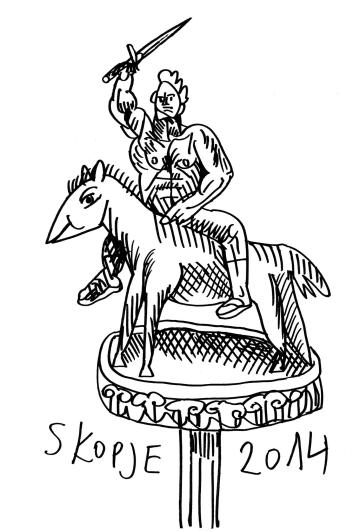
by Zampa di Leone
via Valentina Stojanchevska and Olivera Nikodinovska of BalkanInsight
With many construction contracts for the revamp of the Macedonian capital still secret – and annexes added to them all the time – the total sum being spent on Skopje 2014 remains a mystery.
The Skopje 2014 project, aimed at remaking the run-down capital of Macedonia in grand style, is in danger of becoming a bottomless financial pit as costs overrun and contracts for new buildings and monument multiply. Far from the 80-million-euro price tag initially estimated by the government, some believe that close to 200 million euro have been spent already on bronze, marble and concrete structures intended to beautify the city. This estimate is based on data from the website of the Public Procurement Bureau – but as the data do not cover all the latest constructions, the true figure could well be far higher. Significantly, some contracts for the largest buildings that are part of the revamp remain unpublished or appear to have vanished. As annexes to published contracts have also multiplied, no precise figure as to how much this project is costing the cash-strapped country can be made.
The main opposition Social Democratic Party, SDSM, meanwhile claims that the project may have devoured as much as 350 million euro – or more. Estimate shows that over 63 million euro have been spent on only four buildings and sculptures in central Skopje, in which the Ministry of Culture was the formal investor. But this is not the final bill even for these four, because two of these buildings, the National Theatre and the Philharmonic, are incomplete, so additional resources will be required. Furthermore, although the contracts for the Theatre and nearby Museum of the Macedonian National Struggle were signed in 2007 and 2008, they are still not published, making it difficult to determine precise expenditures.
When construction of these buildings started, the Culture Minister, Elizabeta Kancevska-Milevska, said the Theatre would cost 6 million euro and the Museum 4.5 million euro. But additional annexes and new contracts for the Theatre, still under construction, have pushed the price of this building alone to over 34 million euro, while the Museum bill has now hit 14.5 million.
Skopje 2014 was first presented to the public through a video clip released in 2010.
The revamp, among many other things, envisages a new building for the Foreign Ministry, a 16-million-euro initial contract. It also encompasses reconstruction of the parliament, estimated at 12.8 million euro, and a new bridge across Vardar called “The Eye”, costed at 2 million euro, though this does not include the cost of dozens of sculptures to be placed on it. But the list has grown. Within the last two years, Skopje 2014 has been extended by the addition of several new buildings, monuments and reconstructions.
As part of the project the city has also decided to build classical facades for some 20 existing buildings in the city center. For example, only for the reconstruction of the facades of three buildings that gravitate around the main square, the authorities so far spent over one million euros.
The museum and theatre
One puzzle concerns how much money has gone on the Museum of the Macedonian Struggle.
Although the most subsequent contracts and annexes for the Museum have been published, the initial contract awarded in 2008 has never been disclosed. The Culture Ministry has repeatedly stated that the initial contract, signed with the construction company Beton Stip is worth 4, 5 million euros. However, this contract cannot be found on the Ministry’s web page. Some doubt that this document will ever be revealed, following the opposition allegations made last year that employees of the Culture Ministry forged and destroyed official documents.
Last year, the police filed criminal charges against three employees at the ministry for destroying and forging business books. According to the law such documents need to be kept for at least five years. Despite calls for resignation, Culture Minister Elizabeta Kanceska Milevska insisted that the missing documents were not linked to large sum contracts for the “Skopje 2014” revamp. Only the three employees were penalized, while the suspicions remained for a wider cover up in the affair that was dubbed “Patriotic Broom”.
The opposition parties that made this claim listed the procurement documents for the Museum contract among the allegedly destroyed documents. The ministry has never produced the actual contract in order to rebut the opposition accusations. In the absence of the original contract, the remaining official documents for the Museum include six annexes with a total value of 2.8 million euro, while another 7.2 million has gone on the interior decoration. Thus, instead of the initially announced 4.5 million euro, the Museum, which opened last September, has cost at least 14.5 million euro.
The National Theatre, still under construction, has been marred by similar controversies.
The Ministry has again not published the original contract, awarded in 2007. The cost of this project, meanwhile, now stands at 34.2 million euro, five times the originally projected amount – largely as a result of annexes added to the first contract. For example, over half a million euro were allocated in an annex for “additional and unpredicted matters”, without explaining what this meant. Other annexes, related to interior decoration, installations, lights and others, added an enormous 27.7 million euro to the price tag. Many believe that vague annexes to contracts are a deliberate tool used to conceal the real cost of these monuments. This is because it is not legally necessary to launch a regular procurement procedure if the cost of an individual annex does not exceed that of one-third of the cost stated in the original contract.
Thirty monuments
The complete cost of monuments erected in the central area of the city, now more than 30 in number, is also a mystery. This is mostly because the authorities rarely publish the authors’ fees, or the transportation costs for what in some cases have been giant marble and bronze pieces casted and moulded in Italy, Serbia and elsewhere.
The authorities have already conceded spending 9.4 million euro on the 24-metre-high equestrian statue of Alexander the Great in Macedonia Square, having initially budgeted for 4.5 million – less than half that amount. Some 5.3 million went on the bronze sculpture while the rest went on the decorated pedestal and fountain. The monument by sculptor Valentina Stevanovska was cast by Italy’s Fernando Marineli foundry. Stevanovska is also the author of the equally vast monument to Alexander’s father, Philip, which the authorities say cost 5 million euro.
The sums spent on other monuments in the city centre, such as the Ottoman-era revolutionaries Goce Delcev and Dame Gruev, Byzantine Emperor Justinian I, Czar Samuel, Sts Cyril, Methodius, Clement and Naum, the wartime hero Metodija Andonov Cento and others, vary.
The range from 80,000 euro to 1.7 million each, depending on the size or material used.
According to the Public Procurement Bureau data, the cost of over 30 monuments and pedestals in the city centre, as well as the new bridge, has come to 33 million euro.
Delays push up Philharmonic bill
Construction of the Philharmonic has lagged behind the tempo of construction in respect to other buildings in the project. The concert hall is far from complete, even although construction began back in 2009, before many other projects. It was ambitiously announced that the project would be finish by the end of 2011. But following last year’s budget re-balancing, 246,000 euro intended for this building were redirected to the Museum of Macedonian Struggle. Finalization of this project has been put back to 2013 and current costs have now reached 7.5 million euro.
This contract was initially estimated at 5.9 million euro, but this amount has since increased as a result of annexes for “additional and unpredicted work”. The State Audit Office report from January 2012, related to the work of the Ministry of Culture, noted that the Ministry first engaged an acoustic expert from Germany for 250,000 euro for his services. But only a month after he began work they announced that his position had become vacant.
“We conclude that the vacancy announcement procedure was conducted only to formally satisfy the requirements of the Law for Public Procurement while the institution had already previously started ongoing work related to the acoustics of the building,” the auditors’ report said.
The union of construction workers complained on several occasions to the Ministry about the slow pace of construction. The official explanation was that such a complex project required a longer time frame.
Triumphal Arch
One of the highpoints of the 2014 revamp is the 21-metre-high Triumphal Arch, called “Macedonia”, which opened earlier this year, costed at 5.4 million euro. Also designed by Valentina Stevanovska, it is ornamented with over 30 reliefs in marble representing different phases of Macedonian history.
The basic contract that the Ministry of Culture made with the Granit construction company was signed at 4.3 million euro. But two annexes for additional and unexpected work have since added another 248,000 euro while another 817,000 euro went on for interior decoration and 30,000 euro on designing and professional supervision of the construction.
For the government of Nikola Gruevski the “triumph” in question is the creation of an independent, sovereign Macedonia. But some have asked critical questions. The Association of Macedonian Architects, for one, asked for construction to stop, expressing concerns about the transparency of the procedure and about the chosen location.
Constitutional Court
The government has already spent 35.2 million euro on construction of the building holding the Constitutional Court, State Archives and the Archaeological Museum, although the basic agreement signed in 2009 was set to 24.8 million. During construction, the contract was supplemented by five annexes. Officials, in this case from the government bureau for General and Administrative Matters, justified this again by referring to “additional and unforeseen costs” that jointly increased construction costs by 5 million euro. An additional 5.4 million euro was spent on interior decoration such as relief compositions as well as on the supervision of the project.
The building has also decorated with five more marble sculptures featuring the god of wine, Dionysus, and four muses – costing almost half a million euro. An additional 2.5 million went on floors, ceilings and windows. The completion of the building was set for the end of 2011, but it remains unfinished.
Millions spent in a week?
During a recent debate in parliament on the budget, the opposition claimed that the government recently spent an amazing 18 million euro on Skopje 2014 in just one week. Radmila Shekerinska from the Social Democrats, in a written initiative to parliament supported by 40 opposition legislators, claimed that the government spent 250,000 euro on three willows planted on platforms in the Vardar River, 1.7 million on a fence on the new bridge, 5 million on three fountains, 2.4 million on a sculpture of Prometheus opposite parliament, 5.5 million euro on the monument to Philip of Macedonia, 2.4 million for four golden horses, 146,000 euro for the interior decoration of the Museum of Macedonian Struggle and 850,000 for the interior decoration of the Triumphal Arch.
The opposition argues that the government made major cuts in capital investment, education and health budget owing to the European crisis – but did not cut anything on a project that is basically a luxury for a poor country.“The Skopje 2014 project bears all of the characteristics of the economic policy of the government of Nikola Gruevski: investment in unproductive expenditure, careless spending of taxpayers’ money, criminal and corrupt procurement procedures and annexes and unpaid obligations to the construction companies,” members of the opposition said.
Meanwhile, the State Anti-Corruption Commission says it sees nothing problematic in the addition of numerous annexes to construction contracts, so no inquiry can be launched. They maintain that the annexes meet the terms of the Law on Public Procurement. Sabina Fakic, from the Skopje based anti-corruption watchdog, Center for Civil Communications, CCC, says that murky annexes are not a problem for Skopje 2014 alone, but are a problematic issue generally in public procurement in Macedonia. The CCC says that while annexes to government contracts worth some 23 million euro were signed in 2010, the number almost doubled in 2011 to 41.5 million euro.
“Another problem is the lack of control by the official institutions to assure the objectivity of these additional contracts and to eliminate suspicions of their possible misuse,” Fakic said.
This article is funded under the BICCED project, supported by the Swiss Cultural Programme.
Photos courtesy of Vesna Tašić of SEECult.org where a version of this article was published in Serbian.
Жизнь боярского это чудо/ The Boyar’s life is a miracle
The handover of power after the 2012 Serbian elections meant a shift in the country’s geopolitical alignment as well as its system of government. The effect on the cultural economy is beginning to show the paths its future development might take. This case-study examines ethno-centric cultural real estate projects as symptoms of a possible regression to feudal relations.
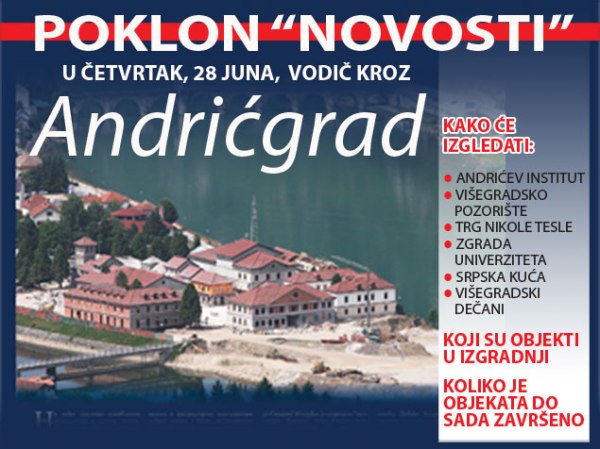
Image source: http://www.novosti.rs/
The rise of the “ethno-city” in Serbia and Serbian-held parts of Bosnia between 2003- 2012 represents a new stage in the retroactive “improvement” of national history, especially of the ethnic-cleansed areas. The “ethno-city”, is a form of sprawling tourist resort in which visitors gain education – that is the acceptable interpretation of the national narrative. Unlike most ordinary “ethno-villages”, which just try to turn profit and survive, the larger, “ethno-cities” are typically built in areas where the population has been cleansed by war or economy. These “ethno-cities” are sanctified and protected by their “ethno” status, which also means they are in a way, state & church-run enterprises under private ownership. If the ethnified villages are the kitchy continuation of their own existence and the regular village tourism, the “cities” seem more like descendants of earlier machines for improving a sense of history, philosophy and spirituality – the baroque “folly”, and the theme park. The latter day Serbian follies have been known to grow into modest hamlets of wooden mountain houses, castles, cinemas, swimming pools, multiple restaurants of national cuisine, clubs, gyms, libraries, kindergarden, saunas, skiing resorts, hotels, and the obligatory Russian-esque wooden village church. The cities, just as the castles of yesteryear with their follies, are built to cater to all the needs of their owners and their guests. Sometimes, they include minor, yet stylish distractions as well – a national hero or a celebrity statue, a monastery, a vintage car or horse buggy, afilm or classical music festival, a business school, organic juice factory, and so on… The local park rangers are at hand to police the grounds, guarding the tranquility of the “estate.”
The description above fits both Nemanja (Emir) Kusturica’s sprawling real-estate and cultural fiefdom, as well as the quaintly massive ethno-village “Stanišići” near Bijeljina. As Kusturica’s first such venture “Drvengrad” is branching out, growing into a fully developed resort, the old story of “a couple of houses with chickens running in the yard” is expediently being forgotten. As if it could have fooled anyone. The project started two years ago, when the director spotted a “beautifully lit” mountaintop across from his film-set. Soon, the designation of the area as a “state national park” was postponed, giving Kusturica time to build, while effecting a ban on construction for the local villagers, over whose pastures the complex now sprawls. That gave way to the next stage, a “minor” expansion in the form of a fully equipped resort. The economy of the expansion is what is of public interest here. Not only were public lands usurped and villagers’ lives and economy damaged, but the expansion has been necessary to justify investment in further regional ambitions: “Andrićgrad”, nearing completion next to Mehmed Pasha’s bridge in Serb-ruled and ethnically cleansed Višegrad, in Bosnia, and just festively announced, “Kraljevograd” next to the Maglič medieval fortress, a heritage site in the Ibar river valley, between Studenica and Žiča monasteries, inside Serbia proper.
The crimes of the local Serbs and the genocide in Višegrad (and Bijeljina) were the subject of several trials in the International tribunal for war crimes, Milan Lukić’s trial being one of the most highly profiled. The “Andrićgrad” project represents a key final stage in successive waves of cultural normalization. As soon as the peace accords rewarded the aggression, Serb director Srdjan Dragojević began filming his fiction over the locations of the recent genocide. With the arrival of Kusturica’s project aiming for the cultural solidification of national gains, an indelible imprint on the political landscape of the region is being made: by literally re-reading the history narrated by architectural occupation. The method of altering reality through retroactive “improvements of medieval infrastructure”1 is carefully shaped so as to be seen as desirable and to be well-received by the Serbian public. There are no negative associations with the nostalgic world of medieval knights; and the lost Serbian kingdom is a bedrock not only of nationalist system of values, but is being branded as the base for a national consensus that has persistently promoted the value of land over life.
The product of all this is, as always, both political and economic. Political, as segregation of desirable culture into gated, commercial theme parks, the historic and architectural mask over the missing middle and new age in Serbian culture, the “ethno-cities” serve as militant cultural bases for the projection of the re-constructed Serbian sovereign continuity spanning the period from feudalism to newer models of social organization. The attraction of medieval period is also grounded in the economic reasoning for the creation of new, openly rightist cultural paradigm, based on the cultural erasure of the consequences of war and genocide from the land itself. I tend to see this stage as a political and cultural necessity, without which the ethnic cleansing would make no sense at all. This is the stage that affirms the continuity of the Serbian nationalist project and traces the agenda for the war crimes right back to the original (recent) group who fought to “improve history” – Serbian security apparatus, politicians and academia of the 1987 vintage, seeking to escape impending democratization by dividing the Yugoslav state into feudal, personal fiefdoms.
The feudal model of running things is actually, an efficient one in centralized environments where the ruler creates the economic model based usually on a single dominant industry that can be run efficiently in a centralized way, just as oil, gas and mining are used in post-democratic Russia. The disregard for the values of law, ecology, human rights and fiscal impunityare added to the levers of economic control by the ruler. This economic model spawns the new boyar, the director/tycoon whose loyalty is awarded large swaths of land, people and history to manage and exploit in name of the church and state. Unlike the capitalist who thrives on competition, or the intermediary stage of the “oligarch”, boyar’s economic standing is primarily the consequence of an entitlement based on professed and proven political loyalty. Serbia’s signs of return to the feudal rule are based on distributed sovereignty, riding on the coattails of increased dominance of oligarchs during the 12 years of democrats rule. This shift is obvious in the diplomatic, political and cultural moves announced by the SNS (The Serbian Progressive Party) during its first 50 days in office.
Obtaining a credit line from Russia on favorable terms, as well as attempting to do the same with China, shows a fiscally bankrupt state opening to front their interests in the Balkans, and willing to accept dependency in favor of fiscal and political responsibility required by the EU. This loan, earmarked for budgetary spending is approved as the political stabilization of the new SNS-SPS (Socialist Party of Seribia) government is about to be finalized; though the announced arms purchases and pending gas bills will ensure Serbia’s long-term dependence on constant handouts. The economic and political price will be fully realized much later, at a stage when robust civil society will have to re-emerge. But for now, the intensity of diplomatic activity, distribution of positions, lands and funds to Putinist loyalists in Serbia is showing the willingness of the SNS to try not only to redistribute, but outsource at least some Serbian sovereignty. After all, in an empire this large, with an emperor so far away, a boyar ready to project constant readiness to serve will be awarded a long and stable rule.
The second, economic aspect differentiating “ethno-cities” from the “ethno-villages” is the neo-feudal model of extendable “concession”, paid for mainly in public property as well as money, diverting it into private construction projects. This type of conversion is frequent in cases of corruption, as awarding contracts and construction projects is far more lucrative than running actual cultural programs, even nationalist ones. In such model, the profit is the state’s participation in the venture, which sole purpose is to get approved and paid. Any actual building (if and at all), serves to justify the follow-on investment, just as making the “ethno-city” seem like a profitably run business. This explains why remoteness of a location or actual profit generation are immaterial to the “success” of the venture.
The ascending scale of publicly admitted costs places Drvengrad at a few million euro, mainly donated privately, (before hotel and ski resort phase), Andrićgrad is advancing through it’s teens, adding publicly admitted infusions from Republika Srpska’s budget amounting to 6.5 mil. marks to the original projection of 10-12 mil. marks2, plus the undervalued land (30000sqm for 50000 conv. marks). Kraljevgrad was just announced by the new SNS government, weighing in at either 103 or 50 mil/eur2 over 5 years, depending on the source. That excludes the value of land, as well as cost-overruns, additional infrastructure, (extended narrow-track railway, roads, parking lots, water, sewage, power, etc…), environmental impact, damage to the private and public property and economy. All that, before Kusturica decides to make another film, or present any of his lavish, 100.000 Euro “Andrić literary awards”. (for slavic literature, taking the name of the original Andrić prize). The conservative estimates are placing the cumulative cost of “raising Kusturica” at anywhere between 30 – 70 mil/eur during the first full SNS mandate in Serbia.
His brand being so closely tied-in to the that of Serbian nationalism, it is less compatible with the usual brand-managed career of an internationally successful director. Kusturica has always shown remarkable loyalty to the state, and it’s budget, returning to graze regularly, rather than depending on the western competitive model of studio production4. However, with the re-evaluation of previous government’s contracts through the emerging nickel prospecting scandal, Kusturica was propelled to rightfully and pre-emptively defend the ecological purity of his geographic domain, between Mokra Gora and Višegrad; unveiling his true status over the lands straddling the pre-war border between Serbia and Bosnia.
All of this opens the question of Kusturica’s real status and role in not only this, but nearly all recent Serbian governments. A friend of Nikita Mihalkov and with access to Putin himself, there is little room left for doubt over his place in the boyar hierarchy. In my opinion, Kusturica is, and has been for some time now the real minister of culture of a unified Serbian state. And yet, his role hasn’t been without heroic, willing sacrifice. A man capable of grand gestures, by acquiring and revitalizing part of Višegrad, he has symbolically accepted the role of managing the imposed and unwanted national guilt, relieving the bourgeois citizens of the Serbian feudal state of any need for responsibility or remembrance. It all belongs to him now – past, present and future.
Text by Nikola Radić Lucati
——————————
1The earlier, greener model of the Serbian “katun” mountain dwellings is abandoned in Andrićgrad for the conscious mimicry of the new, into faux Ottoman and Austrian city square. His cladding of buildings in scavenged stone has been well documented, and the civil unrest it sparked in Trebinje and elsewhere serves as the reminder not to take the supporting public lightly.
http://www.blic.rs/Kultura/Vesti/261366/Grad-inspirisan—Ivom-Andricem
“izgradnja Kamengrada koštaće između 10 i 12 miliona evra. Grad će se prostirati na 2,5 hektara, a izgradiće se 17.500 kvadrata. Gradnja počinje 28. juna, a za četiri godine trebalo bi da bude potpuno završen. Radiće se fazno, iz tri dela od po 6.000 kvadrata.”
3 http://www.kraljevo.org/Vesti-Pregled_lat
4To be fair, various scales of fiscal and political impunity are the only economic model nearly all our film directors have ever worked in successfully, most of their movies being paid for by the people. They are evenly distributed across the vestiges of the party system: (Dragojević – SPS, Paskaljević – URS, G17+, Kusturica – curently above partisan political level).
4To be fair, various scales of fiscal and political impunity are the only economic model nearly all our film directors have ever worked in successfully, most of their movies being paid for by the people. They are evenly distributed across the vestiges of the party system: (Dragojević – SPS, Paskaljević – URS, G17+, Kusturica – curently above partisan political level).
Homophobic Censorship at the MAMM Museum
via lesbiru.com and David Ter-Oganyan’s facebook page
Artist David Ter-Oganyan’s exhibition, “Speed of Light,” which opened on Wednesday, September 5th 2012, at the Multimedia Art Museum in Moscow (MMAM), was subjected to homophobic censorship perpetrated by the museum administration. One of the artist’s works, a video-project using shadow projections which was initially entitled “Propaganda of Homosexuality,” was censored, thus completely distorting the original meaning.
At the opening, the initial title of the work was changed to “Untitled,” without the consent of the author. Apparently, museum director Olga Sviblova considers that, the infamous law “on the prohibition of homosexual propaganda” (which was recently passed in St. Petersburg) is not only an acceptable cultural norm, but should be adopted as a manual for appropriate behavior throughout Russia.
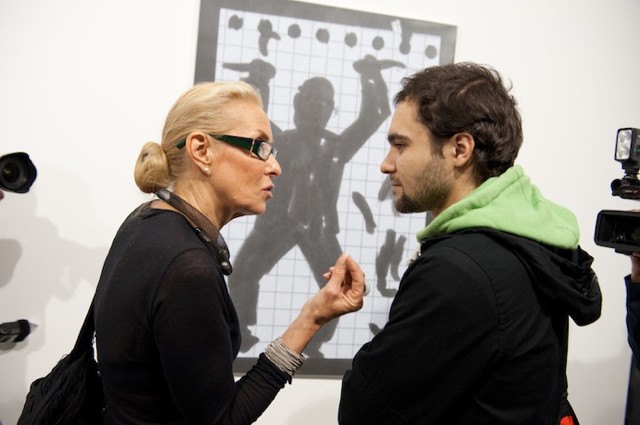
Olga Sviblova and David Ter-Oganyan at the opening of “Speed of Light”
David Ter-Oganyan’s work in question is a projection of human shadows on the exhibition walls, for which he invited real LGBT activists and artists who supported their struggle.
In Ter-Oganyan’s conception of the piece, museum visitors entering the exhibition hall would be passing in front of a light-projector, which would result in their shadows mingling with those of the afore-mentioned gay activists. In this way, audience members themselves would be represented side by side with those who advocate for LGBT rights in Russia. The artist’s intent was to “create a different kind of museum space, in which the real would be combined with the virtual.” According to the artist, his work was supposed to be a metaphor for the erosion of social borders erected on the living social body by the authoritarian government that recently instituted the homophobic laws.
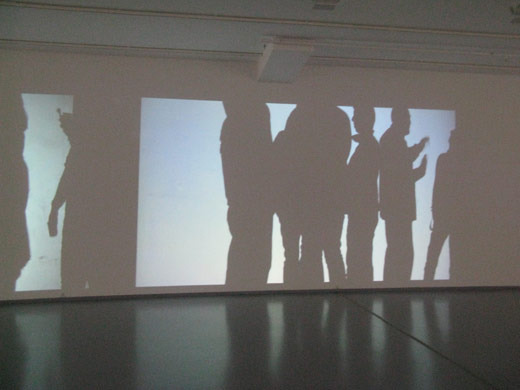
David Ter-Oganyan, Propaganda of Homosexuality, video projection at the MAMM
However, the explanatory text in the exhibition at the MAMM (a piece of paper placed on the wall narrating the meaning of Ter-Oganyan’s work), only talked about the combination of the real and the virtual inside the museum space.
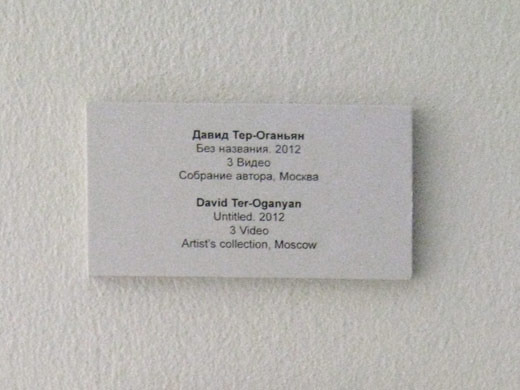
The opening of the exhibition was attended by six LGBT activists from among those who participated in Ter-Oganyan’ video-project, and who noticed the change in the title and explanation of the work. The artist did not realize that before the opening he should have checked if the curator (Ekaterina Inozemtseva) was begin honest with him. When he turned to the organizers for explanations, they assured him that on Friday (the third day of the exhibition) they would correct the title and explanation of his work. But on Saturday night he learned that he had been deceived. It was then that it was finally revealed to him that the museum had no intention of correcting anything.
David Tar-Oganyan commented on the censorship and the discussion around the name of the work before the opening: “I suggested to install the work “Propaganda of Homosexuality” – the museum agreed – at the opening the museum promised to correct the title – but the next day I was told that nothing was going to be changed. According to the artist, he didn’t want to start a scandal right then and there, and instead tried to solve the problem behind the scenes, to fight against the censorship of his work. Desperate to change the situation, he wrote the following post on his facebook page:
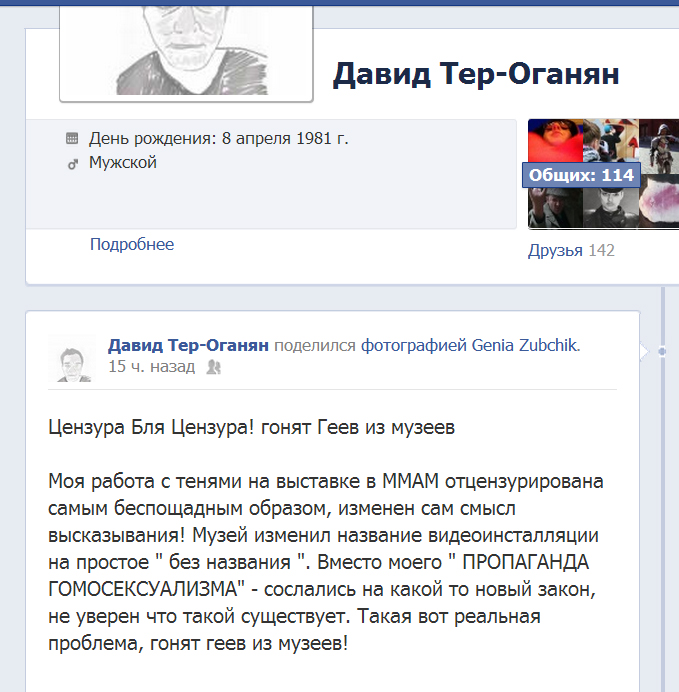
Censorship, fucking censorship! Gays are being driven out of museums
My work involving shadows on display at the MMAM was censored in the most merciless way, by changing the very meaning of my statement! The museum changed the name of my video-work to simply “Untitled.” – instead of my original title “Propaganda of Homosexuality,” referring to the new law – which I am not sure exists yet. This is the real problem: they are driving gays out of museums!
Obviously the problem was not resolved behind the scene and that is why Lesbiru.com decided to publish this material.
Reactions to this case in the blogosphere
– They arrived at a great metaphor for invisibility. State Power and society allow the existence of gays and queers in general – but only as long as they remain invisible.
– If the MAMM wanted to exclude the artist, they should have done so from the beginning. It would have been a “normal” gesture, albeit unpleasant and with homophobic overtones, there would have been negotiations perhaps. Ekaterina Inozemtseva (the curator of the exhibition, who bears the responsibility for everything that has happened), knew the title of the work in advance and did not object to it; she then tried to cover up the change in the title and finally promised to change the label on the third day of the exhibition (although she well knew that no change would occur); only on Saturday night David Ter-Oganyan learned that the title and the text accompanying the work were not corrected after all, that no one was going to correct anything.
– Idiots….and they call this an art museum!
– Suggestion to include in the installation the shadow of a bulldozer!
– The homophobia and queerphobia at the MAMM has not been a secret for some time. When they presented the exhibition of Nan Goldin, for example, they managed to silence her biography, and her work is largely auto-biographical! And what about the annoucement for the Annie Leibovitz exhibition, whose work is also autobiographical? A foot-long text mentioned all her relatives but there was not a word about her beloved, who is represented in her photographs, as though she [her beloved] had never existed!
– I advise the artist confronted with this situation to withdraw from the exhibition […] – the curator violated the artist’s right to freely choose the title of his work, she [Ekaterina Inozemtseva] should not be able to interfere and change the name of the work. I consider this as a real crime – the change of the name completely perverted the meaning of the work, it killed it. Explain to me why this is not an act of vandalism?
– The position of the artist is not that important – but the reality of the homophobic politics operating in the field of contemporary (or visual) art. Also, that Olga Sviblova chose to extend the law in St. Petersburg (the so-called “Milonov” law) onto the territory of the MAMM.
– [Ter-Oganyan’s] Installation was an action – and the reaction to this action was, if not more important, on par with his statement.
Reactions from the artistic community
– Young people, who did not live under the Soviet regime, are surprised to learn of such acts of censorship in public places. This case bears witness to the return of Soviet Power in all its “beauty,” maybe in a softer variant, resembling the period of Perestroika which began in the second part of the 80s.(Sergey Mironenko)
– In Evgeny Zubchenko’s photographs at the opening of the exhibition it is clear that David and Sviblova were engaged in a conversation which seemed unpleasant for both of them. I also noticed this exchange while passing through the exhibition gallery, but I didn’t give it much attention at the time. I found out later about the censorship. (Anton Nikolaev)
– I would have projected the shadows of gay men with erected penises. It would have been more fun. The shadows of the audience would have inevitably bumped into them. (Dmitry Vrubel)
_______________________________________________________
via Valery Lebedev/ Colta.ru
Interview with David Ter-Oganyan on his case of censorship
– How was your project originally conceived?
– My work was inspired by the law banning so-called “propaganda of homosexuality” which was passed in St. Petersburg in the spring of 2012 and in Akhangelsk in the fall of 2011. I was disturbed by these developments and decided to do this project. I met with LGBT activists and their supporters and filmed them – in the video they were simply standing as in a kind of video-picket.
– So in a way you tried to re-enact an action or picket?
– Yes, it was an allusion to that. In the final piece, visitors entering the exhibition and passing in front of the projection beam would case their own shadows which would merge with the shadows of the activists projected on the screen. The title of the piece is “Propaganda of Homosexuality”. I wanted to make a political work, not an abstract one.
– How does this work relate to your older project “Shadows”?
– I basically re-filmed that work. This is another piece altogether, yet it looks similar. I turned it around, looking at it from a different perspective.
– Did the organizers know what your new work was about, were they aware of its content?
– Yes, they were aware of everything. The exhibition’s curator, Ekaterina Inozemstreva knew about my work as early as August 28th – there was email correspondence between us about this. (The exhibition opened September 5th). The only thing they asked me was that I not include any nudity or pornographic scenes, but there was nothing like that in my work and I wasn’t going to include any [nudity, pornography]. And then at the opening of the exhibition I saw that my work had a different name and a different label.
– Did the organizers explain these changes to you?
– Yes, I approached Katya [Inozemtseva] and Olga Sviblova and asked what was going on. They just told me: just don’t say anything, don’t make a scandal, we will change everything back tomorrow. They explained that these changes to my work were supposedly done only for the opening of the exhibition so as not to attract negative attention.
– And did they make those changes?
– No, they didn’t and on Monday I was finally told that that they will not change anything back because of a new law which, according to them will be instituted in Moscow soon.
– Were they referring to the federal bill , which was recently submitted for consideration to the State Duma?
– Sviblova simply said that there are “certain” people who may respond negatively to my work, some powers in Russia, whom she doesn’t want to cross. I then approached the curator and she told me she did everything she could but that Sviblova insisted on changing the name. I could have just withdrawn my work from the exhibition, but I’m not going to do that. At the time when this happened I felt really helpless. My work lost its principal meaning. I thought it as a concrete statement, not an abstract one – referring precisely to the current law that was instituted in St.Petersburg, Novosibirsk, Arhangelsk. And now the work is presented without a title, and with an abstract description – and the museum says they will not change anything, that everything is as it should be. This is censorship.
– Could this situation have been predicted? After all, this is a museum which is supported by state funds – and the topic of your work is quite acute.
– They asked me not to include any explicit nude scenes in my work, saying that they will review all the material and that they are afraid of provocation, that I would repeat the mistakes of my father. But in fact my work did not contain any such provocations. I think that what ended up happening was quite horrible.
– How was the idea of your work conceived? Is it part of a larger project in which you are reacting to the current situation [in Russia]? Why do you, as an artist find it necessary to make a civil action?
– I thought that this is a topic that needs to be raised. It seems to me that the LGBT movement is currently part of a counter-cultural avant-garde. This movement is one of the most radical fronts in the current protest spectrum, and the recent adoption of the law banning “homosexual propaganda”- is a clear confirmation of this. State power fears gay activists and it tries to silence them when it can. This struggle is being waged inside society – it is a struggle which represents the corporeal and subjective (referring to subjectivity) desire to resist the patriarchal order imposed by Power. In this struggle, desire and protest act as engines of a concrete and materialist view, demystifying and calling into question the very foundations of the current regime and exploitation in contemporary society. I conceived of my work when the law (banning “homosexual propaganda”) had just come out – at the time it was feared that in Moscow there would also be something like that instituted. I also wanted to show a version of this work in another exhibition, in a parallel project of the Kiev Biennale. It was not shown there, but for other reasons, mostly technical ones. I wanted to make a political statement through cultural forms: when a person comes to the museum, he/she carries a certain attitude inside. And this attitude would be engaged in a reality which would begin with the name of my piece and then that person would unexpectedly be included inside my work.
– It seems that critical projects are more and more difficult to implement in museums – do you think that there are specific topics that have become taboo?
– Yes I think that’s obvious and also that it is usually done quietly, without the artist’s consent. I was very confident that I could have a dialogue with the museum. Provocation, if it indeed existed in my work was mostly cultural and not aggressive, it was about understanding the problem and reflecting on it.
[…]
– Is there any documentation to prove that the organizers were well aware of everything in advance?
– Yes, the email correspondence between us exists. Everything was prepared quite chaotically but the curator was updated about everything. And there was also our correspondence prior to the opening. Olga said that there would be such a law prohibiting “propaganda”, and especially the “propaganda of homosexuality,” which would be announced on the 8th of September. She declared that she herself supports the gay movement, and that the work would remain as it is and she will talk to me more in person. She long-told me that my work is bad and that the wall text looks stupid. She said that this speaks to my lack of professionalism, that it is impossible to change the name of the piece during the installation. In my opinion, the curator distorted things to her benefit.
Alexander Galkin, who helped David Ter-Oganyan produce the video-projection, commented on this case
We got in touch with a number of LGBT organizations, got to know their members personally and invited them to take part in the video-installation “Propaganda of homosexuality,” explaining them the idea behind the project. They were all interested in doing a good job and were not interested in vulgar provocation. The activists worked long hours on the video-shooting. We invited all of them to the opening, telling them that we wanted to support their social movement and on the part of the museum, to make such a video-protest on the walls of the museum. However, at the opening the activists did not find themselves mentioned in the project altogether. Neither I nor David had checked the labels in advance, because we thought that was the job of the museum. And after the opening, David was led to believe that they would correct the labels. We did not want to make a scandal, and David said that his duty was to change the title of the work back to the original. But the director of the museum intuitively felt as if the law (against propaganda of homosexuality) had already passed. And the way they behaved in this situation was as if the law was (informally) in place. We consulted a lawyer – at the state level and in Moscow there is no such prohibitive law.
Editor’s Note. Originally published in Russian here. The interview has been edited slightly in English to make it more readable.
Launching the ArtLeaks Gazette – Call for Papers
On the urgency of launching the ArtLeaks Gazette
Artleaks was founded in 2011 as an international platform for cultural workers where instances of abuse, corruption and exploitation are exposed and submitted for public inquiry. After over a year of activity, we, members of the collective ArtLeaks felt an urgent need to establish a regular on-line publication as a tool for empowerment in the face of the systemic abuse of cultural workers’ basic labor rights, repression or even blatant censorship and growing corporatization of culture that we encounter today.
Namely: radical (political) projects are co-opted under the umbrella of corporate promotion and gentrification; artistic research is performed on research hand-outs, creating only an illusion of depth while in fact adding to the reserve army of creative capital; the secondary market thrives as auction houses speculate on blue chip artists for enormous amounts of laundered money, following finance capitalism from boom to bust, meanwhile, most artists can’t even make a living and depend on miserly fees, restrictive residencies, and research handouts to survive; galleries and dealers more and more heavily copyright cultural values; approximately 5% of authors, producers and dealers control 80% of all cultural resources (and indeed, in reality, the situation may be even worse than these numbers suggest) ; certain cultural managers and institutions do not shy away from using repressive maneuvers against those who bring into question their mission, politics or dubious engagements with corporate or state benefactors; and last but not least, restrictive national(ist) laws and governments suppress cultural workers through very drastic politics, not to mention the national state functions as a factor of neoliberal expression in the field of culture.
Do you recognize yourself in the scenarios above? Do you accept them as immutable conditions of your labor? We strongly believe that this dire state of affairs can be changed. We do not have to carry on complying to politics that cultivate harsh principles of pseudo-natural selection (or social-Darwinism) – instead we should fight against them and imagine different scenarios based on collective values, fairness and dignity. We strongly believe that issues of exploitation, repression or cooptation cannot be divorced from their specific politico-economic contexts and historical conditions, and need to be raised in connection with a new concept of culture as an invaluable reservoir of the common, as well as new forms of class consciousness in the artistic field in particular, and the cultural field more generally.
Recently, this spectrum of urgencies and the necessity to address them has also become the focus of fundamental discussions and reflection on the part of communities involved in cultural production and certain leftist social and political activists. Among these, we share the concerns of pioneering groups such as the Radical Education Collective (Ljubljana), Precarious Workers’ Brigade (PWB) (London), W.A.G.E. (NYC), Arts &Labor (NYC), the May Congress of Creative Workers (Moscow) and others (see the Related Causes section on our website). The condition of cultural workers has also recently been theorized within the framework of bio-politics – in which cognitive labor is implicitly described as a new hegemonic type of production in the context of the global industrialization of creative work.
The question then emerges, what is creative work today? To structure this undifferentiated categorizations, we will begin by addressing in our journal all those “occupied” with art who are striving towards emancipatory knowledge in the process of their activity. As the contemporary art world more and more envelops different areas of knowledge as well as the production of events, we considered it a priority to focus on this particular field. However, we remain open to discussing urgencies related to other forms of creative activity beyond the art world.
Through our journal, we want to stresses the urgent need to seriously transform these workers’ relationship with institutions, networks and economies involved in the production, reproduction and consumption of art and culture. We will pursue these goals through developing a new approach to the tradition of institutional critique and fostering new forms of artistic production, that may challenge dominant discourses of criticality and social engagement which tame creative forces. We also feel the urgency to link cultural workers’ struggles with similar ones from other fields of human activity – at the same time, we strongly believe that any such sustainable alliances could hardly be built unless we begin with the struggles in our own factories.
Announced Theme for the first issue: Breaking the Silence – Towards Justice, Solidarity and Mobilization
The main theme of the first issue of our journal is establishing a politics of truth by breaking the silence on the art world. What do we actually mean by this? We suggest that breaking the silence on the art world is similar to breaking the silence of family violence and other forms of domestic abuse. Similarly as when coming out with stories of endemic exploitation form inside the household, talking about violence and exploitation in the art world commonly brings shame, ambivalence and fear. But while each case of abuse may be different, we believe these are not singular instances but part of a larger system of repression, abuse and arrogance that have been normalized through the practices of certain cultural managers and institutions. Our task is to find voices, narratives, hybrid forms that raise consciousness about the profound effects of these forms of maltreatments: to break through the normalizing rhetoric that relegate cultural workers’ labor to an activity performed out of instinct, for the survival of culture at large, like sex or child rearing which, too are zones of intense exploitation today.
Implicit in this gesture is a radical form of protest – one that does not simply join the concert of affirmative institutional critique which confirms the system by criticizing it. Rather, breaking the silence implies bringing into question the ways in which the current art system constructs positions for its speakers, and looking for strategies in which to counteract naturalized exploitation and repression today.
At the same time, we recognize that the moment of exposure does not fully address self-organization or, what comes after breaking the silence? We suggest that it is therefore important to link this to solidarity, mobilization and an appeal for justice, as political tools. As it is the understanding of the dynamic interaction between the mobilization of resources, political opportunities in contexts and emancipatory cultural frames that we can use to analyze and construct strategies for cultural workers movements. With summoning the urgency of “potentia agendi” (or the power to act) collectively we also call for the necessity to forge coalitions within the art world and beyond it – alliances that have the concrete ability of exerting a certain political pressure towards achieving the promise of a more just and emancipatory cultural field.
Structure of publication
The journal would be divided into 6 major sections.
A. Critique of cultural dominance apparatuses
Here we will address methodological issues in analyzing the condition of cultural production and the system that allows for the facile exploitation of the cultural labor-force. Ideally, though not necessarily, these theoretical elaborations would be related to concrete case studies of conflicts, exploitation, dissent across various regions of the world, drawing comparisons and providing local context for understanding them.
B. Forms of organization and history of struggles
Cultural workers have been demanding just working conditions, struggling over agency and subjectivity in myriad ways and through various ideas about what this entails. In this section we will analyze historical case-studies of self-organization of cultural workers. Our goal is not to produce a synthetic model out of all of these struggles, rather to examine how problems have been articulated at various levels of (political) organization, with attention to the genealogy of the issues and the interaction between hegemonic discourses (of the institution, corporation, the state) and those employed by cultural workers in their respective communities.
C. The struggle of narrations
In this section we will invite our contributors to develop and practice artistic forms of narration which cannot be fully articulated through direct “leaking”. It should be focused on finding new languages for narration of systemic dysfunctions . We expect these elaborations can take different form of artistic contributions, including comics, poems, films, plays, short stories, librettos etc.
D. Glossary of terms
What do we mean by the concept of “cultural workers”? What does “gentrification” or “systemic abuse” mean in certain contexts? Whose “art world”? This section addresses the necessity of developing a terminology to make theoretical articulations more clear and accessible to our readers. Members of ArtLeaks as well as our contributors to our gazette will be invited to define key terms used in the material presented in the publication. These definitions should be no more that 3-4 sentences long and they should be formulated as a result of a dialogue between all the contributors.
E. Education and its discontents
The conflicts and struggles in the field of creative education are at the core of determining what kind of subjectivities will shape the culture(s) of future generations. It is very important to carefully analyze what is currently at the stake in these specific fields of educational processes and how they are linked with what is happening outside academies and universities. In this section we will discuss possible emancipatory approaches to education that are possible today, which resist pressing commercial demands for flexible and “creative” subjectivities. Can we imagine an alternative system of values based of a different meaning of progress?
F. Best practices and useful resources
In this section we would like to invite people to play out their fantasies of new, just forms of organization of creative life. Developing the tradition of different visionaries of the past we hope that this section will trigger many speculations which might help us collect modest proposals for the future and thus counter the shabby reality of the present. This section is also dedicated to the practices which demonstrate alternative ethical guidelines, and stimulate the creation of a common cultural sphere. This would allow cultural workers to unleash their full potential in creating values based on principles of emancipatory politics, critical reflections and affirmative inspiration of a different world where these values should form the basis of a dignified life.
On Practicalities
Our open call addresses all those who feel the urgency to discuss the aforementioned-issues. We look forward to collecting contributions until the 31st of December 2012. Contributions should be delivered in English or as an exemption in any language after negotiations with the editorial council. The editorial council of Artleaks takes responsibility of communicating with all authors during the editorial process.
Please contact us with any questions, comments and submit materials to : artsleaks@gmail.com. When submitting material, please also note the section under which you would like to see it published.
The on-line gazette will be published in English under the Creative Commons attribution noncommercial-share alike and its materials will be offered for translation in any languages to any interested parts.
We will publish all contributions delivered to us in a separate section. However, our editorial council takes full responsibility in composing an issue of the journal in the way we feel it should be done.
Editorial council for the first issue will consist of: Corina L. Apostol, Vladan Jeremić,Vlad Morariu, David Riff and Dmitry Vilensky.
Report of the 3rd ArtLeaks Assembly in Belgrade and Related Events
Preface
On the 30th of August an ArtLeaks Committee consisting of Corina Apostol, Alina Popa, Rena Raedle and Ştefan Tiron analyzed the condition of several cultural institutions in Belgrade.
First on our list was the problematic case of the Museum of Contemporary Art, a truly amazing piece of modernist architecture. This venue has been closed since 2007, when reconstruction works started but were never finished. At the moment of our visit, an exhibition entitled “What Happened to the Museum of Contemporary Art?” (a non-exhibition of documentation, art interventions and the building interior) was on display. This exhibition represents the first public problematization of the museum’s condition after more than 5 years of silence on behalf of the management and its director, who has been in power for over 12 years. With more than 30 employees and five other venues, the main activities of this institution are conducted from a villa in a rich neighbourhood of Belgrade, serving the private interests of the management, while still funded by public money.
While visiting the “non-exhibition” inside, we discussed why the Belgrade art community did not just simply occupy this empty museum and create an alternative space where cultural workers could share their knowledge, conduct classes and workshops, construct exhibitions. This could be a great experiment in building a space for art and culture using a bottom-up approach.
After this visit we were joined by artist Vladan Jeremić and photographer Benjamin Renter. The second venue we visited that day was the Gallery of the Artists Union of Serbia (ULUS), where the solo-exhibition „I am him“ was on-going. Artist Milica Vergot gave us a tour of the exhibition.
Afterwards, we went on to observe two open air photo-exhibitions in the old fortress of Belgrade, at Kalemegdan Park. The first exhibition entitled „The New Look of Russia“ was sponsored by GAZPROM while the other, „This is Poland“ was produced by the Austrian Embassy.
Some initial conclusions: Very diverse and difficult local context to explore with many problematic points.
3rd ArtLeaks Assemby at the Cultural Center REX
On the 31st of August we organized an internal meeting from 1pm-5pm at the Cultural Center REX. At this meeting participated: Corina L. Apostol, Alina Popa, Ştefan Tiron, Veda Popovici, Vladan Jeremić, Rena Raedle, Noa Treister, Nikola Radić Lucati, Alexander Nikolić and his son Vincent. Isidora Fićović contributed to the discussions via Skype.
Our discussion began with the possibility and conditions of applying for or receiving outside funding for ArtLeaks and establishing a common donation fund which would help us to organize more assemblies and workshops as well as for our forthcoming ArtLeaks Gazette.
Rena Raedle, artist and cultural worker from Belgrade suggested using the model for Wikipedia which is funded through donations by the users via the Wikimedia Foundation, a non-profit charitable organization.
Noa Treister, artist and curator from Belgrade, gave us feedback on our project, suggesting that we should attempt to broaden the scope, focusing not only on artists but also including journalists, other workers and social groups. She also highlighted the importance of formulating positive alternatives, and not just criticizing the status-quo.
The discussion then focused on cultural workers’ rights and self-organization: namely, the question of creating international standards for compensation of cultural work; the difference between NGO-ism, which is based on competition of individuals, and Unionism, based on solidarity; the question of how to include precarious workers in a classical trade union structure and the necessity of updating the traditional form of trade unions, of finding new forms of unionism.
Isidora Fićović, an artist from Belgrade had a very active participation via Skype. She talked about the extremely subordinated and submissive position of artists in Serbian society and their very bad material conditions. She remarked that artists are not well-organised and remain fragmented as a community, therefore it is hard to achieve some level of solidarity among them.
Alexander Nikolić presented his space, BOEM (Association for Art, Culture, Science and Communication) in Vienna and introduced a useful comparison between the contemporary cultural worker and the gastarbeiter (or guest-worker).
Vladan Jeremić introduced the idea of creating a glossary within ArtLeaks to clarify key-terms (such as art worker, cultural worker, gentrification) which have different meanings and nuances according to local contexts. Crucial definitions like for example definition of labor or value in Marxist terms and standardisation of some definitions could be important. Vladan also suggested initiating an “ArtLeaks Country Report” on the local socio-economic-legal conditions of cultural production by country, as often such studies are missing. Vladan will coordinate reports on Serbia, Kosovo, Bulgaria and Bosnia and Herzegovina, while Corina will do the same for Romania, Hungary and Ukraine. We hope this initiative will be expanded to cover as many regions of the globe as possible.
The 3rd ArtLeaks Assembly open to the public began at 7 PM and lasted until 11 PM. The public consisted of approximately 40 people plus announced speakers at the round table.
Art historian and curator Corina Apostol, introduced the ArtLeaks project to the audience. Corina highlighted the urgency of constituting the project which was founded in September 2011, some of our goals and values, and presented 5 case studies of violations and abuses which were published this past year of activity. Corina also stressed that while the project currently works as a council of core members, it is open to receiving new members who wish to join our struggles. Corina also presented some ArtLeaks initiatives such as The No Fee Statement, summarized discussions in previous ArtLeaks Assemblies and Workshops and introduced the forthcoming ArtLeaks journal – a publication dedicated to cultural workers rights. and related struggles. She then invited the audience to offer comments, criticism and suggestions about how ArtLeaks could be improved.
Alina Popa spoke on behalf of the group that she co-founded with Irina Gheorghe in 2009, The Bureau of Melodramatic Research. She discussed their participation in the Pavilion Unicredit exhibition, “Just Do It. Biopolitical Branding” in 2010, where they brought into question this institutions’ relationship with its sponsor, UniCredit Bank, and the fact that artists were not paid for their labor in their installation – “The Soul of Sustainability” (March 2011). This intervention brought the group in collaboration with other founding members of ArtLeaks. Alina also discussed the group’s strategy of melo-critique through which they examine the way in which key elements of melodrama are currently at work on the political scene. In ArtLeaks this strategy may be extended to deal with the position of the witness and modes of production of truth through first-person reports.
Artist and curator Ştefan Tiron presented his own case of being blacklisted from the MNAC (National Museum for Contemporary Art) in Bucharest. He recounted how in 2004, when the museum began to function, he was appointed in the initial curatorial team and was accused of stealing a bag of invitations to the opening. After this incident he completely left the institution. Ştefan also highlighted that people may be afraid to speak out about their cases publicly on ArtLeaks, which doesn’t have a witness protection program. But, what he and others did in Bucharest was to be a step ahead of the people that tried to blackmail and blacklist them: they started a small inquisition jury, inviting witnesses in these cases to retract what they had said publicly, thus forcing the institutions into a public retraction of all the accusation that they had made.
Vesna Milosavljević, journalist from the biggest cultural portal in South-East Europe, SEEcult.org declared that she is ready to re-publish or to support ArtLeaks content; her criticism on ArtLeaks was that the project needs a better PR strategy and to establish stronger communication with the media field.
Selman Trtovac, artist and founder of the artist cooperative Third Belgrade, highlighted the need to talk about positive examples and positive alternatives cultural communities could provide, and not only focus on the negative cases which ArtLeaks exposes. He added that he thinks it is very important to include projects like ArtLeaks in artists’ strategies, to organize artists cooperatives and communities and not only to rely on NGO and official institutions.
Professor emeritus Marica Radojčić, mathematician, artist and president of the Association UMNA-Art&Science, brought up specific cases – the annual exhibition of the Expanded Media department of the ULUS-Association of the Visual Artists of Serbia – when artists are usually forced to finance the event from their own resources, while the funds for exhibitions go to the salaries of the ULUS Administration. She also expressed serious doubts that in Serbia it would be possible to develop serious criticism of the art world, as it seemed to her that the whole population, artists included, are tired and depressed from the war, poverty and struggling for everyday survival.
Curator Maja Ćirić underlined problem of exoticism of the particular cases from the Balkans if they were to be included in ArtLeaks and raised problems of the global and local in art and cultural production. She also highlighted ArtLeaks as a bottom-up project that could be used as a positive model for self-organization.
Rena Raedle highlighted the potential of ArtLeaks to back up local struggles of cultural workers through its international dimension. She discussed public research as a possible methodology to unveil relations of exploitation and mutual blackmailing that are otherwise covered under an alliance of silence. She proposed to develop supportive structures of solidarity on local and international level and introduced the model of a common fond members and users of ArtLeaks would donate to, thus using money as a medium of coherence and solidarity rather than dependence (of project-oriented funding).
Photographer Nikola Radić Lucati discussed the very specific context of Serbia and the Balkans, while mapping big players such as Emir Kusturica or the Serbian Orthodox Church as the most problematic in organizing reactionary hegemony and misuse of public cultural funds. Nikola warned us about post-war situation of the Balkans and all extremely complex difficulties that such societies are facing with. Vladan Jeremić added that the specificity of the region includes the proliferation of the NGO industry and professionalization in the field of NGO and cultural industry. In his view, this constitutes a sizable obstacle for the emancipation of the cultural workers in the Balkans. Until now, it has been the case that NGOs were gathering in networks in order to gain control over funds and political power – thus, control of public and art production space is still maintained by NGOs and not by cultural and art workers unions.
On the 2nd of September we had another ArtLeaks internal meeting at BLOK 70, attended by Corina Apostol, Rena Raedle Vladan Jeremić and Ştefan Tiron. We continued our discussion of the economic organization of ArtLeaks, re-edited the structure and the open call for the forthcoming ArtLeaks Gazette. Ştefan and Vladan coined the term “Cognitive Googlag” (referring to brain drain, mental sweatshops, neuropolitics, general intellect oil fields, necro-productivity, forced immaterial labor camps and self-exploitation) and introduced the idea of an Cultural Workers Pride Parade (similar to LGBT Pride Parades) in order to mobilize cultural workers and raise their class consciousness sense of dignity.
After this internal meeting we payed a visit to “Third Belgrade”, a “mini-utopia” as described by our host Selman Trtovac, who talked about the platform’s’ idea of leaving behind art institutions and building up new, autonomous paradigms. Here, we also heard the disturbing confession of Aleksandra Saška Miljković, a young art historian from Belgrade, about her uncompensated work for the Kinoteka in Belgrade. Her case is a paradigm for an entire generation of European young and highly educated cognitive workers without any optimist future to obtain a decent level of working conditions in their life. We discussed how these cases of eternal interns and volunteers are normalized in Europe and especially on the European economic periphery of the East and South.
The same day we met with journalist and artist Milica Lapčević, who proposed that ArtLeaks include a short summary on every case, as well as an ArtLeaks Asks section on the main page. Her idea was to introduce a form public audit, inspection, and monitoring in the practice of ArtLeaks. She also suggested that ArtLeaks should present its cases globally, similarly to Wikileaks, and highlight more the geopolitical dimension of power and economic relations which she felt was still not clear in our project.
Photos from the ArtLeaks Assembly at the Cultural Center REX taken by Benjamin Renter, Rena Raedle and Vladan Jeremić.
We invite others who participated in our Assembly that would like to add any information that may be missing from this report to contribute by leaving us comments below. We will incorporate these into our report in a timely manner.
Many thanks go out to the Cultural Center REX for hosting us in Belgrade and to all those who participated in the discussions!
 ArtLeaks