Updates
ACT NOW! Submit your story to ArtLeaks and end the silence on exploitation and censorship! Please see the submission guidelines in the "Artleak Your Case" page
Submitted and current instances of abuse are in the "Cases" section
To find out more about us and how to contribute to our struggles, please go to the "About ArtLeaks" page
Please consult "Further Reading" for some critical texts that relate to our struggles
For more platforms dedicated to cultural workers' rights please see "Related Causes"
For past and upcoming ArtLeaks presentations and initiatives please go to "Public Actions"
Open Letter in Support of Pussy Riot (Rodchenko School for Photography and Media Art)
via chtodelatnews
// EN
We, faculty of the Rodchenko School of Photography and Multimedia and other members of the Russian art community, are extremely alarmed by the trial of the three young women accused of hooliganism as a result of their performance in the Cathedral of Christ the Savior. Many of us know one of them, our alumna artist Ekaterina Samutsevich, quite well, but we also know the others, Maria Alyokhina and Nadezhda Tolokonnikova, from their performances. We write this letter to express our complete solidarity with them and also to elaborate on a few points belonging to our field of professional competence.
The accusations against Pussy Riot are false and hypocritical. They are based on “sacrilege,” a term that does not exist in current criminal law. They are a disguised form of political repression: nobody would have persecuted these women had they asked the Virgin Mary to defend Putin, even in a non-traditional manner. The trial against Pussy Riot is a trial against dissidents, and the way the defendants have been treated and detained has been unreasonably severe. As citizens, we are outraged by this repressive trial and, like many other people in our country and around the world, we demand an end to this shameful mockery of justice, and the full vindication and release of Pussy Riot.
People involved in contemporary art in Russia have particular reason to be outraged and alarmed. During the trial, the phrase “contemporary art” was always, when uttered by the prosecution, accompanied by the mocking addendum “so-called.” Its very right to exist was thus questioned. It was implied that contemporary art is a species of hooliganism, which, to make matters worse, is supported “from abroad.” We therefore deem it necessary to speak out on this issue.
Contemporary art, by its very nature, is a public statement about the present day. Its themes and forms may vary, but if the present day is such as it appears in Russia today—a present day characterized by lawlessness, lack of political choice, criminal oppression of citizens by the authorities, the absence of impartial courts, obscurantism and fundamentalism—then the artist has no choice but to stop worrying about formal nuances and become a political artist. It would be impossible and immoral to draw boundaries here, and we refuse to accept the other notions of art, safer for the authorities, that are being imposed on us.
Art is always an act, a deed. To be heard in contemporary Russia, the artist is forced to engage in extreme acts. This has been proven by the huge impact that Pussy Riot’s action has had.
However, we support Pussy Riot not because we think they are entitled to special rights with respect to other citizens—for instance, the right of “provocation.” Mindless provocation has never been the goal of real artists. As artists, Pussy Riot have no special rights, but they do have a special duty—the duty to represent a society whose political will is shackled, a society deprived of freedom and justice, a society with a poor understanding of human rights, a society whose mouth is politically gagged and whose eyes are blinded by mendacious TV channels. Pussy Riot upheld this duty in full. Thanks to their deed and the authorities’ reaction to it, there are now people in all parts of the country who have begun to understand what is happening to them.
As experts, many of us are constantly asked how we assess the quality of Pussy Riot’s performance. Some of us thought from the very outset that it was outstanding, while others of us have changed their opinion over time. The quality of an artwork is not contained in the work itself, but is reflected, rather, in its power, its impact, in commentaries by the artist who made it, and, to a great extent, in the public’s reaction to it. Pussy Riot’s action is an incredibly powerful work of protest art and activist art: it has revealed such profound ills in our society that its impact will continue to be felt for a long time to come. It is only thanks to Pussy Riot that we have begun to discuss things that have not been open to debate for many years. During the months of their detention, as the authorities and the Russian Orthodox Church became more and more relentless, Pussy Riot’s action acquired more and more value, and they themselves grew in our eyes tremendously. Throughout the trial, their public statements and comments were clear, philosophically profound and morally impeccable. We are proud of them. Those speeches will undoubtedly, like the action in the Cathedral of Christ the Savior, find their place in the history of Russian social life.
We also need to stress out that our support for Pussy Riot does not imply an anti-clerical stance; the same is true of the unfairly accused artists. The stance taken by the Russian Orthodox Church in this case contradicts the feelings, thoughts, interests and faith of many ordinary believers, whose eyes have opened by the Pussy Riot case to the real state of affairs in the country and the church. Splitting society (and the art world) into believers and non-believers benefits only the authorities and the corrupt leadership of the Russian Orthodox Church. Pussy Riot spoke on behalf of everyone, and we support them in this.
Contemporary art is not art only for non-believers, or only for the educated, or only for the rich. It is for those who are concerned about what is happening in the present. Contemporary art should be the conscience of society, and that conscience can tell society unpleasant or painful things, sometimes in a way that is irritating and uncomfortable. It is not separated from the common people: it is the first to feel pain, express it and thus attempt to heal it. We are glad that Pussy Riot—as we have come to know them during the trial—have finally shown us the image of what the artist in Russia should be: not a senseless provocateur and prankster, but an orator, a citizen, a hero.
The impact of their action is such that it we believe it absolutely right that Pussy Riot be nominated for the Kandinsky Prize in the “Project of the Year” category. It is also necessary to answer the frequent accusation that artists work for awards. All those involved in contemporary art in Russia know that, given the near-total absence of grant support and professional education, awards are the only form of material and moral mutual support available to the art community. By nominating Pussy Riot, the art community underlines its solidarity in the face of a common threat. We support this and will do everything possible to increase the contemporary art world’s sense of its strength, solidarity and independence in relation to the current unjust regime.
Many of us—Russian artists, curators and critics—work in an international context and know quite well how our country is regarded in cultural circles around the world. Russia’s reputation is now very bad and is already approaching that of Belarus, which is a blank spot on the cultural map.
We declare with all seriousness that a guilty verdict in the Pussy Riot trial, no matter how “light” the subsequent punishment allegedly is, will cause irreparable damage to Russia’s international reputation (if that reputation can still be saved) and put an end to our country’s integration into the international cultural context. It will be a verdict on the entire country, on all of us. A cultural boycott is no mere empty phrase if there is no other way to influence what is happening in our country.
We demand that the court completely vindicate Maria Alyokhina, Yekaterina Samutsevich and Nadezhda Tolokonnikova.
Signed:
Sergei Bratkov
Daniil Bolshakov
Aristarkh Chernyshev
Ekaterina Degot
Vladislav Efimov
Aleskandr Evangely
Antonio Geusa
Dmitry Kabakov
Evgenia Kikodze
Ilya Korobkov
Sergei Khachaturov
Anastasia Khoroshilova
Roman Minaev
Elizaveta Morozova
Valery Nistratov
Lyubov Pchelkina
Kirill Preobrazhensky
Igor Vyazanichev
David Riff
Alexei Shulgin
Andrei Smirnov
Yuri Spitsin
Irina Uspenskaya
Lyudmila Zinchenko
____________________
via Novaya Gazeta
//RU
Представители художественной общественности России обратились с открытым письмом в поддержку участниц Pussy Riot (ПОДПИСИ)
Мы, преподаватели Школы фотографии и мультимедиа имени Родченко и другие представители художественной общественности России, с большой тревогой следим за процессом над тремя молодыми женщинами, которые обвиняются в хулиганстве за свой политический перформанс в Храме Христа Спасителя. Многие из нас хорошо знают одну из девушек, нашу бывшую студентку и художницу Екатерина Самуцевич, но и другие известны нам по их выступлениям, акциям. Этим письмом мы выражаем свою полную солидарность с ними, а также останавливаемся на некоторых вопросах, находящихся в нашей профессиональной компетенции.
Обвинение, выдвинутое Pussy Riot, фальшиво и лицемерно, оно базируется на не существующем в уголовном законодательстве термине «кощунство» и является скрытой политической репрессией —
никто не стал бы преследовать этих женщин, если бы они призвали Богородицу защитить Путина, пусть даже в нетрадиционной форме. Процесс против Pussy Riot – это процесс против инакомыслящих, а обращение с обвиняемыми, содержание их под стражей неоправданно жестоко. Как граждане мы возмущены этим процессом и его репрессивно-обвинительным уклоном и вместе со множеством других людей, в нашей стране и за рубежом, деятелей культуры и простых граждан, православных и нет, требуем прекращения позорного судилища, освобождения Pussy Riot и полного их оправдания.
Однако у сообщества людей, занимающихся в России современным искусством, есть и особые поводы к возмущению.
Нам особенно тревожно, что в ходе процесса само словосочетание «современное искусство» употреблялось обвинением с издевательским дополнением «так называемое», было подвергнуто сомнению само его право на существование, его пытались представить как форму хулиганства, поддерживаемого к тому же «из-за рубежа». Поэтому мы считаем необходимым высказаться по этому поводу.
Современное искусство по своей природе – публичное высказывание о современности. Тема этого высказывания, как и его формы могут быть самыми разными. Но если эта современность такова, какой она является в сегодняшней России: бесправие, отсутствие политического выбора, преступное обращение с гражданами со стороны силовых структур, отсутствие независимого суда, мракобесие и фундаментализм, то настоящий художник просто не может ограничиться созданием форм, он неизбежно становится художником политическим. Проводить здесь границу невозможно и недостойно, и мы отказываемся принимать другие, более безопасные для власти представления об искусстве, которые нам пытаются навязать.
Искусство – это всегда поступок. Современная Россия требует экстремального поступка, чтобы художник оказался услышан. И огромный резонанс, который вызвала акция Pussy Riot, это доказывает.
Вместе с тем мы подчеркиваем, что выступаем в поддержку Pussy Riot не потому, что как у художниц у них есть какие-то особые права по сравнению с остальным обществом, — например, право на «провокацию». Бессмысленная провокация никогда не являлась и не является целью настоящего художника.
То, что Pussy Riot являются художницами, дает им не особые права, но особые обязанности – обязанности выступать от лица общества, скованного в своей политической воле, лишенного свобод и справедливого суда, не имеющего представления о праве, общества темного, бесправного, чей рот заткнут политическим кляпом, а глаза застит лживое телевидение. И эту обязанность Pussy Riot выполнили сполна. Во всех концах страны есть люди, которые благодаря их поступку – и тому, как с ними поступает власть – начинают понимать, что с ними происходит.
Многих из нас как экспертов постоянно спрашивают, как мы расцениваем качество перформанса Pussy Riot. Некоторые из нас с самого начала считали эту акцию выдающимся произведением, другие изменили свое мнение со временем. Качество произведения искусства заключено не в нем самом, но в его силе, влиятельности, в комментариях самого автора, во многом – в общественной реакции на него. Акция Pussy Riot – невероятно мощное произведение протестного активистского искусства, оно вскрыло такие глубокие язвы нашего общества, что реакция будет длиться еще очень долго. Только благодаря им мы стали говорить о вещах, о которых не было принято дискутировать долгие годы. За месяцы, прошедшие с ареста Марии Алехиной, Екатерины Самуцевич и Надежды Толоконниковой, по мере того, как власть и РПЦ демонстрировали к ним всё большую жестокость, их акция очень выросла в своем значении, и сами они выросли в наших глазах. Их публичные выступления на процессе были ответственны, философски глубоки и морально безупречны. Мы гордимся ими. Эти речи, как и сама акция в Храме Христа Спасителя, без сомнения, войдут в историю российской общественной жизни.
Мы хотим подчеркнуть также, что в своей поддержке Pussy Riot выступаем не с антирелигиозных позиций, как не делают этого и сами несправедливо обвиняемые. Позиции, которые занимает РПЦ в этом деле, противоречат и чувствам, и мыслям, и вере, и интересам многих простых верующих, которым происходящее с Pussy Riot открыло глаза на то, что происходит в стране и в церкви.
Раскол общества (и художественного мира) на верующих и неверующих выгоден только власти и верхушке РПЦ. Pussy Riot говорили от лица всех, и мы поддерживаем их в этом.
Современное искусство не есть искусство только для неверующих, или только для образованных, или только для богатых. Оно – для тех, кто озабочен происходящим в современности. Современное искусство должно быть совестью общества, и эта совесть может говорить ему неприятные или болезненные вещи, порой в коробящей и неудобной форме. Оно не отделено от простых людей, оно первым чувствует боль, выражает ее и тем самым исцеляет. Мы рады, что Pussy Riot – какими мы их узнали на протяжении этого процесса – наконец явили нам образ художника в России, каким он должен быть: не бессмысленного провокатора или шутника, а оратора, гражданина, героя.
Резонанс этой акции таков, что мы считаем совершенно правильным выдвижение этого проекта на премию Кандинского в номинации «проект года». Необходимо ответить и на обвинение, которое часто инкриминируют художникам, что они работают для премий. Но все, кто занимается современным искусством в России, знает, что в условиях почти отсутствующей грантовой поддержки для художников, в условиях почти несуществующего профессионального образования премия есть единственная возможность и материальной, и моральной взаимоподдержки, которая доступна художественному сообществу. Этой номинацией художественное сообщество подчеркивает свою солидарность перед лицом общей угрозы. Мы поддерживаем это и сделаем все возможное, чтобы мир современного искусства еще больше почувствовал свою силу, сплоченность и независимость по отношению к существующему несправедливому порядку.
Многие из нас – российских художников, кураторов, критиков – работают в международном контексте и хорошо знают, каково отношение к нашей стране на культурной сцене всего мира.
Репутация России сейчас очень плохая и уже приближается к репутации Белоруссии, которая, как известно, является белым пятном на культурной карте.
Мы должны со всей серьезностью заявить, что обвинительный вердикт на процессе Pussy Riot, каким бы якобы «легким» ни было наказание, нанесет непоправимый урон международной репутации России (если эту репутацию еще можно спасти) и поставит крест на интеграции нашей страны в интернациональный культурный контекст. Это будет приговор всей стране, всем нам. Слово о культурном бойкоте не являются пустым звуком, если нет другой возможности повлиять на происходящее в стране.
Мы требуем полного оправдания Марии Алехиной, Екатерины Самуцевич и Надежды Толоконниковой.
Сергей Братков
Игорь Вязаничев
Екатерина Деготь
Антонио Джеуза
Александр Евангели
Владислав Ефимов
Людмила Зинченко
Дмитрий Кабаков
Евгения Кикодзе
Илья Коробков
Роман Минаев
Елизавета Морозова
Валерий Нистратов
Давид Рифф
Андрей Смирнов
Сергей Хачатуров
Анастасия Хорошилова
Аристарх Чернышев
Алексей Шульгин
Ирина Успенская
Любовь Пчелкина
Даниил Большаков
Кирилл Преображенский
Юрий Спицин
Slavoj Žižek on Pussy Riot: “The True Blashphemy”
Pussy Riot members accused of blasphemy and hatred of religion? The answer is easy: the true blasphemy is the state accusation itself, formulating as a crime of religious hatred something which was clearly a political act of protest against the ruling clique. Recall Brecht’s old quip from his Beggars’ Opera: “What is the robbing of a bank compared to the founding of a new bank?” In 2008, Wall Street gave us the new version: what is the stealing of a couple of thousand of dollars, for which one goes to prison, compared to financial speculations that deprive tens of millions of their homes and savings, and are then rewarded by state help of sublime grandeur? Now, we got another version from Russia, from the power of the state: What is a modest Pussy Riot obscene provocation in a church compared to the accusation against Pussy Riot, this gigantic obscene provocation of the state apparatus which mocks any notion of decent law and order?
Was the act of Pussy Riot cynical? There are two kinds of cynicism: the bitter cynicism of the oppressed which unmasks the hypocrisy of those in power, and the cynicism of the oppressors themselves who openly violate their own proclaimed principles. The cynicism of Pussy Riot is of the first kind, while the cynicism of those in power – why not call their authoritarian brutality a Prick Riot – is of the much more ominous second kind.
Back in 1905, Leon Trotsky characterized tsarist Russia as “a vicious combination of the Asian knout and the European stock market.” Does this designation not hold more and more also for the Russia of today? Does it not announce the rise of the new phase of capitalism, capitalism with Asian values (which, of course, has nothing to do with Asia and everything to do with the anti-democratic tendencies in today’s global capitalism).
If we understand cynicism as ruthless pragmatism of power which secretly laughs at its own principles, then Pussy Riot are anti-cynicism embodied. Their message is: IDEAS MATTER. They are conceptual artists in the noblest sense of the word: artists who embody an Idea. This is why they wear balaclavas: masks of de-individualization, of liberating anonymity. The message of their balaclavas is that it doesn’t matter which of them got arrested – they’re not individuals, they’re an Idea. And this is why they are such a threat: it is easy to imprison individuals, but try to imprison an Idea!
The panic of those in power – displayed by their ridiculously excessive brutal reaction – is thus fully justified. The more brutally they act, the more important symbol Pussy Riot will become. Already now the result of the oppressive measures is that Pussy Riot are a household name literally all around the world.
It is the sacred duty of all of us to prevent that the courageous individuals who compose Pussy Riot will not pay in their flesh the price for their becoming a global symbol.
Slavoj Žižek
Original sent to Chto Delat? collective from the author.
Translation in Russian also courtesy of Chto Delat?/ перевод группы “Что делать?”
RU//
Славой Жижек о PUSSY RIOT
НАСТОЯЩЕЕ КОЩУНСТВО
Участницы Pussy Riot обвиняются в кощунстве и ненависти к религии? Ответ прост: настоящее кощунство – это само государственное обвинение, вменяющее преступление на почве религиозной ненависти тому, что очевидным образом было политическим актом протеста против правящей клики. Вспомните старую остроту Брехта из «Трехгрошовой оперы»: «Что такое ограблен
Когда-то, в 1905 году, Лев Троцкий определил царскую Россию как «порочную комбинацию азиатского кнута и европейской биржи». Не подходит ли это определение все больше и больше к сегодняшней России? Не возвещает ли оно подъем новой стадии капитализма – капитализма с азиатскими ценностями (которые, разумеется, не имеют никакого отношения к Азии, но целиком и полностью обусловлены антидемократическими тенденциями сегодняшнего глобального капитализма).
Если понимать цинизм как безжалостный прагматизм власти, втайне насмехающейся над своими собственными принципами, то Pussy Riot тогда – это воплощенный анти-цинизм. Их послание – ИДЕИ ИМЕЮТ ЗНАЧЕНИЕ. Они – концептуальные художники в самом благородном смысле этого слова: художники, воплощающие Идею. Поэтому-то они и носят балаклавы: маски деиндивидуализации, освободительной анонимности. Их балаклавы говорят, что неважно, кого из них арестуют, они – не индивидуумы, они – Идея. Поэтому-то они и представляют такую угрозу – легко посадить в тюрьму индивидуумов, но попробуйте посадить в тюрьму Идею!
Паника властей предержащих – выраженная в их смехотворно избыточной и жестокой реакции – тем самым полностью обоснована. Чем брутальнее они будут действовать, тем более важным символом будут становиться Pussy Riot. Уже сейчас репрессивные меры привели к тому, что имя Pussy Riot на слуху у всего мира.
Священная обязанность всех нас – сделать так, чтобы отважным участницам Pussy Riot не пришлось расплачиваться своей жизнью за то, что они стали глобальным символом.
Славой Жижек
текст от автора, прислан группе “Что делать?”
Artists occupy the Romanian Cultural Institute (ICR)
via ICR (Romanian Cultural Institute) New York
On June 13, 2012 the new Romanian Government issued an urgent ordinance (a law that skips parliament through government responsibility, because of national urgency) in the name of de-politising the Romanian Cultural Institute (thereafter ICR). The urgency? The feeling of national belonging within Romanian communities abroad is permanently threatened by the current organization of the ICR.
Basically, the law changes the mission of the Institute from representing Romanian culture abroad to serving the Romanian communities abroad. So it’s not bringing Romanian culture to foreign audiences anymore, it’s about bringing Romanian culture to the Romanian communities. The law also changes current management and submits the Institute to the Senate. Until now the Institute has been under the authority of the President of Romania, who only appointed the President of the Institute but couldn’t interfere in the programming or structure. This was considered “political control” by the new government, an urgent matter which couldn’t be delayed. So it decided to make it all political by appointing the board by vote of senate. The majority of Senate present, that is. Vice presidents of ICR can’t be affiliated to political parties, according to the new law, but there is no mention about the ICR president’s status – therefore the president could be a member of a political party.
You can read the full text of the ordinance here.
_______________________________
via Romanian Insider
On July 31st 2012, Romanian writer Horia Roman Patapievici and the rest of the leadership of the Romanian Cultural Institute (ICR) announced that they will resign, in response to the announcement of severe budget cuts for the institution. Romania’s Finance Ministry announced ICR its budget will be cut by some EUR 3.1 million, more than a third. The Ministry asked ICR to stay within the around EUR 6.1 million budget this year, as approved at end 2011. The ICR has however spent or committed to spend some EUR 6.9 million this year, so in order to comply with the recent request, it should work on a negative balance until the end of the year, with no budget at all.
On top of it all, the country’s Constitutional Court on Tuesday (July 31) ruled constitutional the ordinance number 27/ 2012, which moves ICR under the Senate supervision and changes its mission, making it responsible for the Romanian national identity abroad. When the ordinance was issued, the leadership of ICR said it would step down if the ordinance was deemed constitutional. By law, the Senate will name the executive directors of ICR and its board.
_______________________________
via Raluca Voinea
Artists occupy the Romanian Cultural Institute (ICR)
Starting today, 03.08.12 at 11:00 AM we are waiting for you at the headquarters of the Romanian Cultural Institute, Al. Alexandru no. 38 in Bucharest to join us for an occupy movement at the ICR. This movement, initiated by members of the cultural community in Romania is a reaction to the change of functioning status and mission of the Institute through the emergency ordinance 27/2012, confirmed by the decision of the Constitutional Court on the 31st of July 2012.
We demand:
– selection of the president and vicepresidents of the Romanian Cultural Institute through a public contest and not through a political nomination;
– selection of the directors of Romanian Cultural Institutes abroad also through a public contest;
– the constitution of a jury commission for these contests, comprising represantatives of both the institutional and the independent cultural community;
– withdrawal of the Romanian Cultural Institute from under the jurisdiction of the Senate concerning the strategy and the content of cultural programs; the constitution, instead, of a non-political and professionally competent board, including representatives of the independent cultural community, able to evaluate the quality of the Institute’s activity;
– establishing a clear and transparent administrative functioning of the Romanian Cultural Institute; the guarantee of non-interference of the Ministry for Foreign Affairs and of the Ministry of Culture into the cultural programs of ICR;
– respecting the budget approved for ICR for 2012 and provisioning a decent budget for the functioning of the institution in the future.
We consider these demands are the minimum to insure the autonomy and de-politicization of a cultural institution of national interest. We invite also all those outside Romania and support this movement to occupy the Romanian Cultural Institutes abroad.
Facebook event page: https://www.facebook.com/events/223919654397364/
A Taxi Moving to the Edge of Disaster
In the way of a vehicle with eclectic interests, we try to avoid pot holes, obstacles and barriers that can be domineering visions, the access to become a part of the art world and the intense marketing of the artists who have more financial support and who are more powerful than others. Borders have become blurry and every country, some less than others, face up to the difficulties to promote education, cultivation and culture. Hence, artists are relegated to a level where they can’t manage to make their voice sound or find an escape route. We seek to analyse and leave a trace of our days, and in order to achieve it we have to move our focus toward the creation of every country, like is reflected in this issue in our trips to Australia and Chine. It is Taxi’s mission, but also its demand, to contribute in this sense to take the best of international arts to the Mexican and international public, promoting the best Mexican artists all around the world. (Taxi Art Magazine, Issue Nr. 1)
What you have just read in the above paragraph is Guadalajara based bilingual (Spanish and English) art magazine Taxi‘s statement of purpose, which was included in its first published issue. By all intents, one would find this as a very honorable task that the editors have set for themselves: here we include the recognized need to address and tackle power structures and their links with financial circuits criss-crossing the artworld, the intention to provide a platform from which emerging Mexican artists with less visibility can make their voice heard locally and internationally, and a horizontal, trans-national approach which would transpass borders, connect cultures, and offer the means for emancipation. That in the same critical pot the magazine also offers space for advertisement for brands of alcohol, holidays in exotic resorts and … art fairs is something that one could, eventually overlook: in the end, Taxi is not the first nor the last one to do it, and, one would self-deceitfully say, nothing is manageable without a bit of compromise with capitalist advertisement.
However, since its first issue things have evolved in a very unhappy direction. The magazine not only offered space for advertisement, but its editors-in-chief had the idea of creating a subscription-based system, in which the subscribers would pay in advance for future issues that would be sent to them by post. For more than four months now, ArtLeaks has received numerous complaints from people who paid in advance but were “forgotten.”

In translation: “I’m still waiting for my magazine, for 2 months I was told that it will come as soon as possible and nothing; and there was no way to speak to you as no contact number exists … such a poor ethic. If all you wanted through these subscriptions were the money, it is maddening that you pose as entrepreneurs and cheat while you steal from people … I wonder to how many more people you did the same … thank you for your attention and service” – writes one subscriber, while many others echo complains referring to the fact that not only they had not received what they paid for, but also that there is in fact no way to contact somebody responsible for this situation, which proves little respect from the staff of the magazine towards its readers. A large part of those who are complaining have subscribed ever since November 2011, when Taxi was present at the Guadalajara book fair.
But, as we investigated these claims, we discovered that not only Taxi‘s readers are treated badly, but also most of the employees of the magazine, which since the beginning of 2012 have been virtually working for free. Taxi‘s bold sentences with which we started this report hide, in reality, an editorial structure in which those in the top who own the material resources use their power to constantly lie, committing to fake promises of paying in due time the wages of the workers, and finding pitiful reasons to break them. Here we will concretely nominate Mr. Ignacio Orozco Espinoza, who is the President and CEO of the magazine. We have received an email correspondence between him and members of the staff who throughout the first half of 2012 have continuously and eventually even desperately asked to be paid the due amount of money.

“Why aren’t you answering to me? I have no money, I need you to pay what you owe to me” reads one of a multiplicity of messages which points to the meager state of ruthless labor exploitation. Indeed, for most of the workers at Taxi, this salary represents the only way of covering their living expenses. In this situation, Mr. Orozco, for whom “bad conscience” and “bad faith” are concepts he has probably never heard of, found little trouble in issuing cheques that could not be cashed in, one of the reasons he provided being that … he is out of money.
We could give Mr. Orozco the benefit of doubt if we didn’t know that Taxi had a booth in the Guadalajara Book fair in 2011 and at Zona Maco – the art fair in Mexico City in 2012 where it even managed to sell pretty well. Still, one would say, in times of financial crisis such as these, sales might not provide enough to cover expenses. But we will need to dismiss this claim soon, as we have found out that Mr. Orozco is also the owner of the Plataforma Galeria (as can be seen here), a commercial gallery which is sometimes advertised in the pages of Taxi and is assumed as its twin-sister project. We read from the gallery’s website that
PLATAFORMA es un espacio de discusión y promoción de arte contemporáneo a nivel nacional e internacional. Nuestro fin principal es generar los elementos conceptuales que nos permitan adquirir, desarrollar y sustentar un perfil que refleje el valor intrínseco del desarrollo cultural, la historia y la visión de un contexto particular. Plataforma también aspira a posicionarse dentro del mercado del arte, por lo que se han implementado una serie de estrategias que se concatenan desde un proyecto general: Promotora Arte. Con el fin de impactar desde distintos ámbitos, se cuenta con un proyecto hermano de promoción del arte contemporáneo, la revista Taxi Around the Art. Ambos proyectos están destinados a generar nuevos vínculos entre el coleccionismo, la comunidad artística y el público en general en aras de participar de un dialogo global y multidisciplinario.
EN/
PLATAFORMA is a space for the discussion and promotion of contemporary art nationally and internationally. Our aim is to generate the conceptual elements that allow us to acquire, develop and sustain a profile that reflects the intrinsic value of cultural development, history and vision of a particular context. Plataforma also aims to position itself on the art market, so we have implemented a number of strategies that are concatenated from a general project: Promotora Arte. In order to have an impact from different areas, there is a sister project to promote contemporary art, the magazine Taxi Around the Art. Both projects are aimed at generating new links between the collectors, the art community and the general public in order to participate in a comprehensive and multidisciplinary dialogue.
Indeed, Plataforma strives to position itself on the artmarket and addresses collectors, as it has managed to be present at Scope Miami in 2011, at the Zona Maco art fair in Mexico City in 2011 and 2012, and at Arco Madrid in 2012 the latter with a project by artist Edgar Cobian. We are very confident that the amount invested in renting spaces in these fairs would have paid not only for the due salaries, but it would have provided some peace of mind concerning the future for the workers at Taxi!
In 2011, Plataforma mounted Monterrey-based artist Rubén Gutierrez’s exhibition entitled “Moving the Nation to the Edge of Disaster”. As someone wrote on the blog of the Taxi art magazine, “Ruben’s work exposes humorously the idea of a fatal destiny, playing with the concept of being-toward-dead as a parody. It may be his Mexican roots insisting on mocking death, or it is simply the artist trying to reveal the mysteries of what comes after the end.” But in the context of what has been described, we believe that there is little humor left in the idea of a fatal destiny: it is the fatal destiny of an art magazine which lost all honesty and credibility when facing both its designated audience and its staff, an art magazine becoming a ghost Taxi moving towards the edge of disaster!
Below you can consult the original complaints (in Spanish) brought to the owner of Taxi Magazine by subscribers and his staff
Many thanks to Vlad Morariu for reporting on this case.
3rd ArtLeaks Working Assembly in Belgrade, August 31st 2012
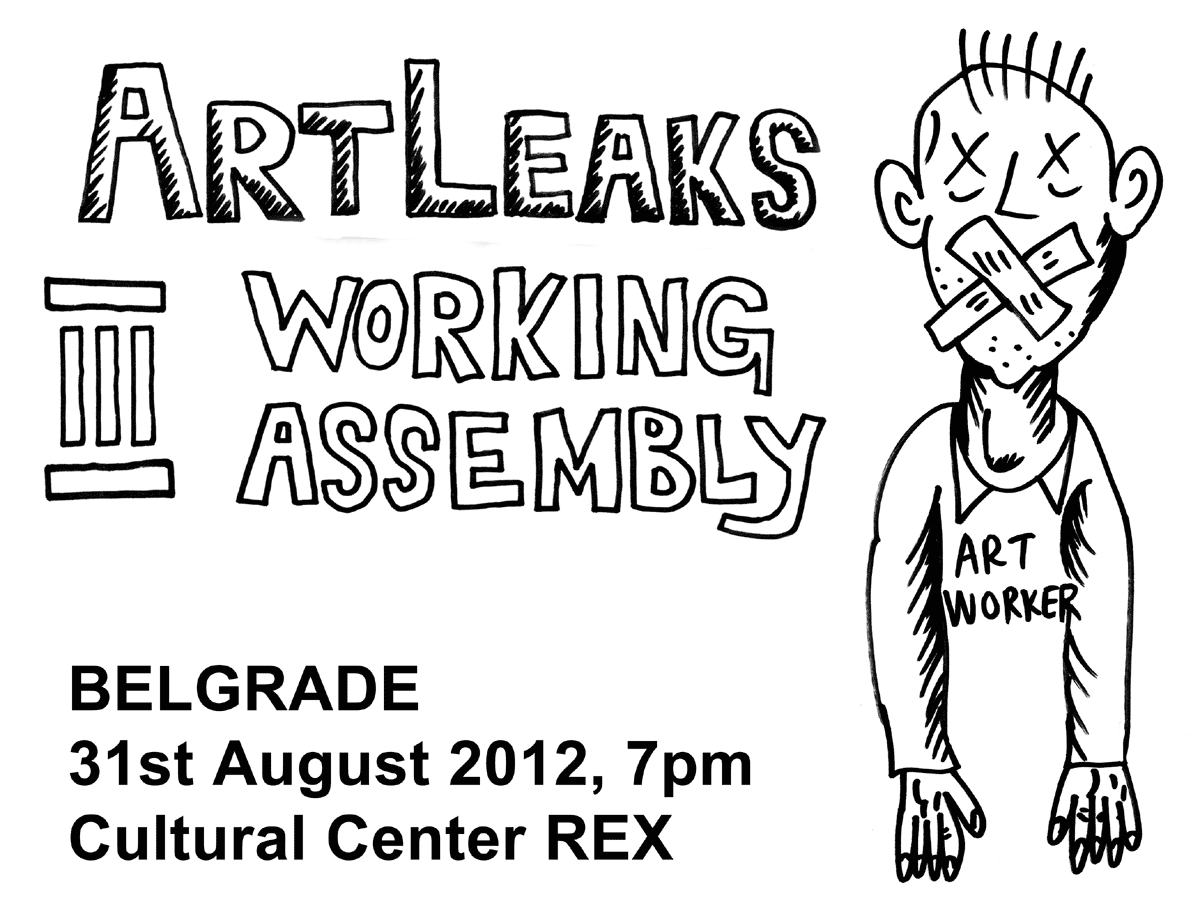
3rd ArtLeaks Working Assembly – Belgrade
Friday, 31st of August, 7pm, 2012
Cultural Center REX, Jevrejska 16, Belgrade, Serbia
ArtLeaks is an international platform for cultural workers where instances of abuse, corruption and exploitation are exposed and submitted for public inquiry. ArtLeaks stresses the urgent need to seriously revise these workers’ relationship with institutions, networks and economies involved with the production and consumption of art and culture. Our goal is to create a space where one could engage directly with actual conditions of cultural work both locally and internationally – conditions that affect those working in cultural production as well as those from traditionally creative fields. Furthermore, ArtLeaks is developing in the direction of creating transversal alliances between local activist and cultural workers groups, through which we may collectively tackle situation of repression and inequality.
Through direct exposure, educational initiatives and a forthcoming on-line publication, we seek to empower like-minded people to stand together against the intense exploitation of cultural labor, all forms of repression, the enclosure of public space and the instrumentalization of radical culture under the umbrella of corporations. We strongly believe that issues of censorship and abuse cannot be divorced from specific politico-economic contexts and further, that they should be raised in connection with new forms of class consciousness in the artistic field in particular, and the cultural field more generally.
Building on our previous experience organizing an ArtLeaks Working Assemblies in Berlin in June 2012 and Moscow in July 2012, we would like to invite you to a similar working-group format that allows direct engagement with the public at the Cultural Center REX in Belgrade.
An outcome of our previous working assemblies was the establishment of alliances with international groups such W.A.G.E.(NYC) , Occupy Museums (NYC), Arts & Labor(NYC), Haben und Brauchen(Berlin), the Precarious Workers Brigade(London), The May Congress of Creative Workers(Moscow), groups whose mission is to formulate direct actions and raise awareness in relation to the above mentioned urgencies and problems. It is our strong belief is that only such internationally coordinated alliances could not only denounce exploitation and censorship in contemporary art and culture, but also collectively imagine new types of organizational articulations which would respond to the needs and desires of political subjects constituted at the crossing points of the current economic, politic and cultural shifts.
For our Belgrade assembly, our goals for further developments are :
(1) To reach new constituencies from the cultural, social, and political milieu of Belgrade, and invite them to join our struggles
(2)To research the local socio-political context in which cultural workers are exploited in Belgrade, Serbia in particular and the Balkans generally; to find out about local cases of abuse, corruption and exploitation
(3)To receive critique regarding the manners in which ArtLeaks is currently functioning and may be improved further
(4) To collectively formulate concrete working methodologies and actions that our cultural workers’ alliances may incorporate into their development.
As for working topics for our assembly, we suggest: formulating narratives of exposure, drafting ethical guidelines, developing terminology to address abuse and exploitation, strategies of constituting alliances.
The Second ArtLeaks Working Assembly in Moscow will be facilitated by Corina Apostol, The Bureau of Melodramatic Research, Stefan Tiron, Vladan Jeremić & Rena Rädle, and other members of the cultural community in Belgrade. (to be announced soon)
Report of ArtLeaks’ Second Public Assembly, Moscow, July 15th 2012
https://art-leaks.org/2012/07/27/report-of-artleaks-second-public-assembly-moscow-july-15th-2012/
Report of ArtLeaks’ First Public Assembly and Workshop, Berlin Jun 3-4th 2012

 ArtLeaks