Updates
ACT NOW! Submit your story to ArtLeaks and end the silence on exploitation and censorship! Please see the submission guidelines in the "Artleak Your Case" page
Submitted and current instances of abuse are in the "Cases" section
To find out more about us and how to contribute to our struggles, please go to the "About ArtLeaks" page
Please consult "Further Reading" for some critical texts that relate to our struggles
For more platforms dedicated to cultural workers' rights please see "Related Causes"
For past and upcoming ArtLeaks presentations and initiatives please go to "Public Actions"
Nothing Can Be Changed Until It Is Faced
As artists, academics, writers and cultural workers who live in Germany and/or work with German cultural institutions, we welcome the joint initiative “GG 5.3. Weltoffenheit,” announced by a broad coalition of prominent German cultural institutions in Berlin on 10 December 2020.
The aforementioned initiative is a belated response to the contentious resolution adopted by German parliament in May 2019, via which the aims and methods of the Palestinian-led solidarity movement, ‘Boycott, Divestment, Sanctions’ (BDS), were formally condemned as antisemitic, leading to a cross-party decision to cut off public funding for projects that “actively support” the BDS movement. The statement criticises this parliamentary resolution, describing it as “dangerous.” We share this concern and view the resolution’s curtailment of the right to boycott as a violation of democratic principles. Since being passed, the resolution has been instrumentalized to distort, malign and silence marginalized positions, in particular those which defend Palestinian rights or are critical of the Israeli occupation.
We urge the German parliament to heed the findings of the European Court of Human Rights, which recently rejected the criminalization of boycotts directed against Israel, ruling clearly against the prosecution of non-violent activists and affirming boycott as a legitimate exercise of freedom of expression (June 2020). No state should be exempt from criticism. Regardless of whether we support BDS or not, as signatories of this letter we share an insistent belief in the right to exercise non-violent pressure on governments that violate human rights.
We reject the German parliamentary resolution because it is this very right which it denies. We reject it because it has exacerbated polarization within the cultural community at a time when the rise of right-wing nationalism calls for us to join in solidarity to combat the surge of hatred that is increasingly prevalent both within Germany’s borders and beyond. We reject it because it has effectively thrown a blanket of censorship over public institutions at precisely the moment when the richly diverse community that is active in Germany, has a valuable role to play in forging a critical and inclusive culture, as an alternative to the authoritarianism, racism and xenophobia that the far right is intent on entrenching.
The resolution has created a repressive climate in which cultural workers are routinely asked to formally renounce BDS, as a prerequisite for working in Germany. Meanwhile, cultural institutions are increasingly driven by fear and paranoia, prone to acts of self-censorship and to pre-emptively de-platforming and excluding critical positions. Open debate around Germany’s past and present responsibilities in relation to Israel/Palestine has been all but suffocated. Forums of cultural exchange in which we previously came together to reflect upon and debate the entangled histories that we emerge from and exist within, are routinely denied, as institutions anxiously seek to avoid political censure and the loss of public funding. In this climate, a number of valuable voices—such as those of Achille Mbembe, Kamila Shamsie, Peter Schäfer, Nirit Sommerfeld and Walid Raad—have already been demonised, obstructing a necessary collective reckoning with the intersecting forces of violence that continue to shape our present.
The resolution is indifferent to the diversity of Jewish opinions both within and beyond Germany; in particular, to the many leftist Jewish and Israeli voices that are vehemently critical of Israel’s well-documented violations of international law. Such voices are, astonishingly—and with increasing frequency—invalidated as ‘antisemitic.’ The resolution additionally disregards warnings issued by foreign policy experts, human rights organisations and German foundations that are directly engaged in the Middle East, many of whom have firmly opposed the problematic manner in which the resolution conflates criticism of Israel with anti-Jewish racism. This conflation shields Israel from being held accountable to standards of international law, and obscures the historical and political circumstances that gave rise to the Palestinian struggle for freedom, justice and equality. It also distracts detrimentally from the ongoing fight against the virulent growth of antisemitism across the globe, including within Germany’s parliament, police force, army and intelligence services.
We acknowledge and deeply value Germany’s ongoing commitment to atoning for the Holocaust. At the same time, we condemn the negligence of the German state when it comes to recognizing and atoning for Germany’s past as a perpetrator of colonial violence. The fight against antisemitism cannot be conveniently decoupled from parallel struggles against Islamophobia, racism and fascism. We emphatically reject the monopolization of narratives of oppression by states such as Germany, which have historically been perpetrators of oppression. We reject the notion that the suffering and trauma of victims of political and historical violence can be measured and ranked.
In solidarity with the cultural institutions that have spoken out before us, we call on German parliament to withdraw the controversial resolution. We call on these institutions to follow their statement with meaningful action. We ask them to lead the way in restoring conditions under which the productive exchange of divergent opinions can occur. Over-zealous monitoring of the political views of cultural workers from the Middle East and Global South, must be seen for what it is—back-door racial profiling—and immediately discontinued. The maligning of individuals by means of baseless charges of antisemitism must stop.
We close with the words of James Baldwin, an astute critic of the evils of the Holocaust, as well as of the horrors of slavery, colonialism and racism:
“Not everything that is faced can be changed. But nothing can be changed until it is faced.”
First Signatories
- Lawrence Abu Hamdan, Artist, Beirut/Dubai
- Tal Adler, Artist, Berlin
- Elena Agudio, Art Historian + Curator, Berlin
- Haig Aivazian, Artist + Director of Beirut Art Center, Beirut
- Antonia Alampi, Curator, Berlin
- Khyam Allami, Musician, Berlin/London
- Udi Aloni, Filmmaker, New York
- Maria Thereza Alves, Artist, Berlin/Naples
- Heba Y. Amin, Artist, Berlin
- Fahim Amir, Philosopher + Author, Vienna
- Yazid Anani, Scholar + Curator, Ramallah
- Ayreen Anastas, Artist, New York
- Angela Anderson, Artist + Researcher, Berlin
- Arjun Appadurai, Professor, Institute for European Ethnology, Humboldt-Universität, Berlin
- Julieta Aranda, Artist + Editor of e-flux journal, Berlin
- Fareed Armaly, Artist, Berlin
- Inke Arns, Curator, Director of HMKV Hartware MedienKunstVerein, Dortmund
- Marwa Arsanios, Artist, Berlin
- Aleida Assman, Professor, University of Konstanz, Konstanz
- Defne Ayas, Curator, Berlin
- Ariella Aïsha Azoulay, Brown University, Providence
- Sindre Bangstad, Research Professor, KIFO, Oslo
- Khaled Barakeh, Artist + Cultural Activist, Berlin
- Yael Bartana, Artist, Berlin/Amsterdam
- Shumon Basar, Writer/Curator, Berlin/Dubai
- Bashir Bashir, Associate Professor of Political Theory, The Open University of Israel, Raanana
- Florian Becker, Bard College Berlin, Berlin
- Jérôme Bel, Choreographer, Paris
- Irad Ben Isaak, Scholar of Yiddish Literature + Culture, Selma Stern Zentrum für Jüdische Studien Berlin-Brandenburg, Berlin
- Lene Berg, Artist, Berlin/Oslo
- Omar Berrada, Writer + Curator, New York
- María Berríos, Curator, 11th Berlin Biennale, Berlin/Copenhagen
- Louise Bethlehem, The Hebrew University of Jerusalem, Hod Hasharon
- Ursula Biemann, Artist, Zurich
- Rossella Biscotti, Artist, Rotterdam/Brussels
- Katinka Bock, Artist, Paris
- Omri Boehm, Associate Professor of Philosophy, New School for Social Research, New York
- Monica Bonvicini, Artist, Berlin
- Shannon Bool, Artist, Berlin
- Pauline Boudry, Artist, Berlin
- Daniel Boyarin, Professor of Talmud / AvH Senior Preisträger, Freie Universität Berlin, Berkeley
- Candice Breitz, Artist, Berlin
- AA Bronson, Artist, Berlin
- Adam Broomberg, Artist, Berlin
- Micha Brumlik, Professor + Senior Advisor: Selma Stern Zentrum für jüdische Studien Berlin-Brandenburg, Berlin
- Erik Bünger, Artist, Berlin
- Federica Bueti, Writer + Researcher, Berlin
- Paolo Caffoni, Editor + Researcher, Berlin
- Banu Cennetoğlu, Artist, Istanbul
- Peter Chametzky, Professor, University of South Carolina, Columbia
- Marco Clausen, Cultural Worker, Berlin
- Steven Cohen, Artist, Lille/Johannesburg
- Alon Confino, Pen Tishkach Chair of Holocaust Studies, Professor of History and Jewish Studies, University of Massachusetts, Amherst
- Eli Cortiñas, Artist, Berlin
- Alice Creischer, Artist, Berlin
- Iftikhar Dadi, Associate Professor, Cornell University, Ithaca
- Jesse Darling, Artist, Berlin/London
- Ekaterina Degot, Director + Chief Curator, Steirischer Herbst, Graz
- T. J. Demos, Professor, University of California, Santa Cruz
- Elsa De Seynes, Cultural Worker, Berlin
- Janneke de Vries, Director of Weserburg Museum for Modern Art, Bremen
- Diedrich Diederichsen, Professor, Akademie der bildenden Künste, Vienna
- Stephen Dillemuth, Artist, Munich
- Esther Dischereit, Poet + Writer, Berlin
- Discoteca Flaming Star , Artist Collective, Berlin
- Sabrina Dittus, Filmmaker, Berlin
- Gürsoy Doğtaş, Art Historian, Universität für angewandte Kunst, Vienna
- Pauline Doutreluingne, Curator, Berlin
- Nika Dubrovsky, Artist, David Graeber’s Museum of Care Foundation, London
- Sam Durant, Artist, Berlin/Los Angeles
- Jimmie Durham, Artist, Berlin/Naples
- Övül Ö. Durmusoglu, Curator, Writer + Educator, Berlin
- Madhusree Dutta, Filmmaker + Curator, currently Artistic Director: Akademie der Künste der Welt, Cologne
- Kerstin Egert, DJ + Producer, Berlin
- Anna Ehrenstein, Artist, Berlin/Tirana
- Galit Eilat, Curator, Interdependent Writer + Curator, Director of Meduza Foundation, Amsterdam
- Antke Antek Engel, Institut für Queer Theory, Berlin
- Köken Ergun, Artist, Istanbul
- Ayse Erkmen, Artist, Berlin/Istanbul
- Charles Esche, Professor + Museum Director, Van Abbemuseum, Eindhoven
- Theo Eshetu, Artist + Filmmaker, Berlin
- Kodwo Eshun, Artist, Filmmaker + Theorist, Berlin/London
- Reem Fadda, Curator, Ramallah
- Nathan Fain, Independent Theatre Maker, Berlin
- Silvia Federici, Scholar + Teacher + Activist, New York
- Dror Feiler, Composer + Artist, Stockholm
- Chiara Figone, Publisher / Archive, Berlin
- Mahdi Fleifel, Film Director, Copenhagen
- iLiana Fokianaki, Curator + Theorist, Director: State of Concept, Athens/Rotterdam
- Forensic Architecture / Forensis ,, London/Berlin
- Rike Frank, Curator, Berlin
- Will Fredo Furtado, Artist, Writer + Editor, Berlin
- Dani Gal, Artist, Berlin
- Katharina Galor, Professor, Berlin
- Tomer Gardi, Writer, Berlin
- Karam Ghossein, Filmmaker, Berlin
- Nida Ghouse, Writer, Berlin
- Sander Gilman, Distinguished Professor of the Liberal Arts + Sciences / Professor of Psychiatry: Emory University, Atlanta
- Natasha Ginwala, Writer + Curator, Berlin/Colombo
- Amos Goldberg, Professor, Department of Jewish History + Contemporary Jewry, Hebrew University of Jerusalem, Jerusalem
- Avery Gordon, Writer, London
- Raphaël Grisey, Artist, Berlin
- Assaf Gruber, Artist, Berlin
- Krist Gruijthuijsen, Curator + Director, KW Institute for Contemporary Art, Berlin
- Ayşe Güleç, Educator, Curator + Activist Researcher, Kassel
- Emanuele Guidi, Curator + Artistic Director, ar/ge kunst Bolzano, Berlin
- Hans Haacke, Artist, New York
- Yassin al Haj Saleh, Writer + Political Dissident, Berlin
- Dorothea von Hantelmann, Art Historian, Bard College Berlin, Berlin
- Donna Haraway, University of California, Santa Cruz
- Shuruq Harb, Artist, Ramallah
- Carl Hegemann, Professor Emeritus, Philosophy + Dramaturgy, Berlin
- Nanna Heidenreich, Scholar + Curator, Berlin
- Mathilde ter Heijne, Artist + Professor / Universität der Künste, Berlin
- Jörg Heiser, Professor, Universität der Künste, Berlin
- Louis Henderson, Artist, Berlin
- Samia Henni, Historian, Educator + Exhibition-Maker, Zurich
- Tobias Hering, Curator, Berlin
- Wieland Hoban, Composer + Translator, Frankfurt
- Gil Z. Hochberg, Professor, Columbia University, New York
- Tom Holert, Writer, Berlin
- Laura Horelli, Artist, Berlin
- Emma Waltraud Howes, Artist, Berlin
- Nataša Ilić, Curator, What, How and for Whom / WHW, Berlin
- Çağla Ilk, Curator, Berlin
- Eva Illouz, Professor of Sociology, Hebrew University, Jerusalem
- Amal Issa, Director of Public Programs, e-flux, New York
- Shahira Issa, Artist, Hamburg
- Muhammad Jabali, Artist + Writer, Berlin
- Stine Marie Jacobsen, Artist, Berlin
- Anna Jäger, Cultural Worker + Translator, Berlin
- Sarah E. James, Art Historian + Gerda Henkel Fellow, Frankfurt am Main
- Pauline Curnier Jardin, Artist, Berlin
- Anne Duk Hee Jordan, Artist, Berlin
- Liad Hussein Kantorowicz, Artist, Berlin
- Mariana Karkoutly, Syrian Legal Criminal Investigator, Berlin
- Nina Katchadourian, Artist + Professor, NYU Gallatin School of Individualized Study, Berlin/New York
- Thomas Keenan, Professor, New York
- Lara Khalidi, Curator, Amsterdam/Jerusalem
- Yazan Khalili, Artist, Amsterdam
- Sami Khatib, Philosopher, Visiting Researcher at Leuphana University, Berlin
- Elias Khoury, Writer, Beirut
- Grada Kilomba, Artist, Berlin
- Thomas Kilpper, Artist + Professor, Bergen University Faculty of Art, Music + Design, Bergen
- Caroline Kirberg, Filmmaker & Producer, Berlin
- Vika Kirchenbauer, Artist, Berlin
- Maya Klar, Filmmaker, Berlin
- Adam Kleinman, Writer + Curator, New York
- Brian Klug, University of Oxford, Oxford
- Erden Kosova, Art Critic, Berlin/Istanbul
- Prem Krishnamurthy, Designer + Curator, Berlin/New York
- Brian Kuan Wood, Editor + Writer, New York
- Raimund Kummer, Artist, Berlin
- Brigitta Kuster, Cultural Producer + Junior Professor, Humboldt-Universität, Berlin
- Nadav Lapid, Filmmaker + Writer, Tel Aviv
- Kristina Leko, Artist + Educator, Universität der Künste, Berlin
- Boaz Levin, Writer + Curator, Berlin
- Justin Lieberman, Artist, Munich
- Elisa Liepsch, Performing Arts Programmer, Brussels
- Matthias Lilienthal, Dramaturg, Berlin
- Thomas Locher, Artist + Rector: Hochschule für Grafik und Buchkunst , Leipzig
- Siddhartha Lokanandi, Bookseller, Berlin
- Renate Lorenz, Artist, Berlin
- Sven Lütticken, Art Historian, Utrecht
- Maha Maamoun, Artist, Curator + Publisher, Berlin/Cairo
- Wietske Maas, Curator, BAK, basis voor actuele kunst, Berlin/Utrecht
- Jens Maier Roethe, Film Producer, Berlin
- Antonia Majaca, Writer + Curator, Berlin
- Antje Majewski, Artist + Professor, Berlin
- Jumana Manna, Artist, Berlin
- Jaleh Mansoor, Associate Professor, University of British Columbia, Vancouver
- Renzo Martens, Artist, Amsterdam
- Mattin (Martin Artiach), Artist, Berlin
- Tom McCarthy, Novelist, Berlin
- Bjørn Melhus, Artist, Berlin
- Angela Melitopoulos, Artist, Berlin
- Chantal Meloni, Lawyer + International Criminal Law Professor, Berlin/Milan
- Eva Menasse, Novelist, Berlin
- Doreen Mende, Curator, Writer + Theorist, Berlin/Geneva
- Jasmina Metwaly, Artist, Berlin
- Eva Meyer, Writer, Berlin
- Markus Miessen, Architect + Writer, Berlin
- Ana María Millán, Artist, Berlin
- Zoë Claire Miller, Artist, Berlin
- Nicholas Mirzoeff, Professor, New York University, New York
- Carmen Mörsch, Professor for Art Education, Mainz Art Academy, Johannes Gutenberg University, Mainz
- Elke aus dem Moore, Director, Akademie Schloss Solitude, Stuttgart
- Alexandra Murray-Leslie, Artist, Trondheim
- Sina Najafi, Editor-in-Chief, Cabinet Magazine, Berlin/New York
- Bonaventure Soh Bejeng Ndikung, Curator, Berlin/Bamenda
- Dalia Neis, Writer + Musician + Educator, Berlin
- Marcel Odenbach, Artist, Cologne
- Pınar Öğrenci, Artist + Lecturer, Berlin
- Ahmet Öğüt, Artist, Berlin/Amsterdam
- Vanessa Ohlraun, Rector, Hochschule für Bildende Künste Braunschweig, Braunschweig
- Wendelien van Oldenborgh, Artist, Berlin/Rotterdam
- Hagar Ophir, Artist, Berlin
- Uriel Orlow, Artist, Lisbon/London
- Tanja Ostojić, Artist, Berlin
- Ulrike Ottinger, Filmmaker, Berlin
- Matteo Pasquinelli, Professor in Media Philosophy, University of Arts and Design, Karlsruhe
- Hila Peleg, Curator, Haus der Kulturen der Welt, Berlin
- Agustín Pérez Rubio, Curator, 11th Berlin Biennale, Berlin
- Dan Perjovschi, Artist, Bucharest
- Manfred Pernice, Artist + Professor / Universität der Künste, Berlin
- Nataša Petrešin-Bachelez, Interdependent Curator, Paris
- Ana Teixeira Pinto, Guest Professor of Media Philosophy, HfG Karlsruhe, Berlin
- Alexandra Pirici, Artist, Bucharest
- Agnieszka Polska, Artist, Berlin
- Matthew Post, Post Brothers, Curator, Munich/Bialystok
- Luiza Prado de O. Martins, Artist, Berlin
- Paul B. Preciado, Writer + Curator, Pogetto
- Charlotte Prodger, Artist, Glasgow
- Pary El-Qalqili, Writer + Film Director, Berlin
- Judy Radul, Professor of Art, Simon Fraser University, Vancouver
- Rachael Rakes, Curator, BAK, basis voor actuele kunst, Utrecht
- Michael Rakowitz, Artist, Chicago
- Milo Rau, Director + Author, Ghent/Cologne
- Judith Raum, Artist , Berlin
- Nora Razian, Curator, Dubai
- Juliane Rebentisch, Professor of Philosophy, Offenbach/Frankfurt
- Patricia Reed, Writer + Artist, Berlin
- David Riff, Artist + Curator, Berlin
- Philip Rizk, Filmmaker, Berlin
- Jacqueline Rose, Professor of Humanities + Co-Director, Birkbeck Institute for the Humanities, London
- Roee Rosen, Artist, Bnei Zion
- Martha Rosler, Artist, New York
- Michael Rothberg, Professor, University of California, Los Angeles
- Romy Rüegger, Artist + Writer, Berlin
- David Rych, Artist, Berlin
- Susanne Sachsse, Actress, Berlin
- Natascha Sadr Haghighian, Artist, Berlin
- Alon Sahar, Filmmaker, Berlin
- Anjalika Sagar, The Otolith Group, London
- Ivana Sajko, Writer, Berlin
- Anri Sala, Artist, Berlin
- Mohammad Salemy, Artist, The New Centre for Research & Practice, Berlin
- Rasha Salti, Writer + Curator, Berlin/Beirut
- Karin Sander, Artist + Academic, Berlin
- Regina Sarreiter, Cultural Worker + Anthropologist, Berlin
- Aura Satz, Artist, Royal College of Art, London
- Eran Schaerf, Artist, Berlin
- Miriam Schickler, Cultural Worker, Berlin
- Stefanie Schulte Strathaus, Film Curator, Berlin
- Alya Sebti, Curator, Berlin
- Ashkan Sepahvand, Writer + Artist, Berlin/Oxford
- Reem Shadid, Curator/Researcher, Ramallah
- Nizan Shaked, California State University, Long Beach
- Tai Shani, Artist, London
- Basma Al-Sharif, Artist, Berlin
- Mati Shemoelof, Writer, Berlin
- Marc Siegel, Film Scholar, Berlin
- Andreas Siekmann, Artist, Berlin
- Nicolas Siepen, Artist, Berlin
- Katharina Sieverding, Artist + Professor of Visual Culture Studies, Düsseldorf
- Joshua Simon, Curator + Writer, Philadelphia/Tel Aviv-Jaffa
- Siska , Visual Artist + Musician, Berlin
- Slavs and Tatars , Artist Collective, Berlin
- Mounira Al Solh, Artist + Professor, Kunsthochschule Kassel, Beirut/Amsterdam
- Lili Sommerfeld, Musician, Berlin
- Mari Spirito, Director + Curator, Protocinema, Istanbul/New York
- Anna-Sophie Springer, Curator, Author + Publisher, Berlin
- Jonas Staal, Artist, Athens/Amsterdam
- Klaus Staeck, Artist, Heidelberg
- Maximilian Steinbeis, Chief Editor, Verfassungsblog, Berlin
- Bettina Steinbrügge, Director, Hamburg
- Eva Stenram, Artist, Berlin
- Angelika Stepken, Curator + Director of Villa Romana, Florence
- Young-jun Tak, Artist + Editor, Berlin/Seoul
- Kathy-Ann Tan, Curator + Writer, Berlin
- Hadas Tapouchi, Artist, Berlin
- Michael Taussig, Professor Emeritus, Columbia University, New York
- Mark Terkessidis, Writer, Berlin
- Wibke Tiarks, Artist, Berlin
- Jonas Tinius, Social Anthropologist, Berlin
- Christine Tohme, Founding Director, Ashkal Alwan, Beirut
- Oraib Toukan, Artist, Berlin
- Vassilis S. Tsianos, Professor, Fachhochschule Kiel, Kiel
- Margarita Tsomou, Professor + Curator, Berlin
- Peter Ullrich, Senior Researcher, Technische Universität Berlin / Fellow at the Zentrum für Antisemitismusforschung, Berlin
- Tanya Ury, Artist + Writer, Cologne
- Françoise Vergès, Political Theorist, Decolonial + Antiracist Feminist, Paris
- Jan Verwoert, Writer + Educator, Berlin
- Eyal Vexler, Cultural Producer, Berlin
- Anton Vidokle, Artist + Editor of e-flux journal, Berlin/New York
- Danh Vō, Artist, Berlin/Mexico City
- Shira Wachsmann, Artist, Berlin
- Caleb Waldorf, Artist, Berlin
- Haytham Al-Wardany, Writer, Berlin
- Julian Warner, Cultural Anthropologist, Munich
- Joanna Warsza, Curator, Berlin
- Stephanie Weber, Art Historian, Munich
- Eyal Weizman, Architect, London/Berlin
- Christine Würmell, Artist, Berlin
- Misal Adnan Yıldız, Curator, Berlin
- Yehudit Yinhar, Artist, Berlin
- Moshe Zimmermann, Historian + Former director of the Richard Koebner Minerva Center for German History, Hebrew University, Jerusalem
- Tirdad Zolghadr, Curator, Berlin
- Himmat Zu’bi, Scholar, EUME / Forum Transregionale Studien, Berlin
- Moshe Zuckermann, Professor, Institute for the History + Philosophy of Science + Ideas, Tel Aviv University, Tel Aviv
To add your name to the list of signatories, please go here: https://nothingchangeduntilfaced.com/sign-letter
Art Workers Speak out Against Wave of Violence in Serbia
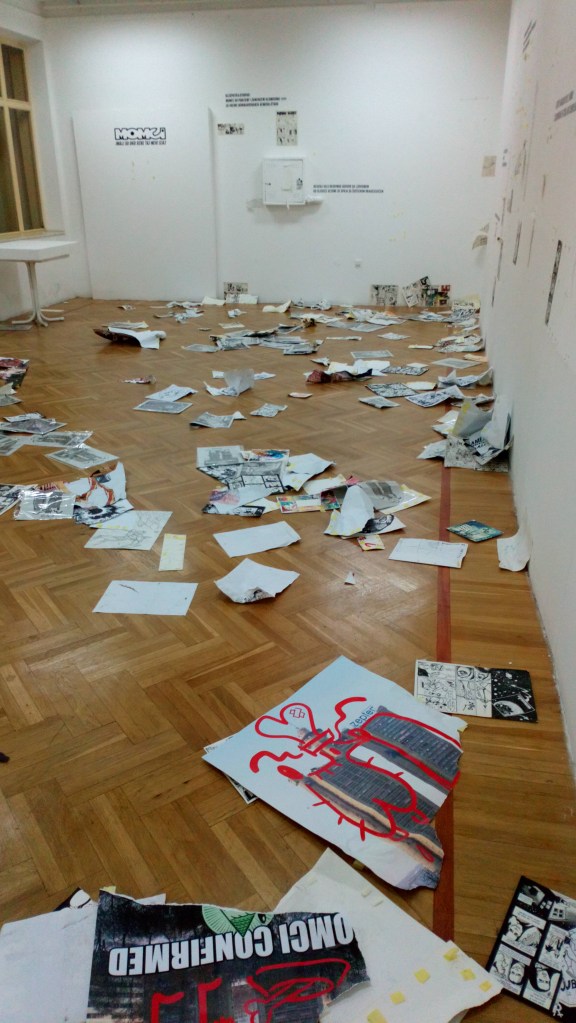
Today, October 18 2020, in front of the pavilion of the Artists’ Union of Serbia (ULUS) in Belgrade, artists and cultural workers gathered to express solidarity with a comic artist group whose exhibition was destroyed five days ago. They were also protesting the inappropriate reaction of the Ministry of Culture of the Republic of Serbia to the continuing violence of right-wing extremist groups against cultural workers.
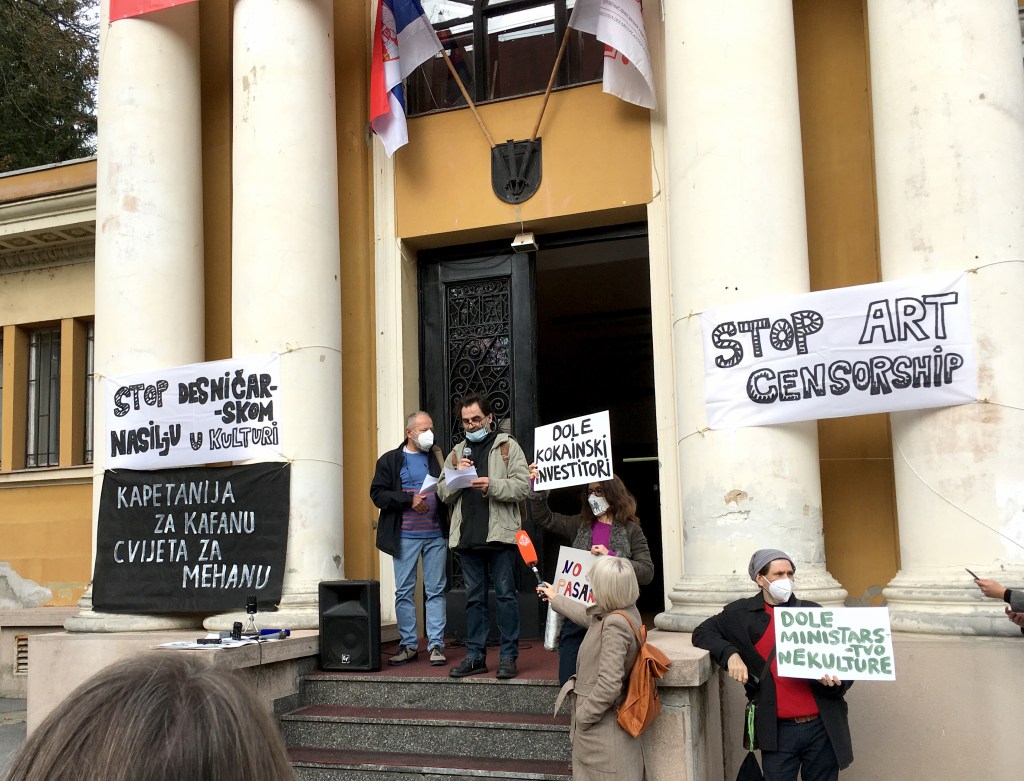
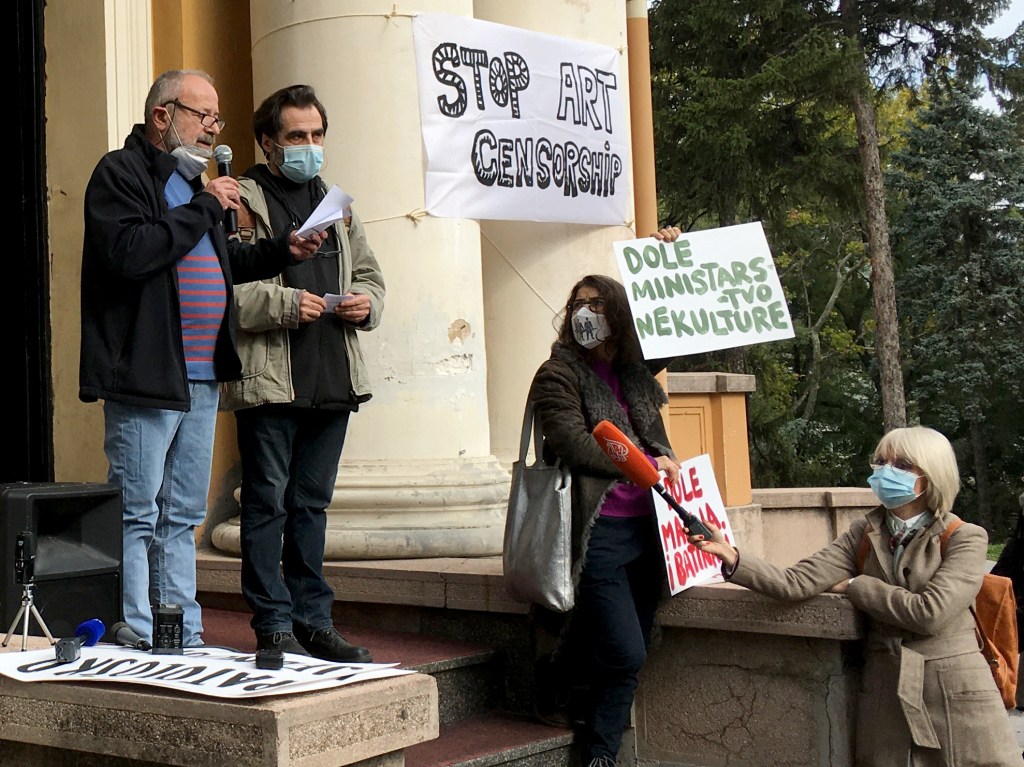
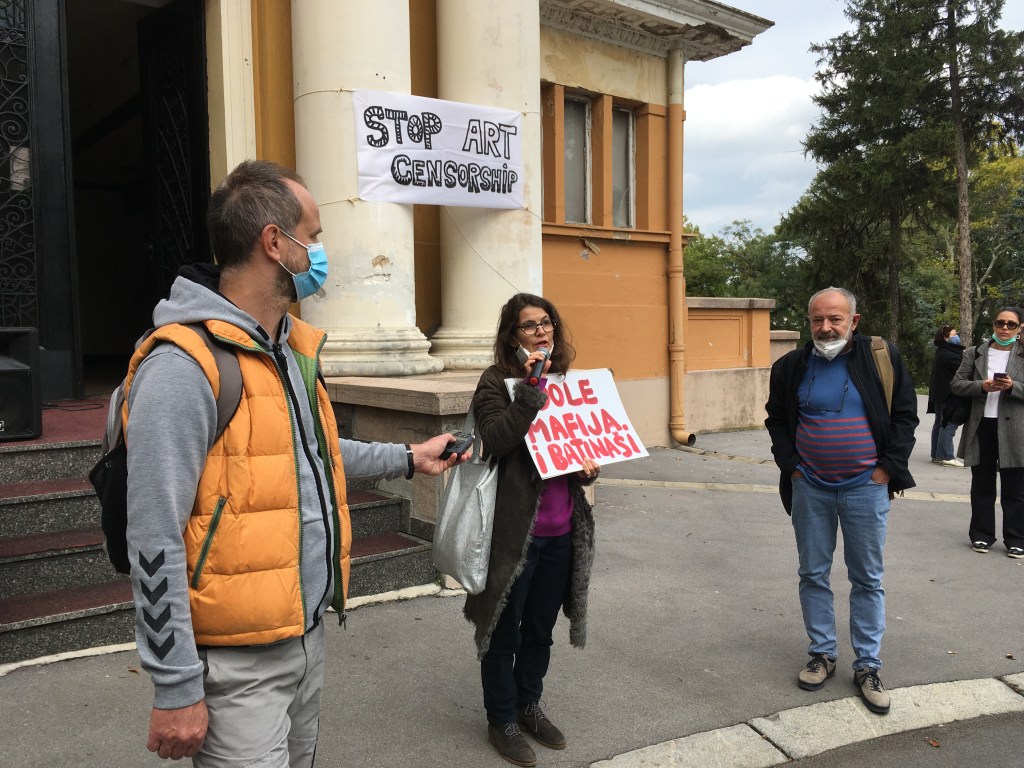

Photographs by Rena Raedle
Board members of the artists’ association and other speakers once again condemned the Ministry of Culture’s attacks on the freedom of art and the denigration of cultural and artists’ associations in its statements. The appointment of a competent person to the ministerial office was demanded.
The occasion for the solidarity gathering was the recent attack on the exhibition of comic drawings created by the group “Momci” during the Yugoslav wars in the 1990’s. Five days ago, a group of young people dressed in black and equipped with tear gas had entered the Stara Kapetanija Gallery and devastated the entire exhibition ( https://www.telegraf.rs/english/3249565-threats-over-drawing-of-a-bloodied-baby-carried-out-hooligans-break-into-exhibition-throw-tear-gas ).
The exhibited works depicted the normalization of violence in the society of the Nineties in a morbid style of humor. The cartoon that incurred the anger of part of the internet public and eventually resulted in the attack, was the drawing of a baby with its eyes wide open, in a pool of blood and with an axe in its head. The caption “Crybaby – a baby who’s whiny gets an ax in the head” was a quotation that the illustrator took from the press at the time.
The attack was sharply condemned by numerous cultural organizations, including the artists’ associations ULUS and ULUV, the Organization of the Independent Cultural Scene of Serbia NKSS and the PEN Club of Serbia. Attacks by right-wing extremist groups on theater makers, actors, artists and other cultural workers are common in Serbia. Mostly they are directed against any kind of activity dealing with the war crimes committed in the name of Serbia during the Yugoslav wars.
Another dimension of hostility towards cultural workers became visible in the official statement of the Serbian Ministry of Culture (https://www.kultura.gov.rs/vest/sr/5318/saopstenje-ministarstva-kulture-i-informisanja-u-vezi-sa-izlozbom-u-umetnickoj-galeriji-stara-kapetanija-u-zemunu.php )
in which it condemned the violent attack on the exhibition, while emphasizing that the exhibition should not have taken place in the first place. According to the Ministry of Culture, the works on display represent “a pathology and degeneration of consciousness and not any form of art”. The exhibition, it goes on to say, is “evil” and “belongs to the underworld of the human mind, just as the attackers on it belong to the underworld of hooligans”.
Large parts of the cultural public were appalled by the official reaction. They criticized the use of Nazi-like jargon and other discriminatory terms in the Ministry’s statement about the exhibited artwork and called for the protection of artistic freedom.
The Ministry responded with a series of grave insults and accusations on its website against the artists’ organizations and individuals who had spoken out in the media, and threatened to file criminal charges in one case ( http://www.seecult.org/vest/protest-i-osuda-nasilja-na-izlozbi-ali-i-reagovanja-ministarstva-kulture ).
The rhetoric of the Ministry of Culture reminds in a disturbing way of the language used in hate campaigns. Blatant examples of such campaigns are conducted on the website “prismotra.” There, cultural workers, journalists, human rights activists and other committed individuals who do not fit into the platform’s right-wing extremist world view are pilloried. The unknown operators deliberately disseminate half-truths about the attitudes and activities of individuals, some of whom are barely known to the public, in order to publicly brand them as enemies of society.
– Rena Raedle, ArtLeaks
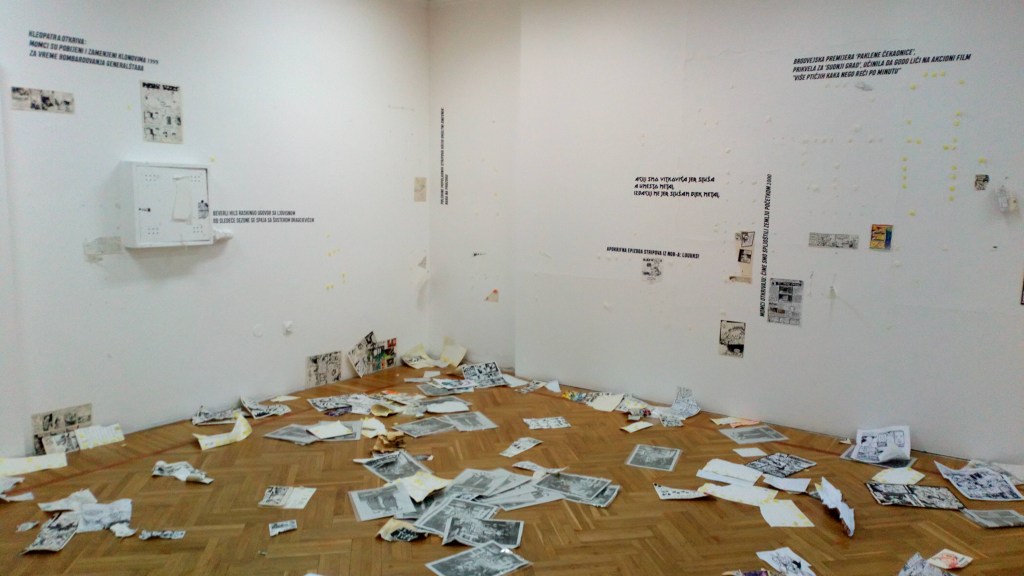


Photographs by Anita Buncic
Manifesta and the Minorities of Marseille: Answer the Accusations of Discrimination and Migrants Exploitation
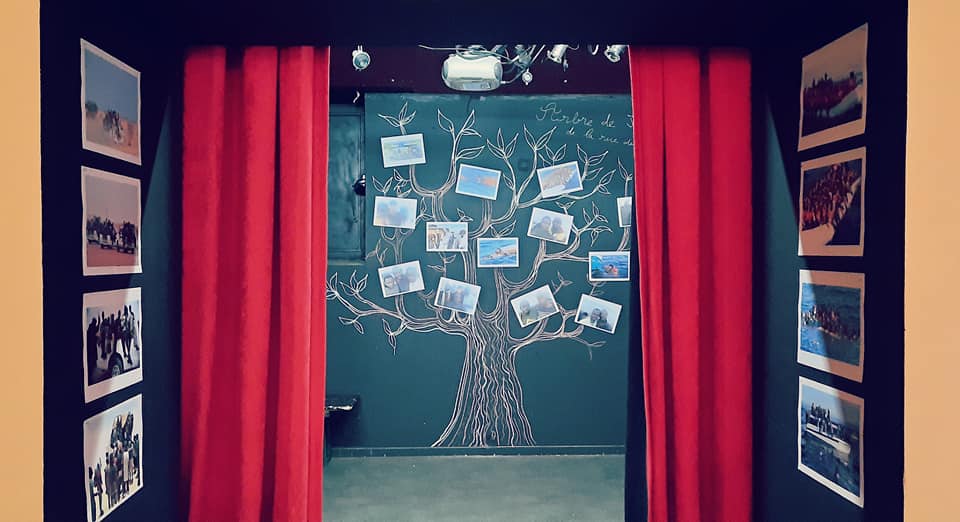
We are a Marseille-based and international network of artists, academics, activists and citizens, who are interested in centering the voices of black, people of color, LGBTIQ+[i], disabled and migrant communities through cultural programs and community building initiatives.
Through this statement, we would like to reiterate our desire for a truly inclusive avant-garde creative environment, challenging international artistic institutions that are most often radically above ground in Marseille, such as the Manifesta biennale present this month in Marseille.
Manifesta had previously been accused of exploitation and opaque funds management, today Manifesta’s board is accused of racial discrimination, Homonationalism, and the exploitation of the most marginalized.
We call on the artistic, intellectual, activist communities and any one engaged in this field to join us in this open discussion and debate that will hopefully provide collective reflections and ways forward for us as the creative and activist community in the city, as well as for representatives of Manifesta and partner associations, in the future as they move to another locale, in regards to these accusations of discrimination and exploitation of the most marginalized among us.
Indeed for the past year, many of us have been working with Manifesta, the nomadic European biennial of contemporary art, which came to Marseille for its 13th edition. Seeing this as a positive opportunity to showcase the city’s diversity, and in the spirit of openness, many of us agreed to collaborate with the biennale and planned a range of activities for August and September 2020. In addition to the challenges presented by the current pandemic, which has shaken the world as we know it, there have also been several accusations reported against certain members of the Manifesta team and associated artists and organizations exhibiting policies of systemic racism, exploitation of marginalized narratives and bodies, and the general lack of financial transparency.
In this call for collective inquiry and action, we would like to reaffirm our position, which puts the communities we are part of and represent at the forefront, and strongly oppose racial discrimination, and the extraction of experiences and work of marginalized groups in the name of cultural production and consumption. From our point of view, this is due to larger systeminc issues deeply rooted in the French society, where cycles and application of infrahumanizing[ii] mechanisms, whether conscious or unconscious, are even clear to see even in the so-called progressive movements.
Since October 2019, a range of proposals and consultations have been provided to Manifesta on effective mapping of the artistic and cultural context of Marseille, alongside the planning and implementation of inclusive and intersectional events by members of our network. However, to date some of our most marginalized partners are yet to be paid and the costs incurred reimbursed[iii], despite the fact that our budgets and program were ready for June[iv].
And, where decisions to pay such groups have been made, they have been done last minute due to tense confronations convincing the budget holders that indeed, everyone contributing to projects has the right to be paid for their labor, not just professional artists, intellectuals, and racially white people, who are still prioritized financially and hierarchically at the moment. An overall report of Manifesta 13’s artists by gender, race, and nationalaity is already publically available, where men and white people form the majority of the participants[v].
Therefore, some of us have put forward the hypothesis, which remains to be validated, that while Manifesta proposes to “rethink the relations between culture and society investigating and catalyzing positive social change in Europe through contemporary culture in a continuous dialogue with the social sphere of a specific place,” the reality is that it instead uses the reputation of local associations, with long histories of social justice work on ground in Marseille, without adequately reimbursing their expenses or citing them appropriately in their produced program from a perspective that is both clientelist and based on entryism.
Although agreements have now been made to cover some of these tiny expenses in the overall budget, we do not yet know, among other things, if the activities including people with disabilities, participating in a show scheduled for mid-October at La Criée will or will not be compensated financially. Furthermore, it could now be argued that the resistance to immediately agree to pay marginalized communities contributing to projects points to more problematic financial policies that prioritize and privilege institutional stakeholders, while expecting black, communities of color, and people with disabilities to contribute for free as an act of solidarity, as if it were already a sufficient honor for us to be highlighted in the programming of this biennial.
Based on our experiences, we decided to launch an informal survey to see if this kind of dynamic was applied to other networks in the city, which revealed that our network is not alone, and indeed, many other local artists, intellectuals and cultural organizers have criticized the biennale for similar issues as addressed in this statement, for having repeatedly renounced the initial commitments, without financially compensating the social actors concerned, for their working time and their intellectual productions. Confronted with this state of affairs, it is also curious to see Manifesta now push racialized members of their team to the forefront to resolve these issues, when a few months ago, it was also reported that certain Manifesta bosses and patrons would not appreciate the Islamic identities to be put forward in artistic programming[vi].
Since many of these concerns have been directly addressed with the biennial, the artistic team of the 13th edition now seems open addressing some of these structural issues within. However, in the past, the 11th edition of the biennal was also criticized harshly for problematic payment policies and non-payment of workers[vii], which potentially points towards a deeper structural and systemic issue, where in the bi-annually evolving teams and locations of Manifesta allows for the institution to push critical reflections under the rug and thus, avoid any change of consequence.
Instead our collective, joined in this endeavor by certain Manifesta curators who want to work on that issue internally, in order to ask the board of the latter for a truly progressive and inclusive work ethic towards all, which was the basis of our proposals for Manifesta 13. We ask for open critical reflections on the impact of the biennial’s collaborations and partnerships in the city and its communities, in order for Manifesta to get rid of any rag having to do with “pinkwahsing” [viii], “institutional racism” [ix], and “migrantwashing.” [x]
From this experience, many of us have been compelled to ask, why are the most marginalized among us not the first to benefit from the fruits of our labor? Are these dynamics related to the little consideration given to contemporary and social art, or is there an additional dimension to these visibly recurring inequalities?
In these times of “Black lives Matters”, and deconstruction of fascistic or supremacist identities, we invited the people of Marseille who are concerned to join us during a dinner debate on these topics[xi], at the CALEM institute of Marseille, and we have now created a fundraising campaign in order to compensate the marginalized artists cheated by Manifesta 13[xii].
“For us, the act of making ourselves visible is political”
– Angela Robertson, Our Dance of Revolution[xiii].
Dr. Ludovic-Mohamed Zahed (director of the CALEM[xiv] Institute, the gay imam of Marseille)
Dr. Amina wadud (retired Professor of Islamic Studies and The Lady Imam)
Dr. Michaël Privot (Islamologue, Fondateur de l’IEEI, Bruxelles, ancien président de l’ENAR)
Abdullah Qureshi (independent artist and visual curator, PhD candidate in contemporary art)
Alexandre Marcel (president of the IDAHOT France committee)
Erika Nomeni (Baham Arts, pour visibiliser les artistes minorisé.es et les femmes à Marseille)
Paulo Hggns (Ze Gaitho, queer inclusive parties in Marseille)
Moussa Fofana (co-founder of Migrants LGBT+ & solidaires in Marseille)
Souleymane Traore (co-founder of Migrants LGBT+ & solidaires in Marseille)
Tom Porcher Guinet (El Manba, citizen network for the rights of Migrants in Marseille)
Mariam SaintDenis (Filles de Blédards, in Paris and Marseille)
Yvan X. (artistic director of an LGBT+ festival in France)
Harry Gaabor (plastician artist in Marseille)
Rabha Attaf (journalist & president of Confluences, for human rights in Marseille)
Osman X. (coordinator for Hidayah, queer Muslims UK)
Fares Chiter (linguist, member of CALEM in Marseille)
Jérémie Yorillo (in charge of information and trainings in Marseille)
Denis Caiozzi (filmaker and member of Migrants LGBT+ & solidaires in Marseille)
Didier Dubois Laume (artist painter, founder of café lunettes rouge for LGBT+ HIV+)
Adam Hussain (dance-artist, somatic movement practitioner and researcher)
Adi Bharat (PhD, university of Michigan, JMRN – Jewish Muslim dialogue)
Adrian Stiefel (Eglise protestante de Genève, responsable de l’Antenne LGBTI du LAB)
Musab Atasoy (imam queer de la communauté inclusive de Londres et conseiller de CALEM)
[i] Lesbians, gays, bisexuals, transgender and plus.
[ii] Consider that some are less worthy of being respected by their work, with regard to their body, in their identity.
[iii] In particular, the association of LGBT + Migrants in Marseille. At the same time, the migrants from the Saint-Just squat had to establish a “more equal balance of power”, they told us, so that each of the participants was paid fairly, with a proper employment contract.
[iv] Initial date of the Manifesta 13, before the Covid crisis postponed the entire programming.
[v] We refer here to a study by Daria Harper, intersectional journalist and New York writer, on the over-representation of artists of European origin, in Marseille, during Manifesta 13. Available online: https://www.artsy.net/article/artsy-editorial-manifesta-13s-artists-gender-race-nationality
[vi] A call was launched in 2018, following racist remarks by curator Kasper König, presented as a prominent member of the German artistic community, by a collective of migrant, black, indigenous, lesbian, queer and trans artists from color: “We observe that structural levels of racism and discrimination disappear when we voice our criticisms, and that we are accused of being aggressive or of feeling sorry for ourselves when we speak out! “WE ARE SICK OF IT”. Available online: https://hyperallergic.com/474836/german-museum-director-and-curator-accused-of-making-racist-remarks-about-german-turks-at-panel/ . Plus, according to certain curators of Manifesta 13, the former right wing mayor of Marseille asked the Manifesta board not to talk about “migrations”.
[vii] In 2018, Manifesta came under fire for criticism over charges of exploitation and unpaid labor. Available online: https://news.artnet.com/art-world/manifesta-11-comes-fire-unpaid-labor-620975
[viii] According to L. Zahed, it is the use of the struggles for the rights of gay, lesbian, transgender and intersex minorities for ideological and capitalist ends. Cf. « LGBT musulman-es : du Placard aux Lumières » (CALEM, 2016 – http://www.calem.eu/francais2/CALEM-edition-LGBT-Musulman-es-face-obscurantismes-homonationalismes_Ludovic-Mohamed-Zahed-2017.html). In 2014, Russian artists called for a boycott of Manifesta because, in their view, this biennial, taking place at the time in Saint Petersburg, did not attach any importance to V. Putin’s discrimination against their LGBT + communities. Available online: https://www.nytimes.com/2014/10/10/world/europe/allowed-a-space-for-criticism-artists-in-russia-have-fun-with-it.html
[ix] According to F. Dhume, we speak of institutional racism when, apart from any clear and direct intention to harm certain ethnic groups, the institutions or actors within them develop practices whose effect is to exclude or to interiorize such groups. Cf. « Du racisme institutionnel à la discrimination systémique ? Reformuler l’approche critique » (Migrations Société 2016/1 (N° 163), pages 33 à 46 – https://www.cairn.info/revue-migrations-societe-2016-1-page-33.htm).
[x] Using the bodies and life stories of migrants to generate buzz, compensation and strengthen the humanist reputation of an institution that in reality cares little for their fate, neither on the court nor on the long term. Some Manifesta curators showed their attachment to the fight against poverty, while on the same day we were told that the budget allocated to activities developed by LGBT + migrants would not benefit from any financial support, however, we have concluded for several years. months, before the postponement of Manifesta from June to September 2020. Available online: https://news.artnet.com/exhibitions/manifesta-13-interview-1904466
[xi] on Saturday, October 3rd 2020.
[xii] Especially the LGBT+ Migrants and the disabled ones: https://www.helloasso.com/associations/calem/collectes/for-the-lgbt-migrants-and-disabled-of-manifesta-13
[xiii] In the documentary by Phillip Pike (2019): «Our Dance of Revolution» (minutes 31.45). Roaring rivers films, Canada.
[xiv] This international organization, based in Marseille, is no longer an advisor to Manifesta or the AOZIZ network (founded by Andrew Graham, L’Autre Maison, and Béatrice Pedraza, Arthalie), for the realization of the intersectional activities planned for the end of September, the beginning of October. CALEM has accepted this new proposal from some curators of Manifesta which consists in helping them to put together a report on the current situation, as well as a preliminary investigation questionnaire and an ethical charter for future Manifesta 13 and their partners.
Cancelled Collective Actions: Open Letter

To the curators, directors, and board members of the Whitney Museum:
We are living through a moment marked by well-intentioned, but all too often hollow, gestures of support for Black Lives and racial justice. We understand that the now cancelled Collective Actions originated from a place of well intentioned interest in marking a historical moment of political action. Though it was our commitment to mutual aid and political action that brought us together and drew you to us in the first place, rather than joining us in that effort and that spirit of reciprocal support, the missteps made here stand in marked contrast to the ethical framework within which these projects were created. We come together here to ask what a real effort by the Whitney Museum to support communities further marginalized and pushed toward precarity in this moment of global crisis and national reckoning might look like.
The Whitney’s formal statement in support of Black communities states that you have increased the racial diversity of your collection, exhibitions, and performances. The ways in which you acquired our work and planned to show it, without conversation with or consent from many of the included artists, demonstrates an undervaluing of our labor and denial of our agency. This calls into question how you have increased the diversity of your collection. The purpose of acquiring work is not only to preserve a moment in time but also to support living artists. All too often, Black, Indigineous, and POC artists are invited in because our radicality serves to signify institutional inclusivity and progressiveness. This performance of racial inclusion seldom comes alongside a real commitment to supporting historically excluded communities. That we were brought into the museum through an administrative loophole in which the special collection acquisition made it possible to collect and exhibit our work without adhering to the museum’s own standards of compensation offers an important insight into how Black, Indigineous, and POC artists continue to be inadvertently marginalized and exploited.
While this is very much a situation born of the specific longstanding problems of the Whitney Museum, it is also true that there are very few institutions who don’t suffer from the same blindspots. Rather than hurriedly cancelling a show whose failures lay in the museum’s rush to encapsulate a still unfolding historical moment, the museum could have taken the time to listen and respond. The brave move would have been to lean into the discomfort rather than further demonstrating our dispensability to your institution by cancelling the show within hours of receiving criticism online. We want to be clear that this is not a calling out of the failure of any individual. These fumblings are born of the broken system that undergirds all of our lives and our institutions. That the Whitney found itself in a situation in which it was called out by individuals and communities who felt their actions here were unethical and exploitative is neither new nor remarkable. What could be new, what could be remarkable is to allow the radicality of collective vision and action to seep into the fabric of your institutional foundation. You could change.
We urge the Whitney Museum to take this opportunity to do so. We’re writing to you on September 17th, the day of the scheduled opening of the Collective Action exhibition. We ask that you as an institution commit to a year of action – of mobilization and introspection. How will you take less and give more to historically excluded communities? How will you institute ethical guidelines in future acquisition practices? How will you ensure that your institution holds the capacity to navigate this charged political moment without relying on the unpaid labour of Black, Indigenous, and POC artists and community members to advocate for the betterment of your institution?
We appreciate that the Whitney has entered into dialogue with many of the artists from the now cancelled Collective Actions. The question at the root of our collective actions and of your assembling of our work, is how can we make use of the means we have available to us to support the urgent needs of our most vulnerable in this time of global and national crisis? This is a critical historical moment that calls for us to move past easy statements of support for Black lives into the real work to transform and dismantle oppressive systems of power. We, the undersigned, come together now as we will again in a year, as an offer of accountability. Let us hold each other to the task of real action and intervention in this time of change.
Sincerely,
Kara Springer, Whitney ISP ‘18
Chiara No, Artist
fields harrington, Whitney ISP ‘20
Kirsten Hatfield
Nicole Rodrigues
Charles Mason III, Artist
Spyros Rennt, Artist
Simi Mahtani, Artist
Joe Kusy, Artist
Texas Isaiah, Artist
Katy Nelson
Jessica Caponigro, Snake Hair Press
Mark Clennon
Marcus Maddox
Zora J Murff, University of Arkansas / Strange Fire Collective
Lola Flash, Artist
Kevin Claiborne
Christelle de Castro
Clay Hickson
Linda Huang, Designer
Andrew LeClair, Designer
Lukaza Branfman-Verissimo
Mimi Zhu, Artist
Sheldon Abba, People’s Film Program
Alicia Smith
Daniel Arnold
Denise Shanté Brown, Holistic Design Strategist
Anthony Geathers
Milcah Bassel, Sol JC
Shantal Henry, Sol JC
Michelle Pérez, Sol JC
Gisel Endara, Sol JC
Joana Arruda, Sol JC
Serena Hocharoen
Kimi Hanauer, Press Press
Seitu Ken Jones, Seitu Jones Studio
Justine Kelley
Julia Kim Smith, Artist
Ike Edeani
Taeyoon Choi
Ciara Mendez
Alex Hodor-Lee
Kenny Cousins
Shaniqwa Jarvis, Artist
Georgia McCandlish
Jessica Foley, Photographer
Dana Scruggs, Photographer
Brandon English, Resistor NYC
Matt Lavine
Steve Saiz, Artist
Adam Lucas, Designer
L’Sharesee Burrell
Read more:
https://hyperallergic.com/584340/whitney-museum-black-lives-matter-covid-19-exhibition-canceled/
We write as artists taking part in British Art Show 9, a major touring exhibition of contemporary art in the UK that will open in Wolverhampton before travelling to Aberdeen, Plymouth, and Manchester in 2021/22. This exhibition is organised by Hayward Gallery Touring, part of the Southbank Centre, Europe’s largest centre for the arts. We write to condemn the Southbank Centre’s plan to make almost 400 staff redundant across all departments, including 37 of 38 front of house staff at the Hayward Gallery.
These redundancies will affect 63-68% of the Southbank Centre’s workforce, disproportionately impacting the most disadvantaged and precarious: the largely young people, Black and POC members of staff, and people with disabilities who make up the lowest paid strata of the institution. For a detailed description of the situation, and a thorough assessment of the Southbank Centre’s responses, we refer to https://saveoursouthbank.com.
British Art Show 9 is framed around the key categories of ‘healing, care and reparative history; tactics for togetherness; and imagining new futures’. With this in mind, as artists contributing to this exhibition, as workers affiliated with the Southbank centre, and many of us directly affected by similar actions at other institutions, we refuse to separate the actions of the Senior Leadership Team at Southbank Centre from the work we are being asked to perform. We refuse to remain silent as these brutal and unnecessary cuts are rolled out. We stand in solidarity with all members of staff directly affected.Arts institutions espousing the politics of anti-racism, class mobility, queer struggle, disability activism, social justice, and the work of liberation must embed these politics within their structures, and not just present them as topics of exhibition or performative statements.
These organisations have a responsibility to represent the public interest and an accordant duty to their staff. It is unconscionable that in the midst of an unprecedented global pandemic, and the climate of stress, economic uncertainty, and insecurity that accompanies it, the Southbank Centre and other large arts institutions are abandoning huge swathes of their workforces. These actions blatantly contradict their stated aims and purposes.We reiterate the demands of PCS and Unite in asking that the Southbank Centre uses the Culture Recovery Fund to pay full redundancy agreements for all affected staff.We question the decision not to re-open the Southbank Centre site until at least April 2021 (with the exception of Hayward Gallery, which provisionally reopened to the public on Saturday 1 August for a maximum of three months).
This decision means that this major cultural space, so closely linked to the post-war vision of cultural access for all, is very visibly deemed to be unimportant, and the public are denied its spaces and its resources. If the Southbank were to be open now (as many cultural spaces are, with creative solutions to public health needs) we suggest these redundancies could be mitigated, as work, footfall, and engagement would be possible, if greatly changed. Furthermore, when the Southbank Centre reopens officially in 2021, it will operate with an entirely new operating structure. According to senior management only 10% of its full capacity across its venues will be used for the arts and the other 90% will be reserved for rental!
This shows the undue influence of neo-liberal tactics on the future of the Southbank and public art venues in the U.K in general, by putting profits before people!We decry any institution in which senior staff make annual salaries over £100,000 (and according to Southbank Centre’s 18/19 annual report, their Chief Executive’s salary and bonus subject to tax totalled £240,750) while instituting mass redundancies.
We insist upon an art world that respects, honours, and protects its workers.
Simeon Barclay
Oliver Beer
Zach Blas
Kathrin Böhm
Maeve Brennan
James Bridle
Helen Cammock
Jamie Crewe
Sean Edwards
Mandy El-Sayegh
Mark Essen
Daniel Fernández Pascual
Gaika
Beatrice Gibson
Patrick Goddard
Anne Hardy
Celia Hempton
Andy Holden
Joey Holder
Marguerite Humeau
Lawrence Lek
Ghislaine Leung
Paul Maheke
Elaine Mitchener
Oscar Murillo
Grace Ndiritu
Uriel Orlow
Hardeep Pandhal
Hetain Patel
Florence Peake
Heather Phillipson
Joanna Piotrowska
Abigail Reynolds
Margaret Salmon
Hrair Sarkissian
Katie Schwab
Alon Schwabe
Tai Shani
Marianna Simnett
Victoria Sin
Hanna Tuulikki
Alberta Whittle
Rehana Zaman
 ArtLeaks