Updates
ACT NOW! Submit your story to ArtLeaks and end the silence on exploitation and censorship! Please see the submission guidelines in the "Artleak Your Case" page
Submitted and current instances of abuse are in the "Cases" section
To find out more about us and how to contribute to our struggles, please go to the "About ArtLeaks" page
Please consult "Further Reading" for some critical texts that relate to our struggles
For more platforms dedicated to cultural workers' rights please see "Related Causes"
For past and upcoming ArtLeaks presentations and initiatives please go to "Public Actions"
Open Statement To The President Of The VBKÖ
- “We Demand A General Assembly”
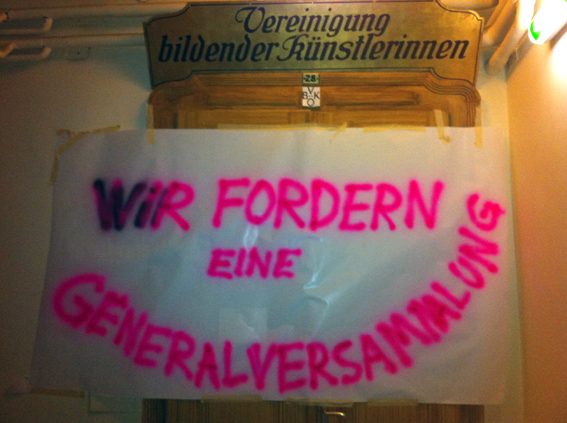
This public statement is being issued out of necessity by members and former-members of the Austrian Association of Women Artists (VBKÖ), in response to neglect for democratic governance by its current president, Rudolfine Lackner.
The VBKÖ was established in 1910 and holds an important position in lobbying for women’s rights in the arts. We, the undersigned, believe the organization is currently going against its commitment to fair representation and democratic governance through the actions and behavior of its current president.
Lackner has been the president of the VBKÖ beginning with 1998. Although we have been involved in the activities of the VBKÖ before 2010 (its centennial anniversary), the association accepted few new members on this occasion – and this was solely the decision of the president. What this membership entailed has never been concretely stated, other than a € 100 membership fee requirement. From 2009 to 2011, we mainly did unpaid work for the VBKÖ in the form of linking it to networks, artists and theorists; providing knowledge and content; translating and proofreading; designing printed matters; contributing to the VBKÖ’s publications; organizing materials, equipment and transport; curating events, discussion rounds, symposia, readers and exhibitions; and representing the VBKÖ in jury sessions.
Rudolfine Lackner began her presidency without being elected and has continued to occupy this position since 1998 – without once organizing formal elections as stated in the regulations (at most issuing statements to the members that she would simply remain in her position.) Due to a lack of transparency, contesting this decision on a legal level was hard to undertake. It was never clear if Lackner’s statements should be taken as a de facto election, or which public space could be otherwise used to bring these problems to the fore. Constant personal conflicts between the president and the members only aggravated this situation. These are just some of the reasons why the VBKÖ did not have an inclusive organizational structure for years. We believe a more engaged group of members would counterbalance the president’s position of absolute authority. Further, a members’ forum would openly expose the exclusions taking place and eventually elect another president – if these shortcomings would be openly discussed amongst a greater plurality.
Shortly after a small and short-lived VBKÖ members’ structure was established in 2010, Lackner tried to abolish it. Other strategic moves included concealing the decision-making process and suppressing information on what project members were involved in. Additionally, all major decisions were never shared with the members, not to mention the public.
No election or consultation ever took place when “erasing” or pressuring out members, nor when accepting new ones; thus, a general sense of isolation among members and a feeling exclusion from fair and equal participation dominates the organization.
We believe Lackner’s reasons for avoiding a general assembly are that such an assembly could lead to a majority of the members voting to elect a new president of the organization. In the past, many current and former members have shared their stories about these abuses and the urgency for fair governance. By establishing a general assembly, no president would have exclusive access to the historical archives, sole control over the decision-making process in the organization or be entitled to manipulate public resources for one’s personal benefit.
Therefore, we demand the following from Rudolfine Lackner:
We demand a democratic structure for this public institution
We demand democratic elections
We demand a decentralization of power
We demand plurality in decision-making
We demand transparency of the regulations
We demand transparency of the finances
We demand access to the protocols of meetings and decisions
We demand concrete information on membership
We demand the opening of the institution to new members
We demand access to the historical archives
We demand a democratic process in creating the curatorial program
We demand a democratic process in re-articulating statutes
We demand clear structures of communication
We demand mutual respect
We demand respect for women artists by their own colleagues
We demand a general assembly to discuss the above-mentioned topics, as our given rights!
We believe in this institution and its potential for women artists and are ready to fight for it !
Elke Auer
Veronika Dirnhofer
Lina Dokuzovic
Hilde Fuchs
Nina Höchtl
Esther Straganz
Angela Wiedermann
Julia Wieger
“Without Limits”: “Anti-Putin” Installation Censored at Petersburg Contemporary Art Forum
In the contemporary cultural landscape panorama [sic], when conventional forms and aspects of art coexist with completely new art practices, the priorities get diametrically split [sic] and often impervious to each other [sic]. Meanwhile, we affirm the possibility to [sic] work out mutually acceptable and clear criteria in the evaluation of both a [sic] whole process and individual events in arts [sic].
– excerpt from the Art & Reality Annual International Forum, “About the Forum”
_____
www.openspace.ru reports:
Exhibition “Without Limits” Had Its Limits
November 30, 2011
The forum, which took place in the Boris Yeltsin Presidential Library November 25–27, was attended by Russian and foreign artists, critics, art historians, experts, gallerists, and patrons. Its theme was contemporary art criticism.
The first exhibition of the “Without Limits” project took place as part of the forum. It featured pieces by young artists and students working in a wide variety of genres and tendencies. According to organizers, the experimental convergence of different formats within a single art space would help address the forum’s major objectives — to comprehend the state of contemporary visual art and analyze the potential of modern technologies for the presentation of different kinds of creativity.
The exhibition included “The Stars Speak,” an interactive installation by Vasily Klenov, a student at the Rodchenko Moscow School of Photography and Multimedia. The installation contained images of Russian stars — Maxim Galkin, Filipp Kirkorov, Andrei Makarevich, and Andrei Malakhov — alongside a display panel in the shape of comic-strip speech balloons. Visitors could type a message in these balloons using a special keyboard.
After one visitor typed in the phrase, “Putin must be castrated, just as he castrated democracy,” exhibition organizers demanded that the message defaming the prime minister be deleted. However, Vasily Klenov refused, explaining that, first, it was technically impossible, and second, that the idea of the installation had been precisely to give viewers the opportunity to freely express their thoughts.
The artist and his work were then quickly expelled from the exhibition.
Forum organizers did their best to hush up the scandal. When one of the artists participating in the exhibition, Sofia Gavrilova, tried to publicly announce what had happened, her microphone was turned off, and the live broadcast of the proceedings was preempted by a splash screen featuring the forum’s logo. Organizers explained all this as the result of technical difficulties and continued the forum.
Three Reperformers from “Marina Abramović: The Artist is Present” Respond to the MOCA Gala Performances
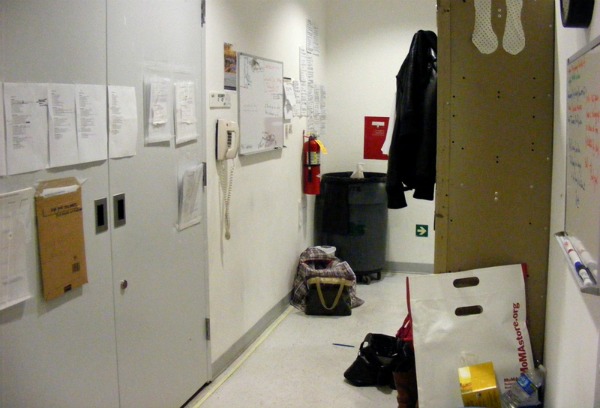
Hallway converted to performer green room on the 6th floor of the Museum of Modern Art. Photo: Abigail Levine
We read with interest and dismay Yvonne Rainer’s critique of Marina Abramović’s performance proposal for the Los Angeles MOCA gala earlier this month. We hold these two artists in the highest esteem—for the courageousness, intelligence, humor and beauty of their work and for their unapologetically unconventional lives as women and outspoken citizens. We had the opportunity to train with Abramović and perform in the three months of her retrospective at the MoMA in New York in the Spring of 2010.
In her critique, more explicit in the first “unofficial” letter to MOCA director Jeffrey Deitch, Rainer focuses on two issues. One is her concern over what Abramović was asking the performers to do at the gala. Rainer deemed the performances exploitative, particularly understanding them, as she did, simply as party entertainment. The other issue is the performers’ inadequate pay for demanding labor: $150 for a day of rehearsal and a challenging, somewhat risky 4-5 hour performance day. Rainer’s final letter focuses on the former, raising many legitimate critiques. However, we think this latter issue demands attention, as well.
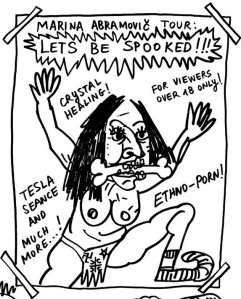
Zampa di Leone, from Zampa di Leone #24/07
Leading up to the Abramović retrospective in 2010, the 39 “reperformers” engaged in a series of successful negotiations with the MoMA for better wages and working conditions.* The initial offer we received from the museum struck many of us as untenable: $50 for a 2 1/2 hour performance shift, no compensation for prep time or time in between shifts, and, most troublingly, no workman’s compensation, which would cover us in the case of injury. Through a first round of negotiations, we achieved a modest pay increase and a change of status to “temporary employee,” which provided us workman’s compensation and some other benefits. However, we were only able to approach a fair wage for our work after two fainting performers made evident the difficulty and risk of our work. Still, we were not paid enough to avoid working other jobs during the run of the exhibit. **
In 2008-2009, the MoMA’s operating budget was $160 million.*** This puts it well in line with major opera houses and Broadway theaters, which must pay their performing artists union wages. More than 750,000 people attended the Abramović exhibit. By all accounts, it was a blockbuster show for the MoMA. If live performance is going to be one of the revitalizing forces of mainstream art museums, the performing artists who are making that possible must work in decent conditions and be fairly paid.
Marina had made clear in our auditions that all terms of employment would be handled by the museum. For a variety of reasons, we chose not to try to bring Marina into our contract negotiations. We had had a remarkable training week the previous summer, and we knew this would be important work, both experientially and, potentially, for our careers. Marina spoke to us about the challenges she had faced trying to bring live performance into a major museum on such a large scale. Many of us also felt a commitment to this creative experiment.****
The issues that Rainer focuses on in her letter are worthy of serious attention. It is clear that new complications arise as the risky and provocative actions of performance art get transferred from the body of the artist to those of hired performers. Do the performers lose their agency? Does an action that is challenging when framed as art become exploitative when framed as entertainment? The issues Rainer raises of the homogeneity of the performers, in terms of race and body type, are also vital concerns. They are not unique to the MOCA gala performances and deserve to be addressed on a more systemic level.
We are pleased to see an active debate emerging around these issues in the last few weeks. We use the moment to make a clear call to artists to insist that performers who are embodying their works are paid fairly and work under respectful conditions. We call on museum directors and curators to pay performers decent wages, wages in line with the value that the institutions derive from their work, and provide safe and comfortable working environments. And we call on performers to demand that this happens. We do not have to compromise decent pay and fair working conditions, especially in the largest and wealthiest institutions in the country, to be involved with interesting artists and work.
Finally, we make this call humbly in the face of the many millions in this country out of work and facing economic hardship. We hope our efforts will be a piece of a larger movement for labor rights.
–Abigail Levine, Gary Lai, Rebecca Brooks
November 28, 2011
* Some reperformers objected to the idea of renegotiating the contract, feeling the offer was fair and the experience worth it on its own. We had a lively and open debate via email. A small number signed the original offer. Most held off and, ultimately, all reperformers signed the updated contracts.
** The original 2007 Zampa di Leone poster, depicting Marina Abramović, Klaus Biesenbach and Hans Ulrich Obrist is available here.
*** Boroff, Phillip. “Museum of Modern Art’s Lowry Earned $1.32 Million in 2008-2009.” Bloomberg News.
**** The issues regarding performer security raised in relation to the MOCA benefit were addressed fully by the MoMA and Abramovic. Both leading up to the MoMA exhibit and throughout the run, we worked closely with the remarkable security staff at the MoMA. We had procedures in place for responding to inappropriate action by viewers or unsafe conditions. The security guards were sensitive and important collaborators in our work.
This open letter was originally published on the Performance Club website.
Also read Sara Wookey’s Open Letter to Artists in conjunction with the LA MOCA Gala and Marina Abramovic’s performance pice.
Free Matvei Krylov!
Alexey Eremenko from The Moscow Times reports on the case of an opposition activist currently facing two years in jail for splashing water in the face of a prosecutor who jailed his comrades and allegedly threatened to kill him, according to the Agora rights group.
Dmitry Putenikhin, a member of The Other Russia, attacked Alexei Smirnov outside Moscow’s Tverskoi District Court on Friday shortly after the latter jailed five people, including three fellow activists, for participating in Manezh Square rioting last December. The verdict has raised eyebrows because the riots were racially charged, while The Other Russia is not a nationalist group. Critics say the authorities chose the organization as a scapegoat.
Putenikhin, also known under the alias Matvei Krylov, did not flee after the attack, explaining to journalists that his actions were “improvised.” A video released by RIA-Novosti showed police brutally detaining him and three other people minutes after the attack. Putenikhin, who remains in detention, was initially charged with petty hooliganism, but over the weekend, police reclassified the charge to threatening an official on duty.
Police acted on a complaint by Smirnov, who said Putenikhin shouted “death to prosecutors” when splashing the water on him, Interfax reported, citing a spokesman for Other Russia. Putenikhin’s lawyer, Svetlana Sidorkina, said her client never threatened Smirnov, only telling him “we won’t forget, we won’t forgive,” which does not qualify as a death threat, as reported by Agora in a statement. The video of the incident didn’t shed any light on the matter, as it included neither statement.
Nationalists rallied on Manezh Square in December to protest an allegedly botched probe into the death of a football fan, killed in a brawl with Dagestani locals, six of whom were recently jailed. The identical court rulings in the Dagestani and Other Russia trials were widely seen as a means to placate nationalists ahead of their Russian March rally on Nov. 4, 2011.
______
Matvei’s numerous comrades, friends, colleagues, and admirers have organized a vigorous public campaign for his release. The campaign’s virtual headquarters is the web site http://plennik.org/ru. There you’ll find information (in Russian) about Matvei’s case, his biography, and suggestions on how to help him gain release from police custody, fund his legal defense, and publicize his story.
If you would like to join the campaign by organizing solidarity actions in your own country or city, or want to know how best you can help Matvei and the campaign from outside Russia, please write to: plennik.org@gmail.com.
Campaigners have already help a number of events and protest rallies in Matvei’s defense and more are scheduled for the coming days, including a rally/concert at 2:00 p.m. on November 27 on Chistye Prudy in central Moscow:
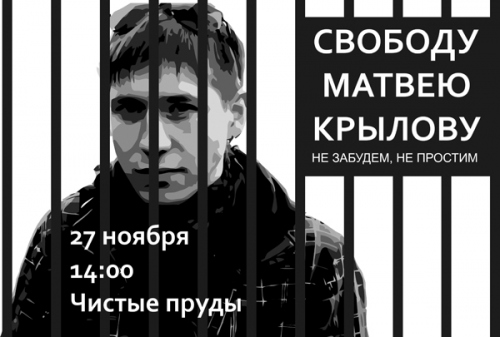
and a group art show at 5:00 p.m. on November 26 at the Zverevsky Center in Moscow (Metro station Baumanskaya; ul. Novoryazanskaya, 29):

Matvei has played a key role in reviving and organizing the sixties tradition of open-air poetry readings at the Mayakovsky monument in central Moscow, as reflected in this article from last year:
Poets rediscover Moscow platform to oppose leaders
AFP, MOSCOW
Fri, Sep 17, 2010
Matvei Krylov perched on a barricade in a central Moscow square and began reciting a poem by a Soviet-era dissident as a rag-tag audience, from goths to a headscarfed pensioner, gathered to listen. Every month a group of left-wing activists and amateur poets gathers to riff on Russian Prime Minister Vladimir Putin and problems such as the deadly August forest fires in a rare outlet for criticism of the Russian authorities.
The readings take place on Triumfalnaya Ploshchad, also the scene of regular attempts to hold unsanctioned protests on the 31st day of the month, to demand constitutional rights, which are roughly put down by riot police. Police have also tried to stop the poetry readings and asked that they avoid swearing or mentioning politics, organizers said.
Under the shadow of an immense statue of the great Soviet poet of the 1920s, Vladimir Mayakovsky, famous for his explosive rhymes, the readings recall the dissident poetry of the 1960s that rattled the Communist authorities. “The police have an order to put a stop to any politics. They warn us not to talk about Putin,” said poet and left-wing activist Vladimir Koverdyayev, a member of the banned National Bolshevik party.
“Last time they tried to detain us, we had to explain for a long time that it’s not political,” said Krylov, a member of the same party. “For them, any gathering of people is a meeting, a protest. It’s extremists, potential enemies.”At the latest reading, around 50 people, most in their 20s, gathered on a drizzly evening. Some drank cognac and ate chocolate as poets stepped up with typed pages to an improvised oil drum rostrum. Two curious policemen looked on grinning. One asked a journalist how long the readings would last, but both drifted off after listening to a few lines. Despite the ban, references to Putin and Russian President Dmitry Medvedev abounded.
Koverdyayev, 36, read a poem that ridiculed the police rules.“It’s not allowed, but I don’t give a fuck/ I mean I don’t give a toss,” he read. “It’s high time for Dima and Vova to be sent for a rest,” he said, using the nicknames for Medvedev and Putin. Another poet, Vladislav Tushnin, mocked Putin’s televised appearances during last month’s forest fires.“Putin takes a ride on a speed boat/ He and [emergency minister Sergei] Shoigu are raking in the dough/ We’re sick of this, Putin/ We have had enough of this television circus,” he read. Arseny Molchanov read a protest poem called Country — and almost all the audience joined in with a word perfect recitation.
“Turn on rag-doll Channel One/ Turn it on for even a minute/ The premier says the conveyor lines are working great/ The minister says everything is cool in the army,” he said. “And my country … she only hears the great songs of Dima Bilan/ She breathes through the scars of Kursk, Nord-Ost, Chechnya and Beslan,” he said, juxtaposing the Eurovision song winner with Russia’s worst modern tragedies. Some of the poetry is doggerel, but some is powerful. Molchanov is the best known figure, a kind of rock ’n’ roll poet who regularly performs his poetry with musicians at Moscow clubs.
Last month the readings were visited by British poet Alan Brownjohn. Koverdyayev and Krylov both have plenty of experience of political combat. Boyish-looking with floppy hair, Krylov risks jail if he gets in trouble with the police since he is serving a suspended sentence for breaking into the foreign ministry’s lobby last year in an attempted protest. Koverdyayev, dressed smartly and carrying a leather case, leads the National Bolsheviks in the Moscow region. He was briefly held in a psychiatric hospital in 2008 after he was detained on drugs charges. He was later pronounced sane and fined for drugs possession.
Krylov opened the latest reading with a poem by a Soviet dissident who died in a prison camp, Yury Galanskov. “Beaten to the ground, I spit on your iron city, packed with money and dirt,” Krylov shouted on the square, which has been barricaded off by the Moscow city authorities in an apparent move to deter protests. Titled the Human Manifesto, the poem became the unofficial anthem of poetry readings on the same spot during the Khrushchev-era thaw. Galanskov and other dissidents including Vladimir Bukovsky were the initiators.
Those readings came to an abrupt end in 1961 when the authorities cracked down on the poets and brought five of them to trial. The new generation of poetry readers sees parallels. “I think it is approximately the same time,” Koverdyayev said. “People aren’t able to express their opinion openly. People are uniting.” Watching the poetry reading was a 70-year-old math teacher, who gave her name as Lyubov Alexeyevna, who said she remembered the Soviet-era gatherings although she never went along herself. But she traveled from a suburb for this event after hearing about it on the Echo of Moscow radio. “I’m very worried about what is going on in our country,” she said, citing plans to build a highway through forest near Moscow and rising food prices.“It’s really great. I see they have bright faces, not beaten down,” she said. “I did not expect that so many young people would come along. Now they have revived the readings, good for them.”
______
Finally, here is a video about Matvei’s life and case (in Russian):
Keep informed about Matvei’s case here (in Russian) and here. (in English)
Thanks to chtodelat news for reporting on this story.
Open Letter to Artists
I participated in an audition on November 7th for performance artist Marina Abramović’s production for the annual gala of the Museum of Contemporary Art, Los Angeles. I auditioned because I wanted to participate in the project of an artist whose work I have followed with interest for many years and because it was affiliated with MOCA, an institution that I have a connection with as a Los Angeles-based artist. Out of approximately eight hundred applicants, I was one of two hundred selected to audition. Ultimately, I was offered the role of one of six nude females to re-enact Abramović’s signature work, Nude with Skeleton (2002), at the center of tables with seats priced at up to $100,000 each. For reasons I detail here—reasons which I strongly believe need to be made public—I turned it down.
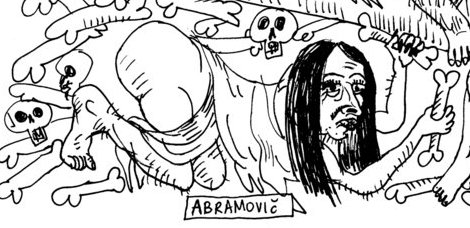
Zampa di Leone, from Tanja in Wonderland, 2004
I am writing to address three main points: One, to add my voice to the discourse around this event as an artist who was critical of the experience and decided to walk away, a voice which I feel has been absent thus far in the LA Times and New York Times coverage; Two, to clarify my identity as the informant about the conditions being asked of artists and make clear why I chose, up till now, to be anonymous in regards to my email to Yvonne Rainer; And three, to prompt a shift of thinking of cultural workers to consider, when either accepting or rejecting work of any kind, the short- and long-term impact of our personal choices on the entire field. Each point is to support my overriding interest in organizing and forming a union that secures labor standards and fair wages for fine and performing artists in Los Angeles and beyond.
I refused to participate as a performer because what I anticipated would be a few hours of creative labor, a meal, and the chance to network with like-minded colleagues turned out to be an unfairly remunerated job. I was expected to lie naked and speechless on a slowly rotating table, starting from before guests arrived and lasting until after they left (a total of nearly four hours. I was expected to ignore (by staying in what Abramović refers to as “performance mode”) any potential physical or verbal harassment while performing. I was expected to commit to fifteen hours of rehearsal time, and sign a Non-Disclosure Agreement stating that if I spoke to anyone about what happened in the audition I was liable for being sued by Bounce Events, Marketing, Inc., the event’s producer, for a sum of $1 million dollars plus attorney fees.
I was to be paid $150. During the audition, there was no mention of safeguards, signs, or signals for performers in distress, and when I asked about what protection would be provided I was told it could not be guaranteed. What I experienced as an auditionee for this work was extremely problematic, exploitative, and potentially abusive.
I am a professional dancer and choreographer with 16 years of experience working in the United States, Canada and Europe, and I hold a Master of Fine Arts degree in Dance from the University of California, Los Angeles. As a professional artist working towards earning a middle class living in Los Angeles, I am outraged that there are no official or even unofficial standard practice measures for working conditions, compensation, and benefits for artists and performers, or for relations between creator, performer, presenting venue and production company in regard to such highly respected and professionalized individuals and institutions such as Abramović and MOCA. In Europe I produced over a dozen performance works involving casts up to 15 to 20 artists. When I hired dancers, I was obliged to follow a national union pay scale agreement based on each artist’s number of years of experience. In Canada, where I recently performed a work by another artist, I was paid $350 for one performance that lasted 15 minutes, not including rehearsal time that was supported by another fee for up to 35 hours, in accordance with the standards set by CARFAC (Canadian Artists Representation/Le Front Des Artistes Canadiens) established in 1968.
If my call for labor standards for artists seems out of bounds, think of the Screen Actors Guild (SAG, established 1933), the American Federation of Musicians (AFM, founded 1896), or the umbrella organization the Associated Actors and Artistes of America (the 4A’s, founded in 1919), which hold the film, theater and music industries to regulatory and best practice standards for commercial working artists and entertainers. If there is any group of cultural workers that deserves basic standards of labor, it is us performers working in museums, whose medium is our own bodies and deserve humane treatment and respect. Artists of all disciplines deserve fair and equal treatment and can organize if we care enough to put the effort into it. I would rather be the face of the outspoken artist then the silenced, slowly rotating head (or, worse, “centerpiece”) at the table. I want a voice, loud and clear.
Abramović’s call for artists was, as the LA Times quoted, for “strong, silent types.”I am certainly strong but I am not comfortable with silence in this situation. I refuse to be a silent artist regarding issues that affect my livelihood and the culture of my practice. There are issues too important to be silenced and I just happen to be the one to speak out, to break that silence. I spoke out in response to ethics, not artistic material or content, and I know that I am not the only one who feels the way I do.
I rejected the offer to work with Abramović and MOCA—to participate in perpetuating unethical, exploitative and discriminatory labor practices—with my community in mind. It has moved me to work towards the establishment of ethical standards, labor rights and equal pay for artists, especially dancers, who tend to be some of the lowest paid artists.
The time has come for artists in Los Angeles and elsewhere to unite, organize, and work toward changing the degenerate discrepancies between the wealthy and powerful funders of art and the artists, mainly poor, who are at its service and are expected to provide so-called avant-garde, prescient content or “entertainment,” as is increasingly the case—what is nonetheless merchandise in the service of money. We must do this not because of what happened at MOCA but in response to a greater need (painfully demonstrated by the events at MOCA) for equity and justice for cultural workers.
I am not judging my colleagues who accepted their roles in this work and I, too, am vulnerable to the cult of charisma surrounding celebrity artists. I am judging, rather, the current social, cultural, and economic conditions that have rendered the exploitation of cultural workers commonplace, natural, and even horrifically banal, whether its perpetrated by entities such as MOCA and Abramović or self-imposed by the artists themselves.
I want to suggest another mode of thinking: When we, as artists, accept or reject work, when we participate in the making of a work, even (or perhaps especially) when it is not our own, we contribute to the establishment of standards and precedents for our cohort and all who will come after us.
To conclude, I am grateful to Rainer for utilizing her position (without a request from me) of cultural authority and respect to make these issues public for the sake of launching a debate that has been overlooked for too long. Jeffrey Deitch, Director of MOCA, was quoted in the LA Times as saying, in response to receiving my anonymous email and Rainer’s letter, “Art is about dialogue.” While I agree, Deitch’s idea of dialogue here is only a palliative. It obscures a situation of injustice in which both artist and institution have proven irresponsible in their unwillingness to recognize that art is not immune to ethical standards. Let’s have a new discourse that begins on this thought.
This open letter was originally published on The Performance Club website.
Yvonne Rainer’s original protest letter can be read here.
Zampa di Leone, Tanja in Wonderland, 2004, is available here.
And a recent related article in ArtInfo: How do performance artists make money? A market inquiry
 ArtLeaks