Updates
ACT NOW! Submit your story to ArtLeaks and end the silence on exploitation and censorship! Please see the submission guidelines in the "Artleak Your Case" page
Submitted and current instances of abuse are in the "Cases" section
To find out more about us and how to contribute to our struggles, please go to the "About ArtLeaks" page
Please consult "Further Reading" for some critical texts that relate to our struggles
For more platforms dedicated to cultural workers' rights please see "Related Causes"
For past and upcoming ArtLeaks presentations and initiatives please go to "Public Actions"
Stop The War On Art Workers!
ArtLeaks stands in solidarity with the efforts of Teamsters Local 814 Professional Art Handlers!
After the most profitable year in the history of the company, auction house Sotheby’s locked out its longtime, dedicated employees on Aug. 1 2011, while in the middle of contract negotiations. Those employees handle artwork and antiques valued at hundreds of millions of dollars. The company replaced its longtime, dedicated union employees with unskilled replacement workers.
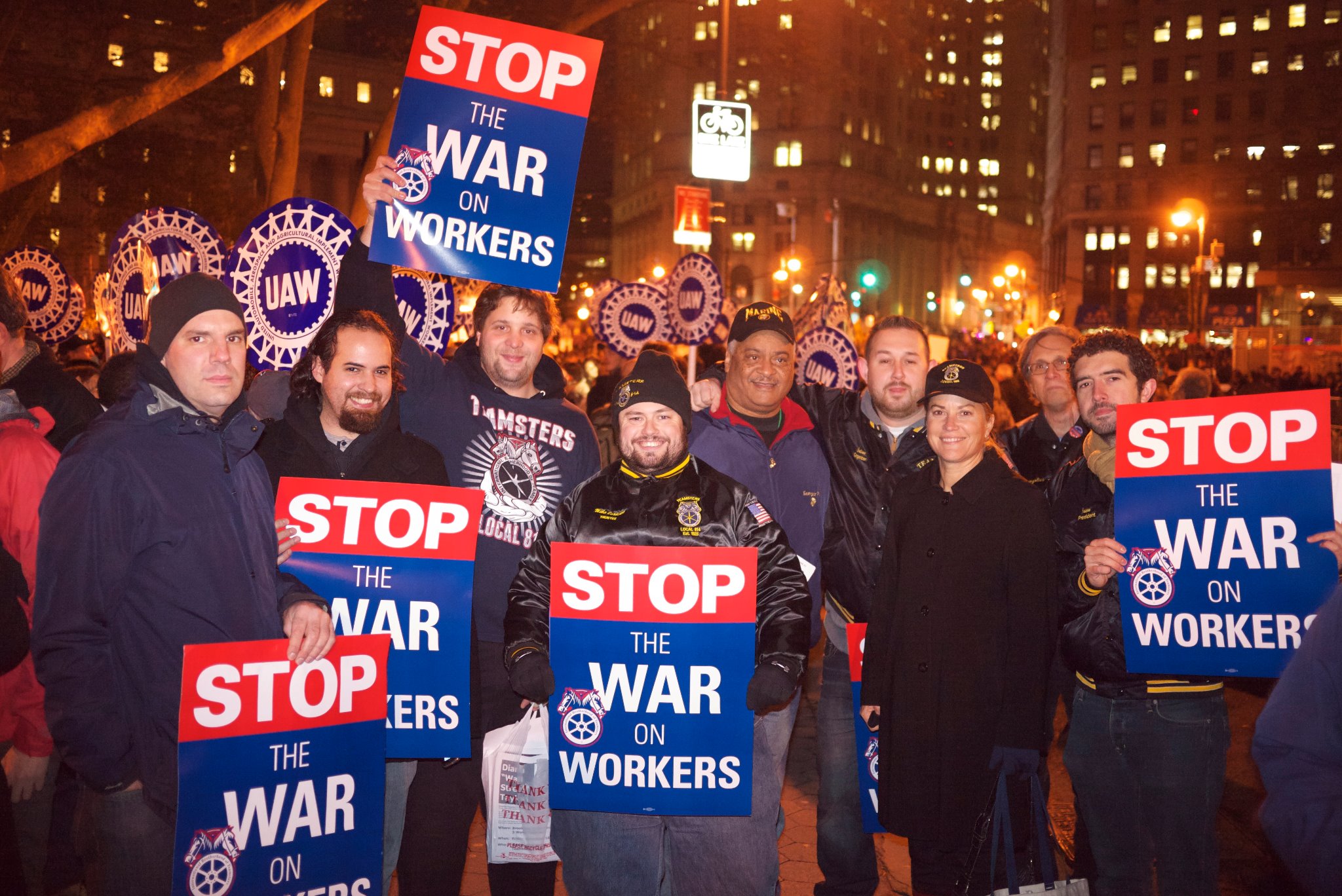
Teamsters' Day of Action Protest, November 19, 2011, NYC
“Sotheby’s hired Jackson Lewis, one of America’s most notoriously union-hostile law firm, to sabotage our contract talks. Jackson Lewis specializes in helping New York employers destroy permanent, professional jobs by bringing in a temporary workforce with high turnover,” said Jason Ide, President of Teamsters Local 814, which represents the 43 locked-out workers. “New York can’t afford to lose more good jobs, and art patrons need to know that outsourced art handlers at Sotheby’s aren’t destroying their treasures.”
“Sotheby’s has joined the growing ranks of companies that abuse their workers despite making hundreds of millions in profit. The Teamsters will always stand up for working people, and we are here to tell Sotheby’s that when they act like a corporate bully, we will fight back,” said Teamsters General President James P. Hoffa.
“New Yorkers need to know that these Sotheby’s workers—these experienced and dedicated art handlers who are responsible for protecting priceless works of art—are being treated unfairly,” said George Miranda, Teamsters International Vice President and President of Teamsters Joint Council 16 in New York. “Replacing experienced art handlers with outsourced workers is a bad way to handle New York’s fine art.”
When Sotheby’s experienced the most profitable quarter in its 267-year history, it rewarded its top management royally. Sotheby’s CEO Bill Ruprecht’s salary almost doubled in 2010 to $6 million. In several bargaining sessions since the Aug. 1 lockout, there has been little movement from the company to settle the contract.
“We are responsible for shipping, receiving, unpacking, assembling, and installing exhibitions of artwork and antiques valued in the millions of dollars,” said Julian Tysch, a locked-out Sotheby’s art handler. “With profits over $100 million in the last quarter alone, I don’t understand why Sotheby’s would make such a bad decision to outsource this sensitive work and kick us to the curb for no reason.”
Founded in 1903, the Teamsters Union represents more than 1.4 million hardworking men and women inthe United States and Canada. Visit www.teamster.org for more information.
Also, keep track of related events initiated by the Occupy Wall Street working group, Arts&Labor.
No Fee Statement
ArtLeaks provides the community with the “No Fee Statement,” in order to make visible corporate and publicly funded institutions’ refusal to compensate their workforce equitably.
We encourage cultural workers to demand that managers representing these institutions complete this statement and then share it publicly – whenever one is not remunerated for one’s contribution to any exhibition or cultural manifestation backed by corporate sponsorship or benefiting from public funding.
This form can be downloaded in .pdf or .doc format.
By making these abuses official, we require that these institutions take public responsibility for their promotion of unfair treatment of cultural workers. Please consider sharing any completed forms with us through email, so that we may publish an overview of how generalized this treatment has become.
Autowhat?!
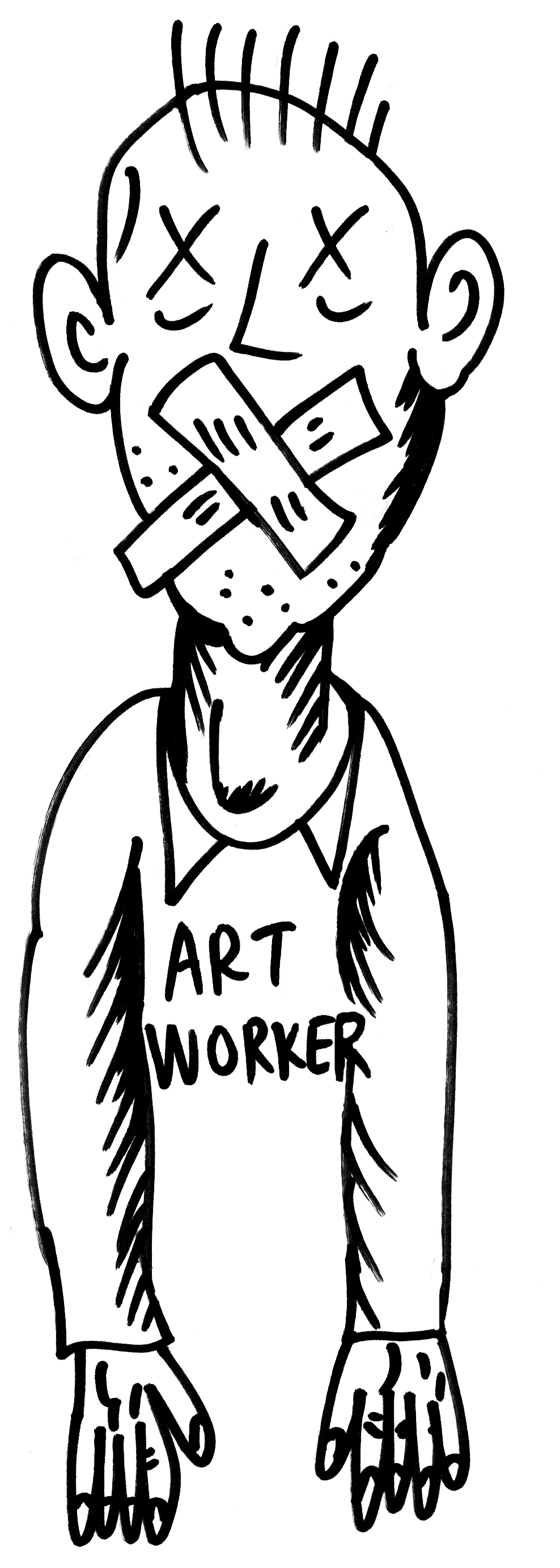
Zampa di Leone, Art Worker, 2011
In the beginning there was autonomy: a refusal to consider art as merely expressing ideas and operating within the dominant ideologies of Religion, States, Kingdoms and so on. Now that the dominant ideology is capitalism and there is no space whatsoever outside it, not in art as anywhere else, what do we mean by autonomy? What is it to be autonomous in art except to fully embrace the individualism of the global market (while feeling better about oneself)?
Everything smells like fascism: right-wing governments are on the rise everywhere, the European economic policy is destroying any trace of social organization and support – Europe is becoming a fortress, an unlivable place both for the ones that want to get in and the ones inside that have been ordered to ‘tighten their belts’. Why again claim the autonomy of art now?
The current attack on art is part of an attack to society at large. It comes at the same time as austerity measures are imposed on ‘poor’ european countries and reforms are killing the university systems all over Europe. What is happening to art can’t be looked at as an isolated problem or fight, that’s why autonomy may not be the most useful concept right now.
Autonomy has gone bad. After managing to create a little more free space for art to exist otherwise, autonomy became a pretext to reduce art to high-level entertainment for the bourgeoisie and anyone in need of a short break from the desert of working life. It made of art a ‘world on its own’, with its players, territories, systems of valorization, set of practices and so on: in other words, an autonomous market. It basically became the opposite of autonomy. It made artists depend on funding like pandas depend of WWF. It made artists accept that they are ‘exceptions’ and should be protected and supported, unlike the other workers of other sectors who need to strive for profit just to survive. And it’s nice to work for pleasure, to reflect on your practice and ethics, to be able to fail and make attempts. But why the access to these privileges should be reduced to artists alone? Is art more needed or more beautiful than anything else that people can do? Why can’t a shop keeper apply for funding so that he can work less or not be slave of wild competition? why does an artist have to continue producing work all the time just to keep her status and access to funding?
Coming back to the pandas, why to make a campaign to save a species when the whole ecosystem is about to collapse?
The same goes for art, why do we want to save art as we know it instead of proliferating art ? can it be a social reactivation of art? a politicization of art? an ‘artification’ of society? Whatever, anything that would allow art to become something else than what we already know and that is anyway dissatisfying. It’s a chance to re-think artistic practices as capacities active in the social composition, why do we really want to safeguard the liminal armless position that art has been assigned and we have happily fulfilled until now?
Why don’t we co-opt the cuts and turn them against the governments and the economical policy that guides them?
Not even the government thinks that by cutting the funding artists will stop, on the contrary, they will continue working and creating value but now economically taking care of themselves. It’s just a management strategy, a way to reduce useless labor costs. And sadly this is what will really happen if we try to defend our little privileges instead of taking this occasion to re-think what we can do, what we are able to do and do it.
It’s silly to keep dividing ourselves into categories of belonging (like ‘artist’, ’employee’, ‘shop keeper’), the only aim of these categories is to delimit a market, separate fields of exploitation. Why don’t we instead start to think of ourselves just as people that have different and ever-changing set of capacities, that depend on one other, that can group and regroup ad infinitum, capable of self-organization?
What if to cut art, social and education funding could actually reveal to be the neoliberal regime’s biggest mistake? What if people would start to disregard institutions and start making art, education and society themselves? That would actually be closer to autonomy, but an autonomy that is busy with generating life and therefore cannot be autonomous from itself. Of course there is always the risk of just volunteer-working, of continuing to create value for free and being co-opted, but there is also the chance to create other systems of valorization, since the crisis is so profound that it involves all aspects of life.
There’s a lot to make and to invent, a whole society, innumerable forms of life. Do we want to defend the autonomy of art or shall we put our highly skilled and pretty hands right in the middle of the dirt, not afraid of making a mess? Not afraid of failing or of not having a plan, capable of acting from the present in which we find ourselves, giving up categories and opening up to futures we’re not yet able to imagine – cause they don’t depend on us alone or on a plan on which we have previously agreed.
Valentina Desideri, ArtLeaks co-founder
This text was originally published in the October 2011 issue of the web-zine Bezna, on the autonomy of contemporary art and artists.
An Artist Suspected Of Terrorism
The German artist Christoph Faulhaber was awarded a state grant in 2007 and invited to exhibit his project “Mister Security,” in the United States in September 2008. But suddenly, the FBI started investigating him and he had to leave the country.
In retrospect, one has to really ask how it all could have come to this. All those involved knew the artist’s project dealt with security and state power. And yet, Christoph Faulhaber, who had been awarded a grant by the State of Rhineland Palatinate for a six-month residency at Location One in New York, was forced to abort his project after just two weeks.
The expulsion was triggered by a visit from two FBI officers raising concerns over his “Mister Security” project in New York. From then on, the 36-year-old Faulhaber was considered a threat and was forced to leave the country. “Suddenly I found myself all on my own, the entire support network faded away,” recounted the artist, who documented his experiences in New York and the consequences in his autobiographical work “Ich wie es wirklich war” (“Me the way it really was”).
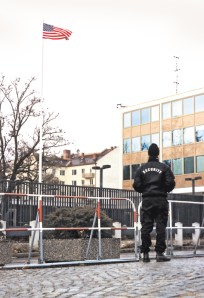
Lukasz Chrobok / Christoph Faulhaber, Mister Security - München, 2005/2007
The controversial concept of the project, on which Faulhaber based his application and earned his grant, would later become the very cause of his expulsion. In 2005 he founded the fictitious protection company “Mister Security.” Together with his colleague Lukasz Chrobok, they showed up wearing bomber jackets and holding photo cameras outside German and foreign US embassies and consulates in order to “observe public space,” as the artists declared. The sometimes curt, sometimes crude reactions of the police officers (“Your shoes look like my old work shoes”) were – without their knowledge – recorded by the artist with a dictaphone and subsequently published along with pictures from hidden cameras in the catalogue “Mister Security. To serve and observe.”
One of the goals of the intervention was to demonstrate “how one’s rights are being restricted as a result of the prima facie assumption that one is a terrorist.” In retrospect, it is obvious that information about Faulhaber’s artistic activities were directly passed on to the American security authorities, as it took several months for the artist to be granted a US visa.
According to Faulhaber: “Due to my work dealing with political issues (Surveillance, Security, Terror, Guantanamo) I was rejected from obtaining the visa. It took several letters from the ministry of culture addressing this issue to the US Ambassador in Berlin to finally obtain the visa.”
The next hurdle appeared at the airport in New York [JFK], where the artist landed on September 1st, 2008: “The pilot announced that all of the passengers should have their passports ready upon leaving the plane,” Faulhaber explained. “When it came to check my documents, an officer called: ‘I got him, let’s go’.” The artist was subsequently subjected to official procedure for terrorist suspects.
Obscure faxes, hysteria – and always the FBI
The artist was interrogated for hours. In addition, Faulhaber’s suitcase was searched and all documents in it were photocopied. “I had working material I had gathered for half a year with me, including newspaper reports about September 11 and Japanese women who torture cats with stilettos,” the artist said. After he was finally permitted to enter the country and was given his documents back, he was surprised to find two classified faxes sent by US security institutions dealing with his ‘case’. A mistake? Was he being set up? To this day Faulhaber does not know the answer for sure.
Four days later two agents from the FBI’s Counter-Terrorism Department came to the Location One premises in SoHo to ask the artist more questions. In the end, the officers became part of the artist’s “Mister Security” project. Shortly after their visit, Claire Montgomery, the director of New York’s Location One, who had invited Christoph Faulhaber to exhibit, informed him that he had to leave their institution for security reasons. Thus, the collaboration was terminated, the artist’s grant was subsequently revoked by the state foundation and his apartment lease was cancelled effective immediately. Faulhaber, at this point in a state of panic due to all the hysteria surrounding his case, handed the two obscure faxes to the legal department of the German Embassy. He no longer had the courage to take them with him. Feeling hounded, the artist decided to do a “last barbecue in the park,” during which he burnt all the copies he had made earlier, but not before memorizing the contents by heart – which dealt with insufficient information about his person.
Once he returned to Germany, he was contacted by Danièle Perrier, the director of the artists’ residence Schloss Balmoral in Bad Ems, who was responsible for awarding grants. Perrier informed him that the basis for his grant had been a contract with the artists’ residence, Location One. Moreover, this institution had the right to cancel the residency at any time “due to misconduct or gross negligence on the part of the artist or within 30 days for any other reason.” A legal suit followed. In the end, Christoph Faulhaber was paid a compensation of 7000 Euros and was struck off the list of grant recipients.
On the occasion of an exhibition and artist talk in Frankfurt (in 2009), one audience member wanted to know whether the events couldn’t be interpreted as a stroke of good fortune for his art. Faulhaber replied laconically: “At this rate, I’m afraid I’ll never be able to stop.”
This text has been edited from an article by Sandra Danicke, published in Art-Das Kunstmagazin, March 2009
This case has been publicized in German media, but was never made public in the U.S.
Many thanks to Jasmina Tumbas and Michael Scuffil for translation and editing assistance.
Just Another Case of Toxic Leadership
Only by entering the narratives of leadership and corporate life can we walk the road toward positive transformation. – Alan Goldman
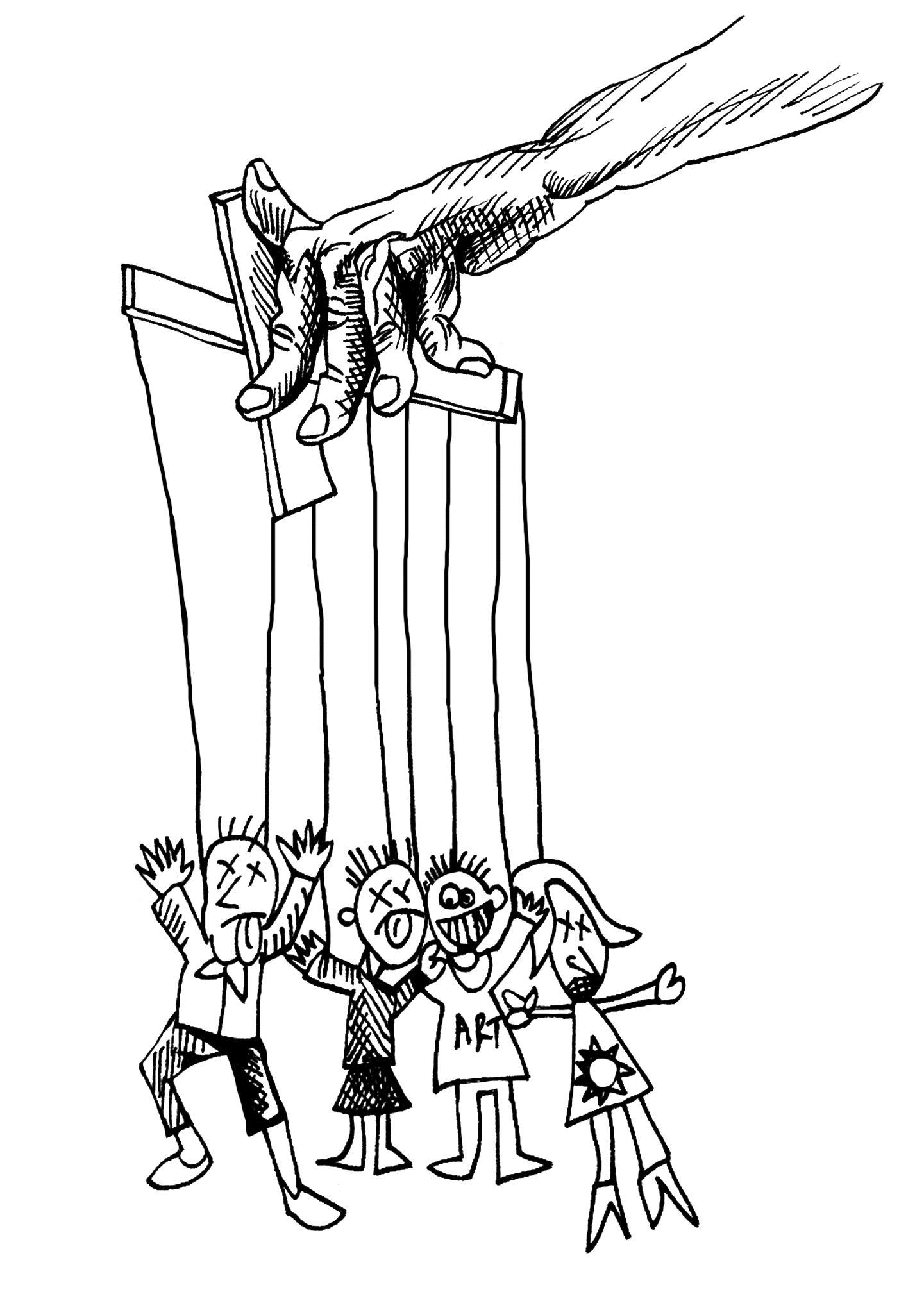
ArtLeaks, Zampa di Leone, 2011
As a response to the letter of complaint issued by Pavilion UniCredit, I want to tackle a singular but central recurring point – the question of leaders and leadership in their words. Their case and their actions mark them out as a possible extension into the backwaters of the art-world, of Alan Goldman’s arguments presented in his book Transforming Toxic Leaders.
In short, Goldman offers a unique view about life behind closed corporate doors (as well as hospitals and other important modern institutions). His book is based on a long personal experience in doing professional executive coaching and consultancy, while trying to find out what is wrong with company leaders and what the remedy is. Alan Goldman is not afraid to investigate the “metastasizing” long term patterns and bad behaviors that emanate from the top leadership. The high cost of bad behavior in corporate circles at top management and executive levels bears witness to this in our daily lives.
On a smaller and more insignificant scale at the art-world level, we have struggled to understand and find a possible way out of Pavilion UniCredit – offering artleak revelations into “behind-the-scenes fears, hostilities, and internal warfare” plaguing some of today’s art institutions and contemporary art centers, because, sadly enough, financial institutions are not isolated cases.
In the meantime, Pavilion UniCredit’s enemies have been labeled un-productive, incompetent, lacking initiative, sucking the chrome, being drunk&destructive&drugged, and downright envious about the many “accomplishments” of Pavilion UniCredit – of taking sides with their former employees and sabotaging their holy organization. In fact, the most poignant issue to consider is their fear of being ousted, of losing the grip over their small but autocratic art kingdom. The very understandable and human fear of not being a leader any more, the frightening possibility of not being seen as leaders and masters anymore, is truly unbearable.
I would like to dispel all fears of a coup-d’état, of taking over or of becoming the next leader in their place. I know it is very hard to make the leaders feel at ease in their current and tenuous situations. They need the unanimous vote, the audience applause and the cheering employee chorus.
But the question still stands: If we do not pose a threat to the organization and its top leadership, why the desperation to hang on to such a bewildering array of pompous titles, high priestly functions, boisterous name-droppings, directorial signatures, monolithic headers, glorious overachievements and venomous reactions? Why the theatre of success and why all the vanity metrics?
We know that the media and the audience ask leaders to show big growth numbers. Start-up guru Eric Ries puts the blame on vanity metrics as responsible for furnishing a false sense of permanent success, making it impossible to judge the true health of a business or the way the leadership treats their collaborators and clients. Pavilion UniCredit was a real leader in a more general trend of spewing out big numbers by the load, fashioning self-importance through hypnotic academic credentials, and by always feigning innocence and benevolence. But this was also their (and many other CEOs’) major weakness, we might add.
We also know that the current artistic and economic environment puts a lot of pressure on the leaders to boast about their five-year-plans, to outstrip their competitors’ claims, to attract outside support and to never even dream of disappointing their overlords. Being an over-achiever is not easy nowadays, and institutions can become self-inflicted burdens very quickly, from their inception onward.
We are just trying a bit to transform a toxic leadership and the Pavilion UniCredit CEO‘s life so that may it may stop infecting their executive board and/or management teams. And I think our warnings were heard and taken into account, and that we are ever more close to detoxification in seeing how our executive consultancy has worked out for their present collaborations. If we cannot stop the abuse immediately, at least we can maybe make it easier for future collaborators. This is what Goldman said about toxic leadership, and we think that he was right. It is our firm belief that many of our actions would, in the best sense, also function as a “detoxification” and warning model, a guided and positive pressure to transform toxic leaders and their organizational authoritarian rule into something more benign.
Let’s be clear that we do NOT envy any of the toxic existence and bad vibes that are a fact of company and Pavilion UniCredit life. One has to really ponder such heavy questions. How could we? How could one ever envy it? With Goldman’s help we try to distinguish different levels of toxic leadership as well as their prognoses and remedies.
Goldman identifies a predominantly authoritarian and bullying leadership style that was enacted during massive corporate downsizing, rightsizing, and layoffs. This is not just a characteristic of banks, life insurance companies, or Wall Street life. Compassion and genuine responses to others (ex- or present employees) are lacking, as well as a truly emotionally intelligent leadership. Like many other modern countries, Romania has had a long history of monarchic and autocratic rule, a tradition that is now kept alive by art centers, institutions kept under the reign of toxic leadership.
Like Goldman, we know that toxicity is a fact of life in such institutions and companies, but it is little talked about and generally taken for granted and usual. It is, most of the time, a topic of general consent that the CEO’s sovereign power must remain unquestioned – firm in the face of critique, absolute and unswerving in order to function smoothly, to get the next Biennale going, to publish the next anniversary magazine, and to crackdown on any dissenting parties. But, as Goldman says quite clearly, hiding out behind academic titles, hollow data and magical surveys is definitively over.
Stefan Tiron of Paradis Garaj/Kunsthalle Batistei, ArtLeaks co-founder
Many thanks to John M. Stokes for editing assistance.
 ArtLeaks