Updates
ACT NOW! Submit your story to ArtLeaks and end the silence on exploitation and censorship! Please see the submission guidelines in the "Artleak Your Case" page
Submitted and current instances of abuse are in the "Cases" section
To find out more about us and how to contribute to our struggles, please go to the "About ArtLeaks" page
Please consult "Further Reading" for some critical texts that relate to our struggles
For more platforms dedicated to cultural workers' rights please see "Related Causes"
For past and upcoming ArtLeaks presentations and initiatives please go to "Public Actions"
Pavilion UniCredit 2010/2011 – A Collective Protest Letter
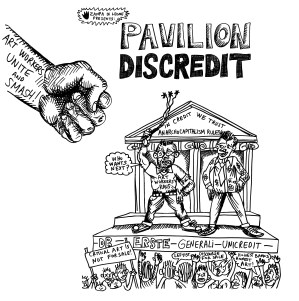
Zampa di Leone, Pavilion DisCredit, March 2011
This protest letter begins with the particular set of circumstances which brought together an international group of art workers from different positions in the field. Through these exchanges, they decided work collectively to make visible the conditions of inequality and exploitation that they wanted to rescue from slander, gossip or leave them unquestioned as the privilege of institutions. Namely, we began collaborating as a group of artists, curators, art historians and intellectuals who wanted to publicly bring to light Pavilion UniCredit’s consistent mistreatment of artists, workers and even visitors to their center in Bucharest. This center is devoted to contemporary art and culture and financed by one of the most prominent banks in Europe – UniCredit Tiriac Bank. Yet, we see its mission to provide a space for critical thinking and dialogue compromised – through the management’s repressive maneuvers against those of us who problematized their politics and criticized their engagement with their main sponsor.[…] Continue reading more ->
An Open Letter on the 2008 Kandinsky Prize
We admit it upfront: we don’t care much for the artist Alexei Belyaev (Guintovt), and we don’t care about him. His art is beyond the pale of criticism, and we have never had any illusions about his political views. By the mid-1990s, he had already drifted into the orbit of Eduard Limonov’s National Bolsheviks, and he would later join Alexander Dugin’s breakaway Eurasian Movement. You do not have to be a political scientist to recognize these people for what they are: part of a reactionary global trend toward ultra-right/ultra-left nationalism. Belyaev’s statements and artworks reflect this political identity. His work glorifies violence, imperial domination, blood, soil, and war. It does this in a consciously triumphal neo-Stalinist aesthetic, mixing crimson with gold leaf to confirm its redundant imperialist messages. Some members of the local bourgeoisie are taken with this aesthetic. Fascism thus enters the salon—a salon we would rather ignore. […] Continue reading more ->
The Dialectics of Hopelessness: Visions and Visibility Around the 2005 Moscow Biennale
In Russia, the last three years have passed under the banner of economic and political consolidation. This banner does not just symbolize “unity”, presented as an abstract concept of the consolidated, federalized State. Instead, it flies above all areas of socio-cultural production, heralding the artificial construction of a new (Russian) “way of life”, modelled on a fusion of bureacratic socialism and crypto-fascist hodge-podge life-style patriotism. Yet despite all of the comprehensive talk of security, administrative rationalization, controlled work conditions (offices rather than black- markets), and domestic comfort (“Mother knows best”), this “way of life”, this seemingly self-perpetuating stability, always looks artificial, much like a monkey in a suit of armor. All hell is breaking loose everywhere, Russia included, as the old infrastructure seems to be heading for a serious crisis. “Time is out of joint” on “The Planet of the Apes”, full of ruptures and breaks, taking on increasingly monstrous forms, and no amount of make-up can make a monkey into a man. Still, most politicians and business-people seem to believe that true reforms begin with cosmetics. This does not simply amount to an image-campaign but a redefinition of visibility […] Continue reading more ->
The Dialectics of Hopelessness- Visions and Visibility Around the 2005 Moscow Biennale
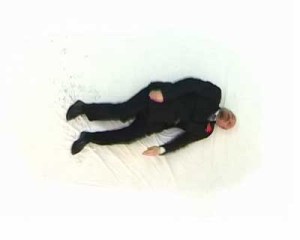
The Blue Noses, “Lenin turning in his grave," videoinstallation "The Little Men," 2004
In Russia, the last three years have passed under the banner of economic and political consolidation. This banner does not just symbolize “unity”, presented as an abstract concept of the consolidated, federalized State. Instead, it flies above all areas of socio-cultural production, heralding the artificial construction of a new (Russian) “way of life”, modelled on a fusion of bureacratic socialism and crypto-fascist hodge-podge life-style patriotism. Yet despite all of the comprehensive talk of security, administrative rationalization, controlled work conditions (offices rather than black- markets), and domestic comfort (“Mother knows best”), this “way of life”, this seemingly self-perpetuating stability, always looks artificial, much like a monkey in a suit of armor. All hell is breaking loose everywhere, Russia included, as the old infrastructure seems to be heading for a serious crisis. “Time is out of joint” on “The Planet of the Apes”, full of ruptures and breaks, taking on increasingly monstrous forms, and no amount of make-up can make a monkey into a man. Still, most politicians and business-people seem to believe that true reforms begin with cosmetics. This does not simply amount to an image-campaign but a redefinition of visibility. […]
The New Russia, more than anything else, needs to look more respectable, modern, and even fashionable. Never mind the latent nationalism and the criminal past. No one really cares except the foreigners. The main thing is to look good for the global marketplace, to attract investments, to play at “civil society” – a concept only thinkable as a spectacle or a farce -, to keep everything firmly under control, to make sure that “kitchen-maids don’t rule the state”, and to render all of the very real social and infrastructural problem-zones invisible. In a sense, one could describe this period as the Velvet Revolution’s Bonapartist phase: an artificial stabilization after a period of sudden social change and adventure. Or, as Boris Kagarlitsky put it recently, the imposition of “Egyptian democracy”, firmly controlled, and unfortunately, corrupt beyond imagination.
Incidentally, state-capitalism’s stablization of visibility is interwoven with a paradigm-shift in the discourse of visuality of the new Russian elite. The new Russian elite – Putin’s political backbone – is not completely satisfied with its image, its lifestyle. Enough vodka, enough steam baths: no more prostitutes, no more fascism, give us a Jaguar instead of a Jeep Cherokee. All that old, barbaric stuff just isn’t slick enough, although it may be funny sometimes, as works by the Novosibirsk art group The Blue Noses demonstrate. New nouvelle-cuisine restaurants, new boutiques, new pay-per-view channels, new magazines, new erotica (give us nymphets as in newer works by the ex-dog-man Oleg Kulik, floating in the amniotic sea of simulated desire), and most importantly, do something about the dйcor. The dйcor, until now, has been marked by a curious absence of “high” contemporary visual culture. Instead of icons and Faberge eggs, today’s Russian elite finds itself wanting contemporary art as a more modern means of confirming its own identity. The elite’s taste in art has been “improving”, “normalizing”, even if, in terms of numbers, the Russian art market is still dominated by the corrupted ex-official artists and their snow-covered landscapes, their cheap copies of Modigliani or Picasso, their megalomaniac statues of Peter the Great (Tseriteli). So what if even Yuppies still prefer antiquities or designer-suits to buying a painting or two to spiff up their homes? This is about to change. And if it doesn’t, the State will help.
One of the biggest problems facing the (political) visibility of “Russo-Egyptian democracy” and the visuality of its new elite is that it has not yet transcended the phase of normalizing gloss and selective revelation, demonstration of “business as usual” and “dirty PR”. Since […] the poetics of the mass-medial language used in Russia today are designed to simulate “democracy” and “transparency”, but actually pursue the dual strategy of “hiding” problematic areas (withholding visibility) and providing temporary visibility, effecting selective revelations of ugliness, as arguments for counterstrategy or affirmations of complexity. In the best case scenario, complexity is simplified (more or less drastically), while the argument for counterstrategy is criminalized, to be eliminated or erased by cosmetic surgery, or subordinated to a power-vertical at the very least. The only real weapon against these terrifying revelations is their transformation into positive visibility, their re-visualization. If Putinism ever finds the means to effect this re-visualization, to perfect the means of representation (as did Reaganism, however briefly, by tapping into the primal motives of paradisical greed and apocalyptic fear), it will have succeeded.
But for now, the problem is that the poetics of selective revelation are very difficult to control. When they run amuck, the desire for political visibility – coupled to the stylistic improvement of costumes and stage-props – is frustrated by grotesque, pseudo-pornographic images of corruption, by negative propaganda, mudslinging, filth. Positive and negative figures overlap in simulatory diaramas, leading to complete confusion and ultimate passivity: things are never as they seem, so why even try to change them? As such, most selective revelations reveal the melancholy trivia of failure. Such failures of political visibility usually leads from the glossy veneer of highlife to the banality and lowlife triviality of the everyday.
First Moscow Biennale of Contemporary Art - Dialectics of Hope (January 28–February 28, 2005)
Take, for an example, the discourses and controversies surrounding “the big project for Russia”, the First Moscow Biennale for Contemporary Art. The source of many a pseudo-utopian dream, carried to reality on an optimistic upwind, the Biennale was meant to supply form to all of this new interest in visuality and visibility, a provincial market stimulator, vibrating across the (newly stabilized) erogenous-optical zones that connect visuality and visibility, reclaiming at least some of its political importance in forming visual language by reaching more massive, popular exposure. But now, after more than a year of concrete planning, the Moscow Biennale is in the process of recovering from a paranoid crisis, after certain things – embarassments – inevitably became visible. None of these things were very pleasant; they revealed the petty details of corruption that, perhaps, are better left unseen.
For the purposes of this essay, this petty little story begins with a rhetorical fragment from the web-site of the Moscow Biennale, unsigned although attributed to one of the Biennale’s chief lobbyists, Viktor Misiano:
“One of the most obvious consequences of political and economical stabilisation in Russia is the growing interest of the Russian society in contemporary culture, and more precisely in contemporary art. As a result a totally new Russian art infrastructure has emerged through art fairs, commercial galleries, non-profit exhibition spaces, festivals and conferences.[…] The Russian art world is developing fast and there is a certain opinion, conviction, vision and understanding that the country needs to organise a major international art event, which would be able to introduce current and relevant art movements to a Russian audience by presenting the most interesting examples of contemporary art. It is the right time in Moscow to create a major international art event, the first of this kind for our country. […] The Moscow Biennale of Contemporary Art would build on the success of other events like the famous Tchaikovsky Musical Festival, Moscow International Film Festival and “The Golden Mask” Theater Festival.”
To briefly rearticulate Misiano’s logic, pushing aside the canned enthusiasm of his rhetoric: as both economy and politics stabilize, Russian society takes an interest in art, both as spectators and consumers. In order to stimulate the consumer’s interest, which is still provincial, one needs a “big event”, a biennale. Never mind that big events are under constant criticism for being spaces for the agents of globalization: These “no-wheres” need to be reclaimed now-and-here, as forums for genuine social exchange, less mediated, less visible (more visual), cleared of elitist exclusion and bureacratic corruption. Of course, a certain degree of compromise with representative visibility (the famous Tchaikovsky Musical Festival, Moscow International Film Festival and “The Golden Mask” Theater Festival etc.) is necessary but…: newflash…:
21.05.2004.
“The Moscow Biennale Will Open Without Viktor Misiano. It has come to light that Viktor Misiano, the deputy director of the State Museum-Exhibition Center ROSIZO, editor in chief of the “Moscow Art Magazine”, and one of Russia’s prominent curators, has been removed from the curatorial group entrusted with organizing the First Moscow Biennale of Contemporary Art. According to the delicate formulation of the Ministry of Culture, under whose aegis the Biennale is being organized, Misiano was relieved of his duties in order concentrate on other important exhibition-projects: at present, he is curating Russia’s contributions to the Biennales in Sao Paolo and Venice. But according to our source, the reason for Misiano’s removal lies in a conflict that neither the Ministry of Culture nor the curators themselves are very eager to talk about. The international collective of curators includes famous names such as Robert Storr of the MoMA, Rosa Martinez and Jara Bubnova, authors of the “Manifesta”, Nicolas Bourriaud, Hans Ulrich Obrist, who made a sensation last year in Venice, and others. As far as artists are concerned, the organizers are counting on the participation of Western “stars” such as Maurizio Catalan, Rirkrit Tiravania, Sergio Vega, Monika Sosnowska, and Isaac Julian. The list of Russian participants has yet to be confirmed, but almost certainly will include Oleg Kulik, the group AES+F, and the Blue Noses as well as the radical performance artist Elena Kovylina.”
Like most newspaper clippings, this little announcement is outdated. Times are changing so quickly, that by today, the entire story has changed. Don’t panic. The Biennale is to feature young artists (i.e. under 35) from both Russia and abroad. In the following selective revelation, we find out why.
9.7.2004.
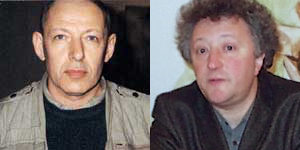
Joseph Bakstein and Viktor Misiano
The Moscow Biennale of Contemporary Art is Presented to the Press. The guests invited to the press conference at Moscow’s luxurious “Mariott” had to shuffle their feet in the corridors for quite some time, awaiting the arrival of the assembly’s chairman, the head of the Federal Agency for Culture and Cinematography, Mikhail Shvydkoi. […] Other “attendants” included the members of the Biennale’s organizational comittee: the head of the department for visual art of the Federal Agency for Culture and Cinematography, Maia Kobakhidze, the comissioner of the Biennale and general director of ROSIZO, Evgeny Zyablov, and last but not least, the assistant director of ROSIZO and Curator-Coordinator of the Biennale, Joseph Backstein. The only absentee was Victor Misiano, who is the other assistant director and one of the main inspirators of the idea of the Biennale. To put it lightly, the reason for his absence can be explained by a certain ideological rift with certain contemporary artists who have become popular lately, some of them through Misiano’s efforts and those of the “Moscow Art Magazine”, which he edits. His colleague Joseph Backstein explains Misiano’s absence even more diplomatically: “Viktor is in high demand all over the world. Sadly, he has no time left for the preparations of the Moscow Biennale.”
It seems obvious that all of this doesn’t quite correspond to reality. Let us demonstrate or reveal, albeit selectively.
4.8.2004.
“An open discussion on the Moscow Biennale and its organizational methods has been opened on the site artinfo.ru. The site has published two documents, which previously only circulated behind the scenes”, which show that Misiano was removed as the result of a bureaucratic intrigue. These documents show that Backstein was able to effect Misiano’s unconditional removal by writing a denunciatory letter, reminiscent of the Stalin-era. By claiming that Misiano had taken “a destructive position”, was creating “an obstruction” by “intriguing” and “spreading disinformation”, and was not displaying enough “loyalty”, both to his fellow Russians and his international colleagues, Backstein made the recommendation – albeit with a “broken heart” – that Misiano be removed for good. While such intrigues are unfortunate, they are nothing special; in fact, they probably happen all of the time. The real “sensation” consists in the following: although the letter was written “in the name” of the curatorial group, it did not include any of the co-curator’s signatures, even though they had visited Moscow and should have been informed or consulted, signing the letter as a show of their consent. Instead, Backstein’s denunciatory memorandum was co-signed by four of Moscow’s most well-known artists, namely Oleg Kulik and the AES+F group. The reason for their signature was supposedly to corroborate Backstein’s claim that Misiano had been spreading the rumor that they would not participate in the Biennale. After a month’s deliberation, Misiano was removed, notwithstanding all of his contributions to the project of the Biennale.

Joseph Backstein's denunciatory memorandum co-signed by Oleg Kulik and the AES+F group
This gave rise to the fear that the removal of Misiano as “an official face” would lead to the re-appropriation, destruction or state-privatization of the “Moscow Art Magazine“, the art-community’s main open forum. These fears are not unfounded. There are rumors that the Ministry of Culture has cut all funding for Moscow’s only discursive-artistic publication. The editorial board, whose salaries were paid by the Ministry of Culture, have been withheld for months. As one says in America, you’ll never work in this town again.)
Answering the fears raised and the problems posed by these selective revelations, which demonstrate an unethical rupture in an art-scene long since divided by intrigues and squabbles, an informal group of artists, critics and other cultural figures published an open letter with the demand for transparance around the Biennale. This demand is interesting because it reflects the problematique of the relationship between visibility (of public personae) and selective revelation quite concisely and can be used as a point of departure in beginning a critique of its discourse, both negative and positive. The partially visible intrigues and maneuvers around the project of the Moscow Biennale reveal a deep rift within the artistic community, which cannot agree on which model of visibility and transparence the new Russian elite actually wants.
So what kind of art does the new Russian elite actually want? Maybe it wants spectacular events, Glamorama and fame, feather-light provocations, burlesques and carnivals, glossed-over eroticism, and obvious visual opulence, befitting of its luxurious new offices and villas? Or perhaps it would prefer an edited version of history, painted in deeply satisfied timbres, aged with the patina of authenticity, confirming the international value of Russia’s pre- and post-Soviet cultural legacy?
Take, for an example, artists like Oleg Kulik, AES+F, or The Blue Noses. Just like the post-conceptual irony of Brit-Pop, the irony or mystery of these prominent artists of the 1990s wears thin when it becomes clear that their art can be easily used in a pseudo-global advertising campaign (cf. Kulik and “Blue Noses” as advertising-figures for “Absolut”), ironically playing with the deeply rooted cultural stereotypes of Russian identity, as it is perceived in the West. In an international context, they function as ethno-pop (and not like post-national Brit pop): no-one really cares about their complex background; most people simply enjoy their carnivalesque, life-confirming images of the new “Russian bear”, loveably tamed by the consumption of vodka and other attractive goods. In this sense, they represent the “new quality” of their age, largely because they are so visible all over the world. Their art is conciously (visibly) designed for consumption by a new elite, but this is actually its fatal flaw. To put it in plainer language, many people are already sick of their open cynicism, the (equally transparent) image of their corrupt monopoly over visibility, which seems to be coming true. […]
This gives rise to a serious question […]: perhaps the new Russian elite does need a dose of social-critical art, art that captures or avoids the spectacle, art that documents reality in all of its sordid (and splendid) details, art that considers its main goal as communication over the Common, rather than auto-canonizing discourses on social representation? Perhaps people need a dose of utopia once in a while, especially if it somehow – however vaguely – belongs to the domain of the forbidden, the invisible. Call this resistance, if you may, notwithstanding all of the skepticism toward radical chic, or better yet, call it resistance with revolutionary potential, whose obscurity (non-transparence) questions and overthrows the elitist assumptions of visibility and representation, attempting to imagine a world defined by complex visions rather than simplifying (representative) visualizations.
This kind of art is hardly compatible to the commercializing mindset of the other group. Why dwell on the eye-sores of the every-day? And why engage in experiments whose results are consciously ephemeral or ugly? The new elite has little use for “nonspectacular” art or psychoanalytical performance (e.g. the ESCAPE Program, or the St. Petersburg collective Factory of Found Clothes [Glucklya and Tsaplya]), nor can it really accept the “neo-Communist realism” (or “post-dissident art”) of Dmitry Gutov and his Lifshitz Institute. It also will have trouble integrating socially critical documentalism and situationism (e.g. Dmitry Vilensky and the work group “What is to be done?”), just to name a few key positions. In other words, it will eventually discard the entire artistic Left, shutting down many of the off-spaces that have resisted the “privatization” free-for-all and the more recent trend toward globalized stability according to plan. The official-vulgar version is that no-one really cares about the Left and its Marxian theorizing, just as no-one really care about the war in Chechnya or the reduction of benefits for pensioners who are already well below the poverty line. No-one really cares about democracy either, so if the cultural Left is “shut down” or marginalized programmatically, its disappearance will go unnoticed, much like the exit of liberalism from the stage of parliamentary politics.
To recapitulate and simplify: the conflicts around the Moscow Biennale selectively reveal two “camps” who do not only differ upon what kind of art to produce, but how to utilize the global and the local in order to produce it.
Thus, the goal of the First Moscow Biennale is to negotiate between these two conceptions, in order to a) selectively reveal their productive conflict, and b) to afford (respectable) visibility to contemporary art from Russia as a whole, notwithstanding all of the differences in (ethical, aesthetic, and political) opinion. The name of the Biennale, “The Dialectics of Hope”, comes from a book titlte by the sociologist, activist, and director of the Moscow Center for Globalization Studies Boris Kagarlitsky. This could be understood as a concession, a peace offering, a provision of visibility, promising that the Biennale would have an inclusive character and reflect different positions, including the critical view of contemporary capitalism. This conception (still created with rather than without Viktor Misiano, who is far more familiar with the Cultural Left that Backstein) was somehow synchronized to the widespread movements toward politicization as a form of “resistance” against alienation, sadness and hopelessness, in the full understanding that the age of utopias has expired. In other words, this conception grudgingly accepts the emotional integrity of art from the Left, although it fails to understand its inner significance and its necessary consequences.
However, the press conference of July 8th seemed to redefine the hopes placed on the Biennale as a point of inclusive consensus between different aestetico-political models. At the press-conference, the announcement of its title led to the question of whether the Biennale would be a “left-wing event”. Now, however, it was Evgenij Zyablov, the commissar of the Biennale, who answered that the project would definitively not come “from the Left”, although “art cannot be seen in isolation for engagement”, and “contemporary art reflects social problems”. Another unnamed member of the press conference said that the Biennale would reflect a kind of “monitoring” of left-wing ideas. Here, it is clear that social responsibility is a kind of nuisance that needs to be justified, if at all. Criticism of social reality is really only excusable if it can be subsumed as a strategy of (State/corporate) representation, as a form of (federal) “monitoring”. As such, it can documented and revealed selectively, in order to fit the needs of the projected (and increasingly real) new Russian elite. But does the Cultural Left really want to “be seen” (and used) in this way? As Boris Kagarlitsky writes in his letter of protest, published on http://www.gif.ru:
“All of this gives rise to a paradoxical situation: the context of my work legitimates a project that enjoys the support of the Russian elites, who were hardly ever noted for their sympathy to the theory and praxis of the Left. Of course, “Leftist” and “progressive” rhetorics are in fashion again – we see, for an example, how they accompany any legal project focused on depriving the working class yet another privilege. The same thing seems to be happening in culture: it seems quite natural and timely for official culture to appeal to discourse from the Left. However, for progressive, independent art, this use of words is inadmissable, even fatal.”
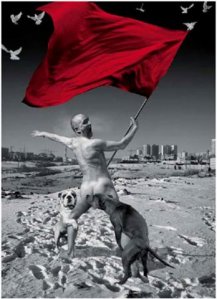
Oleg Kulik, Eclipse, From the series "Russian," 1999
Along with these general political implications, the artistic Left – if one can even apply this term to the multitude of non-glamorous approaches to art – was far more disconcerted by the fact that the removal of Misiano through Backstein took place with the support of Kulik and AES+F, which was already partially revealed (by Misiano) before the press-conference might be an attempted coupe d’etat. The aesthetic programme announced at the Biennale’s first press conference seemed to confirm this idea. Throughout July and August, it seemed as though Kulik and AES+F might have succeeded, ensuring the inclusion of the superstars that legitimate their presence as well as their own coronation in the pantheon of superstardom. Perhaps the most articulate formulation of this fear comes from Bogdan Mamonov, re-presenting the age-old choice visibility and vision, between becoming an official face or being an artist. The real cultural-political basis of this superstructural formulation is overdetermined by the liklihood that Kulik, Dubbosarsky and Vinogradov, or AES+F, might, at some point, become the representative-artistic face of a new state and a new elite, in some surreal blend of Putin meets Saatchi-Pop. Is it so very difficult to imagine Kulik or Dubbosarsky as professors of art academies, like Lьpertz or Immendorf in Germany? It remains to be seen whether this is or is not a paranoid projection.
In this sense, one can speak of two factions, whose latent conflict seemed about to implode. But then, just after Boris Kagarlitsky had written his letter of solidarity, another newsflash.
2.09.2004.
At a press-luncheon, the organizers of the Moscow Biennale of Contemporary Art announced that the main venue for the Biennale would be the former Museum of Lenin, the Historical Museum, instead of the Central House of Artist. The main curatorial project hosted here would only consist of young artists (20-30 years of age) and unknown figure, who’s names “won’t tell you anything…yet”. […] Now, the Biennale’s central project will include artists from different countries (a model geography might include Europe, China, Korea, India, Nigeria, Brazil, Argentina, Puerto Rico, the USA etc.) Let us remind the reader that this exhibition does not have more than 45 participants. And if the organizers had announced that they were going to invite Oleg Kulik, AES, or Anatoly Osmolovsky and other Russian “stars”, this announcement has been now rendered null and void. Not one name of the new artist list has been confirmed and will only be announced 2 weeks in advance of the vernissage.
These announcements temporarily eclipsed all other issues and replaced the various letters of protest on www.gif.ru for the first ten days of September. Backstein’s change in direction does not only demostrate how effective or healthy – how problematic – a little transparency can be but it also shows that there is, as of yet, absolutely no consensus as to which forms of visibility and visuality the new Russian elite really wants. I suppose it was difficult not to realize that the Biennale’s image was in danger of being corrupted, becoming some kind of virus of dissent among the artists, a revolt or uprising against the superstars. Thus, Backstein changed the Biennale’s image, redefining its visibility: he announced a great variety of fringe programs, in addition to the Solomonic judgement of an age-limit. In this sense, the investigative journalism was a success, but of course, the means of representation, of providing visibility haven’t changed hands, even if their rules have been revised.
Yet, even if one agrees that the battle for the means of representation (of producing visibility) sometimes justifies such stratagems, one can’t help but feel that one is being manipulated by yet another visibility strategy, another political-technological ploy. This manipulation only hides some fundamental indecisiveness: the suit of armor doesn’t fit somehow – first glamor, then “Wunderkinder”, what’s next in the “Dialectics of Hope”? – and each further move is less comfortable than the last.
David Riff, member of the work group Chto Delat?, 2005
(originally published at gif.ru, 15 February 2005)
Materials on the Moscow Biennale Conflict (in Russian) can be consulted here.
See also: The First Moscow Biennial – The Mirror of the Russian Liberal Reforms// Viktor Misiano interviewed by Vasile Ernu, published in IDEA Arts+Society, Issue #21, 2005
An Open Letter on the 2008 Kandinsky Prize
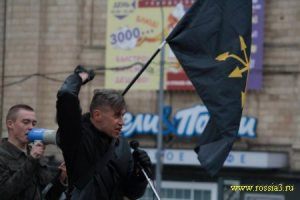
Alexey Beliayev-Guintovt
We admit it upfront: we don’t care much for the artist Alexei Belyaev (Guintovt), and we don’t care about him. His art is beyond the pale of criticism, and we have never had any illusions about his political views. By the mid-1990s, he had already drifted into the orbit of Eduard Limonov’s National Bolsheviks, and he would later join Alexander Dugin’s breakaway Eurasian Movement. You do not have to be a political scientist to recognize these people for what they are: part of a reactionary global trend toward ultra-right/ultra-left nationalism. Belyaev’s statements and artworks reflect this political identity. His work glorifies violence, imperial domination, blood, soil, and war. It does this in a consciously triumphal neo-Stalinist aesthetic, mixing crimson with gold leaf to confirm its redundant imperialist messages. Some members of the local bourgeoisie are taken with this aesthetic. Fascism thus enters the salon—a salon we would rather ignore.
We thus have no vested interest in criticizing the Kandinsky Prize. Founded on the cusp of the recent Russian art boom, this $50,000 award (with its longlist show of sixty artists) is a contemporary version of the salon, the institution that has defined art throughout the bourgeois age. Initiated by the glossy art magazine ArtKhronika, supported by the Solomon R. Guggenheim Foundation, and sponsored by Deutsche Bank, the Kandinsky Prize is clearly yet another neoliberal franchise, easiest to promote with a servile, aggressively populist local contingent. Its first edition eared at least some credibility by supporting the beleaguered curator Andrei Yerofeyev and giving its top award to activist-turned-formalist Anatoly Osmolovsky. But now, as the overall socio-political situation shows signs of changing for the worse, the divided jury of the Kandinsky Prize has decided to include Belyaev in the short list of its “Artist of the Year” nomination. Belyaev, however, is a crypto-fascist. The liberal press immediately picked up this scandal. Such scandals in the salon always play into the hands of the artist, his gallery, his admirers, and the critics. Most importantly, they promote the political views of these people. We do not share the rosy liberal illusion that the free market and the circulation of capital can fully convert any kind of engaged art, that artists like Belyaev tame and defuse potentially dangerous ideologies. Instead, the market makes them fashionable among the salon’s novelty-loving clientele in a mutated, glamorous form.
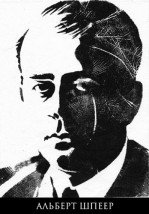
Alexei Belyaev-Gintovt, Iron Age: Albert Speer, 2004
Enough about Belyaev: he deserves the Leni Riefenstahl Prize, as dissenting jury member Yerofeyev aptly put it. What is more important is that this decision is acutely symptomatic of cultural production in Russia today. It is not that the curators and critics in the jury of the Kandinsky Prize are fascist sympathizers, although “the jury’s decision can be interpreted as a show of solidarity with [Belyaev’s] position,” as Joseph Backstein, Moscow Biennale commissar, noted. The problem is that they are ultra-liberals. Their market utopianism makes no distinction between right and left, brown and red, fascism and communism; it sees irony lurking around every corner to make everything nice and normal again. “We didn’t talk about the artist’s political convictions,” says jury member Alexander Borovsky, head of the Russian Museum’s contemporary art department. Borovsky also claims that Belyaev’s work is a distanced, playful take on the etatist zeitgeist. But there is nothing playful in Belyaev’s calls for Russian tanks to roll on Tbilisi, to execute the Georgian president, to create a “Greater Serbia” or to “liberate” the former Soviet republics under the banner of a Eurasian (read: Russian) Empire. Most importantly, there is nothing playful in his art. Much of it is propaganda, and should be judged as such.
By airbrushing Belyaev, Borovsky proves that he is indifferent to art’s political dimension. It is this indifference that unites the obscure “left-nationalist,” essentially postmodern ideology of Eurasianism and the pan-aestheticism of the Russian business and media elites who control the board of the Kandinsky Prize. “Let a thousand flowers bloom!” “All ideologies are equal!” “Art beyond politics!” cry all these respectable people as one, thus legitimizing increasingly overt expressions of genuinely felt fascism in the public sphere. Their indifference is a form of complicity. This indifference also extends to the non-Russian members of the jury such as future Moscow Biennale curator Jean-Hubert Martin or Guggenheim curator Valerie Hillings. They can always excuse themselves by saying that they are not really familiar with the Russian context, and were not able to participate fully in the selection of the Kandinsky Prize’s short list. But this “excuse” often disguises the cynicism of neocolonial irresponsibility, when foreign experts choose to ignore the contexts in which they plant the seeds of contemporary global culture.

Alexey Beliayev-Guintovt, We will return everything, 2008, digital print, From the «Eschatological project»
The local context is indeed increasingly taking on an ominous form. As prominent Russian art critic Andrei Kovalev cuttingly puts it, the presence of figures like Belyaev testifies to the “ruling elite’s rapid drift toward fascism” in a moment of crisis. This elite is already deeply reactionary and anti-democratic, having accumulated its capital violently through shock privatization and expropriation. Five years ago, it began using contemporary art as a means of civic legitimation, establishing its hegemony over the more liberal, glamorous side of cultural life during the Putin “normalization.” The recent Russian contemporary art “boom” is closely bound up with the use of surplus oil profits, and expresses a peculiar bourgeois-progressivist self-confidence that silences any doubts about the “bright and shining” future. In other words, the authoritarian undertone has always been there. For example, when the first Moscow Biennale opened,ArtKhronika’s editor-in-chief Nikolai Molok wrote an editorial entitled, “Everyone Shut Up!” in which he ordered the art scene to suspend criticism and be thankful for what they had received. Now ArtKhronika prints sympathetic interviews with Belyaev. Molok defends the artist’s creative position, saying it “expresses the tendency of state-building” with its search for a “great style.” Does he mean that, after the petrodollars dry up, Russian state-building will consist of militarism and neo-imperial claims? Does the Kandinsky Prize want to tell us that a corresponding style of engaged art is already a legitimate part of the Russian public sphere?
“Everyone shut up!” This is the result of fifteen years of Russian society’s political degradation, and the conclusion of the epoch of transnational privatization. It has left society bereft of even the most basic tools for critical analysis, democratic discussion, civic consciousness, and class solidarity. We call upon artists, critics, editors, and art lovers to boycott the Kandinsky Prize and to distance themselves from its model of valorization. We call upon anyone still capable of critical thought to interrupt the fascistoid dreams of the Russian elite and the apolitical indifference of those who follow in their wake.
Vpered (Forward!) Socialist Movement Chto Delat Platform December 2008 Epilogue This collective protest letter was echoed by several like-minded critics and artists who heavily criticized Alexey Belyaev-Gintovt‘s winning of the Kandinsky Prize. Shortly thereafter, Deutsche Bank Art representative Friedhelm Hütte publicly apologized for the fact that, as a member of the jury, he had supported the winner with his vote. Further reading here. ArtLeaks


