Updates
ACT NOW! Submit your story to ArtLeaks and end the silence on exploitation and censorship! Please see the submission guidelines in the "Artleak Your Case" page
Submitted and current instances of abuse are in the "Cases" section
To find out more about us and how to contribute to our struggles, please go to the "About ArtLeaks" page
Please consult "Further Reading" for some critical texts that relate to our struggles
For more platforms dedicated to cultural workers' rights please see "Related Causes"
For past and upcoming ArtLeaks presentations and initiatives please go to "Public Actions"
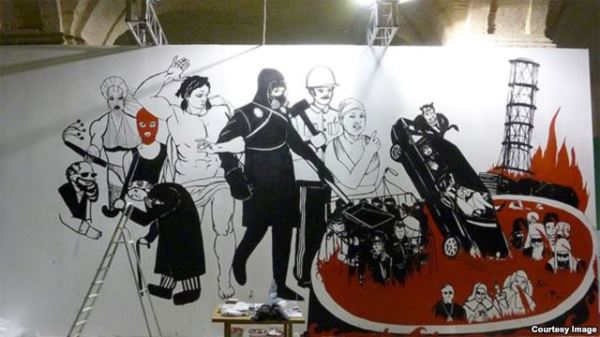
Ukrainian artist Volodymyr Kuznetsov’s “Koliivschina: Judgment Day”
Natalia Zabolotna’s primary job as director of the Mystetskyi Arsenal art museum in Kyiv was to oversee the pieces under her roof.
But on July 25, the night before a visit by President Viktor Yanukovych and the opening of an exhibit meant to celebrate Ukrainian heritage, she took a can of black paint and doused a piece that she deemed “immoral.”
A day later, the destruction of artist Volodymyr Kuznetsov’s “Koliivschina: Judgment Day” has prompted the resignation of the museum’s deputy, helped fuel a street protest, and triggered alarm within the country’s artistic community.
Speaking to RFE/RL’s Ukrainian Service, Kuznetsov expressed shock at the destruction of his piece.
“I had agreed to come on Thursday night (July 25) to finish the work. In the afternoon, I was not allowed to come inside,” he said. “At first, I did not know that my work had been painted over.”
The painting, a mural measuring 11 meters by 5 meters, showed a flaming nuclear reactor with priests and judges semi-submerged in a vat of red liquid. A car that appeared to be carrying officials was shown plunging into the vat — likely a reference to the numerous traffic accidents caused by officials in the country. A hodgepodge of other figures were grouped alongside, including what appeared to be the image of Iryna Krashkova, the woman who accused two police officers and a civilian of beating and raping her last month. Her case has prompted a wave of protests.
Zabolotna, who has since apologized for destroying the work, cited the nature of the exhibit in explaining her actions. “Great and Grand,” as the exhibit is called, opened to the public this week in commemoration of the 1,025th anniversary of the baptism of Kievan Rus, the medieval kingdom that laid the Orthodox foundation for modern-day Russia, Belarus, and Ukraine.
In comments printed in the publication “Left Bank,” Zabolotna said the exhibit “should inspire pride in the state.”
“You cannot criticize the homeland, just as you cannot criticize your mother. I feel that anything said against the homeland is immoral,” she added. Zabolotna also claimed that Kuznetsov had diverged in his work from the concept that was previously agreed upon.
The same explanation was cited by the Ukrainian Ministry of Culture, which denied any involvement in the incident. Some observers have suggested that Zabolotna was under pressure to get rid of the work ahead of Yanukovych’s visit. Others suggested that she may have feared the state would cut funding to the museum over the painting.
But Kuznetsov said the act was unforgivable.
“No one has the right to destroy somebody’s work, especially to do this without permission,” he said. “Perhaps there is a hierarchy at Arsenal and it is against such a hierarchy — state and religious — that my work is directed.”
Another artwork, “Molotov Cocktail” by Vasyl Tsygalov, was also reportedly removed from the exhibit ahead of its opening.
The controversy helped fuel a small protest that was held outside of the museum on July 26. Eight people were arrested for holding the unsanctioned rally against what they described as the mixing of church and state in Ukraine and official censorship.
The incident has also led to two resignations. Kateryna Stukalova left her position as the editor in chief of the journal “Art Ukraine,” which was founded by Zabolotna. Alexander Solovyov, the deputy director of the Mystetskyi Arsenal museum, also stepped down in protest.
Speaking to RFE/RL’s Ukrainian Service, he said, “This is not censorship but self-censorship. In the work of Kuznetsov, I see nothing more terrible than our life.”
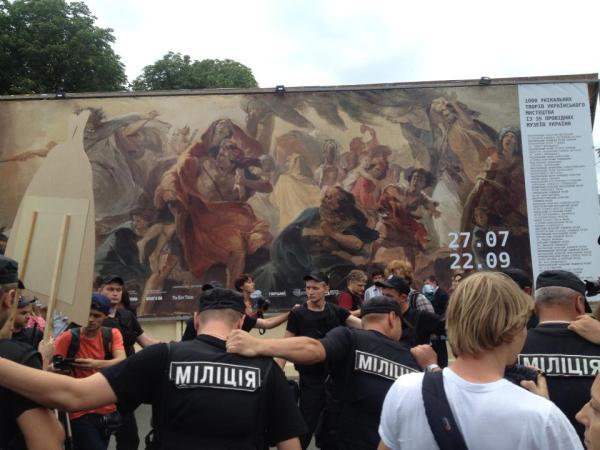
Photo: Nataliya Gumenyuk
Written by RFE/RL correspondent Richard Solash based on reporting by RFE/RL’s Ukrainian Service.
//EN
Dear Ms Sassen,
In an interview with the German daily ‘tageszeitung’ published on May, 25th 2013 you answered extensively with regards to your position as curator of this year’s international building exhibition (IBA) currently underway in the Hamburg borough of Wilhelmsburg. Throughout the interview you emphasize that there can be no talk of ‘gentrification’. You virtually refrain from corroborating your statement with hard facts beyond your repeated statement that the managers of the building exhibition show ‘goodwill’ and that it is their ‘declared aim’ to not drive out the ‘local residents’.
We were quite surprised to read this. Judging by a few of your texts which we have studied, it was our understanding that it is your intention to point out a growing polarization as a result of the development of ‘global cities’. In the interview published by the ‘Tageszeitung’ you point out your experience of Latin American cities, amongst other, and mention that you have seen ‘the full brutality of New York’s gentrification’. Surely these experiences are significant. However, the situation of people that are evicted from their homes or that have to pay an increasing part of their household income for their rent is not being alleviated by pointing out that it can even be worse elsewhere.
We don’t doubt your answer that you’ve seen much of the world. However, in your role as curator for the building exhibition you obviously seem to have had your eyes closed. A simple research would have shown that since 2000 the rents in our town have risen in a degree overshadowing all other German towns. The developments in Hamburg have even surpassed those of Munich which is well-known for its continuously rising rents. It wouldn’t even have been necessary to talk to representatives of the ‘right-to-the-city’ movement or to our own initiative. The very publications of the IBA assert that rents have risen in Wilhelmsburg comparatively more than in other similarly poor boroughs of Hamburg.
Indeed, new tenants in the boroughs on the islands of the Elbe (Elbinseln), i.e. those where the IBA has developed most of its activities, are faced with rents that have doubled throughout the last decade whilst wages of low-paid workers as well as incomes of the unemployed have remained stagnant. In our view it is cynical at best to call this an ‘upgrade without displacement’ while at the same time referring to ‘Latin America’ as a negative example.
In our view there is an undeniable relation between these developments and the IBA. The IBA must be considered a strategic instrument which is intended to improve the image of the borough not just by means of the newly erected buildings but also beyond those as part of the Hamburg Senate’s campaigns ‘Growing City’ (Wachsende Stadt) and the envisioned ‘Bridging of the Elbe’ (Sprung über die Elbe).
We assume you might agree with us when we say that an improved image has repercussions for the housing market and we are therefore surprised to find that an ‘upgrade without displacement’ is sufficient in itself to not be looking more closely at local developments. The project you refer to, i.e. the so-called ‘Global Neighbourhood’ (Weltquartier), comprises flats that have been substantially refurbished. During the refurbishment phase the majority of the residents were relocated to other flats. An unknown number of tenants returned into the as yet unfinished project. These tenants receive new contracts which, according to our information, oblige them to pay up to 20% more for their basic rent as compared to the old contracts. Claiming, as you do, that it is only to do about ‘a few cents more’ clearly shows a lack of information about the borough’s current situation on your part. Additionally, tenants have to pay higher rents because of the enlarged flats.
Contrary to your claim many tenants initially refused to have their contracts rescinded. This in itself was a strong pressure tool which considerably slowed down the construction process and may have prompted the SAGA/GWG to make more concessions with regards to compensation, provision of funds for removals and the tenants’ right to return to their flats.
This development has a lot to do with the tenants’ attentiveness and their self-organization and nothing with ‘participation’ as there has been no participation of the tenants in the redevelopment of their borough whatsoever, may the landlords and the IBA representatives claim whatever they wish to. Whether or not the development of the ‘Global Neighbourhood’ will result in displacements cannot finally be ascertained as of today. This is, of course, no surprise in gentrification processes which take place over years or maybe even decades. However, the numbers you give in your interview seem to be completely unfounded in our view. Not even the IBA has published them anywhere.
The interview’s headline runs ‘We have protected the people’ and you thus provide a legitimation for the city’s urban development schemes in general and more specifically for its realization in Wilhelmsburg while at the same time delegitimizing the critics by mentioning ‘young people from the anti-gentrification movement’ whose arguments supposedly are not well-founded. In our view your interview makes your stance as a critical scientist incredible. Given that rents are rising all across the market these newly constructed IBA buildings hardly provide a protection: the basic rent for flats in these buildings is three times as high as it was in Wilhelmsburg ten years ago. And nobody will earnestly suppose that the residents of a working-class neighbourhood characterized by high rates of unemployment, labour migration and low-paid jobs will have an opportunity to move to the newly erected high-priced owner-occupied flats in other boroughs.
Have you had a chance to talk to the inhabitants of the Korallus neighbourhood (Korallusviertel) which are obliged by the real estate corporation GAGFAH to pay ever rising rents for continuously deteriorating flats? And have you had the chance to speak with at least one tenant of the ‘Global Neighbourhood’? In our view critical science is characterized by taking sides for these very people. You, however, are taking sides exclusively with the officials of the building exhibition. Critical Science must act truthfully with regards to facts. However, you have not provided any evidence for your claims. It remains incomprehensible to us why a critical urban sociologist simply ignores obvious policies meant to attract so-called middle-class tenants or rent rises resulting from a symbolical upgrading and talks of an ‘upgrade without displacement’ without providing any evidence whatsoever. It is similarly incomprehensible to us why a renowned urban sociologist shows no intention to at least keep a minimal critical distance to development projects she is invited to participate in.
Given that the idea of critical science is still of importance to us and given that we hope to establish a communication on urban development projects in Wilhelmsburg and the Veddel we encourage a dispute beyond allegiances and third-party funding in the hope of opening up spaces where neoliberal urban development projects can be named as such. In this sense we hope for a lively discussion on urban development in the global cities of the Global North and for a science that becomes less complicit in urban development strategies, thereby making it less complicit in enforcing exclusion processes that are being criticized elsewhere.
We would very much appreciate a response to the following address: aku-wilhelmsburg@riseup.net.
Arbeitskreis Umstrukturierung Wilhelmsburg
This open letter is supported by other initiatives, who are part of the right to the city network in Hamburg: Avanti – Projekt undogmatische Linke, BUKO-Arbeitsschwerpunkt Stadt Raum Hamburg, Centro Sociale, Gängeviertel Hamburg, Keimzelle Hamburg, LOMU, Unser! Areal.
More information about the developments in Hamburg-Wilhelmsburg: http://akuwilhelmsburg.blogsport.eu/.
DE//
Sehr geehrte Saskia Sassen,
in einem Interview in der tageszeitung vom 25. Mai haben Sie sich ausführlich zu Ihrer Rolle als Kuratorin der Internationalen Bauausstellung (IBA) im Hamburger Stadtteil Wilhelmsburg geäußert. In diesem Gespräch betonen Sie, dass in Wilhelmsburg von Gentrifizierung keine Rede sein kann. Dabei verzichten Sie fast durchgehend darauf, diese Behauptung mit Fakten zu belegen – abgesehen davon, dass Sie den Akteuren der Bauausstellung bei fast jeder Antwort „guten Willen“ attestieren und deren „erklärtes Ziel“ betonen, die „ansässigen Anwohner“ nicht zu vertreiben.
Wir haben uns über diese Aussagen sehr gewundert. Wir kennen zumindest einige Ihrer Texte, die wir bislang so verstanden haben, dass Sie auf die wachsende soziale Polarisierung hinweisen möchten, die durch die Entwicklung der „globalen Städte“ entstehen kann. In dem Gespräch mit der tageszeitung verweisen Sie unter anderem auf Ihre Erfahrungen in Lateinamerika oder darauf, dass Sie „die Gentrifizierung in ihrer vollen Brutalität in New York gesehen haben“. Sicherlich sind diese Erfahrungen bedeutend. Aber die Lebenssituation von Menschen, die aus ihren Wohnungen geräumt werden, oder Leuten, die einen immer höheren Anteil ihres Einkommens für ihre Miete ausgeben, wird dadurch nicht besser, dass man sie darauf hinweist, dass es anderswo noch schlimmer sein kann.
Wir bezweifeln Ihre Aussage nicht, dass Sie viel von der Welt gesehen haben. Aber in Ihrer Rolle als Kuratorin der Bauausstellung haben Sie offensichtlich die Augen geschlossen. Denn eine einfache Recherche hätte genügt, um festzustellen, dass es in unserer Stadt in den 2000er Jahren Mietsteigerungen gab, die alle anderen bundesdeutschen Städte übertreffen. Selbst die exorbitanten Mietsteigerungen in München werden durch die Hamburger Entwicklungen überboten. Dabei hätten Sie nicht einmal mit VertreterInnen der Recht-auf-Stadt-Bewegung oder mit unserer Initiative sprechen müssen. Selbst in den Veröffentlichungen der IBA wird konstatiert, dass die Mieten in Wilhelmsburg weitaus stärker gestiegen sind als in vergleichbar armen Stadtteilen Hamburgs. In der Tat gilt vor allem für die Quartiere der Elbinseln, in denen die Bauausstellung die stärksten Aktivitäten aufzuweisen hat, dass die Preise bei Neuvermietungen sich im vergangenen Jahrzehnt fast verdoppelt haben. Gleichzeitig sind die Löhne der unteren Beschäftigtengruppen ebenso wie die Einkommen der Erwerbslosen stagniert. Diese Entwicklung unter Hinweis auf „Lateinamerika“ als „Aufwertung ohne Verdrängung“ zu bezeichnen, können wir nur zynisch nennen.
Wir bringen diese Entwicklungen sehr wohl mit der IBA in Verbindung. Sie ist schließlich ein strategisches Instrument, das auch außerhalb der eigenen Bauprojekte im Rahmen der Wachsenden Stadt und des Sprungs über die Elbe das Image des Stadtteils aufpolieren soll. Dass ein verändertes Image Auswirkungen auf den Wohnungsmarkt hat, der, wie das Wort schon andeutet, über durch Marktmechanismen gesteuert wird, darüber sind wir uns sicherlich einig. Vor diesem Hintergrund wundern wir uns schon, dass allein die Nennung einer „Aufwertung ohne Verdrängung“ als grundlegendes Ziel genügt, um nicht mehr genauer hinzuschauen. Das einzige Beispiel zur Wohnraumpolitik in Wilhelmsburg, das Sie benennen, ist das sogenannte „Weltquartier“.
Auch hier haben wir uns sehr über Ihre Aussagen gewundert. Das „Weltquartier“ ist ein Projekt, in dem Wohnungen, wie Sie es ja auch beschreiben, umfassend saniert worden sind. Die BewohnerInnen wurden während der Sanierungsphase überwiegend in anderen Wohnungen untergebracht. Ein unbekannter Anteil der BewohnerInnen ist wieder in das noch unabgeschlossene Bauprojekt zurückgezogen. Diese Menschen erhalten dann neue Mietverträge, die nach unseren Recherchen bei der m2-Kaltmiete um bis zu 20 Prozent über den alten Mietpreisen liegen. Die Behauptung, es ginge hier „um nur wenige Cent“, ist eine Falschinformation, die von grober Unkenntnis der Situation in diesem Quartier zeugt. Zudem erhöht sich die zu zahlende Gesamtmiete bei vielen Betroffenen durch die Vergrößerung der Wohnfläche wesentlich stärker als oben angegeben. Im Gegensatz zu dem, was Sie behaupten, haben sich zunächst sehr viele MieterInnen der Kündigung ihrer Mietverträge verweigert – ein gutes Druckmittel, das den Bauprozess, wie man heute sieht, stark verzögert hat und was dazu beigetragen haben mag, dass die SAGA/GWG Konzessionen bei Abfindungen, Umzugshilfen und beim Rückkehrrecht machen musste.
Diese Entwicklung hat viel mit der Aufmerksamkeit und der Selbstorganisation der MieterInnen dieses Quartiers zu tun, aber nichts mit „Partizipation“. Denn eine Beteiligung der MieterInnen beim Gesamtkonzept des Umbaus dieses Quartiers hat an keiner einzigen Stelle stattgefunden, obgleich Vermieter und Bauausstellung nicht müde werden, dies zu behaupten. Ob es im „Weltquartier“ zu einer Verdrängung kommen wird oder nicht, kann seriös heute noch nicht behauptet werden – das ist bei Gentrifizierungsprozessen, die über viele Jahre oder sogar Jahrzehnte wirken, nichts Neues. Aber die Zahlen zu diesem Quartier – die einzigen Zahlen, die Sie in Ihrem Interview nennen – sind unseres Erachtens völlig ausder Luft gegriffen. Sie wurden auch nirgends durch die Internationale Bauausstellung veröffentlicht.
Unter der Überschrift „Wir haben die Leute geschützt“ legitimieren Sie insgesamt die Hamburger und Wilhelmsburger Stadtentwicklungspolitik, und Sie delegitimieren die KritikerInnen, indem Sie von „jungen Leuten aus der Anti-Gentrifizierungsbewegung“ sprechen, die nicht genügend fundiert argumentieren. Ihr Interview ist aus unserer Sicht ein Beispiel für eine Haltung, mit der Sie sich selbst als kritische Wissenschaftlerin unglaubwürdig machen. Angesichts der flächendeckend steigenden Mieten bedeuten die Neubauten auf dem Gelände der Bauausstellung wohl kaum einen Schutz: Die Kaltmiete beträgt dort fast das Dreifache dessen, was noch vor zehn Jahren in Wilhelmsburg bezahlt wurde. Und dass die EinwohnerInnen eines früher von ArbeiterInnen geprägten Stadtteils, die Erwerbslosen, die neuen ArbeitsmigrantInnen, die NiedriglohnbezieherInnen auf die millionenschweren Eigentumswohnungen ausweichen werden, das wird niemand ernsthaft annehmen können. Haben Sie sich mal mit den BewohnerInnen des Korallusviertels unterhalten, die durch den Immobilienkonzern GAGFAH genötigt werden, immer höhere Mieten für immer schlechtere Wohnungen zu bezahlen? Und haben Sie mit einer einzigen MieterIn aus dem “Weltquartier“ gesprochen?
Kritische Wissenschaft zeichnet sich aus unserer Sicht durch eine Parteinahme für genau diese Menschen aus. Sie hingegen ergreifen ausschließlich Partei für die Funktionäre der Bauausstellung. Kritische Wissenschaft geht aufrichtig mit den Fakten um, Sie verzichten fast durchgehend auf Nachweise für Ihre Behauptungen. Warum eine kritische Stadtforscherin eigentlich sehr offensichtliche Anwerbepolitiken für Angehörige der sogenannten Mittelschichten und aus der symbolischen Aufwertung resultierende Mietsteigerungen einfach ignoriert und belegfrei einer „Aufwertung ohne Verdrängung“ das Wort redet, bleibt uns schleierhaft. Ebenfalls unklar ist es für uns, warum es anscheinend noch nicht einmal die Position einer renommierten Stadtforscherin möglich macht, gegenüber den sie einladenden Stadtentwicklungsprojekten zumindest eine minimale kritische Distanz zu bewahren.
Weil uns an der Vorstellung von kritischer Wissenschaft etwas liegt und wir hoffen, auch über die Stadtentwicklung in Wilhelmsburg und der Veddel ins Gespräch kommen zu können, plädieren wir für eine Auseinandersetzung jenseits von Loyalitäten und Drittmittelförderung, die es dann auch wieder möglich macht, offensichtlich neoliberale Stadtentwicklungsprojekte als solche zu benennen. Wir hoffen in diesem Sinne auf eine lebhafte Diskussion über Stadtentwicklung auch in den global cities des Nordens und auf eine Wissenschaft, die sich weniger leicht zur Komplizin von Stadtentwicklungsstrategien macht und so die andernorts beklagten Ausschließungen weiter verschärft.
Wir bitten sie hiermit um eine Stellungnahme, die Sie gerne an die Adresse aku-wilhelmsburg@riseup.net senden können.
Arbeitskreis Umstrukturierung Wilhelmsburg
Dieser offene Brief wird unterstützt von folgenden Initiativen aus dem Recht auf Stadt Netzwerk Hamburg: Avanti – Projekt undogmatische Linke, BUKO-Arbeitsschwerpunkt Stadt Raum Hamburg, Centro Sociale, Gängeviertel Hamburg, Keimzelle Hamburg, LOMU, Unser! Areal.
Weitere Informationen zu den Umstrukturierungen in Wilhelmsburg: http://akuwilhelmsburg.blogsport.eu/
via Mykola Rydnyi
Ukraine’s national pavilion at the Venice Biennale this year raised several problematic issues. The selection of participating artists [Mykola Ridnyi, Gamlet Zinkovskyi, Zhanna Kadyrova] was done by the Institute for Contemporary Art (IPSI), led by Victor Sydorenko, the commissioner of the pavilion. Sydorenko himself represented Urkaine at Venice as an artist in 2003. The appointed curators were Oleksandr Soloviov and Victoria Burlaka, who had also participated in the national pavilion in Venice before. It so happened that right after the participants had been chosen, the Minister of Culture of Ukraine was replaced, a change which delayed the pavilion preparation process for months, regardless of all organizational deadlines. Moreover, the state-allocated budget of 100.000 Euros caused a lot of criticism in the press, as Ukraine is not one of the richest country in the world. As many financial questions arose, the participating artists were forced to justify every dime they spent to the Ministry of Culture, and in some instances were not compensated for the costs they incurred. The artists either produced the works in the exhibition previously to the biennale or created new works from their personal budgets. Furthermore, the pavilion organizers did not even take responsibility for the transportation of the finished works.
What follows is a selection of diary-like entries by Mykola Ridnyi and Zhanna Kadyrova about their experiences before, during and after the opening of the Ukrainian National Pavilion at the Venice Biennale 2013.
25.05
Mykola Ridnyi: I arrived in Venice. The opening of the National Pavilion of Ukraine was scheduled for the 29th of May, which meant I had only four days to install my works – a rather nerve-wracking situation. It was not possible for me to arrive earlier: the state budget allocated funds for only a six-day stay in Venice. I found all this out a month before the trip, when the press release went out (including to the international press) – by then it was impossible to pass up my participation. In fact, I found out that I will be taking part in this project with certainty only two months before the trip, during a working meeting.
The Ukrainian national pavilion was placed in an even smaller and narrower space than what I had imagined from the photographs. There was no funding for preliminary visits to the site, as the Ministry of Culture did not understand the need for them.
Hotel. There was no accommodation provided for artists’ girlfriends/ wives or boyfriends/ husbands. Therefore my companion had to stay in the hotel room illegally. The trick worked. In the morning I stole away croissants and yoghurt. In my case, the room was booked for two people, but not for me and my companion, but for me and another person involved in the exhibition organization. We lived in close quarters, but it was not impossible . The artist Gamlet [Zinkovskyi] had a similar situation, but the same trick did not work in his case, and he and his partner had to live separately.
Zhanna Kadyrova: My assistants Denis and Timofey and I came to Venice on the 20th in order to prepare everything. As both of my works had to be built on site, I asked for 10 days for the installation, however I was told that the conditions were the same for all the participants – 6 days and nothing more! The first few days we lived in the apartment of the REP group and then moved to a hotel on the Lido. (besides Kadyrova, the group includes Kseniya Gnylytska, Nikita Kadan, Volodymyr Kuznetsov, Lada Nakonechna, Olesya Khomenko. The artists organized an exhibition “Union of Hovels” on the Lido Island, while Kadan participated in the Pinchuk Art Center’s “Future Generation Prize” at the Palazzo Contarini Polignac). It turned out that they had booked a triple room for us, without even asking if this was appropriate for me and my assistants. Before, I had to convince the organizers that without my assistants I could not physically build the installation, and that if they wanted the work in the exhibition and to publish it in the catalogue, then they had to consider the technical side of things as well.

Opening of the Ukrainian Pavilion, © artukraine.com.ua
25-28.05
Ridnyi: The installation of the exhibition. The situation was tense as the planned installations did not fit in the space. Victor Sidorenko, the commissioner of the project, was the only person who had seen the space before, when he came to Venice on an earlier trip at his own expense. But he and the curators, Oleksandr Soloviov and Victoria Burlaka, were still in Ukraine and due to arrive only a day before the opening. Like everyone else, they were only funded to spend six days in Venice. All the artists were assigned one coordinator who was also the installer. Together we placed the podium under the art objects, sawed down the tables that turned out to be too large, fastened the projectors to the ceiling…Zhanna Kadyrova received help to install her works from a couple of friends who came as her assistants and by the artist Kseniya Gnylytska, who despite exhibiting elsewhere, showed her friendly solidarity.
Kadyrova: In addition to helping construct the installations, Denis also did the video-editing while Timofey handled the sound editing and all technical communications. We had to spend two weeks in Venice to prepare for the opening, while the Ministry of Culture only paid for accommodation and board for six days. Neither the artists nor their assistants were paid.
The delivery of the materials for installation to Venice was a very difficult issue. To avoid any problems, I asked the Italian gallery that I work with, Continua, to have all materials on hand before I arrived. The delivery took five days. According to the Ukrainian legislation, it was not possible to send money for the materials to be bought in Italy: it is necessary to make a contract with the person which receives and buys them. Considering that I received my production fee on Friday, May 17th, if I had arrived in Venice on the 20th and ordered the materials there, I would have got them only on May 25th. In addition, I needed ten days to assemble the work. Therefore, at the opening on May 29th we would have had a stack of unfinished works and bags of cement. Furthermore, that there was a preliminary agreement that the Biennale commission would be also visiting our pavilion at the opening.
27.05
Ridnyi: We barely managed to get everything ready for the opening, except that the my complete sculpture series was missing. My series “Platform” were on loan from the collection of the Moscow Foundation Victoria. They were delivered separately from Moscow, and not Kiev, with a horrible delay.
28.05
Ridnyi: The sculptures arrived one day before the opening, but, we were in for an unpleasant surprise: the sculptures had been scratched and broken on the way. The Ministry of Culture employees told me that they knew the works that were being sent had some minor damages before leaving Moscow. It was the first I had heard about it. One of the works was broken into fragments, and this damage was obviously caused by the negligence of the transportation company. I remembered then how they had recommended that I take out insurance on the series myself, supposedly to speed up the transportation process. Someone had even suggested the wild scenario that I should have driven to Moscow at my own expense and bring the works from there. I listened to Zhanna’s advice and my own common sense, and of course did not take any liability myself. In this case, my intuition failed. As a result, only one object out of four was suitable to be displayed in the pavilion. That night I decided to drink heavily.
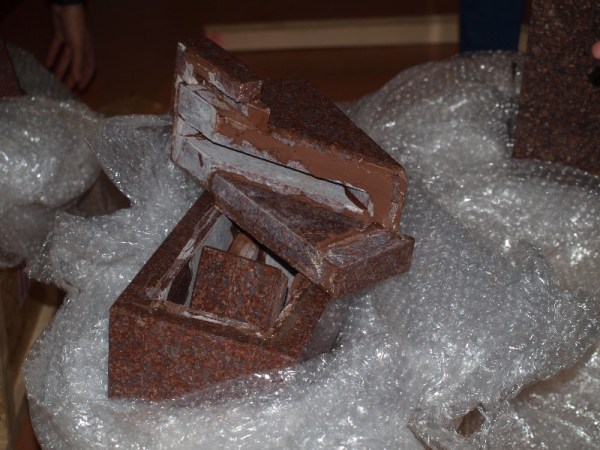
Broken fragments of Rydnyi’s “Platform” series, © Mykola Rydnyi
Kadyrova: We left the pavilion at 10 PM. We managed to finish everything in time. Since the plasma display that I had ordered I received at the last minute (on Wednesday, May 15th, in the afternoon, and I had to take it through customs on Friday, May 17th in the morning), I was only able to make the design and adjust the image, but could not do a sound test: I saw the columns from the work only once they were in the pavilion – and it turned out that they didn’t match the plasma display. Through some miracle, we managed to find a converter in Venice, and it finally worked!
29.05
Ridnyi: Opening day; some unexpected details came up. It turned out that there would be a Ukrainian-Italian business forum in the Palazzo Loredan, a floor above where our exhibition was located. It also turned out that we had a joint reception with this business forum.
A lot of journalists from TV channels came. They asked about the works, but that’s the last thing I wanted to talk about. My dissatisfaction with the organization overshadowed all artistic messages.
The exhibition opening. After the Vice Prime Minister of Ukraine gave a speech, suddenly, we heard the national anthem being played. This came as a surprise even to the Commissioner of the project, since he didn’t have time to finish his speech. Everyone looked dazed and confused. At the same time, I noticed that the entrance to the exhibition was covered by a patriotic yellow and blue ribbon [e.n. Ukrainian flag colors]. The ribbon was then officially cut and each artists received a pice of it. I kept mine as an artifact for a future project. Meanwhile, a concert began outside. A team of male dancers in traditional costumes accompanied by girls in embroidered shirts singing. The last one to go was an elderly woman singing Ave Maria. She could not finish it off with a dramatic ending because the equipment was turned off – she was clearly upset and indignant about this. Some time ago, I filmed a concert in honor of “School Day” at a vocational school in Kharkov. I even had an idea to adorn the video with embroidery and place it in the National Pavilion at the Biennale, but even without my irony the scenario came true in the form of this official live performance.
Kadyrova: At 10 am we were kicked out from the hotel – on Opening Day! I took this as a very symbolic gesture. I was late for the opening ceremony, after hearing complaints from the Ministry of Culture. But the fact was that during the installation of the project there was not one agreement between the participants and the organizers, making all claims ridiculous.
31.05
Rydnyi: After I was forced to check out of the hotel, as my six days of paid budget ran out, I took advantage of my friends’ invitation to spend the night in their rented apartment.
01.06
Ridnyi: I went to the self-organized exhibition “The Union of Hovels” on the remote beach Lido. The idea of the exhibition belongs to the group “Hydrada.” I brought a video on my laptop to be shown in the exhibition. On my way, on the vaporetto I ran into a friend to whom I mentioned the upcoming event. She asked, “Is there an exhibition for sure, I don’t see it in listed in any guide?” I said yes, and I was quite happy with this format. Despite its remote location, not only participants themselves but also curators, gallery owners and artists from other countries came to the exhibition. Inspired by the Lido, but with a bitter Venetian after-taste, I left the next day to wonder around Naples.
Kadyrova: After the show at the Lido, I spent the night on the beach. The weather was good, and I did not want to bother any of my friends to host me.
03.06
Kadyrova: Departure from Treviso, on the airline Wizzair; my flight was delayed for five hours. The day before, some friends were even “luckier”: the Venice – Kiev flight was cancelled altogether.
05.06
Ridnyi: We flew out of Rome to Ukraine. They refused to pay for my return ticket because it was dated “later than June 3rd.” According to the state bureaucracy, the artist cannot be compensated for the return trip if the ticket is dated later than the date of the official opening of the national pavilion. I still had to somehow find a way to get home from Kiev to Kharkov. However, there was no budget for internal travel – moreover, after the upgrades for the Euro-2012 the trains are significantly more expensive. The seats on the express have european prices, but are not of european quality. In short, according to the bureaucratic logic, it became clear to me that for them Ukraine is just Kiev.
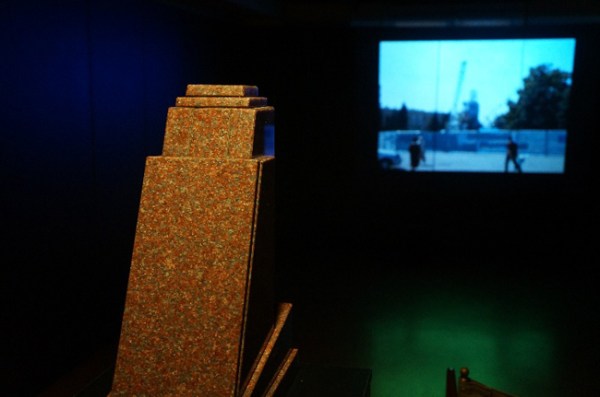
The only sculpture in Rydnyi’s series that could be exhibited, © Colta.ru
06.06
Ridnyi: I called the Ministry of Culture to clarify when they will reimburse me for the vaporetto trips in Venice. According to the preliminary agreements, these expenses should have been covered. But I was told that they were carefully reconsidering it, because I had given a very critical interview. It was particularly offensive to them that I spoke about my broken sculptures. Their reasoning was as follows: “We don’t need an international scandal! We prefer to solve it quietly.”
Kadyrova: The Ministry took all my checks to be translated and reviewed. Afterwards, they called back and said that I should give things like knife and pliers to the Ministry to store, as they were reusable. They did not even consider the receipts for sound hardware and plasmas – as they were not stamped.
Ridnyi: All in all, the questions remain: will there be a sequel to this story, two years later and with different actors? And does it have to play out in the same way?
A part of this article was published in Russian on colta.ru. Translation by Corina L. Apostol.
On Saturday, June 22nd 2013, over 800 cultural workers and artists went out to protest in the Square of the Republic in Belgrade, the capital of Serbia, as well as in Novi Sad, Niš and Vršac. Such a protest on a massive scale is almost unprecedented in the country. These protests did not come out of thin air. A lot of accumulated anger and dissatisfaction with many socio-economic and political issues in recent years culminated yesterday.
The most important structural, social and political causes for the protest are: corruption and nepotism in the field of culture and non-transparent redistribution of the resources; poverty of workers in the field of culture; the change of the government from democrats to conservatives on in the Republic of Serbia and the cutting the funds for so called “non-patriotic” art; the fact that freelance artists and cultural workers are not able to renew their health insurance, because social benefits have not been paid since January 2013 by the cultural department of the city of Belgrade (governed by the Democrats).
It was a silent protest, that did not feature any official speakers and was not meant to be clearly articulated politically, taking into consideration many differences among the protestors, united for the first time on such a massive scale. Many cultural workers in Serbia are divided by their position in the process of cultural production between those employed by the state, freelance artists and those with the so called freelance entrepreneur cultural workers (NGO) status. Although all of them are dependent on state and international (mostly EU) funds, their unity was the most important factor to drive this first massive protest. The general discourse of the protest was not focused on social problems, the precarious position of the cultural workers and corruption, but it was more about culture and moral values and directed against any political party power over art and culture.
A group of artists and activists decided to make several actions within the protest itself. A week ago, artist Saša Stojanović and activist and artist Vladan Jeremić published a statement about the urgent need to articulate a protest toward social problems (the text of their statement is bellow), to connect the protest with other workers struggles in the country and internationally. Many artist colleagues supported this initiative and distributed their statement during the protest. Peace activists Women in Black participated in a joint action within the protest, supporting their artist and cultural workers colleagues. Slogans on banners read: “Stop Cultural Racism! Stop Exploitation! Culture is not a Commodity, We won’t Give the Public Goods! Stop Ethno-Clericalization!”
This year, the public budget for culture was dramatically cut down to 0,6 % (international standard is around 2,5) of the total budget. The cuts were criticized previously in the media and there was even a soft critique of cultural industries vs. art and culture at a meeting of the liberal cultural elite a few months ago. Already the previous democratic liberal government started massive neoliberal reforms and introduced commercialization and privatization in the cultural sector. Projects supported by the state right now are mostly in the creative industry field, such as the MIXER festival or patriotic and church projects such as “Edict of Milan – 113-2013, Serbia” or reconstruction of the museum of the Serbian Orthodox Church. Both major art museums, Museum of Contemporary Art (visited last year by the ArtLeaks committee), and National Museum are closed to the public.
Funding has also been cut to other important cultural institutions, including the October Salon, an annual art exhibition, the theater festival BITEF, the Palić Film Festival, the International Children’s Theater Festival, etc.. The recommendation to artists made by some members of the Ministry commission was to promote “patriotic values” in their work. Surprisingly, these austerity measures did not stop the organization of expensive productions for the state program. Here are a few significant cases among many that have triggered anger and contributed to the massive protest to happen.
The first is a theater play called “Constantin”, part of the official State program for the anniversary celebration “Edict of Milan – 113-2013, Serbia”. The show was developed this spring, in 20 days (!) with a mostly state funded budget of 180.000 Euro – while the director of the play, Jug Radivojević, and video designer Jug Radivojević shared an artist fee of 15.400 Euro each. In turn, several citizens and politicians of the opposition protested against the misuse of state funds in Niš, where a drafted budget for the play was passed by the city parliament under irregular circumstances and pressure from above. “We call the citizens of Niš to boycott the play dedicated to Constantin, because this show costs 180.000 Euro, because it is impossible in Serbia and elsewhere to earn 20.000 within 15 days, except you are part of a drug cartel” said member of city parliament Srđan Pešić for Al Jaszeera Balkans. Any recording of the play that was performed in Belgrade, Niš and Novi Sad, was forbidden for journalists, which produced a minor scandal in Novi Sad. Open protests or critical media reporting on corruption in culture are rare, but do exist.
Last year, “Whistle” (“Pistaljka”), an internet platform that investigates abuse of office in among government, public and private enterprises and other institutions in Serbia, made public that the Historical Archives of Belgrade declared the amount of Dorijan Kolundžija’s artist fees a state secret. His gallery “Studio for New Media Solutions” delivered consulting for fireworks and light design for New Year’s Eve 2012 and the opening of the new Ada Bridge. Dorijan Kolundžija at the same time produces projects through the non-profit organizations KIOSK and MIKSER that, according “Whistle”’s research, were given from the state budget, around 50.000 Euro per year since 2008. Some media reported that due to the high rank of his mother, Nada Kolundžija, head of the Democratic Party’s “Club of the Serbian Parliament,” Dorijan is among the best payed “artists” in Serbia.
These are just some of the many cases of corruption and non-transparent distribution of public funds that led to these larger protests.The reaction of the Ministry of Culture of Serbia after the protests was typical: they claimed that all money has been spent and that the reason for the current bad situation is the global economical crisis. Serbian artists and cultural workers announce new protests and actions in the next days to happen.
___________________________________________________________________________
Saša Stojanović and Vladan Jeremić’s Statement
With this declaration we support the protest of artists and cultural workers. We call all citizens to join and to participate in this initiative!
The so-called democratic authorities that took over institutions after 5th of October 2000, increasingly alienated them from artists and cultural producers under the shabby excuse of „necessity of transition“ and quickly melted into the old clientelistic networks, fantasizing of the great global market of cultural industry that will bring wealth.
Today, at the moment when even these clientelistic networks cannot be satisfied anymore, conditions are ripe for a general protest! The precarious position of cultural workers is unbearable, as creative labor has in fact turned into unpaid labor. Neoliberal austerity measures, closure of public institutions and budget cuts present a trend that will worsen if we won’t struggle against it.
Abstract attacks on “the state”, “bad governance” or ministries won’t lead to the solving the much more profound problems at hand, nor help elucidate their causes. Citizens are brutally deprived of a public cultural life (two museums are closed to public: the National Museum because of restitution and the Museum of Contemporary Art because of bad management), culture is being re-traditionalized, we are witnessing cultural racism, clericalization, attempts to bring back monarchy and similar phenomena. Neoliberal politics demand commercialization of culture and closing down of public institutions.
The state of affairs in culture can’t be isolated from the broader societal conditions in which Serbia and the region are situated. Our protest needs to be linked with the struggles of all workers for the defense of public goods. Only politics of solidarity and economic democracy can create preconditions for cultural institutions that will support the production of social values and creative freedom.
Saša Stojanović and Vladan Jeremić, artists, Belgrade, 18. 06. 2013
Photo-documentation of the protests in Belgrade curtesy of Deana Jovanović and Rena Raedle
Video-documentation of the protest
On Friday night Swiss police fired rubber bullets and teargas at an artist-activist group who took over Japanese artist Tadashi Kawamata and architect Christophe Scheidegger’s politically uncomfortable ‘Favela Café’ at Art Basel, a fully working eatery in the guise of impoverished urban areas. Art Basel allowed the group to protest for a limited time only.
At 10:05pm on Friday, June 14th a police action attempted to shut down a gathering of 150 people or so who came together over the course of the day to peacefully “occupy” a highly controversial artwork by Japanese artist Tadashi Kawamata and architect Christophe Scheidegger entitled Favela Café (2013). The occupiers were fired at by tear gas and rubber bullets outside of Art Basel’s Main Halls.
The work itself, which serves expensive coffee, pastries and cold cut sandwiches to Art World/Fair goers was erected this year as part of a commissioned installation project by Art Basel for Messeplatz, the main square within the annual fair and grounds contested as public space. After the Fair doors close on June 16, Art Basel is planning to ‘donate’ the structure for use as a bar and restaurant with a community garden.
In the media, the occupy activists have been portrayed as art hooligans who have allegedly attacked the police and are now facing serious fines, although the worst property damage they inflicted was drawing with chalk in the exhibition space.
It seems clear that discussions are necessary at this time to begin unpacking and addressing issues instigated by the work itself, its context, the lack of open criticality, the type of resistance and use of force we see so systematically/forumulaically regardless of what these public spaces are, where they happen to exist and what they represent.
http://makingarthappen.com/2013/06/12/art-basel-2013/
___________________________________________________________________________
Video documentation of the building of the obscene project “Favela Café” and the art crowds toasting at the opening: a cynical celebration indeed.
___________________________________________________________________________
Earlier this year activists from “Basel wird besetzt” (Basel will be occupied) had occupied an empty building in the city, aiming to build self-managed project spaces and a cultural center. On their website “Basel wird besetzt” openly criticized the purely profit-oriented residential construction politics of the city of Basel. This anti-gentrification activist group was evicted by the police after just one month. You can find out more information about them on the website: http://www.countdown-basel.tk/ (in German)
 ArtLeaks