Updates
ACT NOW! Submit your story to ArtLeaks and end the silence on exploitation and censorship! Please see the submission guidelines in the "Artleak Your Case" page
Submitted and current instances of abuse are in the "Cases" section
To find out more about us and how to contribute to our struggles, please go to the "About ArtLeaks" page
Please consult "Further Reading" for some critical texts that relate to our struggles
For more platforms dedicated to cultural workers' rights please see "Related Causes"
For past and upcoming ArtLeaks presentations and initiatives please go to "Public Actions"
US artwork that angered energy industry pulled
via Kevin Smith /Platform & Index on Censorship
A controversial climate change sculpture was removed after it upset donors from the energy industry in the US. Kevin Smith asks whether corporate sponsorship by companies like BP and Shell has an affect on artistic freedom in the UK.
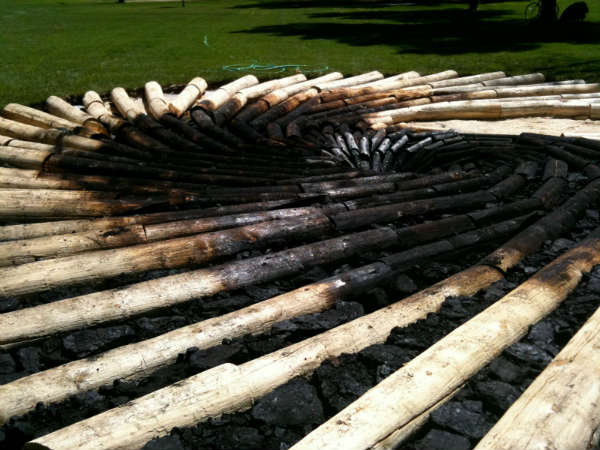
Artist Chris Drury’s 2011 sculpture Carbon Sink: What Goes Around Comes Around. Image: Chris Drury
It’s hardly breaking news that big fossil fuel companies often exert a great deal of influence over political processes through campaign contributions and lobbying. On 13 September, the New York Times, for example, reported that, with nearly two months to go before Election Day on 6 November, estimated spending on television ads promoting coal and more oil and gas drilling or criticising clean energy had exceeded $153 million this year. But how do the oil, gas and mining industries exert influence over the cultural sector? A recent American example is instructive, demonstrating how this influence can lead to institutions buckling under political pressure, censoring art and lying to the public.
“Carbon Sink: What Goes Around Comes Around” had barely been installed at the University of Wyoming before it was removed without warning in May 2012. The installation, which was 36-foot in diameter, consisted of a “flat whirlpool of beetle-killed logs spiraling into a vortex of charred, black wood and studded with large lumps of Wyoming coal”, representing natural and human-induced global warming.
It was a provocative installation in a state where the fossil fuel industry is a major economic driver and the 2011 sculpture by British artist Chris Drury immediately generated controversy. Marion Loomis, executive director of the Wyoming Mining Association, told a local newspaper:
They get millions of dollars in royalties from oil, gas and coal to run the university, and then they put up a monument attacking me, demonising the industry. I understand academic freedom, and we’re very supportive of it, but it’s still disappointing.
Bowing to pressure from both the local mining industry — a major university donor — and outraged local Republican officials, the university removed the installation after less than a year. It’s worth noting that in the fiscal year 2011 the university received $43.1 million in private donations via the University of Wyoming Foundation — when releasing the figures, fund president Ben Blaylock said donations from the energy sector were on the increase. After initially claiming the sculpture was removed because of water damage, in October a local radio investigation obtained emails that revealed the university actually decided to remove Carbon Sink “because of the controversy it generated”.
This episode is extreme, but it’s not entirely isolated. In December 2011, fashion label Lacoste demanded the removal of artist Larissa Sansour from a Swiss photographic competition it was sponsoring for being “too pro-Palestinian”. In the UK, draconian cuts to public spending on the arts sector means that more organisations are being pressured to find corporate sponsorship. But is the price sacrificing content?
Arts Council England, which supports museums, galleries and theatres, has had its government funding cut by 29.6 per cent last year. Arts and cultural organisations are now much more reliant on private contributions. In the UK, some of the most high profile arts sponsorship deals have been with the oil industry: the Tate galleries have taken money from oil giant BP for more than 20 years. At the end of 2011, BP announced a £10 million deal for four arts institutions, including Tate, over five years. BP also sponsors the British Museum, the Royal Opera House and the National Portrait Gallery, while Shell is a long-term sponsor of the Southbank Centre.
Increased levels of corporate sponsorship of the arts can lead to overt interference in programming and curatorial decision-making but there hasn’t yet been a smoking gun incident on the scale of what happened in Wyoming. One can only speculate what the response might be from BP if Tate Modern were to use the iconic Turbine Hall for a large installation that explicitly referenced the environmental and human rights abuses of the oil industry.
There are justified fears that long-standing sponsorship arrangements lead to self-censorship — one of the most pernicious enemies of freedom of expression. If overt political pressure is brought to bear we stand a chance of discovering it, but we will never have conclusive evidence of what has not been programmed, who has not been invited, which work has not been made, or which issues have not been tackled.
In 2011, at an oil-related event at the London Literature Festival at the Southbank Centre, a duty manager insisted on vetting materials on a stall in case they were critical of Shell, while in 2010, Tate staff sought to ensure that a workshop on disobedience didn’t go anywhere near the issue of the gallery’s sponsors — accidentally giving birth to the art-activist collective Liberate Tate in the process. This sort of self-censorship is arguably a far harder nut to crack, and one that serves corporate sponsors’ purposes far more successfully than a sponsorship agreement that sets down in writing what can and can’t be said, made, or done.
There’s an institutional opacity of Tate and others in refusing to “go there”on the subject of controversial sponsorship choices, beyond trotting out a series of platitudes as to BP or Shell being great friends to the arts. Sadly, we may have to rely on initiatives like ArtLeaks, which gives an anonymous space for people within these institutions to give insight into the inevitable impact of corporate sponsorship on many of the UK’s most prominent institutions.
Kevin Smith campaigns on oil sponsorship of the arts for Platform, an environmental and human rights organisation that combines arts, research and activism. He is the co-editor of Not If But When – Culture Beyond Oil.
Presentation of the international platform ArtLeaks. On the urgency of launching the ArtLeaks Gazette, London, 7th November 2012
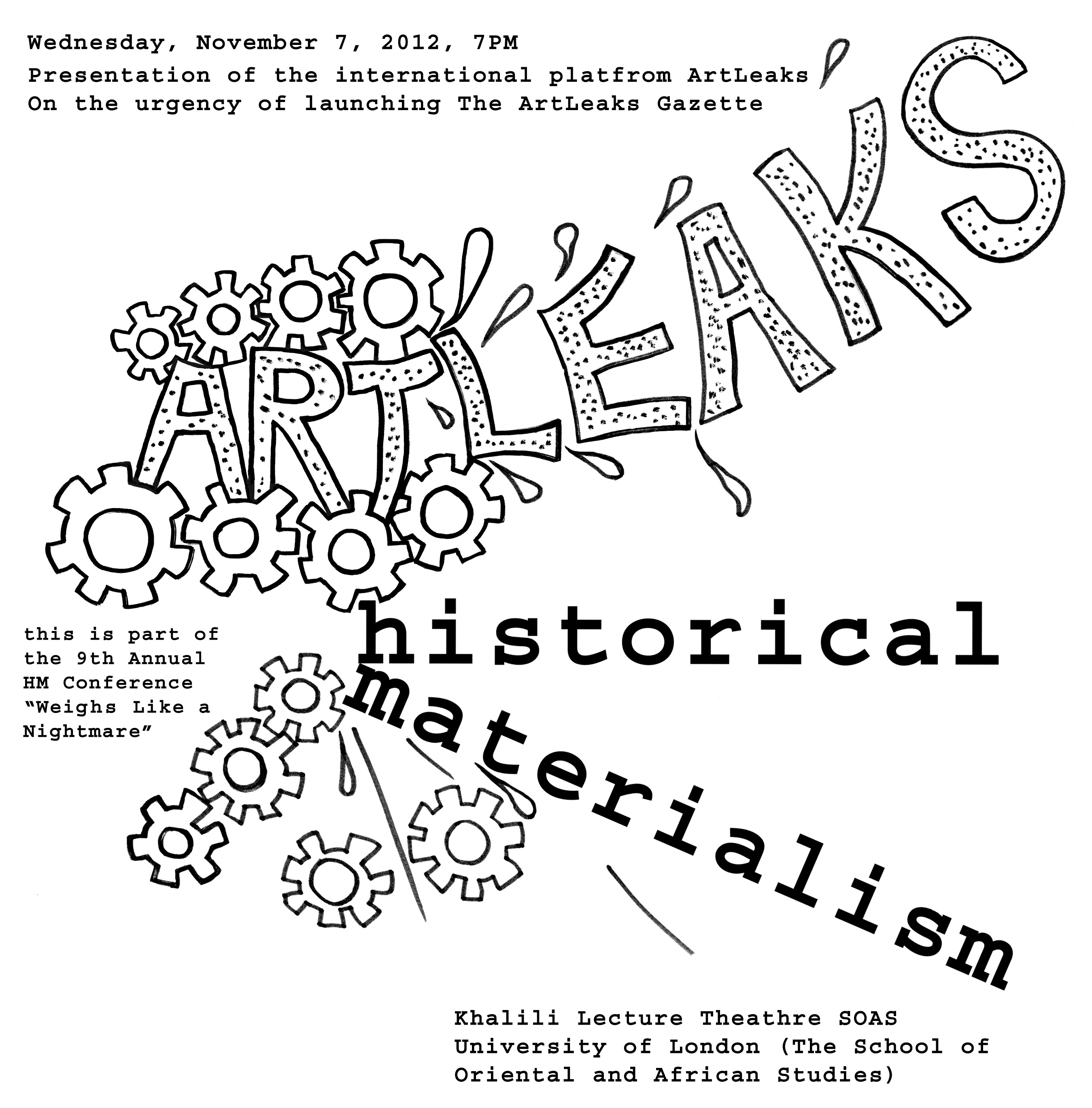
Flyer by Zampa di Leone
ArtLeaks prepares to make a presentation of its activities and organizes a workshop as part of the 9th Annual Historical Materialism Conference ‘Weighs Like a Nightmare’, London, from 7 PM on Wednesday, November 7th, 2012
Location: Khalili Lecture Theatre SOAS, University of London (the School of Oriental and African Studies)
ArtLeaks is an international platform for cultural workers where instances of abuse, corruption and exploitation are exposed and submitted for public inquiry. ArtLeaks’ mission is to create a space where one could engage directly with actual conditions of cultural work internationally – conditions that affect those working in cultural production as well as those from traditionally creative fields. Furthermore, ArtLeaks is developing in the direction of creating transversal alliances between local activist and cultural workers groups, through which we may collectively tackle situation of repression and inequality.
1) Critique of cultural dominance apparatuses
Here we will address methodological issues in analyzing the condition of cultural production and the system that allows for the facile exploitation of the cultural labor-force. We will try to relate methodology with concrete case studies of conflicts, exploitation, dissent across various regions of the world, drawing comparisons and providing local context for understanding them.
2) The struggle of narrations
This working group will develop and practice artistic forms of narration which cannot be fully articulated through direct “leaking”. Our focus will be finding new languages for narration of systemic dysfunctions . We expect these elaborations to take different forms of artistic contributions, such as comics, poems, drawings, short stories, librettos etc.
3) Education and its discontents
The conflicts and struggles in the field of creative education are at the core of determining what kind of subjectivities will shape the culture(s) of future generations. It is important therefore to analyze what is currently at the stake in these specific fields of educational processes and how they are linked with what is happening outside academies and universities. Here we will discuss possible emancipatory approaches to education that are possible today, which resist pressing commercial demands for flexible and “creative” subjectivities. Can we imagine an alternative system of values based of a different meaning of progress?
4) Best practices and useful resources
In this working group we invite people to play out their fantasies of new, just forms of organization of creative life. Developing the tradition of different visionaries of the past we hope will trigger many speculations which might help us collect modest proposals for the future and thus counter the shabby reality of the present. This also includes practices which demonstrate alternative ethical guidelines, and stimulate the creation of a common cultural sphere.
At the end of the working group session, we will present our findings to each other and come together for some final conclusions and future common aims.
Facilitators of the event: Corina L. Apostol & Vlad Morariu
The editorial council for the first issue of the ArtLeaks Gazette will consist of: Corina L. Apostol, Vladan Jeremić, Vlad Morariu, David Riff and Dmitry Vilensky.
More about the ArtLeaks Gazette: https://art-leaks.org/artleaks-gazette/
More about Historical Materialism : http://www.historicalmaterialism.org/
Many thanks to Historical Materialism & Steve Edwards for hosting us!
Welcome to the Third World Art World
via Tanja Ostojic / Art & Economics Group
I attended a meeting with the head of visual arts, film and media in the House of World Cultures in Berlin, yesterday. She invited me to take part in a group show – that will open in the HKW Labor Berlin exhibition room on December 14 this year – as a kind of compensation, since my solo show that was scheduled to be open in the same space in January 2012 was canceled 5 months prior to the date, since the exhibition rooms were rented out to the Transmediale, as I was informed.
I accepted the invitation for the group show and brought with me the “No Fee Statement”, that I downloaded from ArtLeaks web site and asked kindly the curator who is in the same time the director of the visual arts, to sign it. Information that I filed in, I copied from the letter I got by the assistant of the curator one day before, and they are the following:
“I Valerie Smith, the undersigned, hereby certify that the
– artistic work
– other type of work: production costs for the art work
of Ms. Tanja Ostojic
part of the exhibition LABOR BERLIN 12 – ‘Drifting’ in Haus der Kulturen der Welt Berlin, opening on December 14, 2012, will not to be remunerated.
Further more, in the frame of this show:
1. Haus der Kulturen der Welt can’t cover any production expenses for the art works that will be exhibited.
2. The artists will deliver the art works to the team members of Haus der Kulturen der Welt ready to be displayed. Haus der Kulturen der Welt cannot be in charge of framing art work.
3. The exhibition – like all the exhibitions in the Labor Berlin series – will not be watched by security personnel. Haus der Kulturen der Welt cannot cover any insurance for the art work. This includes the transportation of the work to HKW.
4. Haus der Kulturen der Welt cannot pay fees to the artists.
”
etc…
I believe that the state funded, representative institutions such as House of World Cultures in Berlin should not compromise with the exhibitions that are not properly funded and are based on unpaid artist labour and private investments of the invited artists whose are works and not subject of insurance while no exhibition guards are employed in the frame of the show.
It seems that they are not willing to sign the paper, but i would like to advice my artist colleagues to please download the form “NO FEE STATEMENT”
https://art-leaks.org/2011/10/11/no-fee-statement/
and ask the unpaid job offers to be filed and signed and distributed on the growing international artist syndicate web site:
https://art-leaks.org/archives/
In addition, i would like to share with you this great text by the amassing performance artist Guillermo Gómez-Peña in collaboration with Emma Tramposch: Welcome to the Third World Art World
————————————
“For us, performance artists who have operated in a culture of extreme crisis all these years, (the current financial crisis) is not a big deal. We just have to get slightly more creative, bold and resourceful. Our calendar is consistently full and we are always busy. We are just working with half of the budgets we used to 5 years ago. We are more worried by our chic painter and sculptor colleagues who depend more on the commercial gallery circuit or by the big dance and theater organizations whose yearly budgets are 5 times larger than ours. Our heart goes for them. We can be flexible and adapt because we are small and permanent reinvention is the machinery of performance.”
GP as “Unemployed Artist,” working the streets of downtown, Mexico City, 1995
1.-There was a time when it was desirable for our wild performance troupe (La Pocha Nostra) to be located in the US, and particularly in San Francisco. The US was still an open society (remember?) and San Francisco, a welcoming, affordable and eccentric city with a robust funding structure and a palpable hangover from a 1960’s spirit of social, sexual & aesthetic experimentation. But something went profoundly wrong in the process…
Re-caping for those with short term memory: First came the dot com era with its imaginary wealth displacing the working class and the arts community; then came the Bush administration followed by 9/11 and the zeitgeist of the country dramatically shifted overnight to a culture of paranoid nationalism and high security. After a brief utopian dance party with Obama’s election, came the sudden collapse of the US economy and the resurgence of a virulent far right. But the financial despair soon proved to be a global phenomenon (the end of Western capitalism?). There were many casualties, including social programs, public education and the arts.
Nowadays, we just don’t know anymore how good of an idea it is to remain in San Francisco, or even in the US at all. In the map of our desires, suddenly Surinam and Paraguay become exciting prospects for relocation.
2.-Nowadays you will find just two full-time members in the “Pocha International Operational Center” located in San Francisco. The 8 other core troupe members are spread throughout the US, Canada, Portugal, Spain, Brasil, Mexico or wherever they can find a temporary job. Not to mention the more than 30 “Pocha associates” living in 10 other countries.
We are your a/typical global/anti-global performance troupe. We handle most of our projects online through Google documents, Skype, photo blogs and email, and then we meet on the road. It’s a semi-functional model in a dysfunctional art world. And the crucial decisions often have to be made overnight. For example, when a grant does not come through, it may affect the amount of members participating in a portion of a tour. When a producer or curator tells us two months before the project, they have been substantially defunded, this can be heart wrenching for our troupe and our humble month-to-month economy. Last minute cancellations due to the changing political and financial climate are customary but keep us constantly on our toes! We are resilient, stubborn and will maintain our sense of humor with a fierce (and somewhat naive) passion. Que otra? Puro performance!
3.-What follows is an account from an archetypal week in the life of an experimental art troupe in 2012 America. We have omitted names of people and organizations out of chivalry (okay, and to protect their $#%^&%^$#@ identities). Enjoy the telenovela:
a)- We have recently changed the location of our headquarters from downtown SF back to the heart of the bohemian Mission District. Our new location is funky, exciting …. and hopefully not temporary. Everytime we see a tall white male in a suit roaming around the space or talking to the owner of the building…we get nervous. Can our new landlords survive the rampant defunding of the arts and overwhelming gentrification? We are all in the same boat and pray every night to the holy madonna of critical art. Besides, we are willing to dance for as long as the party lasts around here and then, when the party is over, we are ready to pack up and move to Senegal or Borneo. Nowadays, history starts when you wake up and ends when you go to sleep. The rest is…academic discourse.
b)- Recently we received the news that an extremely important continental gathering of artists that was to take place in Mexico City has been cancelled due to “security” concerns. Our troupe was an integral part of it. Later on, an insider tells us that “the Mexican government was worried about the upcoming pope’s visit coinciding with the aquelarre (gathering of dangerous brujos).” it’ pure Chicano sci -fi que no?
c)- The excitement continues: The day before we are about to ship a commissioned installation to a major museum, the curator tells us by phone. “Sorry, but we have lost all our funding. We won’t be able to pay you for the commission. I hope you understand. (Dramatic pause) Can you still send us the stuff?” (Dramatic pause) We are not lacking in understanding and we are certainly not stupid. ( Like most of our peers, we are fighting for basic funding in a time and place where art has become the last priority and the art world is showing its ugliest face. It’s every man/woman for him/herself. We are skilled now at compromising but don’t always see that reciprocated by major institutions). We ended up sending a much smaller version of the commissioned installation just to help them save face. They didn’t even thank us.
d)- The case of the disappearing chic curator: Sometimes, even if it feels like a contract has been signed in blood many months in advance, it turns out to have been….well, fake theater blood. Case in point: We had been planning for months an epic performance project in Amsterdam involving the whole troupe and 20 European-based Arab artists. Just 2 weeks before departure the curator falls completely out of communication and sends a “Sorry, its just gotten too complex for me. We are postponing the project for next year…” sort of email. With the help of another organization based in the same city we are able to save the project but just barely & for a much smaller budget. We may never understand what truly went wrong (did the curator have a nervous breakdown?) Unfortunately, in this rarified climate it seems that some people have simply lost their manners…and bravado.
e)- Sometimes its difficult to assess which projects we should wisely dedicate our time to before the contract gets signed. i.e. For one year, La Pocha Nostra was working closely with a festival in Europe we had a long standing relationship. Our role was to curate an exciting group of performance artists from the Americas and coordinate their participation in performances, film screenings and lectures as part of the larger festival. We engaged for months in detailed conversations both with the artists and festival organizers.
To everyone’s surprise the festival cancelled only one month before between 40 to 50 artists and curators were scheduled to travel from all parts of the world. The details of the decision to cancel the well-respected festival eventually led to police investigation. La Pocha was never paid for one year of curatorial, production and coordination work. Looks like a case for the special experimental arts division of Scotland Yard! Not only did this impact our small organization’s cash flow for months but it impacted the plans of numerous individual artists. A positive outcome? We have a kick ass, ready to go, performance festival featuring some of the best performance artists from the Americas! Anyone interested?
f)- These days we expect the unexpected in a daily basis. Today X Institution calls us to confess they won’t be able to host our upcoming winter school because they “were just expelled from their current site by a local politician.” The next day, we receive another phone call from Greece or Portugal stating how excited they would be to host a summer school next year but they don’t have any funds. What’s our response? “No problem, we just need to call the Chicano National Bank and get a big loan.”
g)- We are constantly reminded by local arts funding sources that they are also trying to stay afloat in the same troubled financial currents. Our heart goes for them. We have been told by crestfallen funders: “In the meantime, try Kickstarter. Everyone is doing it!” Then we think to ourselves: “How many Kickstarter campaigns can one undertake in a year and isn’t it backwards for funders to recommend this format as an alternative?” Other funders suggest politely: “Have you tried corporate sponsors?” Sure, we think to ourselves. Coca-cola or Nike would love to fund a Pocha Nostra extravaganza involving politicized acupuncture, transvestite shamans & mariachi butoh – thanks for the advice! While we are at it, we should see if Lady Gaga wants to host one of our international performance schools so she can further develop her Pocha-inspired aesthetic?
4.- Last minute surprises and cancellations are sometimes putting La Pocha in red numbers for a few months, and to whom are we going to complain? Is there a complaint board for performance artists in Reality #4? But we certainly do not mean to sound like we are complaining. We are wonderfully swamped with invitations to perform in extremely unusual contexts and exotic countries. One after the other, the invitations arrive. But many of these have one thing in common: “Our budget is humble. You understand. Times are tough. Can you guys fundraise your airplane tickets?” Sure, do you also want us to pay your dentist bill?
More phone calls and email invitations come in: “Can you perform at our fundraiser next week?” “Can you donate an artwork for our upcoming auction?” “We are organizing a major conference on performance archives at X Museum and would love for you to be the keynote speaker. We can offer you $50 and a parking pass.” “Sure-Gomez-Peña thinks to himself: Do you also want me to bartender during the gala night?”
Operating in the experimental art world, at times feels like being in a casino; other times it feels like the proletarian Wall Street or a low-rider roller-coaster. It’s certainly never dull…but our landlords and doctors tend to not agree with us.
What seems different from past financial crises is that the economic conditions of the so-called first world and those of the third world institutions are being leveled. And now, Brazil or Colombia may be more reliable than the US, Germany or the UK. In fact, this year for the first time in 8 years, 90% of the international participants of our summer school in Oaxaca came from developing countries, places like Nigeria, Colombia, Chile, Brasil…and yes, there were a few brave gringos and canadians who still haven’t succumb to the fear of violence in Mexico.
For us, performance artists who have operated in a culture of extreme crisis all these years, it’s not a big deal. We just have to get slightly more creative, bold and resourceful. Our calendar is still full, we are just working with half of the budgets we used to 5 years ago. We are more worried by our chic painter and sculptor colleagues whose depend more on the commercial gallery circuit or by the big dance and theater organizations whose yearly budgets are 5 times larger than ours. Our heart goes for them. We can be flexible and adapt because we are small and permanent reinvention is the machinery of performance..
5.- Conclusions: These are clearly times for radical reinvention. For the moment all we can do is keep discussing and looking for new models of funding, distribution and presentation of our ideas that acknowledge the volatile and unpredictable political and economic changes of our collapsing world. And we are considering relocating partime to a new place in the world where a new bohemia is thriving and rents are considerably lower: Oaxaca, Istambul, Rio, Sao Paolo, Warsaw, Lisbon…any suggestions? Personal and national economies may change over night in dramatic ways but one thing we can never afford to lose is…our sense of humor and imagination.
So dear chic First world colleagues from London, New York, Berlin, Paris, Milan y anexas, welcome to the Third World Art World!! It’s exciting and dangerous down here. We’ll get you a place to stay in our family’s basement and a place to rehearse in a beauty parlor or butcher shop…after hours. We’ll perform at the local “Occupy” location and later on we can crash the local Modern Art Museum fundraiser to bring Matthew Barney or Marina Abramovic to town.
Gómez-Peña and Tramposch
San Francisco, 2012
PS: Do you have similar travel notes from the Third World Art World to share with us? Please send us a postcard from your journey!
LA POCHA NOSTRA
2857 24TH STREET
SAN FRANCISCO, CA
94110
Email: POCHA@POCHANOSTRA.COM
_____________________________
UPDATE via Tanja Ostojic
Late this evening, while playing with my kid at home, I got unexpectedly a call from HKW. They explained that there is a general feeling that they do not like my blog and the “no fee statement” letter in it and that I should remove it. They argued that the HKW does not operate normally in such a way and that they do pay fees to the artists they collaborate with. I gladly offered to publish their statement about the issue but they are not interested in that so far. They would like me to remove “the letter”. I explain that they should not get it personally and that I have only wrote facts without sentiments and that for my artistic positioning it is crucial to speak truth and there for I can not accept the censorship proposal.
via The School for Theory and Activism – Bishkek and Arkadiy Kots band
//EN
This is a joint statement by the “School for Theory and Activism – Bishkek” (SHTAB) and the band Arkadiy Kots in response to the cancellation of the band’s concert at the State National Russian Drama Theater named after Ch. Aitmatov in Bishkek.
On October 19th, 2012 the band Arkadiy Kots was scheduled to give a performance inside the Russian Drama Theater in Bishkek. However, on October 16th, the organizers of the concert – “Art Initiatives” and SHTAB – were informed that the management of the theater decided to revoke permission to rent their space “due to the fact that the small stage is being used for repetitions on the 19th of October 2012.” At the same time, the management verbally informed the organizers that the real reason for refusing to let them use the space was because they had a received a call from “certain governmental authorities,” recommending that the concert should not be allowed to take place inside the walls of the theater.
The band Arkadiy Kots (Moscow) have been playing together for almost two years – they perform songs in different musical styles, some adapted from poems, on the themes of protest and resistance. Among others, they are inspired by Fyodor Sologub, Bertolt Brecht and Alexander Brener. Arkadiy Kots strongly believe that is important to create a new activist culture (anti-bourgeois, anti-fascist, proletarian, feminist), going beyond party-ideology and sub-cultural stereotypes.
Arkadiy Kots’ concert in Bishkek was supposed to be part of the presentation of the Central Asian Pavilion of the 54th Venice Biennale 2012, “Lingua Franca/ Франк тили” in Bishkek. “Lingua Franca”/Франк тили is the first exhibition of the Central Asia Pavilion at the Venice Biennale that is now extensively being presented in Central Asia itself. In 2011, at the 54th Venice Biennale “Lingua Franca”/Франк тили, which tested the universality of art, offered a critical view on contemporary art as a global project. While the structure of the exhibition in Bishkek follows the one held in Venice, curators and organizers considered it essential to also assign the exhibition a political aspect that is relevant to the region. That is why “Lingua Franca” in Bishkek changed its aspect by bringing to the forefront not the test of universality, but the test on language, history and politics.
Both the organizers and the musicians regard this case as nothing less than a deliberate act of censorship perpetrated by the theater. Furthermore, they consider this a situation alarming concern, as there have been other cases of censorship in Kyrgystan recently. We also draw attention to the fact that, aside from the current obvious censorship, in preparation for this concert we faced the pressure of implicit censorship when, mostly commercial venues, which position themselves as independent and progressive have refused to host our concert because of the open political agenda of “Arkadiy Kots.”
We regard this case of censorship against our anti-fascist band – with no reasons given, making only a vague reference to authority – as contrary to the very principles of a free and democratic society, which is so loudly and so often proclaimed in Kyrgystan. It should be especially worrying that this censorship was perpetrated against musicians who are active participants in the Russian anti-fascist movement, and who strongly condemn xenophobia and violence against migrant workers in Russia. Unofficially, about one million Kyrgyz citizens annually travel to Russia to work, where they are subjected to discrimination and abuse. Thus, paradoxically, the censors in Kyrgystan are neither in solidarity with their fellow citizens nor with those who support them, rather with those who perpetrate xenophobia.
Despite all of this, Arkadiy Kots’ concert will take place in Bishkek under the slogan “Against Censorship.” It will be relocated at the Metro Pub, on October 20th from 8 PM.
October 17th, 2012
Bishkek-Moscow
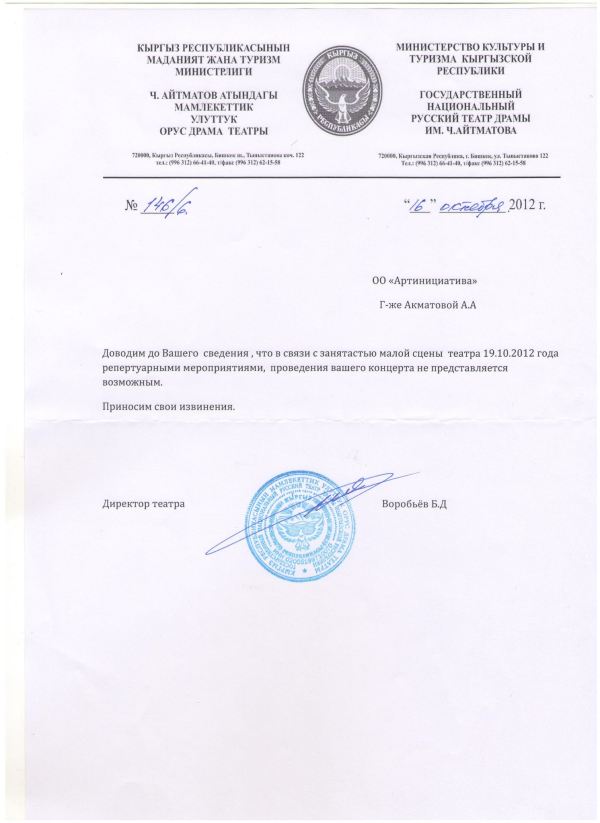
Official letter issued the State National Russian Drama Theater “Aimatov” in Bishkek, revoking permission for the use of their space for the concert on October 19th
Editor’s Note. This translation has been slightly edited for republication here. The original statement in Russian is published below.
//RU
ЗАЯВЛЕНИЕ ПО ЦЕНЗУРЕ КОНЦЕРТА В БИШКЕКЕ
Заявление «Школы теории и активизма – Бишкек» (ШТАБ) и группы «Аркадий Коц» по поводу отмены концерта группы в Государственном национальном русском театре драмы им. Ч. Айтматова в Бишкеке.
19 октября 2012 года должен был состояться концерт группы «Аркадий Коц» в Русском драматическом театре в Бишкеке. Однако 16 октября организаторам концерта – ОО «Арт-Инициат ивы» и ШТАБУ – руководство театра сообщило об отказе в предоставлении помещения в аренду «в связи с занятостью малой сцены театра 19.10.2012 репертуарными мероприятиями». Руководство театра в устной форме сообщило организаторам, что реальной причиной отказа в проведении концерта послужил какой-то звонок из «госструктур», которые рекомендовали от проведения концерта в стенах театра отказаться.
Группа «Аркадий Коц» (Москва) существует около двух лет, сочиняет в разных музыкальных стилистиках песни на стихи поэтов разных времен, работавших с темами протеста и сопротивления – Федора Сологуба, Бертольта Брехта, Александра Бренера и других. «Аркадий Коц» считает важным создание новой активистской (антибуржуазной, профсоюзной, феминистской, антифашистской) культуры, преодолевающей как партийно-идеологические, так и субкультурные стереотипы.
Концерт группы «Аркадий Коц» в Бишкеке проходит в рамках выставки Павильона Центральной Азии на 54-й Венецианской биеннале-2011 «Lingua franca/Франк тили» в Бишкеке. Выставка в Бишкеке исследует связи языка, истории и политики, а также обращается к рефлексии глобального протестного движения, во многом определяющего сегодняшнюю мировую повестку.
Прецедент, когда цензурному контролю – без объяснения оснований, со смутной ссылкой на власть, фактически произвольно – подвергаетсяанти фашистская группа, расценивается нами как противоречащий принципам демократического и свободного общества, о построении которого так громко и так часто заявляется в Кыргызстане. Особенно тревожным нам кажется то, что цензуре в Кыргызстане подвергся концерт группы, музыканты которой являются активными участниками российского антифашистского движения и открыто выступают против ксенофобии и насилия в отношении трудовых мигрантов в России. По неофициальным данным около миллиона граждан Кыргызстана ежегодно выезжает в Россию в трудовую миграцию и подвергается там дискриминации и насилию. Парадоксально, но кыргызстанские цензоры оказываются в этой ситуации солидарными не со своими согражданами, а с теми, кто проявляет по отношению к ним ксенофобию.
17 октября, 2012
UPDATE
EN//
Arkady Kots’ concert took place on October 20 in the bar” Metro pub’ under the slogan “Against censorship.” Through their lyrics, the musicians demanded respect for human rights and freedom. They had been banned from performing in the State National Russian Drama Theater in Bishkek where the concert was originally planned. Foto-reportage of the event here: http://kloop.kg/blog/kloop_galleries/arkadij-kots-kontsert-protiv-tsenzury/
RU//
Выступление российской группы «Аркадий Коц» прошло 20 октября в баре «Метро паб» под лозунгом «Против цензуры». Музыканты текстами своих песен призывает к соблюдению прав и свобод людей. Ранее им запретили выступать в Русском драмтеатре Бишкека, где изначально планировался концерт. Фоторепортаж с концерта группы “Аркадий Коц” в Бишкеке: http://kloop.kg/blog/kloop_galleries/arkadij-kots-kontsert-protiv-tsenzury/
 ArtLeaks