Updates
ACT NOW! Submit your story to ArtLeaks and end the silence on exploitation and censorship! Please see the submission guidelines in the "Artleak Your Case" page
Submitted and current instances of abuse are in the "Cases" section
To find out more about us and how to contribute to our struggles, please go to the "About ArtLeaks" page
Please consult "Further Reading" for some critical texts that relate to our struggles
For more platforms dedicated to cultural workers' rights please see "Related Causes"
For past and upcoming ArtLeaks presentations and initiatives please go to "Public Actions"
Yuri Albert: “I am not going to Shanghai because of censorship”
via ArtChronika and Yuri Albert’s facebook page
Artist Yuri Albert recently made public his refusal to participate in the 2012 Shanghai Biennale. He explained that the reason was that Chinese officials wanted to censor one of his works. The artist released a statement about this on his Facebook page on Monday, September 3rd.
The works of four Russian artists, including Albert, Anatoly Osmolovsky, Dmitry Gutov and Andrei Filippov, were to be exhibited in the Moscow Pavilion, curated by the Stella Art Foundation. According to Yuri Albert, he was supposed to participate in the exhibition with two projects – “Self-portrait with eyes closed” (a description of a Van Gogh painting in Braille scipt) and ” Moscow Poll “(a voting booth with audience participation, for which he was awarded the Kandinsky Prize last year).
“A couple of weeks ago, the Chinese officials gave me an ultimatum to remove the first two questions from the installation [“Moscow Poll”‘]. I did not agree to their demands and refused to participate in the Biennale. These two questions were:
1) Would the fact that no Russian artists protested against the war with Georgia, cause you to change your attitude towards contemporary Russian art?
2) Does the strengthening of censorship and self-censorship affect the quality of contemporary Russian art? ” – declared the artist.
In an interview with “ArtChronika” the artist added that the curators of the Biennale are well aware of his decision.”As far as I know, they tried to change the decision of the Chinese officials, but did not manage to. I have no complaints about them, ” Albert said.
“The censorship did not come from the curators of the Biennale, but from the government officials, whose names are not known” – declared Nikolay Molok, the director of development for the Stella Art Foundation. “We tried to convince the Chinese officials to change their minds, explaining that Albert’s work has been exhibited in Moscow and even received the Kandinsky Prize, but they were unwavering. Moreover, I learned that Yuri Albert is not the only victim, but that there were other artists who were censored in the Biennale. ”
Molok confirmed that Yuri Albert will not participate in the Shanghai Biennale this year. “He remained firm in his position not to take part in this event. We are very sorry that Yuri will not participate. “
He added: “We discussed the situation with the other participants in the exhibition – Anatoly Osmolovsky, Dmitry Gutov and Andrei Filippov – as well as with the management of the Stella Art Fundation and with Boris Groys, one of the curators of the Biennale. All felt that they needed to continue the project. ”
Nikolay Molok explained that the project will be complemented by other works of the remaining three members of the Moscow Pavilion. He also commented that if such a situation occurred in Europe or in Russia, probably, their position would be different.
The 9th Shanghai Biennale will take place from October 1st, 2012 to March 31st, 2013 at the new Shanghai Museum of Contemporary Art, which is located on the premises of the former electric-station Nanshi on the Huangpu river.
The curatorial team of the Biennale this year includes Qiu Zhijie, professor at the School of Inter-media Art of China Art Academy, art critic, media theorist and philosopher Boris Groys, Jens Hoffmann, director of the Wattis Institute for Contemporary Art (San Francisco) and Johnson Chan guest professor of China Academy of Art in Hangzhou.
This year a system of separate city-pavilions was introduced in the Biennale structure, which was developed in collaboration with art institutions in the following cities Mumbai, Istanbul, Teheran, Hong-Kong, Taipei, London, Barcelona and Berlin.
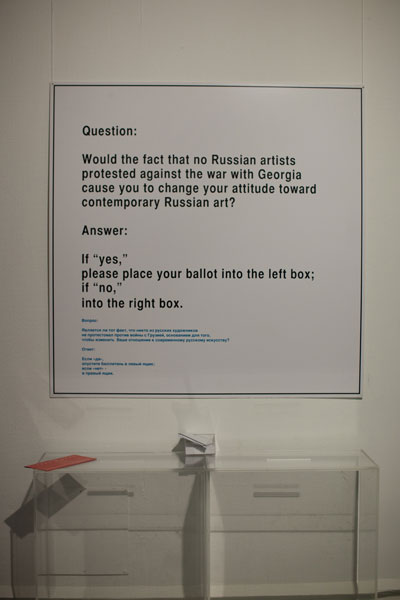
Yuri Albert, from the project “Moscow Poll” (2009), courtesy of the Kandinsky Prize
Translation from original materials in Russian by Corina L. Apostol.
Director Penland School of Crafts: REPAY THE ARTISTS!
via John Britt / Clay Club
Petitioning Director Penland School of Crafts: to get economic justice for all the artists who were denied pay because of illegal overtime practices employed by Penland School for 7 years.
I worked at Penland for about 4 ½ years and during my time as the Studios Coordinator, I was asked to conduct an illegal overtime policy that had been in effect from 2000 – 2007. This was against workers who made $10 -$12.00 an hour and were barely able to pay their bills. I declined and became a Whistle Blower against Penland School who refused to stop the policy. After, quitting in protest and informing them of my discussions with the Wage and Labor board, they finally admitted that they conducted 7 years of an illegal overtime policy, ceased implementing it and agreed to pay back wages to employees. I agreed to allow them to handle it “in house” provide they complied and stopped the practice. This was my mistake because I trusted that Penland would live up to their word. They did not!
Several months ago I was informed by a former employee that he never received payment and so I went to Penland and asked why that was? They assured me everyone was paid going back three years. Since that discussion, I found 3 others that were within three year window and hadn’t been reimbursed for illegal over time either. All they say now is that the matter has been resolved and they refuse to reopen it, in spite of multiple discussions with board members.
My thinking is that if you honestly made an error and mistakenly structured your overtime rules to deny coordinators the pay that they deserved, then you would surely want to reimburse them all. The coordinators did the work and Penland got the benefit so they should be paid.
The coordinators were all artists who were working very hard at Penland and simultaneously being asked for art donations to be sold at the auction, while being denied their legal overtime. To me it is just disgusting that they make around $500,000 every year at the Penland Auction and somehow can’t find any money to pay back what these coordinators/artists legally earned. And while this is going on, they manage to build million dollar buildings every year. They are not poor, they just choose not to pay their artists.
So I am coming to you to ask for help to get these artists the justice that they deserve. It is not about the money but the idea that arrogant not-for-profit arts organization like Penland can so egregiously abuse workers with no consequences simply because they will black list anyone who crosses them. If they are allowed to trample on the rights of the very people they are purporting to serve, artists and craftspeople, then workers there are never safe.
Please help me convince the administration that paying all of these artists, from 2000 – 2007 for work they did is the right thing to do. If you want to help to send email to rob@pulleynstudio.com , jeanmclaughlin@penland.org , and please cc: me at occupypenland@gmail.com This is because the letters I have sent to them never see the light of day but this needs to be out in the open! So please post on your Facebook page and blogs.
If you don’t know what to write, just write: “REPAY THE PENLAND ARTISTS!” It is that simple.
If you could share this letter on Facebook and with as many artists and friends as you could, I would really appreciate it. I am trying to get 5,000 emails as soon as possible! I also ask that you stop donating to Penland’s until they REPAY THE ARTISTS!
The artists that work at Penland are the ones who make the Penland magic possible. If artists don’t stand up for other artists then there will never be justice.
Thanks for trying to make a difference!
John Britt Pottery
What follows is the text of the message Penland School has sent to the local community about this matter:
To the Penland community:
Some of you may have recently received a communication from potter John Britt having to do with past employment practices at Penland. During the past week, he has also made numerous posts about this on Facebook and other Internet platforms. We have posted a response on our website, which you can read here:http://www.penland.org/about/response.html.The situation in question was resolved in 2007, although John was clearly not satisfied with the way it was handled. We want to assure you that Penland follows all applicable labor laws, including those governing overtime pay, which is the issue underlying John’s complaint. If, after reading our response, you have further questions, you can direct them to Jean McLaughlin (jeanmclaughlin@penland.org) or Robin Dreyer (publications@penland.org). We are committed to answering all inquiries and will be sure to get back to you.
Thanks for your ongoing support of Penland School.
To sign the petition in support of the Penland School of Crafts employees who deserve compensation go here.
To follow the blog where this case is being disccussed go here.
UPDATE: Penland School of Crafts responds
What Happened and What We Are Doing About It
Action and a statement about the controversy over Penland’s past payroll system
September 1, 2012
Penland School of Crafts has recently been the subject of public discussion resulting from a past payroll problem. The board and staff are taking action at this time that we hope will bring the matter to a reasonable conclusion. We are also posting detailed responses to some of the issues that have been raised.
Prior to 2007 Penland’s payroll was managed in a way that unintentionally resulted in hourly employees not always being properly compensated when they worked overtime. Simply put, Penland paid employees every two weeks, and hours were recorded as a single number for the pay period. While hourly employees were paid time-and-a-half if they recorded more than 80 hours in a two-week time period, they should have been paid time-and-half if they worked more than 40 hours in a single workweek. Penland’s handling of overtime was not intentionally incorrect; the staff members administering the process believed it to be legal
The problem was brought to light in 2007, it was fixed going forward, and, following the recommendation of the school’s lawyer specializing in labor law, a group of then-current employees were compensated for back wages for the previous two years. Also following our lawyer’s advice, we did not attempt to contact former employees who had worked during that time, but we paid one former employee who contacted us about back pay. The mistake in the system was not denied or hidden–it was corrected. However, a recent campaign against Penland, led by a community member who worked at the school during that time, has brought a lot of attention to the limited scope of the retroactive employee compensation.
While we have elected not to conduct an adversarial public conversation on multiple Internet platforms, the board and staff of the school have revisited the decisions made in 2007 and have decided that the choice not to go beyond the recommendations of our legal counsel does not reflect Penland’s values and aspirations. Although the mistake in the timekeeping system was not intentional, we regret this mistake and the way in which it was addressed, and we are sorry that hard-working staff members were not properly compensated for their work.
In light of this, the board of trustees has decided to do the following:
This week, we sent checks and a letter of explanation and apology to two other studio coordinators who were no longer working at Penland in August 2007 whose records show that they should have received overtime pay for hours worked between August 2005 and August 2007. We are able to do this despite the inadequate information in Penland’s timesheets from that period because, during those two years, the studio manager kept and saved time logs for coordinators, which makes it possible to reconstruct their hours on a weekly basis. This means that all coordinators whose records show they should have gotten extra compensation in that two-year period have been paid. Several other coordinators who worked during this time period and whose records do not show they are owed compensation will also be invited to contact Penland if they believe these records are incorrect.
We are also sending a letter of explanation and apology to every studio coordinator who worked between January 2000 and August 2005 inviting them to call deputy director Jerry Jackson if they believe that they worked overtime at Penland and were not properly paid. Because the timesheets from this period don’t give us a way to tell how much extra pay any of these coordinators should have received, Jerry will work with each individual to agree on a fair amount of compensation.
Many people have expressed disappointment that Penland did not handle this more generously in 2007. We agree that we should have, and that is why are taking these steps. We feel these actions will bring the matter under discussion to a conclusion.
Although the problem raised had to do with the school’s fiscal relationship with its employees, much of the public airing has been framed as a conflict between Penland and artists. This has been especially troubling because artists–whether they are professional, amateur, or aspiring–are the reason Penland exists. Every dollar we spend supports artistic growth.
Penland is a magical place that has changed the lives of thousands. But it is a complicated place to run; it is run by people, and people make mistakes. We are sorry for the mistakes that created this situation, and we are proud of our association with this school. We hope that we can now go back to the business of helping people live creative lives.
Glen Hardymon, chair, board of trustees
Rob Pulleyn, vice chair, board of trustees
ADDENDUM: September 5, 2012.
We are in the process of contacting the former coordinators in question to let them know that we are addressing this situation and want to talk to them. Jerry Jackson, deputy director, is reviewing the timesheets and payroll records for any information that will be helpful in determining fair settlements. An independent party will evaluate our payroll calculations to determing the accuracy and completeness of the review and discuss with Jerry the method for working with the former coordinators on fair resolutions. Jerr will work with the former coordinators so the school can arrive at a fair resolution with each person.
CALL AGAINST NO FEE/ Výzva proti nulové mzdě
via Tereza Stejskalová / Výzva proti nulové mzdě
//EN
To the representatives of cultural organizations operated by state, region, or city as well as the centers of contemporary art financed from the public budget:
We wish to point out the lack of willingness on the part of art institutions to pay fees to artists and other cultural producers (e.g., free-lance curators). In this call we address the consequences of such a behavior and we call on you to change your approach towards those without whom you could not realize the cultural program – the reason the institution exists in the first place.
If you don’t pay artists and curators fees (not mentioning the fact that in some cases you don’t contribute to the production of the work or program), it is a sign of a lack of respect towards the cultural producer and the hours, days, or months of work that resulted in an art exhibition or another form of cultural program. You thus refuse to take the responsibility for the living conditions of the cultural producer, whose work legitimizes your existence. You leave it to to others – the author himself/herself, the art community, family members or the commercial sphere. However, you do pay your employees as well as all the others who participate in the project/exhibition (graphic designers, gallery guards and all the other services providers). Why are the artists (and sometimes also the curators) the only people from the long chain of service providers who do not get any honorarium? Without them you would not be able to fulfill the specific role of a gallery funded from the public budget, the exhibition space would remain empty. The activity of the institution depends on the existence of a thriving artistic scene, it should therefore consider the living conditions of those who are part of it.
Perhaps you think that by exhibiting an artwork you contribute to its author’s visibility and in this way you raise the value of his work in the market and this should be his or her reward. If this is the case, we would like to point out that art galleries and museums have been since the beginning a part of the public space. They strive for social relevancy that is not exhausted by the tax paid when an art work is sold. As do other parts of the public sphere, also art requires institutional structure for creation, presentation and critical reception. It should be taken for granted that all the activities involved in creation, presentation and reception of art in galleries funded by public finance are taken into account and allocated in the budget dedicated to manage these institutions.
Galleries are not advertising spaces supposed to provide the artists with commercial “rating” for the tax-payers’ money. The artist or cultural producer is not a businessman who invests into an uncertain future. His or her work is the reason people visit the institution no matter what happens with it in the future. You take the advantage of that there is an endless line of artists who are willing to believe in the promise of a symbolic or financial gain and fill your exhibition space on credit.
It is also necessary to consider that art has transformed itself in the recent years and so did the art institution. The artist does not create artefacts in the privacy of his/her studio. Today, it is the institution that stimulates artistic practice through a curator’s assignment. Some works exist only in the space and time of an exhibition, in the communication with the audience and are therefore difficult if not impossible to sell. Czech institutions have to come to terms with this tendency of art and not be passively aggressive lacking interest and understanding.
The artist and curator should be an equal partner and the financial and other conditions of the project should be transparent and stated beforehand.
You could object that that in the times of austerity measures the budget is limited. However, also when it was not so limited, you did not act very differently. It is precisely in the times of crisis that it becomes clear that gallery institutions should reconsider their priorities and stop exploiting the enthusiasm of artists, curators, and the structures they have created. It is time to actually support art and not only provide it with a temporary exhibition space.
Hynek Alt, artist
Zbyněk Baladrán, artist
Jan Haubelt, artist
Vít Havránek, curator
Václav Magid, artist and curator
Pavla Sceranková
Jiří Skála, artist
Jakub Stejskal, theoretician
Tereza Stejskalová, curator
Pavel Sterec, artist
Tomáš Svoboda, artist
Jiří Thýn, artist
Aleksandra Vajd, artist
Dušan Zahoranský, artist and curator
To read a full list of supporters of this call go here.
If you would like to support our call, please write your name and profession to vyzvaprotinulovemzde@gmail.com
//CS
Komu: představitelům kulturních příspěvkových organizací, státních, krajských a městských galeriích a center současného umění financovaných z veřejných rozpočtů
Věc: Chceme upozornit na neochotu institucí platit honoráře umělcům a dalším kulturním producentům, například kurátorům „na volné noze“. V této výzvěchceme připomenout důsledky takového konání a vyzýváme vás, abyste změnili svůj přístup k těm, bez jejichž spolupráce by nebylo možné vytvářet arealizovat kulturní program, kvůli němuž jsou kulturní instituce zřizovány.
Pokud umělcům/umělkyním neplatíte honorář (nemluvě o tom, že v některých případech ani nepřispíváte na produkci uměleckého díla), je to výrazhluboké neúcty k hodinám, dnům či měsícům práce, jež vyústila ve výstavu či kulturní program. Odmítáte tím zároveň nést odpovědnost za životnípodmínky kulturního producenta, jehož práce legitimizuje existenci vaší instituce. Přesouváte ji na někoho jiného, především na autora/autorku,uměleckou komunitu, rodinné příslušníky či komerční sektor. Své zaměstnance přitom oceňujete stejně jako všechny ostatní, kteří se na výstavě čiprojektu podílí (grafické designéry, kustody, veškeré externí služby atd.). Klademe si proto otázku – proč jsou umělci a umělkyně (a někdy i kurátoři čikurátorky) jediní lidé z dlouhé řady dodavatelů prací a služeb, kteří honorář nedostávají? Vždyť bez nich by primární služba, kvůli níž je galerie zřizována zveřejných zdrojů, zůstala nenaplněna a prostor galerie by zůstal prázdný. Činnost institucí závisí na čilé umělecké scéně, jejich zájem i podpora by seměly přirozeně týkat i životních podmínek těch, kteří ji vytvářejí.
Možná se domníváte, že vystavením uměleckého díla přispíváte k autorově viditelnosti, zvyšujete tak jeho cenu na trhu a právě tím jej odměňujete. Rádibychom poukázali na skutečnost, že galerie a muzea výtvarného umění byla od svého vzniku součástí veřejného prostoru. Jako taková aspirují naspolečenskou relevantnost, která se nevyčerpává zdaněním cen za prodaná umělecká díla. Tak jako jiné veřejné statky i ty umělecké vyžadujíinstitucionální podhoubí pro tvorbu, prezentaci i kritickou recepci. Mělo by pak být samozřejmé, že všechny složky podílející se na tvorbě, prezentaci arecepci umění v galeriích financovaných z veřejných prostředků najdou své místo v alokaci financí určených na spravování těchto institucí.
Galerijní instituce nejsou reklamním prostorem udělujícím umělci komerční „rating“ za peníze daňových poplatníků. Umělec a kulturní producent nenípodnikatel ani spekulant. Neinvestuje do nejistého zisku v budoucnosti. Jeho či její práce je důvodem, proč veřejnost instituce navštěvuje a to bez ohleduna to, co se s ní stane v budoucnosti. Zneužíváte skutečnosti, že tu existuje stále se doplňující řada umělců, kteří jsou ochotni uvěřit příslibůmsymbolického či finančního zisku a na úvěr znovu naplnit výstavní prostor vaší instituce.
Je rovněž nutné vzít v potaz, že umění se v posledních letech proměnilo a s ním i postavení galerijní instituce. Umělec již delší dobu netvoří jen artefakty vsoukromí svého ateliéru. Dnes je to právě instituce, která stimuluje uměleckou tvorbu a podstatným způsobem se na ní podílí (např. kurátorskýmzadáním). Některá díla dokonce existují pouze v časoprostoru výstavy a v komunikaci s návštěvníkem, jsou nepřenosnou (a neprodejnou) kvalitou. Českéinstituce se musí také s touto tendencí umělecké tvorby, jež se objevila v posledních padesáti letech, adekvátně vyrovnat a aktivně na ni reagovat – a nese stavět do pasivně agresivní pozice nezájmu, neúčasti a neporozumění.
Umělec či kurátor na volné noze je pro vás rovnocenným partnerem, mělo by tedy být samozřejmé, že finanční i jiné podmínky výstavy či projektu jsoutransparentní a předem jasně stanovené.
Můžete namítnout, že v čase úsporných opatření mají instituce omezený rozpočet. Ale ani když omezený nebyl, nejednali jste jinak. A je to právě v doběkrize, kdy je zřetelné, že by galerijní instituce měly přehodnotit své priority, přestat parazitovat na voluntarismu umělců, kurátorů a jimi vytvořenýchstrukturách a začít umění podporovat – nikoliv mu jen poskytovat dočasný prostor pro vystavení.
Hynek Alt, umělec
Zbyněk Baladrán, umělec
Jan Haubelt, umělec
Vít Havránek, kurátor
Václav Magid, umělec a kurátor
Pavla Sceranková, umělkyně
Jiří Skála, umělec
Jakub Stejskal, teoretik
Tereza Stejskalová, kurátorka
Pavel Sterec, umělec
Tomáš Svoboda, umělec
Jiří Thýn, umělec
Tomáš Uhnák, umělec
Aleksandra Vajd, umělkyně
Dušan Zahoranský, umělec a kurátor
K výzvě se dále připojili.
Pokud se k výzvě chcete připojit, napište své jméno na vyzvaprotinulovemzde@gmail.com
Schedule of the 3rd ArtLeaks Working Assembly in Belgrade
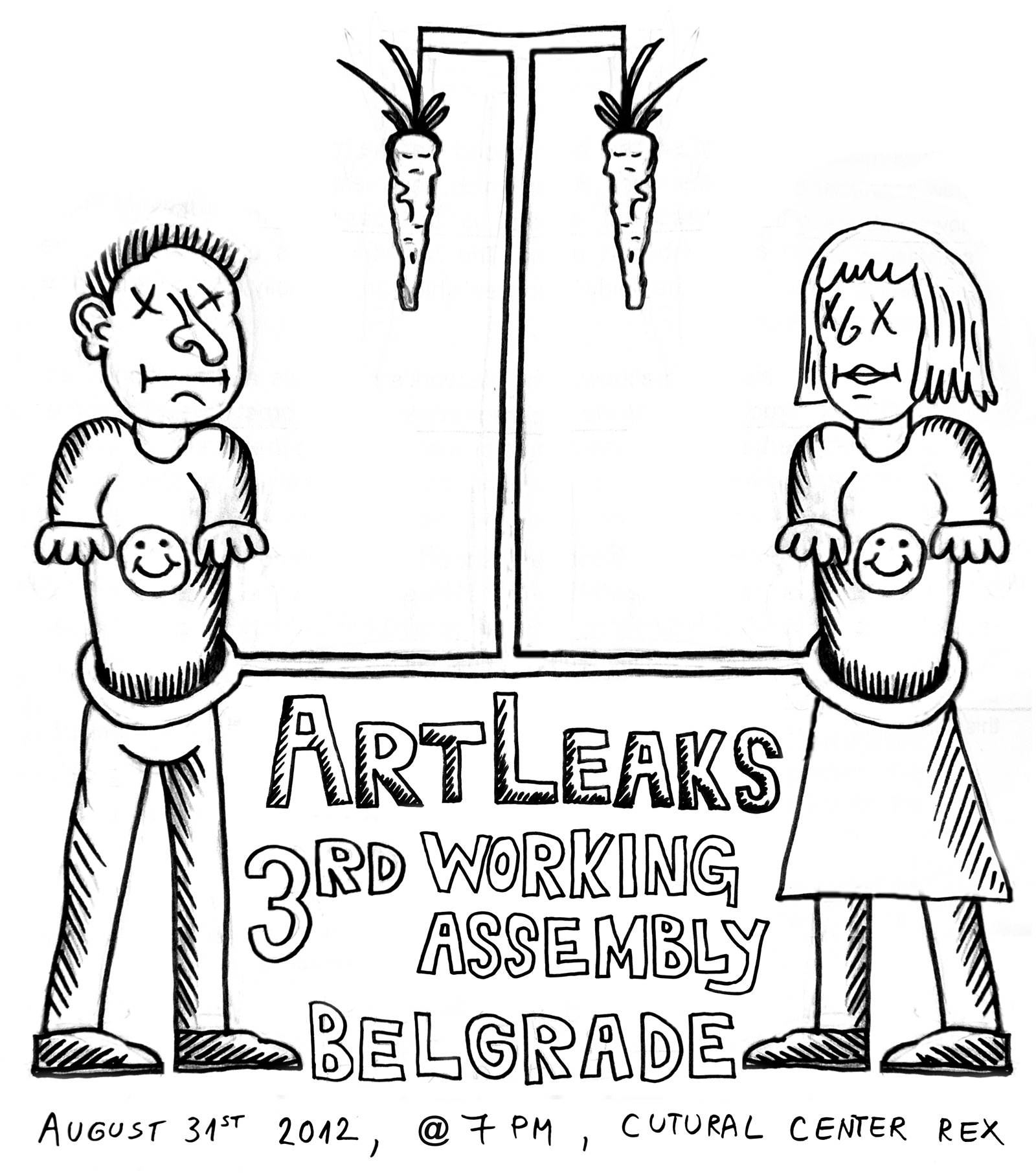
Poster by Zampa di Leone
//EN
3rd ArtLeaks Working Assembly – Belgrade
Friday, 31st of August, 7pm, 2012
Cultural Center REX, Jevrejska 16, Belgrade, Serbia
Facebook event page here.
Building on our previous experience organizing an ArtLeaks Working Assemblies in Berlin in June 2012 and Moscow in July 2012, we invite you to a similar working-group format that allows direct engagement with the public at the Cultural Center REX in Belgrade.
For our Belgrade assembly, our goals for further developments are :
(1) To reach new constituencies from the cultural, social, and political milieu of Belgrade, and invite them to join our struggles
(2)To research the local socio-political context in which cultural workers are exploited in Belgrade, Serbia in particular and the Balkans generally; to find out about local cases of abuse, corruption and exploitation
(3)To receive critique regarding the manner in which ArtLeaks is currently functioning and may be improved further
(4) To collectively formulate concrete working methodologies and actions that our cultural workers’ alliances may incorporate into their development
Schedule
30th of August 2012
Arrival of the participants
31st of August 2012
– 13:00-17:00h ArtLeaks internal meeting at REX (all participants are invited to join)
– 19:00-22:30 ArtLeaks Assembly at the Cultural Center REX, Jevrejska 16 (open to the public)
Program:
– 19:00-19:45 Presentation of the ArtLeaks platform
Introducing ArtLeaks: on the urgency of the project, its goals, methodologies, values; although ArtLeaks has core members, we wish to expand the project and invite other people to join us
Presentation of 3-4 case-studies, ArtLeaks initiatives (no fee statement, workshops, assemblies, forthcoming journal), facilitators: Corina L. Apostol, Vladan Jeremić, Ștefan Tiron and The Bureau of Melodramatic Research
– 19:45-20:15 Discussion among the participants : Corina L. Apostol, Ștefan Tiron, The Bureau of Melodramatic Research, Vladan Jeremić, Rena Raedle, Selman Trtovac, Vesna Milosavljević /SEEcult.org, Maja Ćirić, Nikola Radić Lucati, Noa Treister and Pavle Ćosić /KORNET
Summarizing some important points of debate from previous assemblies, and opening up discussion points: formulating narratives of exposure, drafting ethical guidelines, developing terminology to address abuse and exploitation, strategies of constituting alliances.
Comments, criticism, suggestions about further improvement of ArtLeaks.
– 20:15-20:45 Break: Drinks and refreshments
– 20:45-21:55 Presentation of the local context and local case studies, every participant has 10 mins to contribute. Participants: Selman Trtovac, Vesna Milosavljević, Maja Ćirić, Nikola Radić Lucati, Noa Treister and Pavle Ćosić
– 21:55-22:30 Discussion among the participants, local context and similar activities/projects
1st of September 2012
Free time for guests to explore the city of Belgrade, museums, galleries, etc.
2nd of September 2012
– 13-17h ArtLeaks internal meeting at BLOK 70
Dinner party
3rd of September 2012
Departure of the participants
This event is not sponsored by any foundation and it is realized with individual resources of the members and participants of the ArtLeaks. Special thanks to Cultural Center REX for the generous opportunity to have our assembly event in their space on the 31st of August 2012.
SER//
Treći ArtLeaks radni skup – Beograd
Kulturni centar REX, Jevrejska 16
31. avgust 2012. u 19h
Učestvuju: Corina L. Apostol, Maja Ćirić, Pavle Ćosić / KORNET, Nikola Radić Lucati, Vladan Jeremić, Selman Trtovac, Vesna Milosavljević / SEEcult.org, Ștefan Tiron, Noa Treister, The Bureau of Melodramatic Research i Rena Rädle
Međunarodna platforma ArtLeaks, posvećena otkrivanju zloupotreba, korupcije i izrabljivanja u oblasti kulture i umetnosti, kao i promeni stanja u tim sektorima, održaće 31. avgusta radnu skupštinu u Beogradu, posle nedavnih sličnih okupljanja u Berlinu i Moskvi.
Skup ArtLeaksa u Kulturnom centru Rex trebalo bi da inspiriše predstavnike lokalnog kulturnog, društvenog i političkog miljea da se pridruže toj međunarodnoj platformi, a poslužiće i za sagledavanje opšteg konteksta rada i eksploatacije kulturnih radnika u Beogradu, Srbiji i na Balkanu generalno.
Takođe, ArtLeaks očekuje da dobije kritičke ocene u vezi sa načinom sopstvenog funkcionisanja kako bi mogao da ga unapredi.
Predviđeno je i zajedničko formulisanje konkretnih radnih metodologija i akcija koje bi različite forme udruživanja radnika u kulturi mogle da primene u svom daljem razvoju.
Prethodne dve radne skupštine ArtLeaksa iznedrile su osnivanje saveza sa internacionalnim grupama kao što su W.A.G.E.(Njujork), Occupy Museums (Njujork), Arts & Labor (Njujork), Haben und Brauchen (Berlin), the Precarious Workers Brigade (London), The May Congress of Creative Workers (Moskva). Njihova misija je formulisanje direktnih akcija i podizanje svesti o uslovima rada i problemima radnika u kulturi i umetnosti.
Osnivači ArtLeaksa veruju da jedino međunarodno koordinisani savezi mogu da razotkriju izrabljivanje i cenzuru u današnjoj umetnosti i kulturi, ali isto tako i da zajednički osmisle nove organizacione modele koji bi odgovorili na potrebe i želje političkih subjekata nastalih na dodirnim tačkama aktuelnih ekonomskih, političkih i kulturnih preokreta.
ArtLeaks je 15. jula održao i skup u Moskvi, a prva radna skupština i radionica održani su početkom juna u Berlinu.
Platforma ArtLeaks počela je da radi 2011. godine, otkrivajući i istražujući slučajeve problematične finansijske politike u savremenoj kulturi, intenzivnu eksploataciju rada u kulturi, preuzimanje javnog prostora posvećeno tzv. nezavisnim inicijativama, aproprijacije kulture pod okriljem zloglasanih korporacija. Više možete naći na linku: http://art-leaks.org
Događaj ne finansiraju fondacije, nego se realizuje od sredstava članova i učesnika ArtLeaks. Posebna zahvala Kulturnom centru REX za velikodušnu mogućnost organizacije ovog događaja u njihovom prostoru 31. avgusta 2012.
Open Letter to Black Umbrella Board of Trustees, Taylor & Francis Group, and Arts Council England
It is with growing alarm and concern that we, members of the Third Text Advisory Council and close supporters of Third Text, have watched the Board of Trustees take unilateral actions that are hurtful to Founding Editor Rasheed Araeen and damaging to the shared artistic, intellectual and political vision of this journal.
We write this letter to say that we will not allow the continuing disrespect of Rasheed or the undermining of the shared principles that form the core of Third Text’s ethos and politics. We will take collective steps to defend the vision of the journal and make it clear to its global readership that this vision is being seriously compromised.
Third Text has been published since 1987 by Black Umbrella, an organization founded in 1984 to fight the routine institutional exclusion of non-Western artists in the London artworld. Since 2002, Taylor & Francis have published Third Text on behalf of Black Umbrella, with funding from Arts Council England.
It is crucial to remember that Black Umbrella and Third Text were founded in a long political struggle against discrimination and exclusion, a struggle in which Rasheed Araeen played an integral role. Third Text stands for a globalized art and culture of liberation and justice. That is why we care about it and will defend it. Moreover, if todayThird Text represents a truly global conception of art and critical practice unequalled by any other journal published, and has earned a truly global readership, this achievement reflects Rasheed’s tireless work and commitment over decades. We, the writers, Advisors, and supporters of Third Text, understand this and underscore here our deep respect for Rasheed’s founding vision and leadership.
In this light, the actions of the Trustees since July 2011 aiming to oust Rasheed constitute a fundamental alteration of the vision and character of Third Text. This conservative agenda is visually confirmed in the face that scowls from the latest issue of the journal, replacing the world map that has graced its cover since its founding.
We are not concerned with the small details and disputes of this crisis. We are concerned with the large actions that have done damage and threaten the vision we share. The essential chronology is as follows:
In July 2011, the Trustees took the extraordinary unilateral action of dismissing Rasheed Araeen as Executive Director of Black Umbrella, in effect locking him out of the day-to-day running of the journal. They did this without consulting with the Third Text Editorial Board or Advisory Council and without any attempt to publicly explain or justify such a drastic action.
Nearly a year later, in June 2012, Rasheed wrote and circulated a letter notifying us of the Trustees’ action and the subsequent failure of all attempts to resolve the disputes. For most of us, this was the first we heard of the crisis within the journal.
Mario Pissarra, the managing director of Africa South Art Initiative (ASAI) and Lize van Robbroeck, editor in chief of Third Text Africa, responded with an open letter calling on the Trustees to explain their actions and urging writers and Advisors in the meantime to refrain from submitting or recommending further articles to the journal.
The Trustees responded to Pissarra and van Robbroeck’s letter on 2 August 2012. While professing allegiance to Rasheed’s vision, they nevertheless presumed to be its true interpreters and caretakers and proceeded to condemn Rasheed in bureaucratic and legal language.
Four days later, five of the nine members of the Third Text Editorial Board rejected these explanations by resigning in protest [These members were Ali Ahmad, Jorella Andrews, Annie E. Coombes, Christine Eyene and Amna Malik). In their letter of 6 August, they called for an independent investigation and review of the management and editorial structure of the journal, including the role of the Trustees.
This is the context of the present letter and collective action. In our view, what has taken place is unacceptable. Clearly, there were major divergences and sharp disputes regarding funding strategies in the current financial crisis and official turn to austerity. But no such differences justify the removal, without consultation or justification, of the man who more than any other defined the vision we share and established the standards of the journal we know and love.
Far more than the Trustees – who hold their positions because Rasheed was generous enough to so honor them – we, the writers, readers and Advisory Council members of Third Text, are the practice and life of this journal. Without us, its pages will lose much of the diversity and commitment that have contributed over the years to its intellectual vitality. We know this and will not stand by and passively watch the transformation of an exceptional and necessary journal into one more depoliticized concession to market forces. If Third Text is to be made to betray its vision, then it will be without us – and the parting of ways will then be real.
There is one way to avoid that. The Trustees must fully and immediately reinstate Rasheed Araeen in his former positions as the Executive Director of Black Umbrella and working Founding Editor of Third Text. This would be the first step in assuring us that the vision of the journal has been protected. It would also open the door to a more dialogic and consultative process of negotiation and resolution.
Should the Trustees fail to reinstate Rasheed by 31 August 2012, we will take collective steps to prevent their action from acquiring any appearance of legitimacy. Those of us who are on the Advisory Council will resign our positions. Together with the others who are signing this letter, we will urge a global boycott of the journal among our peers and well-wishers of Third Text across the world.
Third Text Advisory Council Members:
Rustom Bharucha International Research Centre, Berlin, Germany
Guy Brett Honorary Professor, University of the Arts, London, UK
Geeta Kapur art critic and curator, New Delhi, India
Tabish Khair Aarhus University, Denmark
José-Carlos Mariátegui Editor, Third Text Latin America, Lima, Peru
Benita Parry University of Warwick, UK
Mario Pissarra, Africa South Art Initiative, University of Cape Town, South Africa
Gene Ray Berlin, Germany, and Geneva University of Art and Design, Switzerland
John Roberts University of Wolverhampton, UK
Gayatri Chakravorty Spivak Columbia University, New York, USA
Julian Stallabrass Courtauld Institute of Art, London, UK
Victor Tupitsyn Professor Emeritus, Pace University, New York, USA
Slavoj Zizek Birkbeck Institute for the Humanities, University of London, UK, and University of Ljubljana, Slovenia
Third Text Associates:
Durriya Kazi Third Text Asia, Karachi, Pakistan
Nighat Mir Third Text Asia, Karachi, Pakistan
Everlyn Nicodemus Edinburgh UK, former Third Text Advisory Council member
Nafisa Rizvi Third Text Asia, Karachi, Pakistan
Lize van Robbroeck Editor in Chief, Third Text Africa
Kristian Romare Edinburgh, UK, former Third Text Advisory Council member
Third Text Contributors and Supporters:
Tejpal S. Ajji University of California Los Angeles, USA
Shahidul Alam Pathshala South Asian Media Academy, Dhaka, Bangladesh
Vivien Ashley London, UK
Etienne Balibar, Professor Emeritus, University of Paris, France, and University of California Irvine, USA
Hans Belting Center for Art and Media, Karlsruhe, Germany
Sutapa Biswas Film and Video Umbrella, London, UK
Iain Boal Birkbeck, University of London, UK
Kamal Boullata artist and writer, Menton, France
Anthony Bond Art Gallery of New South Wales, Sydney, Australia
Susan Buck-Morss Distinguished Professor, Graduate Center, City University of New York, USA
Andrea Buddensieg Center for Art and Media, Karlsruhe, Germany
Liu Ding artist and curator, Beijing, China
Laura Fantone San Francisco Art Institute, USA
Jose Fernandes Dias Lisbon University, Portugal
Peter Fillingham artist, Chatham, Kent, UK
Stephen Foster John Hansard Gallery, University of Southampton, UK
Richard Gott London, UK
Gabo Guzzo artist, London, UK
Brian Holmes art critic, Chicago, USA
Darren Jorgensen University of Western Australia
Pierre Joris State University of New York Albany, USA
Fredja Klikovac Handel Street Projects, London, UK
Carol Yinghua Lu artist and curator, Beijing, China
Juliet Flower MacCannell Professor Emerita, University of California Irvine, USA
Courtney J. Martin Vanderbilt University, Nashville, Tennessee, USA
Fiamma Montezemolo University of California Berkeley, USA
Lynda Morris Norwich University of the Arts, UK
Barbara Murray International Association of Art Critics, UK
Anna Papaeti University of Göttingen, Germany, and Pafos, Cyprus
Clive Phillpot writer and curator, London, UK
Mikkel Bolt Rasmussen Copenhagen University, Denmark
Francesca Recchia journalist and independent scholar, London, UK
Colin Richards University of Cape Town, South Africa
Alaknanda Samarth actor, London, UK
Hamid Severi curator, Tehran, Iran
Gregory Sholette Queens College, City University of New York, USA
Joni Spigler University of California Berkeley, USA
Pep Subirós Gao lletres, Barcelona, Spain
Margarita Tupitsyn curator and art critic, New York, USA
Donovan Ward Africa South Art Initiative, Cape Town, South Africa
Peter Weibel Center for Art and Media, Karlsruhe, Germany
Lara Weibgen Yale University, New Haven, Connecticut, USA
Chantal Wong Asia Art Archive, Hong Kong, China
Adrian Thomas Wilson University of Massachusetts Amherst, USA
Eddie Yuan San Francisco Art Institute, USA
Original letter was published on the Africa South Art Initiative (ASAI) website on August 15th, 2012.
 ArtLeaks