Updates
ACT NOW! Submit your story to ArtLeaks and end the silence on exploitation and censorship! Please see the submission guidelines in the "Artleak Your Case" page
Submitted and current instances of abuse are in the "Cases" section
To find out more about us and how to contribute to our struggles, please go to the "About ArtLeaks" page
Please consult "Further Reading" for some critical texts that relate to our struggles
For more platforms dedicated to cultural workers' rights please see "Related Causes"
For past and upcoming ArtLeaks presentations and initiatives please go to "Public Actions"
Re-enactment of The Second ArtLeaks Working Assembly in Moscow | May 24, 6:00-9:00 PM (GMT +3)
Reenactment of The Second ArtLeaks Working Assembly in Moscow from Vladan Jeremic & Rena Rädle on Vimeo.
EN//
Eight years ago International representatives of the platforms ArtLeaks and The May Congress of Creative Workers met in Moscow for the Second ArtLeaks Assembly on July 15th, 2012 at 7 PM at Shkola, Park Isskustv “Muzeon.”
See the public announcement of the call from 2012 here:
https://art-leaks.org/2012/07/07/second-artleaks-working-assembly/
They have discussed the topic “What art system do we need?” and today we invite you to join the reenactment of this Assembly which tries to discuss the pressing issue under the same title. ArtLeaks and many other similar groups or organizations emerged after the world financial crisis of 2008 and mostly against cuts and austerity measures that were implemented everywhere. Now, we are in the middle of the pandemic crisis that is bringing new austerities and negative processes. This crisis seems much more complex and harder than one in 2008, the questions and answers here must be much more prompt and different from those anti-austerity and Occupy movements had in the 2010s.
Facilitators: Corina Lucia Apostol, Vladan Jeremic, David Riff, Nikolay Oleynikov and Dmitry Vilensky
The meeting will take place online at:
https://us02web.zoom.us/j/83917254888?pwd=U1V1MEU2NzErSlpHeEpGWXVDWEI1UT09
Corina Apostol is a curator and writer living and working in Tallinn. She is currently a curator at Tallinn Art Hall. She is the co-founder of ArtLeaks and editor of the ArtLeaks Gazette.
Vladan Jeremic is an artist and worker in the field of political education. He is co-founder of the ArtLeaks (2011) and editor of the ArtLeaks Gazette (2013-2019).
David Riff is an artist, writer, and curator living in Berlin. He is currently Senior Curator of Steirischer Herbst festival.
Nikolay Oleynikov artist; punk; antifascist; member of Сhto Delat; Arkady Kots band, among others. Co-organizer of the May Congress of creative workers (2010-2012); co-pilot at Free Home University.
Dmitry Vilensky is an artist and educator. He works mostly in collective practices and focus on developing architecture constructions, educational seminars and learning plays, graphic works, and films. Не is the founding member of Chto Delat (www.chtodelat.org).
The assembly will take place in the framework of the series of nomadic discussions “Unification of the multitudes” (Объединение множеств) on labor and the possibility of uniting independent cultural workers to protect their rights, mutual support and pirate care initiated in Russia by informal group Union.
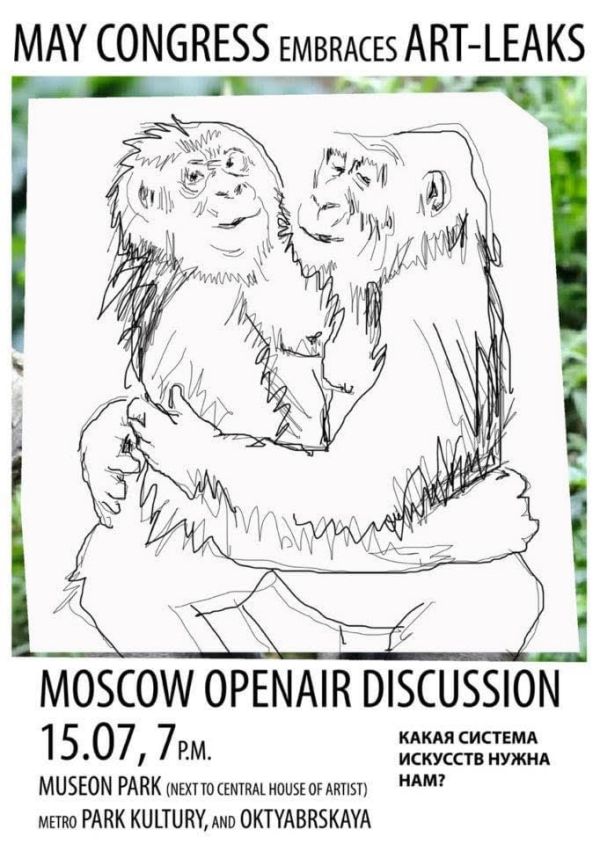
Poster by Nikolay Oleynikov
//RU
Ассамблея пройдет на анг. языке. Текст анонса по русски см. внизу.
https://us02web.zoom.us/j/83917254888?pwd=U1V1MEU2NzErSlpHeEpGWXVDWEI1UT09
Серия кочующих дискуссий “Объединение множеств ” о труде и возможности объединения независимых культурных работников и работниц для защиты своих прав инициирована рабочей группой ЮНИОN
***
8 лет назад международные представители платформ ArtLeaks и Майского конгресса творческих работников встретились в Москве для проведения второй Ассамблеи ArtLeaks 15 июля 2012 года в 19:00 в парке Исскуств «Музеон».
Публичное объявление о событии 2012 года см. здесь
https://art-leaks.org/2012/07/07/second-artleaks-working-assembly/
Для ассамблеи была предложена тема «Какая система искусства нам нужна?» и сегодня мы приглашаем вас присоединиться к реэнакменту этой Ассамблеи, которая пытается обсудить тему под этим же названием. ArtLeaks как и многие другие подобные группы или организации возникли после мирового финансового кризиса 2008 года и в основном против сокращений и мер жесткой экономии, которые применялись повсеместно. Сейчас мы находимся в ситуации пандемического кризиса, который запускает новые еще более жесткие меры сокращений в культуре и другие негативные процессы. Этот кризис оказывается гораздо более сложным и тяжелым, чем кризис 2008 года, и наши ответы на вопросы должны стать точными и действенными, явно отличаясь от тех движений против жесткой экономии, которые были востребованы в 2010-х годах.
Public Statement
May 17.2020
Dear friends and colleagues,
We are pleased to inform you that thanks to our letters, our protests on social media and in the press (radio as well), the Haifa Museum of Art reconsidered its decision to abruptly close this important international feminist show on May 18, so the exhibition is not closing tomorrow! We were informed informally today that it will remain open to the public as it was originally scheduled until June 20, 2020.
Since the exhibition was closed for over two months due to the Corona Quarantine, we will continue to demonstrate tomorrow in front of the Museum, asking for a prolongation from the museum administration, as we believe that it should be actually extended at least until August 26, 2020.
Today an article was published in the daily newspaper in Haifa about our protests, we expect to receive soon an official letter from the Museum.
Thanks, everyone for the international and local support!
We shall keep you informed of future developments!
Artists of the “Women Make History” exhibition in Haifa Museum
Among the participating artists are:
Claude Cahun
Michele Sylvander
Tanja Ostojić
Marina Grzinić
Kathe Bukhart
Shirin Neshat
Stelarc
Liat Elbling
Alona Friedberg
Yael Bartana
Boryana Rossa
Mathilde ter Heijne
Anetta Mona Chisa
Lucia Tkacova
Vanane Borian
Shira Glezerman
Nava Harel Shoshani
Thalia Hoffman
Dganit Elyakim
Yael Meiry
Limor Orenstein
Inbal Mendes Flohr
Veren Nissim
Zamir Shatz
Oleg Mavromati
Iris Kensmil
Sharon Lockhart
Yael Meiry
Izabella Volovnik
Rona Yemfman
Tanja Schlander
Maya Attoun
Efrat Galnoor
Naama Roth
Elham Rokni
Avigail Shklovsky
Michael Blayer
Bianca Eshel Gerchuni
Tsipy Amos Goldstein
Raya Brukenthal
Arahmaiani Fesal
Iris Kensmil
Ariane Littman
Masha Rubin
Shirley Siegal
Meira Grossinger
Assaf Rahat
Roey Victoria Heifetz
Anna Yam
Chief curator: Svetlana Reingold
May 8, 2020
To:
Yotam Yakir
Director of Haifa MuseumsRe: Letter from the Museum on May 7th, 2020 concerning the exhibit “Women Make
History”Dear M. Yakir,
We would like to turn to you personally, as a group of artists, as we believe that a
severe injustice has been done to us by the way the situation was handled and the
decision was taken to close the exhibit. We received the announcement only on
Thursday at noon – when there was no one to talk to – to take down the exhibit on
short notice, by Wednesday, the shipping day. We believe that this is not an honorable and proper way to handle things. The exhibit raises the banner of feminism, and in the thoughtless decision to close the exhibit, more than 50 women artists have experienced exactly the opposite of what the exhibit affirms.This course of action, and the way it has been carried out, conveys the message that
the subject matter is not important and that all the efforts in creating this exhibit, have been for nothing. The disregard of the women artists by the current management of the Haifa Museums (headed by a man), making a ‘cold,’ economic, and arbitrary decision, that is sudden and one-sided, without caring to find a way that will respect all involved – is hurtful and certainly not a feminist decision.The use of section 4 of the contract that permits the Museum to shorten the exhibit
as it pleases, and therefore depriving us of the right to protest, is an act that does not
recognize the essence of the relationship with the artists, especially when the
Museum is tainted by a problematic history and unclear courses of action and must
correct this reputation in the art world. As you remember, Yotam, you have taken on
the directorship with the clear agenda to correct that reputation.We can easily find ways to link the current concerns of corona, with the feminist
exhibit “Women Make History” and believe that the reasons we were given for the
closure of the exhibit do not justify its early closure nor the one-sided and
disrespectful announcement.As you know, many financial resources and efforts were invested, by both the artists
and the Museum, in order to mount the exhibit and to produce it on the highest level. It must be noted that we have not received artists’ fees, and most of us have not even received the reimbursement of our expenses, of our travels, of the mounting, or have not gained any other economic benefit from the exhibit. Our reward is the exposure– which has not happened because of corona.During the period of corona, we have lost the big exposure that was expected to take
place during the days of the Passover holidays, and Independence Day, and now
because of the decision, we (as well as the Museum visitors) have been deprived of
the exposure during Shavuoth and the buzz of the exhibit’s closing days.Exposure is a kind of unwritten agreement between the artists and the space where
they are exhibiting, and therefore we are very much harmed both in our advancement in the field of art, as well as economically. We feel that our considerations as artists have not been taken into account, and even worse, that there has been an attempt here to sweep us under the rug. Many meetings and gallery tours with curators, art lovers and collectors were planned
to take place after the corona restrictions were lifted, which now cannot take
place, and this hurts not only us, the artists, but also the Museum’s audience.We must note that it would have been desirable for the Museum to extend the exhibit’s length (and we still hope that this will happen) as is happening in
many other places, in order for the exhibit to receive the exposure that was its
due, an extension of time that will also be a solution to the reason you are
taking down the exhibit (at least the reason that appears in the Museum’s
official letter.)It is important to note that this decision does not respect the artist Bianca Eshel Gershuni, of blessed memory, who is participating in the Museum in the last exhibit of her life, and she is among the pioneers of feminist art in Israel. Furthermore, we believe that the Museum should hold an honorable event that will take note of her work over the years and will emphasize her presence in the exhibit.
To conclude, we protest the way decisions were made and believe that we should be
partners in a joint thinking process about the ways in which the problem can
be solved. It is important to us, the artists, to show the variety of considerations and constraints, and we want to invite you to a zoom conversation on Sunday at noon, in order to see how we can discuss the matter and to end this period in the best and most honorable way, that will benefit all the sides.Thanking you in advance,
The artists from “Women Make History”Signed:
Alona Friedberg, Anna Yam, Ariane Littman, Assaf Rahat, Efrat Galnoor, Elham Rokni, Inbal Mendes Flohr, Izabella Volovnik, Kathe Burkhart (USA), Liat Elbling, Limor Orenstein, Mathilde ter Heijne (Berlin), Maya Attoun, Masha Rubin, Meira
Grossinger, Michal Blayer, Naama Roth, Nava Harel Shoshani, Raya Bruckenthal,
Roey Victoria Heifetz, Shira Glezerman, Shirley Siegal, Tanja Ostojić (Berlin), Thalia
Hoffman, Tsipy Goldstein, Vanane Borian, Vered Nissim, Yael Meiry.
________________________________________________________
14.5.2020
Artists protesting against the early closure of the show “Women Make History, Feminism in the Age of Transnationalism” at the Haifa Museum (Israel)
We, women and men are protesting against the early closure of the show “Women Make History, Feminism in the Age of Transnationalism,” an important international feminist show which opened at the Haifa Museum on December 21, 2019 and was due to last until June 26, 2020. Like all other museums, the Haifa Museum closed during the pandemic and we were looking towards the reopening of the show on May 17 th with the easing of restrictions throughout the country.
But to our outmost astonishment we were told a few days ago that the show “Women Make History” will close on May 18 th because the museum doesn’t want to re-open a show for 5 weeks and then close down to put up the next exhibition. We find this sudden cold, economic and one-sided cavalier attitude disrespectful towards us. What is more, the use of section 4 of the contract that allows the museum to shorten the exhibit as it please deprives us of the right to protest. We did not receive any artists’ fees and our exposure to visitors, already shortened due to COVID-19, is now ending 5 weeks before the end of the show.
We believe that fighting for culture these days is essential and that fighting for our rights as wo/men artists is no less essential when individual liberties are curbed everywhere. Therefore, we ask the museum to reconsider its decision to close the show on Monday the 18 th and allow instead this important international feminist show that was closed for over two months during the Corona Quarantine to be extend be at least until August 26 2020.
The artists:
Alona Friedberg, Anna Yam, Ariane Littman, Assaf Rahat, Boryana Rossa (USA), Efrat Galnoor, Elham Rokni, Inbal Mendes Flohr, Izabella Volovnik, Kathe Burkhart (USA), Liat Elbling, Limor Orenstein, Marina Grzinic (Slovenia), Masha Rubin, Mathilde ter Heijne (Berlin), Maya Attoun, Meira Grossinger, Michal Blayer, Naama Roth, Nava Harel Shoshani, Oleg Mavromati (USA), Raya Bruckenthal, Roey Victoria Heifetz, Shira Glezerman, Shirley Siegal, Tanja Ostojić (Berlin), Thalia Hoffman, Tsipy Goldstein, Vanane Borian, Vered Nissim, Yael Meiry.
Artists at Risk (AR) COVID-19 Emergency Fund
20 April 2020
Pussy Riot’s Maria Alyokhina and author Neil Gaiman back Covid-19 campaign for artists at risk
Leading international artists are supporting the launch of an emergency fund to help artists who face threats to their freedom or lives and are unable to reach a country of safety during the coronavirus pandemic.
The Covid-19 Emergency Fund for Persecuted Artists has been launched today by the European advocacy organisation Artists at Risk (AR).
Maria Alyokhina, a member of Russian feminist protest group Pussy Riot, and author Neil Gaiman are supporting the campaign alongside Chilean-American playwright Ariel Dorfman, Iraqi painter Dia al-Azzawi, Egyptian musician Ramy Essam, Syrian photographer and curator Issa Touma, Somali musician Lil Baliil and Iraqi author Saadi Youssef.
‘Undemocratic regimes are using the crisis to repress dissent, and that includes cracking down on artistic freedom,’ says Ivor Stodolsky, co-founding director of the organisation Perpetuum Mobile (PM) which runs Artists at Risk (AR). ‘As a result, the dangers faced by artists at risk are currently escalating. We need a rapid-reaction fund for those artists who cannot leave their countries for a place of refuge.’
Artists at Risk (AR) has a strong track record of supporting artists. Since 2013, it has created 17 residencies for artists across 14 countries, including Spain, Finland, Germany and Tunisia, offering temporary AR safe haven residencies for artists who face persecution or imprisonment for exercising their right to freedom of expression. The programme has assisted artists from Brazil, Syria, Vietnam, Egypt and Kenya, among other countries.
Following the closing of borders to limit the spread of coronavirus, artists are no longer able to take up the offer of residencies outside their own countries. In response to the crisis, Artists at Risk (AR) is ramping up its support for artists within their regions. These are art practitioners of almost all disciplines currently facing threats to their freedom and in need of urgent assistance.
‘During the current crisis, some artists are hoping to stay safe behind locked doors, but others are facing eviction from their homes, as they cannot pay the rent due to the impossibility of earning a living during the pandemic. For reasons like this, the Covid-19 crisis doubles artists’ exposure to risk,’ says Marita Muukkonen, co-founding director of Perpetuum Mobile (PM) and Artists at Risk (AR).
The new fund will cover the living costs of artists at risk and, where necessary, relocate artists to a place of safety within their own country or region.
Artists at Risk (AR) is launching a crowdfunding page as part of the campaign to raise an initial 10,000 euros towards the costs https://www.gofundme.com/f/artistsatrisk
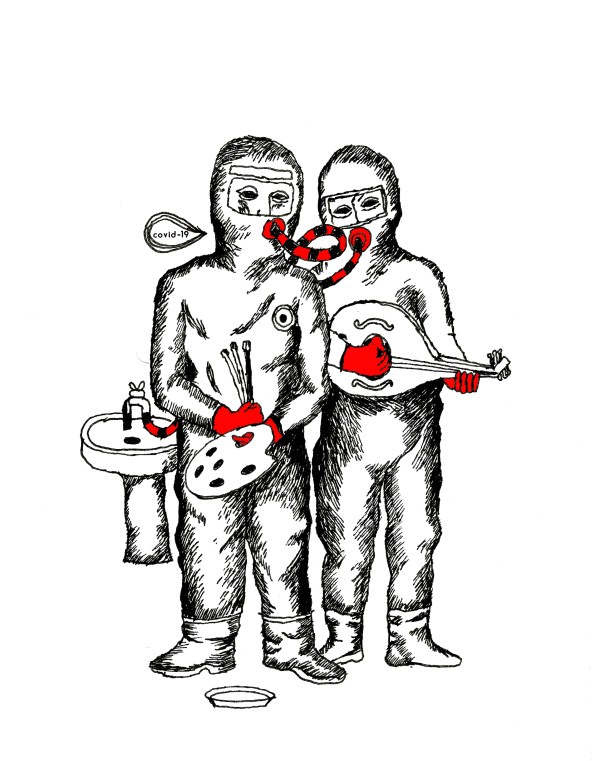
Drawing by Saddam Jumaily
FURTHER INFORMATION
ARTISTS at RISK (AR) is a non-profit organisation with charitable status at the intersection of human rights and the arts. AR is dedicated to mapping the field of persecuted art practitioners and facilitating their safe passage from their countries of origin, hosting them at residencies and curating related projects. Perpetuum Mobile (PM) initiated Artists at Risk (AR) in 2013 as a platform and network to support artists in securing travel documents, providing legal assistance and creating AR-Safe Haven Residencies. The European Parliament honoured Perpetuum Mobile (PM) for its Artists at Risk (AR) programme with the CIVI EUROPAEO PRAEMIUM (European Citizen’s Prize) in 2016.
Campaign: Gofundme AR COVID19 Emergency Fund
CONTACT: Jo Glanville, joglanville@perpetualmobile.org, +44 (0) 7713020971
To art museum directors, trustees, board members, and upper management:
We ask that you do everything in your power to retain all staff members during the COVID-19 crisis. Barely three weeks after the first “stay at home” order was issued in New York, furloughs and layoffs began at virtually all of our city’s museums and cultural institutions. We have a simple demand: before a single museum worker is laid off, let every mid-six- or seven-figure museum director draw a salary of zero. Let our wealthy trustees, who so expertly raise money for council field trips and directors’ first class-flights, fundraise instead for staff retention. Let the conversation around deaccessioning artwork and dipping into endowments start if it means saving jobs.
You are responsible to the people you hire. You must continue to pay them a living wage, even—and especially—in times of duress. This includes janitorial, maintenance, and otherwise unsalaried workers. This includes those who cannot do their regular work from home. You are doubly responsible if you rely on, or have relied upon the labor of unpaid interns, perpetuating a cycle of inaccessibility and exploitation that keeps the museum world run predominantly by the white and independently wealthy. Those at the top should do everything in their power to retain a full staff for the entirety of the crisis.
In New York City alone, art museum directors’ salaries range from upwards of $200,000 to more than $3 million. Yet in this city and across the country, institutional responses to the COVID-19 crisis have resulted in staff cuts, layoffs, and furloughs that overwhelmingly impact the lowest paid workers. Pairing these staffing cuts with empty gestures of financial solidarity—such as tiered salary reductions in the 10–30% range for senior management, as has been implemented at MASS MoCA, the Whitney Museum of American Art, the Cleveland Museum of Art, and others—does nothing to mitigate the devastating effect of job cuts on the livelihoods of those affected and on the cultural landscape.
Additionally, while the idea of moving “business as usual” to online platforms may be appealing to institutions hoping to remain relevant during this time, it is important to recognize that “business as usual” posits the pursuit and maintenance of capital as more important than human life. In fact, considering persistent calls from disability advocates for museums to consider engagement strategies for multiple audiences across multiple platforms, it is doubly insulting that this crisis has allowed institutions to pat themselves on the back for what has, until recently, been an afterthought. While the art world broadly, and museums specifically, may lionize the rabid accumulation of objects, we assert an alternate, perhaps radical idea: that people are simply more important.
The precarity of contract, freelance, frontline, and otherwise marginalized labor is evident in the nearly immediate decision to obstruct the livelihoods of the very real human beings in these roles, whose creativity, enthusiasm, and expertise make significant contributions to culture within and without museums. These workers are regularly denied health benefits and job security even in more stable circumstances, and their summary dismissal reveals not only a systemic undervaluing of the expertise of their employees but also a fundamental lack of commitment to their publics. Educators are often a visitor’s first entry into an artwork, thoughtfully creating curricula, facilitating workshops, and otherwise fostering critical dialogue that stretches the limits of artistic discourse. Teaching artists, who make up a large segment of frontline education staff, are tasked with maintaining their own individual practices while supporting the learning of museum visitors, often at multiple institutions. Deeply knowledgeable about the collections and operations, front of house staff are the literal faces of museums, but their work remains some of the most undervalued in both perception and practice. This is especially egregious when we consider the fact that front of house staff were the employees most vulnerable to COVID-19 before museums were forced to close their doors.
It also must not go unmentioned that educators, frontline workers, and freelancers are often the most diverse in terms of race, gender, class, and life experience. These workers often steer urgent discussions related to labor, diversity, equity, access, and inclusion across the field. To eliminate these positions while retaining only senior management lays waste to vital forms of institutional memory, and decimates any gains made in the name of diversity and representation. It does not go unnoticed that these devastating layoffs disproportionately affect those lacking generational wealth and access, as well as those demanding more of institutional ethics, including union members.
Museum directors, trustees, and upper management: when, eventually, we emerge on the other side of this crisis, how do you want to look back on your response to it? Are your collection and bottom line intact at the expense of large swathes of your staff, whose already precarious livelihoods you have rendered even more so? Or did you prioritize the lives of your workers over the capital of your institutions? A collection of objects alone does not make a museum. Museums are made, maintained, and brought to life by workers. While a liberal call to action might claim that the stakes of the issue at hand lie in the importance or universalism of art, we reject the notion that workers’ rights are contingent on the perceived value of their area of expertise or hierarchy within it. Art workers do not matter because we work in a prestigious field. We are valuable because all workers are valuable, because people are more important than profits.
What is interesting—albeit not surprising—about museums’ trigger-happy responses to COVID-19 is the irony inherent in the discrepancy between the politics that the art world purports to endorse, and those that constitute its structure. It has never been more apparent that those at the art world’s helm are happy to bask in the afterglow of radical politics in art without ever considering implementing those same politics into institutional practices. Institutional critique is fine if it never reverberates beyond the exhibition space. Artists’ critiques of the heteropatriarchy, ableism, white supremacy, and capitalism are acceptable if they turn a profit. Now is the time for institutions to stand behind the values they claim to uphold, and to offer material support to all of their employees, especially the most vulnerable. Now is the time for museums to model a radical future for art and labor.
The authors of this letter have been affiliated with Dia Art Foundation; Museum of Modern Art, New York; New Museum; Smithsonian Museum; and Studio Museum in Harlem. We ask that allies, artists, and those in power in particular sign and share, as art workers could face retaliation.
NYC Museum directors + salaries as of 2018Metropolitan Museum of Art, Thomas P. Campbell, $3,017,012
Museum of Modern Art, Glenn Lowry, $2,286,574
Solomon R. Guggenheim Museum, Richard Armstrong, $1,255,989
Whitney Museum of American Art, Adam Weinberg, $1,083,525
Frick Collection, Ian Wardropper, $839, 916
New Museum of Contemporary Art, $764,738
Brooklyn Museum, Anne Pasternak, $597,871
MoMA PS1, Klaus Biesenbach, $553,515
Jewish Museum, Claudia Gould, $549,043
Dia Art Foundation, Jessica Morgan, $500,799
To sign the petition, visit Change.org .
 ArtLeaks