Updates
ACT NOW! Submit your story to ArtLeaks and end the silence on exploitation and censorship! Please see the submission guidelines in the "Artleak Your Case" page
Submitted and current instances of abuse are in the "Cases" section
To find out more about us and how to contribute to our struggles, please go to the "About ArtLeaks" page
Please consult "Further Reading" for some critical texts that relate to our struggles
For more platforms dedicated to cultural workers' rights please see "Related Causes"
For past and upcoming ArtLeaks presentations and initiatives please go to "Public Actions"
The second iteration of ArtLeaks’ working assembly was facilitated by Corina L. Apostol, David Riff and Dmitry Vilensky in collaboration with members of the May Congress for Creative Workers: Nikolay Oleynikov, Haim Sokol, Evgenia Abramova, Andrey Parshikov and Misha Lilo.
Our assembly took place at Shkola/ School Pavilion in the Park Iskusstv “Muzeon.” Many thanks to Andrey Parshikov for hosting us!
ArtLeaks’ Second assembly took as its main theme the question “What art system do we need?” (You can read our open call for participation here.) Thus, our assembly sought to stress the urgent need to address the dire conditions of cultural production in Moscow in particular and in Russia generally – where cultural workers are faced with violent forms of exploitation of their labor, open cynicism, manipulation as well as severe repression and censorship. Cases published on ArtLeaks from Russia well illustrate the aforementioned ills: see here, here and here.
Corina Apostol, David Riff and Dmitry Vilensky gave a brief overview of the urgencies that made ArtLeaks come into being, its goals and presented some concrete cases that were published in the year since the platform was launched. We also underlined some useful resources which we made available for free use, such as a Further Reading section which we update regularly with critical texts that relate to our struggle and the No Fee Statement (initiated by the Bureau of Melodramatic Research) through which we encourage cultural workers to use in order to make visible corporate and publicly funded institutions’ inequitable compensation of their workforce.
We also emphasized how our collective endeavor (which reunited cultural workers from different cultural contexts and fields of activity) began with a specific case of abuse and censorship which we decided to respond to collectively and give as an example, and create a space where instances of repression, exploitation of cultural labor, being obstructed, or even excluded and fired for speaking out could be shared and addressed publicly. While every context may be different from the point of view of political opportunity, economy and disposition of societal forces, ArtLeaks underlines the necessity to analyze the aforementioned problems as systemic inequalities and exploitation, to expose violations of cultural workers’ rights internationally. Moreover, we highlighted that a significant part of our efforts are not only geared towards exposing cases in order to generate necessary tensions but also towards forging alliances and supporting certain existing initiatives (see our Related Causes) in order to collectively formulate solutions. As an example, we gave the outcome of our previous assembly in Berlin where we supported the formation of a Cultural Workers’ Association that continued to organize around the issues that were raised
After our presentation we opened the floor for comments and questions from the audience.
Surprisingly some of the first reactions speculated on the scenario in which ArtLeaks would become a powerful institutions, which would need a team of lawyers to protect it and command a serious budget for supporting different initiatives (currently ArtLeaks is not funded) – in which case, the question arose of how we would organize the selection process? In our opinion our platform is still at an early stage of development so it did not really make sense to focus on these issues; however, the assembly participants correctly noted that ArtLeaks has the potential to become a serious counter-institution in the near future.
Another important criticism of the current way in which ArtLeaks is operating was that ironically, we strongly advocate for cultural workers to demand decent conditions of production but at the same time, our project demonstrates that such an ambitious initiative can in fact be based on free labor. We have agreed to respond that we must differentiate from grass-roots political activities while also keeping with the goals of our platform, even in the situation in which ArtLeaks would get proper funding – so that ArtLeaks maintains its mission but maybe also foster certain start-up activities.
Participants at the assembly were also interested in discussing the artistic dimension of the case studies which we presented on – namely that in some instances the cultural workers that used our resources decided to present their situation using different conceptual art strategies – intertwined with a documentary or reportage-type of narration. Our position is that ArtLeaks in-itself is not an artistic project and we do not wish it to be displayed as such (for example in an exhibition or a biennale) – rather we conceptualize it as a discursive, critical work. At the same time, it was pointed out that contemporary art is not limited to the medium in which is comes into being and further, that institutional critique is a welcome and established form of artistic production. Moreover, if ArtLeaks is promoting new forms of artistic reflection on labor conflicts, they should by all means be integrated into appropriate institutional projects, which would enable them to gain a much wider economy of attention. However, it is our position that these materials should not be presented under the name of ArtLeaks, rather our platform should play the role of a distribution hub through which any contributor could use their case in any way he or she wants.
A large part of the discussions were focused on the local situation in Moscow: it was highlighted by the participants that this context lacks a tradition of institutional critique precisely because of the ephemerality and instability of the institutional context, the absence of formal classifications in the field of culture on the one hand and the prevalence of individual entrepreneurial activities which exclude concrete goals, strategies and programs as well as a division of responsibilities and professional ethics. As a result of all this, working without a contract, wage delays or not being compensated for one’s labor are standard practices in the local context. Cultural production is therefore turned into a kind of self-enterprise based on informal relationships, and within these thick layers of informal obligations and responsibilities the power dynamic and the flow of capital are hard to discern. Thus, proper resistance, dialogue or alliances are severely hindered or close to impossible.
The issue was raised that ArtLeaks has a unique chance of undertaking a new stage of institutional critique – previous developments of this strategy were always intertwined with institutions and became incorporated into their operations. As opposed to this, it was noted that ArtLeaks presents an external agency which allows for a new position to be articulated, one that is more political as it falls outside of the borders of contracts, institutions, marketing strategies etc. At the same time, our platform is open for participation to people from different countries where classical modes of institutional critique may be quite inefficient because of the concrete political, economic opportunities on those sites.
We also introduced the idea of creating an on-line journal for ArtLeaks and extended a call to contribute to the participants at the assembly. We highlighted that the main task of the journal would not to be just a survey of different cases that were published by our platform, rather to try to reflect systemic injustices and inequalities and expose how these harm cultural production in general. The journal would also seek to find a common language to foster solidarity among cultural workers and engendering a different frames for involving them in political struggles that pertain to the production and distribution of their work.
The culmination of the discussion was on the concept of democracy as it relates to the organization of contemporary culture. Evgenia Abramova suggested that large-scale projects such as the Moscow Biennale should be run by an assembly of all the participants in the production process. This idea sparked a strong opposition from many of the participants, in particular David Riff who remarked that “Art may foster democracy but it is not democratic in its form of organization.” Dmitry Vilensky also criticized the assembly-form giving as example the recent Occupy movements, and instead advocated the reconsideration and actualization of working councils as structures with much more political potential for change.
Photos by Nikolay Oleynikov and Dmitry Vilensky at the ArtLeaks Assembly at Shkola Pavilion in Moscow.
We invite others who participated in our Assembly in Moscow that would like to add any information that may be missing from this report to contribute by leaving us comments below. We will incorporate these into our report in a timely manner.
Special thanks to members of the May Congress for Creative Workers for their support, to Shkola Pavilion in the Park Iskusstv “Muzeon” for hosting us in Moscow and to all those who attended and participated in the discussions!
At the End of the Tyrolean Way
The continuation of the case of artist Oliver Ressler whose work, “Elections are a Con,” was excluded from a juried competition organized by the TKI – Tiroler Kulturinitiativen / IG Kultur Tirol in December 2011, after the Cultural Department of the Tyrolean Provincial Government considered his work to be “wrong.” Read Ressler’s initial statement here.
For German and images please scroll down
EN/
My “Wahlen sind Betrug” (“Elections are a Con”) poster project was selected in November 2011 by a jury using an exemplary open process for the TKI open competition by TKI (Tiroler Kulturinitiativen) on “No theme”. For the first time in the 10-year history of TKI open, the province of Tyrol (Austria) denied funding for an artistic work selected by a jury of experts.
In the ensuing media discussion (1), the Tyrolean provincial government unsuccessfully tried to justify its decision that bordered on censorship. The cultural councilor of the provincial government Dr. Palfrader of the People’s Party (ÖVP) claimed that the “Elections are a Con” artistic work is “factually incorrect” (Tiroler Tageszeitung, 18 January 2012) and “not experimental” enough (Radio Freirad, 1 February 2012). At the request of the news magazine Profil, Palfrader explained that not everything “that claimed to be art, can also be funded” (Profil, 23 January 2012).
After the media displayed little enthusiasm for the arguments of the cultural councilor of the provincial government, the ÖVP Tyrol retaliated during Innsbruck’s city council elections by using the party newspaper Tiroler Weg to print in large letters “Culture is not a self-service store” on an unauthorized reproduction of my poster design. At the very least, they implicitly accused me of the “misuse” of public funds through the unjustified acquisition of public money. In small text next to my work, they printed a note not clearly explaining the context to the reader and they listed “’spurious’ reasons for blocking funding for a project already approved by the jury” (2).
Not only did the provincial government of the Tyrolean People’s Party ignore for political reasons a jury’s decision, but they even misused my artistic work in the electoral campaign for the Innsbruck city council. This was the final straw, and a lawsuit was filed against the Tyrolean People’s Party (ÖVP).
On 16 July 2012, the provincial court in Innsbruck ruled that the Tyrolean People’s Party must under a court directive refrain from unauthorized reproductions or modifications of the poster “Elections are a Con” and must remove, according to their power of disposition, all existing copies of their modification of the artwork “Elections are a Con”. The accused party (ÖVP) must also retract allegations that I have “misused” cultural subsidies. In addition, the defendant must expressly state to the plaintiff that the report in Tiroler Weg 1.12 published in the context of the plaintiff-made poster “Elections are a Con” did not allege a dishonorable or illegal conduct.
The announcement of these obligations in the Tiroler Weg could not be achieved, because the publication has ceased to exist.
Postscript: It seems impossible in the holy land Tyrol to display artistic posters with the text “Elections are a Con”. This text does not seem to be a problem with a version for a project in the Georgian capital of Tbilisi (see figure below).
Oliver Ressler, artist and filmmaker, 20 July 2012
(1) For documentation of the media coverage, see:
http://www.tki.at/tkiweb/tkiweb?page=ShowArticle&service=external&sp=l286
(2) Complaint filed by my lawyers Ploil | Krepp | Boesch, 9 May 2012
/DE
Statement zu einem Prozess rund um das Plakatprojekt „Wahlen sind Betrug“:
Tiroler Weg am Ende
Mein Plakatprojekt „Wahlen sind Betrug“ wurde im Rahmen des Wettbewerbs TKI open der TKI (Tiroler Kulturinitiativen) zum Thema „Kein Thema“ im November 2011 von einer Jury in einem vorbildlich transparenten Prozess ausgewählt. Erstmals in der 10-jährigen Geschichte des TKI open wurde einer von einer Fachjury ausgewählten künstlerischen Arbeit die Förderung aus den Mitteln des Landes Tirol verwehrt. In der darauf folgenden medialen Diskussion (1) versuchte die Tiroler Landesregierung erfolglos, ihre in die Nähe von Zensur geratene Entscheidung zu rechtfertigen. Für die ÖVP-Kulturlandesrätin Dr. Palfrader ist die Arbeit „Wahlen sind Betrug“ „inhaltlich falsch“ (Tiroler Tageszeitung, 18.01.2012) und „nicht experimentell“ genug (Radio Freirad, 01.02.2012). Auf Anfrage des Nachrichtenmagazin Profils erklärt Palfrader, dass nicht alles, „was Kunst zu sein beansprucht, auch gefördert werden kann“ (Profil, 23.01.2012).
Nachdem die Argumente der Kulturlandesrätin in den Medien auf wenig Gegenliebe stießen, holte die ÖVP Tirol im Innsbrucker Gemeinderatswahlkampf in ihrer Parteizeitung „Tiroler Weg“ im März 2012 zum Gegenschlag aus: „Kultur ist kein Selbstbedienungsladen“, wurde in großen Lettern über eine nicht autorisierte Reproduktion meines Plakatentwurfs gesetzt. Zumindest implizit wurde mir vorgeworfen, mich öffentlicher Fördermittel zu „bedienen“, mir also einen Vorteil durch das ungerechtfertigte Erlangen von Fördermitteln verschafft zu haben. Die im Kleingedruckten neben meiner Arbeit abgedruckten Erläuterungen stehen mit der Überschrift nicht direkt in einem für den Leser klar verständlichen Zusammenhang und beschreiben „’fadenscheinige’ Gründe für die Aberkennung der bereits von der Jury zugestandenen Förderungsleistung“ (2).
Die die Tiroler Landesregierung stellende ÖVP ignoriert also nicht nur aus politischen Gründen einen Juryentscheid, sondern missbraucht meine künstlerische Arbeit auch noch im Innsbrucker Gemeinderatswahlkampf. Damit war das Fass voll und eine Klage gegen die Tiroler Landespartei wurde eingebracht.
Am 16.07.2012 fand eine Verhandlung im Landesgericht Innsbruck statt, in der sich die Tiroler Volkspartei in einem gerichtlichen Vergleich verpflichtet hat, es zu unterlassen, das Plakat „Wahlen sind Betrug“ zu vervielfältigen oder zu bearbeiten, und alle in ihrer Verfügungsmacht stehenden bearbeiteten Versionen des Werks „Wahlen sind Betrug“ zu beseitigen. Die beklagte Partei (ÖVP) verpflichtet sich weiters, kreditschädigende Behauptungen, die sinngemäß den Vorwurf beinhalten, dass ich mich an Kultursubventionen „bedient“ habe oder dies versucht habe, zu unterlassen. Weiters erklärt die beklagte Partei ausdrücklich, dass sie dem Kläger mit dem im „Tiroler Weg 1.12“ veröffentlichten Bericht im Zusammenhang mit dem vom Kläger angefertigten Plakat „Wahlen sind Betrug“ kein unehrenhaftes oder rechtswidriges Verhalten unterstellen wollte.
Eine Veröffentlichung dieser Verpflichtungen im Tiroler Weg ist daran gescheitert, dass dieser eingestellt wurde.
Nachsatz: Scheint es im heiligen Land Tirol unmöglich zu sein, künstlerische Plakate mit dem Text „Wahlen sind Betrug“ zu plakatieren, schien dieser Text bei einer Projektversion für die georgische Hauptstadt Tiflis kein Problem zu sein (siehe Abbildung unten).
Oliver Ressler, Künstler und Filmemacher, 20.07.2012
(1) Für eine Dokumentation der Medienberichterstattung siehe http://www.tki.at/tkiweb/tkiweb?page=ShowArticle&service=external&sp=l286
(2) Klageschrift meiner Anwälte Ploil | Krepp | Boesch, 09.05.2012
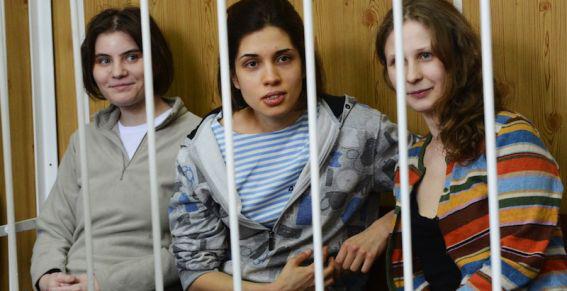
Members of punk band Pussy Riot – (L to R) Yekaterina Samutsevich, Nadezhda Tolokonnikova and Maria Alekhina – sit behind bars during their court hearing in Moscow
A court in Moscow has ruled that three members of the female punk group Pussy Riot must remain in custody for six months after singing a protest song in Moscow’s main Orthodox church, prompting Amnesty International to reiterate its call for their immediate release.
“These three activists have now been behind bars for months,awaiting a trial that should not be taking place, ” said Amnesty International Europe and Central Asia Programme Director John Dalhuisen.
“Even if the three arrested women did take part in the protest, the severity of the response of the Russian authorities and the detention on the serious criminal charge of hooliganism would not be a justifiable response to the peaceful – if, to many, offensive – expression of their political beliefs.”
via Reuters
Defence lawyer Mark Feigin said the court’s acquiescence to a prosecution request to hold Maria Alyokhina, Nadezhda Tolokonnikova and Yekaterina Samutsevich until January 13, 2013, showed Russian leaders had given orders for their conviction.
“Today’s decision only proves again that our role as defendants here is a pure formality,” Feigin told reporters after the hearing, which was closed to the media.
“There is a lot of evidence that the judge will disregard justice in favour of a pre-set instructions on how to rule, which have been handed down by the authorities. They want to find them guilty… to punish them with real jail time.
“It is not a process but a judicial reprisal,” he said.
Putin and the head of Russia’s Orthodox Church, Patriarch Kirill, are among more than 30 people Feigin and his two colleagues want to call to testify as witnesses in the trial.
After the Pussy Riot performance, Kirill said the Church was “under attack by persecutors”. The patriarch has often praised Putin and in February likened his 12-year rule to a “miracle of God”.
Though neither the president nor the patriarch is likely to testify, defence lawyers said the request pointed to those they believe were pulling strings behind the scenes.
“They are trying to make it look like an attack on Russia by some dark powers. It is just a theatre of the absurd, not a real court,” said Nikolai Polozov, another defence lawyer.
via The Guardian
[Pussy Riot] supporters say the powerful Orthodox church, which has close links with Putin, is behind the drive to keep the women in jail. Top church officials have come out in favour of their incarceration. They face up to seven years in prison on charges of hooliganism.
Pussy Riot erupted on the scene amid a wave of protest over Putin’s re-election as president. With bright balaclavas, rabid punk anthems and explicitly anti-government lyrics, they helped enliven Russia’s growing urban protest movement.
Friday’s pre-trial court hearing marked the formal start to the group’s trial. Pre-trial hearings are due to continue next week.
Many religious Russians who initially took offence at Pussy Riot’s church stunt have since called for their release. A poll released on Friday by the Levada Centre, an independent pollster, showed that 50% of Muscovites surveyed were against pursuing the criminal case against the three women, while 36% supported it.
To learn how you can help the three women in the Pussy Riot case and keep updated please visit:
// Please scroll down for English
/RU
Какая система искусств нужна нам?
Интернациональный коллектив организаторов платформы ArtLeaks и Майский Конгресс Творческих Работников (МКТР) приглашает к участию во Второй Ассамблее ArtLeaks, которая пройдет в Москве.
15-го июля 2012 года в 19 часов в пространстве Школа, Парк Искусств «Музеон»
Крымский вал, 2. Проезд: ст. метро “Парк культуры”, “Октябрьская” далее пешком; или на троллейбусе 10, “Б”, остановка “Парк культуры”
http://www.muzeon.ru/karta_proezda
Мы приглашаем к участию творческих работников – всех тех, кто постоянно сталкивается с нарушением своих базовых трудовых прав: тех, кто не получают вознаграждение за свой труд; тех, кого подставили, кинули и послали; тех, кто вынужден работать на десяти работах, но с трудом оплачивают аренду жилья и не успевают участвовать в культурной жизни.
Сегодня производство культуры является всё расширяющейся сферой занятости: с одной стороны, это место, где производятся новые смыслы и формы субъективности, где тестируются самые передовые формы занятости, но в то же время, именно здесь осуществляются самые вопиющие формы эксплуатации и контроля, где процесс извлечения прибыли оказывается ничем не ограничен и спекуляции заложены в саму основу производства.
Не будет преувеличением сказать, что современный мир культуры полностью повторяет общую структуру распределения ценностей в капиталистическом мире, где 3-5% участников процесса контролируют и распоряжаются 70-80% процентами его ресурсов (продажи работ, различные заказы, бюджеты производства, распил гос. грантов и т.д.) В культуре, как нигде ещё, доминируют принципы жесткой конкуренции, непрекращающейся борьбы меньшинства за еще большую степень подчинения общих ресурсов в свою пользу. Эта ситуация становится возможной за счет существования огромной резервной армии труда, позволяющей администраторам культуры основывать свою политику на культивировании жестких принципах псевдо-естественного отбора.
В тоже время нельзя забывать, что культурные процессы не могут быть редуцированы к голым производственным схемам. Система производства и воспроизводства иерархий и ценностей неминуемо вступает в принципиальный конфликт с самой природой свободного творческого акта. Культура обязана сохранять этот дилетантский, радостный подход простого человеческого раз-даривания своих ценностей, отказываясь подчиняться напрямую банальной логике спекуляций и ценообразования.
Можем ли мы вообразить себе такую систему искусства, которая бы не просто гарантировала всем ее участникам достойные условия работы, но стимулировала создание общего культурного пространства, развивающего полноту человеческих способностей в их стремлении к счастью и свободе?
Новая система нужна совсем не из соображений зависти к более успешным игрокам (в этом подло уверены большинство из тех кому удалось пробиться), а из простого понимания того, что капиталистический способ производства перестал быть прогрессивным, а все больше превращается в варварскую машину, калечащую и сдерживающую возможности развития человечества.
В Москве и в России все эти вопросы стоят особенно остро, так как именно здесь участники творческого процесса сталкиваются с наиболее вопиющими формами эксплуатации своего труда, наступлением варварства, открытым цинизмом, грязными махинациями и жесткими формами цензурных репрессий. Каким образом мы готовы им противостоять? Какие формы описаний этих ситуаций мы можем предложить, которые будут не просто очередным свидетельством о несправедливости, но могли бы стать примером организации эффективных мер противодействия различным ситуациям унижения, с которыми сталкиваются творческие работники повседневно в своей активности? Какие есть возможности развития новых форм институциональной критики и в каких форматах создания и распространения она может быть наиболее действенна?
Именно об этом мы предлагаем задуматься вместе всем участникам Московской Ассамблее творческих работников, иницированной платформой ArtLeaks.
В московской ассамблее примут участие со стороны ArtLeaks – Корина Апостол, Жан-Батист Ноди (Société Réaliste), Давид Рифф, Дмитрий Виленский и Николай Олейников (коллектив Что Делать?)
/EN
What art system do we need?
International representatives of the platforms ArtLeaks and The May Congress of Creative Workers (MKTR: http://may-congress.ru/) invite you to take part in the Second ArtLeaks Assembly to be held in Moscow on July 15th, 2012 at 7 PM at Shkola, Park Isskustv “Muzeon.”
Directions: Krymsky Val 2, Metro station “Park Kultury,” “Oktyabrskaya,”; or Bus 10, “B”, station “Park Kultury”
Map: http://www.muzeon.ru/karta_proezda
About Shkola/ School Pavilion (in English): http://www.march.ru/en/news/18/
We extend this call to participation to all cultural workers who are constantly confronted with the violation of their basic labor rights: those who are routinely not compensated for their work, those who have been slandered, ousted and blacklisted for raising their voice, those who have to work several jobs to make ends meet but still encounter great difficulty in paying their rent and do not have time to participate in cultural life.
Today, the production of culture is an expanding sphere of activity: on the one hand, it is the space where new meanings and forms of subjectivity are created and where the most radical forms of activity are tested – yet at the same time it is precisely at this juncture where we encounter some of the most glaring forms of exploitation and control, where the gain of profit seems unrestricted and speculation is embedded in the very logic of production.
Without exaggeration, one can claim that contemporary culture follows the general structure of the distribution of wealth in the capitalist world, where 3-5% of the participants control and dis-pose of 70-80% of resources (material and immaterial labor, production budgets, state grants etc.). As it is the case in other spheres of human activity, art and culture are dominated by principles of fierce competition, forcing the subordinated majority into a bitter struggle for its subsistence. This situation is made possible by the existence of a huge reservoir of labor, which cultural administrators manage according to politics that cultivate stringent principles of pseudo-natural selection.
At the same time we must not forget that cultural processes cannot be reduced to simply production schemes. The system of production and reproduction of hierarchies and values inevitably comes into conflict with the very nature of free creative acts. Culture must retain its amateurish, joyful approach, to freely share its values with society – it should refuse to conform directly to the banal logic of sale and speculation.
Can we imagine a different system of art and culture, which would not only guarantee decent working conditions to the majority of its participants, but also stimulate the creation of a common cultural sphere, one that would allow cultural workers to unleash their full potential in furthering our quest for happiness and freedom?
In Moscow in particular and in Russia generally, the aforementioned issues are particularly acute, since it is precisely here that cultural workers are faced with the most violent forms of exploitation of their labor, with open forms of cynicism and manipulation and, last but not least with severe forms of repression in the guise of manipulation and censorship. Yet most artists and cultural producers have no choice but to accept this situation, however absurd or abnormal it may sometimes seem, dreaming of a “normalcy” in the international scene.
Yet there too, there are problems, as well as people trying to deal with them. How can we organize ourselves internationally to oppose these abuses? Which forms can we find to talk about the absurd and breathtakingly exploitative situations we often find ourselves in? What are the potentials of a new comparative institutional critique, written by cultural workers, and which formats could it include? How can we break the silence?
This is what we propose to discuss and think through with all the participants of the assembly for cultural workers in Moscow, initiated by the platform ArtLeaks.
The Second ArtLeaks Working Assembly in Moscow will be facilitated by Corina Apostol, Jean-Baptiste Naudy (Société Réaliste), David Riff, Dmitry Vilensky and Nikolay Oleynikov (Chto Delat?)
Main facilitators: Corina Apostol, Vlad Morariu, David Riff, Dmitry Vilensky, Raluca Voinea
Through Skype: The Bureau of Melodramatic Research, Vladan Jeremic of Biro Beograd and Zampa di Leone collective, Jean-Baptiste Naudy of Société Réaliste, Tanja Ostojic / Art & Economics Group, Marsha Bradfield / Critical Practice
ArtLeaks members organized our first working assembly followed by a workshop around the issues that are at the core of our mission, namely exposing and dealing with instances of abuse, corruption and exploitation in the artworld. These public events presented a unique opportunity to directly engage the conditions of cultural work that affect cultural workers: those from the traditionally creative fields and those involved in cultural production. In doing so we tried to bridge historical connections with existing pre-conditions of cultural workers self-organization, as well as to build on these models towards international geo-political engagement. We strongly believe that issues of censorship and abuse cannot be divorced from specific politico-economic contexts and further, that they should be raised in connection with new forms of class consciousness in the artistic and cultural fields.
Given the current problematic politics of sponsorship in contemporary art and culture, the intense exploitation of cultural labor and widespread abuse and corruption perpetuated by certain cultural managers and institutions, we sought to engage participants in imagining possibilities for transversal alliances and collective activism. We also sought to receive critique on how to improve the way ArtLeaks is currently functioning and to announce the upcoming launch of our online journal, which will be dedicated to cultural workers’ rights and related struggles.
The events were well attended by local and international artists, theoreticians and activists, as well as members of Occupy Museums and Arts&Labor (NYC), Haben und Brauchen (Berlin), Rosa Perutz collective (Berlin), Interflugs (Berlin) etc.
ArtLeaks Public Assembly, June 3rd, Flutgraben
Corina Apostol gave a brief overview of how ArtLeaks came into being, its mission and gave examples of some concrete cases that were submitted in the year since the platform was launched. ArtLeaks emerged out the necessity to address the bad practices we experienced and witnessed at Pavilion UniCredit in Bucharest – but grew to become an international open platform where similar stories could be shared and addressed. Our platform publicly revealed issues which we face frequently in the workplace: dealing with abusive directors and managers of cultural institutions and having to work in restrictive institutional spaces, controlled by corporations and state organizations embedded in a tight mesh of capital and power; the suspension of critical discourse as a result of all these forces, under the pretext of other existing “emergencies” such as lack of funds, disappearing exhibition spaces, the shrinking of public space; instances when those who criticize bad practices are accused that they are not preoccupied with continuity, stability and certain perennial values which have little to do with actual needs, urgencies or demands of a community; instances of isolation, being obstructed or even being laid off for raising one’s voice.
At the core of our mission is the belief that if one doesn’t raise these problems as part of a larger system of inequality and exploitation, things will not change but become more cemented as they are, normalizing abuses, deepening historical pre-conditions that de-professionalize de-politicize our social mission. ArtLeaks’ mission is not only about naming and shaming, but exposing criminal violation of cultural workers’ rights in general – to this end we make an effort to publish both sides of a conflict and invite commentary from the international community. By engendering an open space for discussion and shedding light on difficult situations, necessary tensions are generated and solutions can begin to be formulated collectively.
David Riff emphasized that one of the most important things ArtLeaks should take into account in its development is finding modes of narrations about abuses which are not so obvious, developing borderline cases in which we are all involved, not only blatant instances of exploitation. ArtLeaks should grow beyond exposing abuses by tackling systemic imbalances. He exemplified that there may be cases with very good conditions of productions, but scenarios in which the critical meaning of artists’ work is expropriated by people who are working in the completely opposite directions. It is very important to find ways to talk about these situations, to try to identify more systemic exploitation and create a pressure that doesn’t just lead to the collapse of a project. Tackling systemic exploitation also means tackling capitalist logic, which is the direction in which ArtLeaks should be functioning.
Vlad Morariu highlighted the overlap between ArtLeaks and the more canonized types of institutional critique in the West which one reads about in art-historical reviews, such as the Art Workers Coalition, The Guerrilla Art Action Group, Art & Language, PAD/D, Group Material. In this context, he emphasized that institutional critique is not something of the past that has been exhausted, but still holds relevance. Equally significant, ArtLeaks also deals with cases from places like India, Mexico, UAE that are not considered the center of the artworld, and generally ignored from the discussions. Mentioning these cases bears weight on rearticulating institutional critique as a practice whose tasks are constantly reformulated by taking into account the specificity of contexts wherein it emerges. We must also include these other contexts when we talk about an international struggle of cultural workers. Another question is whether exposure is enough, and what can we do after exposing these cases of exploitation, how can we act given this knowledge. Finally, while systemic repression is very important, it is equally urgent to deal with self-repression, which happens before we enter institutional spaces.
Raluca Voinea declared that she joined ArtLeaks in solidarity with the conflict situation around the Bucharest art scene, while also fully supporting the idea of making the platform wider for broader participation. She emphasized that she is also interested in how to take the project further, making it not only about exposure but how to join forces and change a system which is broken. It is not really so much about revealing what is in the open, what everyone knows already but revealing the mechanisms that perpetuates the status quo indefinitely. These are not only the mechanisms of the art world but also the ways in which society works today – and we should also think how we as cultural workers can act in changing the broader systems in which we are functioning. It is also important to recognize that as soon as one steps outside the art system in the West cultural work seems to count less and less, and how culture in general seems to have less of a meaning.
Dmitry Vilensky approached ArtLeaks’ imperative “It is time to break the silence!” through feminist psychoanalytical analysis of domestic violence. Similarly, abuses and repression in the artworld happen inside a system, and like in a family it is very hard to speak up. But unless we articulate the cycle of violence we can hardly move forward to change the dynamic, which is related to everyday systemic exploitation. It is also important to find ways to narrate these cases – for example in the initial case of ArtLeaks around Pavilion Unicredit when the artists and curators experienced incredible abuse and very unprofessional relations from the side of the institution, it seemed like there was no network of support to resist or change the course of events. When ArtLeaks co-founders started discussing this and other similar situations, it seemed like there was a great urgency to generate something collectively. We therefore modestly created an online spot where other cultural workers could share their plights, discuss and have access to this type of information. At this point, ArtLeaks is building an online journal dedicated to labor rights and abuse in art and culture. We want to emphasize that it is not only about particular conditions of production but also about who controls the means of production. Finally, the group identity of ArtLeaks is open to anyone who wants to join us and work alongside us – it is a collective platform for empowerment of cultural workers and the art community.
Vladan Jeremic addressed the issues raised by ArtLeaks from his position as an activist, cultural worker and political worker in Belgrade, Serbia. He joined ArtLeaks as this seemed to him the first direct articulation of the possibility to open up the discourse around conditions of cultural work and reflect on a global level. This is not always possible, as there are a lot of situations of violent corruption and criminal activities that go on in contemporary art and culture about which it is very difficult to speak out without a legal frame. Jeremic believes that the first case profiled on ArtLeaks around Pavilion Unicredit was very effective; nevertheless, ArtLeaks should not focus so much on strictly censorship and freedom of expression, but rather on how these may be politically articulated and contextualized. Otherwise we may run into the situation of perpetuating a neo-liberal, pro-democracy fake discourse that lacks political contextualization and serves hegemonic structures. Jeremic also suggested that a strategy for accountability in the art circuit would be to call all organizers of cultural events to transparently share their budget and the working relation dynamics. As generally people like to see art as ethically innocent, we should observe art production in Marxist terms and introduce the concept of “misuse in art.” Thus we could challenge the petit-bourgeois middle class producers that protect this image of art as “clean” to maintain their own status.
Jean-Baptiste Naudy spoke on behalf of the cooperative Société Réaliste. He declared that he joined ArtLeaks out of solidarity with the clear case of corruption and abuse around the Bucharest Biennale – which showed how an international art event can mis-use radical artistic discourse while engaging in dirty neo-liberal practices. ArtLeaks currently has a fluid structure, according to which any cultural worker may join and work together with us. We should take this structure to also generate events in public space, collective actions, political interventions outside of virtual space. We need to create a sense of urgency and solidarity around systemic exploitation. Our factories are the factories of art, we must take back our institutions and for this we must fight together. Whether we are artists, art historians, critics, curators, we have common interests – we are all cultural workers working in this economy and we must take back the means of production. We in ArtLeaks should try to remain as communalistic, horizontal and international as we are at the moment. All of must continue, through our own means, to break the capitalist logic that is expressed in the field of art and culture as well as in other fields of society.
The Bureau of Melodramatic Research suggested that we also take into consideration how the capital of emotions is used and mis-used for economic and political purposes. From Plato to Niechzche and beyond, philosophy is obsessed with tragedy – what would it be like it to have a philosophy instead of a melodrama? Here, the members of the Bureau referred specifically to Michel Foucault’s concerns about recovering the concept of parrhesia, the physical and mental space which would allow one to say everything she has in mind. One wouldn’t hide anything, but open her up to other people through discourse. At stake here is a complete and exact account of what the speaker has in mind so that, to put it in Foucault’s words, the audience is able to comprehend exactly what the speaker thinks. What would it mean to adopt the philosophy of melodrama for ArtLeaks? In our case we cannot simply use an external and detached critique which in a way has been characteristic of classical activism and trade unionism – we should explore other ways of action. We have to recognize that standing in opposition implies both financial and emotional aspects. We must address these claims of detachment and distance, which are patriarchal and hegemonic. Instead, the Bureau proposed an acceptance of the internal position that cultural workers have, to accept that we are acting from uncertain ground – we are all entangled in the art system which we denounce – so how do we address the illusion of autonomy, this detached critique?
Reactions and comments from the audience
It is important to recognize that cultural workers are generally afraid to question the system, to question the gallery or the museum, they are afraid to ask for contracts and this is deeply embedded in our relations with ourselves and with institutions.
Blithe Riley from Occupy Arts&Labor emphasized in response that international solidarity is an idea that a lot of activist groups are excited about. At the same time it is very important to recognize that there are many artworlds, not just one and we tend to focus on the top tier, or “the West” more generally. We should strive to connect with different labor groups and explore models for alternative economies. An example of a successful boycotting campaign is the Gulf Labor Coalition: cultural workers refused to participate in museum exhibitions unless the exploitation of the workers building the museum ceased. But it is more common that if a cultural worker refuses to participate in a project because they are not treated well or because the project is dubious in itself, there is probably going to be someone else taking their place. Articulating these instances via ArtLeaks could empower them in the particular situation.
Developing a glossary or a vocabulary would be helpful in adjusting terminology between the current members of ArtLeaks and potentially new members, and also relating our project to historically similar actions. It could also include a regional context index where areas of cultural and artistic work could be framed. The language of trade unions who fight for workers’ rights could be adapted to cultural production workers, which may help these workers to speak openly about their grievances and legitimize them, and thus organize around. This was also one of the successful outcomes of the assembly, as work on such a glossary has already started on discussion groups that were created in the aftermath of the event.
The local situation in Berlin was also addressed, especially the Berlin Biennale. Local activist considered it a very problematic as it presented itself as a sort of left-wing attack on the ways in which the art world normally functions, but under the guise of a very progressive agenda cultural workers were also being abused there and corruption was taking place. We have to recognize that cultural workers also abuse other cultural workers for their own economies or to garner attention for themselves. While the call for solidarity is welcome, we should also think about how to respond to these kind of practices, and our need to gain attention in the art system.
Marsha Bradfield of Critical Practice and Precarious Workers Brigade (PWB) drew our attention to the fact that while exposure, naming and shaming is important it is also vital to give praise to good practices, to celebrate these. Furthermore, what incentives do employers have to treat cultural workers fairly, to have good practices. Unless we answer these basic questions, platforms like ArtLeaks and PWB can become an end in itself, and not generate something useful. So we have to ask ourselves what do we really want and how we can explain this in a straightforward, clear way. ArtLeaks should not be about retaliation, or simple justice, but about a broader concept of justice.
What it at stake here is also a different type of art community, not just abuse of labor laws. We should also discuss about how people that clean up our exhibition spaces are treated; or how interns are being exploited so frequently and violently – as they are largely treated as a reservoir of free labor.
Cultural workers need to reclaim their dignity, and this starts with the professional protocol in our workplaces. Nowadays it seems like it’s a shame to be an artist or a curator or a writer – that it is more important to be a social worker, to solve conflicts, to be useful in other ways. We are demanded results and effectiveness. So we should first clean-up our art factories and then find common ground with trade unions and other factories and workers.
Another important issue is what comes out of exposing and how we can link this to mobilization. Are anonymity or identification along class lines productive ways to organize around art workers’ struggles? And how safe does one feel to expose something on ArtLeaks.
ArtLeaks proposes that one has to have courage to expose, to take this responsibility. Furhtermore, in the art world it is almost impossible to be anonymous. We are in the situation of living in a close knit community, like that of a small town – unlike the exposures we read about on Wikileaks. We all know which projects go on at a given moment and who is involved in them– so it makes no little sense to hide, although we respect anonymity when cultural workers request of us.
It may be that it is precisely the close-knit, leakish nature of the art world that makes exploitation possible at the same time that makes it impossible to hide. It is perhaps useful to have international observers comment on local cases to break this cycle – to have problems stated from the outside of a local context.
Most cultural workers are struggling to survive and to do their projects – mobilization is very difficult therefore, but it is important to try to organize these kinds of gatherings and build coalitions in the future. There is a lot of interest in continuing these kind of projects of emancipation and solidarity, but in the end it usually happens that a very small group of people end up doing the basics, the ground work. There are many uplifting ideas around what needs to be changed and great possibilities but one has put in the effort to make them happen.
Workshop with Interflugs, June 4th, West Germany
The main focus of the workshop was to discus editorial strategies for the forthcoming ArtLeaks journal and continue exploring possibilities for coalitions and direct actions.
Corina Apostol, Vlad Morariu, David Riff, Dmitry Vilensy and Raluca Voinea raised the following main points to work on regarding the ArtLeaks journal: the structure of the journal itself, what narrative strategies could be used to expose clear cases of abuse as well as less obvious ones, and how to link these to systemic inequalities; continuing to expand on narrative devices, including visual narration and media activist materials; producing comparative analysis of cases and formulating methodologies; in what ways we can exert pressure through leaking information and what is to be done after exposure; the question of confronting institutions, demanding that they be responsible for more fair treatment (for example, making them sign the No Fee Statement introduced on ArtLeaks); discussing the Berlin Biennale as a concrete situation, in a certain historical moment.
Reactions and comments from the audience
The idea of an art assembly was introduced by Ivor Stodolsky of Perpetuum Mobile. The mission of the art assembly would be to analyze and solve cases: inviting both sides of a conflict and anyone that may be interested, presenting the case of aggrieved cultural workers in front of a jury which then extracts from that particular situation the criteria according to which this or that has been done wrong, and how it could be done differently, to turn it into a positive situation. This would ensure more transparency and open the process of “leaking” towards a form of peer-reviewing. It could also help us trace systemic imbalances by comparing cases which are similar and push the project towards formulating methodologies.
The idea of an art assembly may be useful in some cases, but ArtLeaks members feel like it is not important to focus so much on finding a reconciliation organ, but to also build outrage and indignation. An art assembly may placate some of the people involved but instead of remaining trapped in too much dialogue, we should also work towards a steady rise of indignation and an intensification of struggles. We also believe that there may be circumstances in which aggrieved cultural workers may want to engage in a thoughtful dialogue, but this is not always possible. We emphasize that different context require different mechanisms or methodologies that may not work in other places.
ArtLeaks should develop a structure that is more open for broader participation and continue organizing meetings with concrete goals depending on the context or specific conflict situations. ArtLeaks should challenge and provoke institutions but also to build constructive relationships and alliances with them. Institutions are not our main enemy, instead we should have in mind broader, systemic problems that need to be rectified or transformed. ArtLeaks should also develop in the direction of mapping different activist responses to conflicts and abuses and sharing these experiences across localities, as there are diverse politics at work in different parts of the globe.
After general discussions, the workshop split in two main working groups which discussed the following topics
– Writing about specific cases and modes of narration that are politically effective
– Methodologies
– Anonymity and representation
– Alliances that cultural workers are trying to build for fighting together, to reclaim the factories of cultural production
– Creating a board of standards for ethical behavior
– How to address systemic problems and inequalities, how to recreate or re-establish art and culture
– Berlin Biennale as a representative case for finding possibilities of criticism in the context of the Berlin art community
Conclusions and comments of the two working groups
Group 1
– 3 main distinctions: what ArtLeaks can do concretely, what it concretely represent to an international community of art workers, how it can be used to exchange local knowledge and experiences with an international community
– This very meeting can be used to forge more sustainable connections with artists groups internationally; ArtLeaks can’t solve everyone’s problems, it has to work in tandem with other self-organizing initiatives
– This moment is a very interesting situation: through ArtLeaks’ initiative a lot of international cultural workers came together; this moment should be used to create a platform that could work independently of Artleaks, uniting groups presently in the space
– ArtLeaks is a tool to expose and mediate knowledge – a form of investigative journalism that can be used to form alliances – but the moment of exposure cannot fully address self-organization
– The recognized urgent necessity for syndicalizing, unionizing at the local level and forming cosmopolitan alliances
– Concrete plan of action for cultural workers in Berlin: to create a mailing list, a group platform that would facilitate staying in contact and forging connections – a Cultural Workers Association; organizing a meeting in the next two weeks to deepen the connections that were already formed with the occasion of these events
– Suggestions for ArtLeaks: to create a mailing list on google where people can subscribe, cases could be discussed, context could be clarified, there would be inner accountability; this would open ArtLeaks to a peer to peer review, which could be a good way to broaden project, make it an overarching coalition structure.
Group 2
– The problem of narrating cases is related to knowledge and local insight, which should be developed more on ArtLeaks; finding a common frame for discussion is related to translation and languages used: for example, creating a basic glossary for concepts and local contexts descriptions
– Editing and narration problems can be solved through peer to peer reviews, sharing concrete experiences, and by suggesting not one, but several courses of action
– There is a necessity to have an ethical system, methodology, tools for emancipation – to answer the question what do we want as a collective?
– Problems that commercial tendencies are defining more and more our reality
– We need to distinguish between universal ethics which most of us reject and how a different ethic system(s) could be formulated
– We should also address the fact that art is producing a lot of discussions related to leftist culture, but almost always according to capitalist logic
– Human life should be more important than the cultural products
– Finding ways to discussing and experiment, arriving at concrete proposals, while also keeping in mind that creating emancipatory knowledge is a way to start to changing the world
– Problem of legitimation in ArtLeaks should be addressed: who decides which cases are important, who can participate; ArtLeaks should develop a system that is more accountable by opening itself to more participation
– Diversifying ArtLeaks – trying to exert some kind of pressure on the system by trying not to be the same people all the time who are at the forefront of these activist projects
A branch of cultural workers who participated in the ArtLeaks assemblies decided to continue and meet each other in Berlin. They constituted a ‘Cultural Workers Association’ which is currently open for participation to anyone who would like to solidarize around cultural workers’ struggles in the local context and globally. The members of the platform will be involved, in the next several months, in the organization of a series of meetings, whose purpose is to make the project known and invite possible collaborators to join the cause.
Photos by Olga Egorova (Tsaplya) at the ArtLeaks Assembly at Flutgraben, Graphics by Federico Geller in response to the discussions
We invite others who participated in our Assembly and Workshop that would like to add any information that may be missing from this report to contribute by leaving us comments below. We will incorporate these into our report in a timely manner.
Many thanks go out to Flutgraben, Interflugs and West Germany for hosting us in Berlin and to all those who attended and participated in the discussions!
 ArtLeaks