Updates
ACT NOW! Submit your story to ArtLeaks and end the silence on exploitation and censorship! Please see the submission guidelines in the "Artleak Your Case" page
Submitted and current instances of abuse are in the "Cases" section
To find out more about us and how to contribute to our struggles, please go to the "About ArtLeaks" page
Please consult "Further Reading" for some critical texts that relate to our struggles
For more platforms dedicated to cultural workers' rights please see "Related Causes"
For past and upcoming ArtLeaks presentations and initiatives please go to "Public Actions"
Centre for Contemporary Art Ujazdowski Castle: Workers’ Protest Letters (Warsaw, Poland)
Warsaw, May 2012
Director Fabio Cavallucci
Dear Sir,
With the good of the Centre for Contemporary Art Ujazdowski Castle in mind, we would like to express our concern and disillusionment at the way in which you have carried out the mission of the CCA, and the effects of this thus far. This letter is written after a year and a half of your working in our institution. We consider this to be sufficient time to be able to formulate an assessment. Regrettably, for reasons listed in detail below, our assessment is negative. The CCA team has been and still is aware of the need for changes in our institution. We expected that you would be the person to introduce them, and for this reason we gave you our full support, both in the course of the competition for the post of director, as well as following its completion. We began working with you in the Autumn of 2010, full of enthusiasm and hope for the future. We put our trust in you. And, we regret to say, that it has been betrayed you have betrayed it.
We hereby object to the further deterioration of the standing of our institution, to your questioning of the skills and expertise of the staff, and to the squandering of public funds on events with weak concepts (e.g. Neue Wilde, CCA TV, Transistor, Laboratory of the Future Regress/Progress, Four Rooms). We understand the “right to make mistakes”, which you have so often emphasized. However, after the almost two years which have passed since the competition for director, it seems that these mistakes are not followed by any conclusions, worse still, their number has increased rather than decreased. Attached below is a list of selected examples of negligence, ill-considered actions, absurdities, director’s cynicism and excessive ambition.
We are convinced that a national institution of the rank of the CCA Ujazdowski Castle deserves a coherent, well-planned program. Developing a well thought-out, intellectually and artistically significant program requires, we believe, the possibility of an open discussion, adequate time for research, critical self-reflection within the institution, the ability for the curator to take the responsibility for the conceptual value of a project, as well as appropriately acknowledging the competence of the staff. In the course of work on the program, instead of offering us professional arguments, you have presented yourself as a “charismatic leader” who literally demands that we “believe” in him. It is our opinion that developing the program of an institution is not a matter of “belief in a leader”, but rather of professional knowledge, intellectual effort, and critical reflection. Sadly, with every difference of opinion between yourself and the team, you use exactly the same argument – “I’m the director here”. We are well aware of this fact, however, we do not find it sufficient as a genuine argument. It merely expresses the authority that you have been entrusted with, but says little of your competence. To the contrary, we believe that forcing your own opinion – in which you are often alone – by means of orders is a sign of your professional helplessness. In other words, we believe that it is impossible to develop a cultural proposal for a democratic society using authoritarian methods.
It was as a result of such practices that, as of March 2012, the CCA Ujazdowski Castle had no confirmed plans for 2013, with only vague proposals for the second half of the year. You yourself described the plans submitted to the Ministry of Culture as highly tentative. This situation has not been unusual. From the moment you took your post, the program of our institution has been developed by means of improvisation. Decisions concerning specific projects are being made at the last minute, leaving curators no time for adequate realization and for work with artists. The plans of the CCA remain unclear even with respect to the coming weeks (Neue Wilde, Cognitive Situations, Laboratory of the Future Regress/Progress…). It was during your term that the CCA became familiar with the hitherto unknown instrument of a “gap filler”, that is, haphazardly planned projects which serve to fill a gap in the program. In spite of this fact, some of the CCA’s exhibition rooms have remained empty for months (Laboratory Gallery, Entrance Gallery, certain rooms of the CCA Collection Gallery…).
We consider the program you proposed to be a simulation of coherence, achieved by means of three key programs: Postdocument, Office of Possibilities, Laboratory of the Future. This proposal was merely a compilation of distorted ideas that originally served to motivate the curators at the CCA; ideas which were used by you in a selective and superficial manner. This is evident by the fact that the curators have withdrawn from work on specific projects, the “strategic” programs were reduced to but a few events, scattered in time (e.g. the program of Office of Possibilities was cut to five lectures held over the last one and half year, while Postdocument consists of one exhibition instead of eight as initially proposed…). Bad practices at work include forcing curators to change the concept of an exhibition, appropriating the ideas of others and treating them as your own, as well as open statements that “all that matters is the strategy of the director, not the artist”.
Mistakes resulting from ill-considered and inappropriately carried out experiments are one thing, whereas shifting the responsibility for them to staff, accompanied by systematic actions aimed the disintegration of the output of the team of CCA Ujazdowski Castle are another. What we object to, apart from programming mistakes and costly initiatives that are bound to fail, are the bad practices that you have introduced to our institution. These include:
– Lack of mutual trust, evident in the fact that the Director records the meetings with programming staff.
– Screaming and venting emotions at the staff.
– Humiliating the staff by ridiculing their program proposals.
– Simulating an open discussion while at the same time taking arbitrary organizational and programming decisions.
– Blocking the development of staff and blocking cooperation with other national cultural institutions which are treated by the Director as competition rather than entities co-creating national culture.
– Repeated suggestions to retire, addressed to members of the staff who raise doubts as to the decisions of the Director (according to the rule: “If you don’t believe in me, you’re always free to go”).
– Misrepresenting conversations with the staff, even including departures from the truth.
– Introducing a ban on conversations between staff members, including the staff of one department.
– Threatening the staff with an obligation of confidence and risk of firing them (and hiring young, less-demanding staff, or even volunteers).
– Encumbering some staff members with excessive duties, including work on weekends and holidays, while keeping other staff members with no assignments for weeks and months on end.
After numerous meetings between ourselves and external consultations we have come to believe that the actions mentioned above are on the verge of mobbing. If need be, we have detailed accounts of these actions of the Director in our possession. We would also like to express our concern over the slow pace of reforms of our institution resulting from a lack of understanding of the specificity of the place, but also administrative negligence, unfamiliarity with the current regulations, the structure of the institution, and the scope of the duties of the staff. The continuing rotation of employees and disintegration of the team concerns not only the programming staff, but also administrative posts. The resignation of deputy director Wojciech Gorczyca, the resignation of the head of HR department, and the head of Laboratory, are but a few examples of resignations of employees who were aware of risks connected with negligence on the level of the basic management of our workplace.
Since our previous letter was not treated seriously by the director but, to the contrary, triggered a surge of negative phenomena, we address a copy of this letter to the attention of the Ministry of Culture and National Heritage, which has governance of our institution.
The change of the post of Director was to be a step forward, instead it seems we have made a few steps back. An objectively better financial situation as ensured by the governing institution does not translate into an improvement of the condition of our institution. Being aware that the CCA Ujazdowski Castle, a place with which we are professionally connected, is being marginalized, concerned with the future of our institution and hoping to protect the output of years of our work, we call on you to change your actions or step down from your position.
Programming Section of the CCA Ujazdowski Castle
at the Independent Self-governing Trade Union Solidarność
THE BLACK BOOK
THE COLLECTION
– Lowering of the rank of the CCA collection and general lack of concern.
– Assembling exhibitions in a hurry, literally week by week, forcing curators to assemble exhibitions which have no invitations or theoretical preparation. In addition, as the result of director’s incompetence, a Cattalan’s exhibition crops up, and “something” has to be done.
PROJECT ROOM / LABORATORIUM
– The shutting down of Laboratory Gallery which operated for 20 years and was home to groundbreaking exhibitions of Polish art, among them those of Robert Kuśmirowski, Monika Sosnowska, Joanna Rajkowska… and the creation, in spite of resistance from curators, of a “new” space, the so-called PEKAO S.A. PROJECT ROOM (the name was suggested by the director, the sponsor himself did not request that its company be mentioned), the choice of Waliszewska in spite of strong objections, the choice of the room in spite of the strong objection.
– The establishing of a committee which de facto takes no decisions, but is expected to take responsibility.
SAMSUNG ART MASTER
– Acting to the detriment of the prestigious competition and putting the collaboration at risk.
INTERNATIONAL COLLABORATION
– The Adam Mickiewicz Institute/Cologne issue (publicity fiasco, faux pas).
– Recent lack of permission for AIR to participate in a project financed by the European Commission (lack of permission for a letter of partnership for an interesting project!).
– Blocking and preventing meetings with curators, guests of the CCA.
– Presidency of the EU: no one knows what proposals were submitted, the only thing known was that it made no sense and had no chance for funding (the sum was allegedly very high), as a result of which we were probably the only institution in the country that, owing to the director’s incompetence, did not take an active part in the program (the director later explained that he gave a wrong sum while submitting the application because he did not yet know the exchange rate between Euro and Polish zloty).
PUBLICATIONS
– The decline of the publishing program. The number of catalogs and other printed materials has dropped to minimum, and if they are published at all it is only owing to the persistence of the curators (Enclave, Kara Walker).
– In spite of months-long negotiations the vision for the development of Obieg magazine was rejected without any cause, which has resulted in a loss of standing and the marginalization of the title. It is unacceptable to claim that the magazine has insufficient funding and, at the same time, launch a different magazine, Tranzystor, in the same institution which, despite publishing three issues, remains a completely unknown magazine that, unfortunately, is not read.
TELEVISION
– Ever since starting the post the director has been planning the development of a television program while disregarding the experience of staff as well as ignoring the fact that the CCA has been running such a program since the 1990s (originally as part of the Video Collections, and since 2005 as OBIEG.TV). Subsequently, costly attempts made by the director have turned out to be one-off endeavors which discredited the institution and its staff, as a result of which renowned journalists (Anna Theiss, Karolina Korwin-Piotrowska), and critics (Anda Rottenberg), have ceased their collaboration with the CCA. The biggest organizational fiasco was the one-off show in honor of Maurizio Cattelan, the director’s friend, after which TVP Kultura terminated their collaboration on the television project. The director continues to pursue this costly program hiring new coordinators who step down at their own request after several months. At the same time nothing is being done to organize the documentation of the CCA and settle the fundamental issues concerning the copyrights to materials in possession of the institution.
– Transferring the head of the Wideoteka Department to the Laboratory building, sacking him, and then de facto dissolving the Department means that neither the staff nor the interested parties can access the institution’s archives. Unique analogue materials are not being cataloged, digitized, and made accessible, instead they are collected in cardboard boxes and moved from place to place. Without any professional supervision they are at risk of being dispersed or even destroyed.
FILM PRODUCTION
– Film production (or, in fact, submitting an application to the Polish Film Institute for film production) was an idea imposed from above, with no regard for the regulations and requirements of the Institute, lack of budget and genuine vision; subsequent projects were rejected for curious reasons: Norman Leto – because he would not use the CCA’s equipment; Oskar Dawicki and his nature film – “the film is impossible to produce” (despite the experience of one member of the staff in this field!); Angnieszka Polska – complete ignorance of the artist, attempts to force through an incomplete project behind the artist’s back (an extremely unpleasant situation).
– The book on mockumentaries – “money is not a problem, but the CCA has no publishing strategy which is why we won’t publish the book” (the issue required risking 10 000 zloty which would be paid off from the sales proceeds).
INTERNATIONAL EXHIBITIONS PROGRAM
– Not hiring anyone for the vacant post and forfeiting the output/contacts of the department.
– An outrageous discharge and a costly settlement.
THREE-YEAR PROGRAMS
– Laboratory of the Future: uncoordinated, last-minute actions which transformed the institution’s flagship program into a series of random exhibitions, inaccessible to the public and critics
– A scandal with the application for the Office of Possibilities to the city – at the request of the director we prepared an application involving all departments of the CCA, this application was on the way to the city office when we learned by phone that we are eventually forbidden to submit.
– having accepted the curatorial program Postdocument, proposed in the Autumn of 2010, the director made “corrections”, rejecting all eight exhibitions that formed the project. The arguments used were that these are not artists but photographers, what is more, they are young and from Poland. The exhibitions were rejected February 2011, that is less than two months before the opening of the first of the planned shows. As a result, the exhibition of Rafal Milach could be seen in Zacheta (and will be currently shown at C/O in Berlin), while the show of Lukasz Trzcinski was on view at Contretype in Brussels (Autumn 2011), and is currently presented at Kronika in Bytom. Wojciech Wieteska will have an exhibition at Atlas Sztuki in Lódz, while Chris Niedenthal at the CCA Laznia in Gdansk. The aforementioned exhibitions were included in the program proposal of the new director sent to the Ministry of Culture and National Heritage.
– since the exhibitions were rejected we had to withdraw from the accompanying events (meetings, film screenings), this also undermined the authority of CCA staff who established collaboration with partners in Poland (Era New Horizons) and abroad (Hatje Cantz, C/O Berlin).
– after the “corrections” to the three-year program Postdocument, it was possible to negotiate, in the Autumn of 2011, one exhibition which would inaugurate the program in February 2012. This means that the time necessary to prepare the exhibition was little more than four months (not counting holiday breaks), making it effectively impossible to prepare the catalog, arrange certain loans, and raising the cost of transport for works from abroad.
– still before the opening of the exhibition Postdocument, despite renewed attempts, it was impossible to establish the actual content of the program marketed as one of the three key programs of the CCA. Until the end of the Missing Documents show no work on any exhibition or event that would be part of this project was underway. The director came to the conclusion that he would wait and see what happens next and we will do something later. He also withdrew from his earlier decision to include an exhibition of Harun Farocki in the project, as the program of Postdocument would be “too strong”. Subsequent propositions for exhibitions were dismissed by the director as groundless (including shows of such renowned artists as Alfredo Jaar), while the planned international exhibition was thwarted at the outset with the ban on conversations and meetings placed on the curators by the director.
ACCOMPANYING EVENTS PROGRAM
– the project Eco-Summer was an idea imposed by the director and rejected by the curators. In spite of that, we were forced to hastily develop a program and application to the city which had no chances for success; in the case of cinema event the list of films was imposed and included works which approach the subject from a literal and not very innovative perspective (the list we proposed was rejected); the discussion about the project took place 8 hours before the deadline for applications; I was the one blamed the failure of the project; now a mysterious coordinator has been hired to work on the project on which we know nothing.
OTHER CHANCES THE INSTITUTION HAS WASTED
– Failing to submit an application to the National Audiovisual Institute for digitization.
Should we also include financial issues? And worse treatment than in other national institutions or even cultural centers?
_________________________________________________________________________
//EN
667th Company Branch of the Independent
Self-governing Trade Union Solidarnosc
at the Center for Contemporary Art
Ujazdowski Castle Jazdow 2
00-467 Warsaw
Warsaw, September 16, 2013
Mr. Fabio Cavallucci
Director
CCA Ujazdowski Castle
Dear Sir,
Due to information coming from various sources – including yourself – concerning the bad, if not outright disastrous financial situation of the CCA, we would like once again to express our concern over the way our institution is being managed and, at the same time, ask that you account for its present condition and its causes.
Owing to high subsidies from the Ministry of Culture and National Heritage, the CCA Ujazdowski Castle had an unprecedentedly high budget at its disposal in 2012 and 2013. More experienced staff members cannot remember a time in the past when we enjoyed such substantial means. In light of this, we are all the more surprised and concerned with the fact that subsequent projects slated for this year are being cancelled for financial reasons. The exhibitions of Norman Leto and Martha Rosler have already been rescheduled for the next year. We have recently learned that the 20th anniversary edition of the Rozdroże Festival, the project Lutosfera, as well as a project by Paweł Althamer and Artur Żmijewski are also open to question: practically all the key elements of the program left for 2013. These events have been thrown into doubt even though they receive outside funding, largely based on grants from the Ministry of Culture and National Heritage.
This is an unprecedented situation in the history of the CCA, no less unprecedented than the present high budget. We ask ourselves how is it possible that, having more money than ever at its disposal, the CCA is experiencing trouble carrying out key points of its program, such as Paweł Althamer’s project which has been planned for more than two years now.
We have been observing with growing concern the style in which the CCA Ujazdowski Castle is being managed, a style which, in our assessment, is not conducive to rational planning and the administration of project expenses.
The main points of our concern are as follows:
Lack of communication with the team. For more than a year now, all discussions concerning programming at the CCA have ceased. Programming has become a matter of your sole discretion, you alone take the decisions, which are not consulted with anyone, even the board of curators. Recently, you have even stopped informing your team about your plans; the programming staff of the CCA have no knowledge of what they will be working on in the coming months.
There was no attempt at evaluation of the project Green Jazdów, artistically and professionally dubious, which in this year’s budget amounts to c.a. 500 000 zloty. It is also worth mentioning that the project received no funding from the Municipal Office of Warsaw, while funding received from them last year had to be returned due to inappropriate spending.
We also feel we should vehemently object to certain methods of communicating with artists. The case in which an artist invited to contribute to the program was threatened with police action will certainly go down in the history of the CCA!
Inept management of the team and breaking of the labor code. Two flagrant examples are listed below:
a. A typical practice of assigning impossible (due to deadlines or insufficient funding) tasks, beyond the power and competence of the staff, such as asking a person hired for a trial period, with no professional experience and preparation, to create a budget amounting to a million zloty for the Polish-British exhibition, and tasking this person with the responsibility for it.
b. Expecting a person working under a “contract of mandate” (that is with no legally defined working hours) to work a minimum of eight hours a day (as is the case with a full contract of employment) while further stressing that this is in fact not enough anyway, and forcing individuals to work up to 10–12 hours a day or more (obviously, with no extra payment for work done); expecting people to work on weekends and to keep in phone contact with the director after working hours and on weekends.
These issues are discussed in detail in a memo from Henryk Gac, Representative for Programming (attached).
Lack of long-term planning. For an extended period now the confirmed plans of the CCA have not extended beyond a few months. The current season is no exception: the dates and lists of projects for the first half of 2014 are not confirmed, needless to say nor are those of the second half. Exhibitions are often cancelled or moved no more than two months before the official opening (e.g. Martha Rosler, Norman Leto), decisions concerning which projects are pursued are taken at the last moment (e.g. the exhibition culminating the project Laboratory of the Future). Chaos, as well as decisions about changes made on a daily basis, are neither conducive to solid programming work, nor to rational planning of expenses or securing additional funding from outside the CCA budget.
Chaotic employment policy. The CCA has seen a great deal of coming and going. Many of the new staff either step down or are fired after no more than a few months – before they can have the occasion to gain the necessary experience, become involved in their duties or find their place in the team. These resignations are related to the bad conditions of employment (precarious contracts, excessive responsibilities or, on the contrary, responsibilities which are too vaguely defined). As a result, some of the new staff are unable to figure out exactly what they are supposed to do after even several months at the CCA. Hiring a substantial number of people who work under a “contract of mandate”, ad hoc, carrying out hastily assigned and unspecified tasks has led to the fact that – again for the first time in the history of the CCA – the supplemental payroll fund was already depleted in the Summer of 2013, many months before the end of the fiscal year. This causes formal problems and an increase in operational costs.
Disorganization in the Promotion and Fundraising Departments. These two key departments, vital to effective programming, have been reorganized (or one could rather say disorganized) by the director, time and again, for almost three years now. The number of staff at the Promotion Department recently grew to almost 10, but many of its members have no specified responsibilities, which causes chaos and ineffective use of working time. It is our belief that the responsibility for this situation, harmful to the institution, rests with the unprofessional management staff of the CCA (it should be noted that the organization of the Promotion Department lies within the professional duties of deputy director Joanna Szwajcowska). We cannot understand the rationale behind the recent decision to hire an Italian expert in promotion, Mrs. Lara Facco. The team of the Promotion Department was never clearly informed of the role of Mrs. Facco and the rules of their collaboration. Along with Mrs. Facco the Promotion Department has expanded to include two other people whose duties overlap with those of staff members who already worked there. This adds to the chaos and disorientation. In light of the above we kindly request that the criteria for choosing the expert in promotion, the post currently held by Mrs. Facco, be made known to us, along with expected results of her work at the CCA, and reasons behind the costs incurred thus far (an exceptionally high salary, way above the CCA pay grade, costs related to renting an apartment for her in downtown Warsaw, costs of flight tickets Milan-Warsaw-Milan purchased “at every request”). We find such decisions utterly incomprehensible in the face of the financial crisis at the CCA, in August this year, and the steep cost cutting related to programming and the salaries of other staff members. The Fundraising Department, which should have been professionally securing funding for the CCA’s projects for a long time already, is practically not working and, to our knowledge, currently consists of a single employee. This has resulted in an almost complete lack external funding for the Polish-British project – to use only the most recent example. It is also impossible to ascertain which director coordinates the work of this Department.
Downplaying the role of education in national cultural institutions. This is manifest in the fact that funding for both of the CCA’s Education Departments ceased in September this year. We find this even more difficult to accept as the previously planned budget for education was already outrageously low. As a result of the decision to take funding away from the program of Artistic Education Laboratory and the Education Program, both have ceased to operate as of September until the end of the year. In 2013 the CCA spent on the work of these two important departments as little as 0,4 % of its total budget. This is at odds with the mission of the CCA. It would be difficult to find a similar institution anywhere in the world which only allocates c.a. 0,4 % of its programming budget to education.
The incomprehensible division of the CCA’s program. The program is apparently divided into projects that are “tolerated” by the director, and those initiated by the director himself, and which he personally oversees. The former are expected to conform to a clear-cut framework of funding, and they do so. Whereas the latter, realized at the director’s own initiative, seem to enjoy unlimited funding; their budget is not clear-cut, with actual costs often exceeding planned costs by 100% or more (the most recent example: The British British Polish Polish exhibition, originally scheduled budget: 400 000 zloty, final budget: 1 000 000 zloty).
Financial losses caused by failing to comply with project plans in the fields of programming or investment. Among the more disturbing examples is the Rozdroże Festival, which has already received substantial funding, and the project to erect a roof over the CCA’s inner yard, from which the director intends to back out. The roof project has already received 35 000 zloty, while withdrawing from the contract with companies that expected to rent the roofed yard in the second half of the year will result in an additional loss of 80 000 zloty. In general the CCA has suffered gigantic financial losses due to bad management, lack of planning (commissioning services, purchasing materials or flight tickets at the last moment at a significantly higher cost, etc.), constant decision changes resulting from “manual control” also results in a waste of funds. The list of these negative actions is very long.
Intentional marginalization of the Strefa Program for music at the CCA. This has been one of the most important sites for contemporary experimental music in Poland for several years. The Strefa Program has been showcasing national and international artists for three years with practically no financial support on the part of its hosting institution (from January to June 2013 the Strefa Program had a budget of 15 000 zloty). We are also outraged over the neglect and thwarting of the CCA’s long-standing programs, such as Rozdroże Festival and Kino Lab, many of which came to be internationally esteemed.
In the course of an open competition the Ministry of Culture and National Heritage awarded the Art & Present Time Foundation with a substantial grant amounting to 200 000 zloty to cover 49,49 % of the total organizational costs of the International Meeting of Live Arts XX ROZDROŻE 2013. Performances of artists from New York and Warsaw. The festival, which has enjoyed a high standing for years, is organized by the CCA Ujazdowski Castle which signed a collaboration agreement with the aforementioned Foundation in July this year. Under this agreement the CCA is bound to transfer 100 000 zloty into the account of the Foundation (that is 1/4 of the total cost of the event). On September 11 you, the director, informed curator Janusz Marek that the CCA is unable to comply with the terms of the agreement and can transfer no more than 30 000 (30 % of the previously declared sum). Such a sudden and far-reaching reduction of the CCA’s contribution to the festival will entail an automatic and proportional reduction of grants awarded by the Ministry of Culture and National Heritage and the Municipal Office of Warsaw (meaning their significant amount will not be used). As the result of a single and radical decision by the director of the CCA it is impossible to organize the festival (for the first time in its over 20-year-long history), or even to cover the costs related to its cancellation.
The Independent Self-governing Trade Union Solidarność has been reporting issues, related to the functioning of the CCA, resulting from bad management, for over a year now. Our initiatives (such as the letter sent May 24, 2012 and signed by all members of the curatorial staff) have never received a fair answer, nor have they resulted in any attempt at changing the management style on your part as director. The lack of coherence in the running of such a large institution, the lack of knowledge of existing rules and regulations, the lack of regard for the local context of Poland and Warsaw, the lack of responsibility for administering public finances, and last but not least, the lack of respect for artists and their work, as well as the work of curators, technical and administrative staff, have all led the CCA Ujazdowski Castle to financial and ethical bankruptcy.
You are responsible for this situation! The CAA Ujazdowski Castle cannot continue to work this way.
Head of the 667th Company Branch of the
Independent Self-governing Trade Union Solidarność
Janusz Byszewski
To the attention:
Mr Bogdan Zdrojewski
Minister of Culture and National Heritage
Mr Zenon Butkiewicz
Director of the Department for National Cultural Institutions
Minister of Culture and National Heritage
_________________________________________________________________________
//PL
KZ NSZZ Solidarność nr 677
w Centrum Sztuki Współczesnej
Zamek Ujazdowski
ul. Jazdów 2, 00-467 Warszawa
Warszawa, 16.09.2013
Pan Fabio Cavallucci
Dyrektor
CSW Zamek Ujazdowski
Szanowny Panie Dyrektorze,
W związku z dochodzącymi do nas z różnych stron – w tym od Pana – informacjami o złym, wręcz fatalnym stanie finansów CSW, chcielibyśmy po raz kolejny wyrazić zaniepokojenie stylem zarządzania naszą instytucją i jednocześnie poprosić o przedstawienie naszej aktualnej kondycji oraz jej przyczyn.
Dzięki wysokim dotacjom ze strony MKIDN, w sezonach 2012 i 2013 CSW Zamek Ujazdowski dysponował bezprecedensowo wysokim budżetem. Pracownicy z większym doświadczeniem nie pamiętają okresu, w którym mielibyśmy do dyspozycji tak duże środki. Tym bardziej zdziwieni i zaniepokojeni jesteśmy informacjami o odwoływaniu z przyczyn finansowaych kolejnych zaplanowanych na bieżący rok projektów. Przesunięte na rok przyszły zostały już wystawy Normana Leto i Marthy Rosler. Teraz dowiadujemy się, że pod znakiem zapytania stoi również realizacja jubileuszowej, XX edycji Festiwalu Rozdroże, projektu Lutosfera oraz projektu Pawła Althamera i Artura Żmijewskiego, a więc praktycznie wszystkich głównych elementów programu, jakie pozostały nam do zrealizowania w roku 2013. Odwoływanie tych przedsięwzięć rozważane jest pomimo tego, że mają one finansowanie zewnętrzne, pochodzące głównie z grantów MKIDN.
To bezprecedensowa sytuacja w historii CSW podobnie jak bezprecedensowy jest obecny wysoki budżet. Zdajemy sobie pytanie jak to możliwe, że mając więcej pieniędzy niż kiedykolwiek, CSW ma kłopoty ze zrealizowaniem kluczowych punktów programu, w tym takich, które, jak projekt Pawła Althamera, planowane są od ponad 2 lat?
Z rosnącym niepokojem obserwujemy styl zarządzania CSW Zamek Ujazdowski, który, w naszej ocenie, nie sprzyja racjonalnemu planowaniu i realizowaniu wydatków związanych z projektami. Główne przedmioty naszej troski są następujące:
Brak komunikacji z zespołem. Od ponad roku w CSW ustały praktycznie jakiekolwiek dyskusje programowe; o programie decyduje Pan jednoosobowo, bez konsultacji czy choćby debaty z kolegium kuratorów. Ostatnio przestał Pan nawet informować zespół o swoich planach; merytoryczni pracownicy CSW nie wiedzą nad czym będzie pracować instytucja za kilka miesięcy.
Nigdy nie podjęto z zespołem próby ewaluacji bardzo wątpliwego pod względem treści merytorycznych i artystycznych projektu „Zielony Jazdów”, którego tegoroczny budżet zamknie się kwotą ok. 500 000 zł. Warto też zaznaczyć, że nie otrzymano na ten projekt dotacji z Urzędu m.st. Warszawy, a zeszłoroczna została oddana, bo została wydana niezgodnie z przeznaczeniem.
Również niektóre sposoby porozumiewania się z artystami budzą nasz głęboki sprzeciw. Do historii Zamku przejdzie sprawa straszenia policją zaproszonej do programu artystki!
Nieumiejętne zarządzanie zespołem i łamanie kodeksu pracy. Oto dwa, rażące przykłady:
a. Stała praktyka powierzania niemożliwych do wykonania (np. ze względu na małą ilość czasu, brak wystarczającego budżetu itp.) zadań oraz wymaganie realizacji poleceń przekraczających uprawnienia i kompetencję pracowników, np: powierzenie stworzenia milionowego budżetu wystawy polsko – brytyjskiej osobie bez doświadczenia i przygotowania merytorycznego, zatrudnionej na okres próbny oraz obciążenie jej odpowiedzialnością za prawidłową realizację tego budżetu.
b. Wymaganie od osoby zatrudnionej na umowę zlecenie (czyli bez określonego przepisami czasu pracy) minimum ośmiogodzinnego trybu pracy (jak w przypadku umowy o pracę) z zaznaczeniem, że to i tak zdecydowanie za mało, wymuszanie dłuższego czasu pracy, często sięgającego nawet 10 – 12 godzin dziennie i więcej (oczywiście bez dodatkowej zapłaty za wykonaną pracę); wymaganie pracy w weekendy, przymus bycia w kontakcie telefonicznym z dyrekcją po godzinach pracy oraz w weekendy.
Dokładnie te problemy przedstawia pismo pełnomocnika dyrektora ds. Realizacji programu, Henryka Gaca (w załączeniu).
Brak długofalowego planowania. Od dłuższego czasu perspektywa potwierdzonych planów programowych CSW nie wybiega poza kilka miesięcy naprzód. Obecny sezon nie jest wyjątkiem: nie są potwierdzone daty i listy projektów na pierwszą połowę 2014, nie mówiąc o drugiej połowie. Wystawy odwoływane i przesuwane są często na niecałe dwa miesiące przed ich planowanym otwarciem (np. Martha Rosler, Norman Leto), decyzje o realizacji projektów podejmowane są w ostatniej chwili (np. wystawa podsumowująca projekt Laboratorium Przyszłości). Chaos i decyzje o zmianach podejmowane z dnia na dzień nie sprzyjają ani solidnej merytorycznej pracy, ani racjonalnemu planowaniu wydatków, ani pozyskiwaniu dodatkowych środków spoza budżetu CSW.
Chaotyczna polityka zatrudnienia. W CSW zapanowała ogromna rotacja. Wielu z nowo przyjmowanych pracowników odchodzi lub jest zwalnianych po paru miesiącach – zanim pracownicy owi zdążą nabyć doświadczenie, wciągnąć się w swoje obowiązki i odnaleźć swoje miejsce w zespole. Odejścia z pracy związane są z złymi warunkami zatrudnienia (umowy śmieciowe, nadmiar obowiązków lub przeciwnienie – precyzyjne ich zdefiniowanie). W rezultacie niektórzy nowo przyjęci pracownicy po kilku miesiącach spędzonych w CSW wciąż nie widzą do końca, co mają robić. Spontaniczne zatrudnianie ad hoc znacznej ilości osób na umowy zlecenia do naprędce i nieprecyzyjnie definiowanych zadań doprowadziło – znów po raz pierwszy w historii CSW – do wyczerpania bezosobowego funduszu płac już latem 2013, a więc na wiele miesięcy przed końcem roku budżetowego. Skutkuje to problemami natury formalnej oraz wzrostem kosztów operacyjnych.
Dezorganizacja Działu Promocji i Fundraisingu. Dwa kluczowe dla obsługi programu merytorycznego działy od prawie trzech lat są przez Dyrekcję CSW wciąż na nowo organizowane, a w zasadzie dezorganizowane. Dział Promocji rozrósł się w ostatnim czasie do blisko 10 osób, ale wiele z nich nie ma określonych obowiązków, co powoduje chaos i nieefektywne wykorzystywanie czasu pracy. Uważamy, że za tę wysoce niekorzystną dla instytucji sytuację odpowiada brak profesjonalizmu ze strony kadry zarządzającej CSW (przypominamy, że sprawy organizacji Działu Promocji ma w zakresie swoich obowiązków służbowych wicedyrektor Joanna Szwajcowska). Nie rozumiemy z jakiego powodu podjęta została ostatnio decyzja o zatrudnieniu w CSW włoskiej specjalistki od promocji, pani Lary Facco. Zespół Promocji nie został jasno poinformowany o jej roli i zasadach wzajemnej współpracy. Razem z panią Facco w Dziale Promocji pojawiły się dwie kolejne osoby, których obowiązki powielają się z dotychczasowymi obowiązkami innych zatrudnionych tam osób. To powiększa chaos i dezorientację. W związku z tym prosimy o przedstawienie nam kryteriów wyboru specjalisty ds. Promocji na stanowisko piastowane obecnie przez panią Facco oraz oczekiwanych rezultatów jej pracy w CSW, jak również uzasadnienia wszystkich poniesionych w tym wypadku kosztów (bardzo wysoka, odbiegająca od poziomu wynagradzań w CSW pensja, koszty związane z wynajęciem dla niej mieszkania w centrum Warszawy, koszty biletów lotniczych na trasie Mediolan-Warszawa-Mediolan w częstotliwości „na życzenie”). Takie decyzje są dla nas całkowicie niezrozumiałe w kontekście ogłoszonego oficjalnie już w sierpniu kryzysu finansowego CSW i dotkliwego cięcia wydatków programowych oraz płacowych dla innych pracowników. Dział Fundraisingu, który powinien już od dawna w profesjonalny sposób pozyskiwać finansowanie dla projektów realizowanych w CSW, praktycznie nie działa, i o ile nam wiadomo liczy obecnie jedną osobę. Efektem tego jest niemal całkowity brak zewnętrznego wsparcia finansowego przy projekcie polsko-brytyjskim, żeby pozostać przy najbardziej aktualnym przykładzie. Nie można także ustalić, który dyrektor koordynuje prace Działu.
Bagatelizowanie roli edukacji w narodowej instytucji kultury, co przejawia się wstrzymaniem od września br. finansowania obu działów edukcji w CSW. Jest to dla nas tym bardziej nie do zaakceptowania, ponieważ planowany wcześniej budżet na edukację był i tak skandalicznie niski.
Program Laboratorium Edukacji Twórczej i Program Edukacji – po decyzji o zabraniu im wszelkich środków – od września do końca roku przestają funkcjonować. W 2013 roku CSW wydało na działanie tych ważnych działów zaledwie 0,4 % całkowitego budżetu instytucji. Jest to niezgodne z misją CSW. Trudno byłoby znależć na świecie podobną instytucję, która faktycznie na edukację przeznacza ok 0,4 % budżetu przeznaczonego na działaność merytoryczną.
Niezrozumiały podział programu CSW na projekty, które dyrekcja „toleruje” i na te, które inicjowane są przez samego dyrektora, będące pod jego osobistą kuratelą. Te pierwsze muszą mieścić się (i mieszczą się) w ściśle nakreślonych dla nich ramach budżetowych. Z kolei projekty realizowane z osobistej inicjatywy dyrektora, zdają się mieć nieograniczone finansowanie; ich budżety nie są ściśle określone, na porządku dziennym jest przekraczanie pierwotnie założonych kosztów nawet o 100% i więcej (najświeższy przykład: wystawa „Polish Polish British British – pierwotny budżet wystawy 400 000 zł, finalny ponad 1 000 000 zł).
Straty finansowe spowodowane niewywiązywaniem się z realizacji zaplanowanych projektów merytorycznych bądź inwestycyjnych. Niepokojącymi przykładami są tu chociażby Festiwal Rozdroże, na poczet organizacji którego zostały już wydane spore środki finansowe oraz planowane zadaszenie dziedzińca w Zamku Ujazdowskim, z której to decyzji Dyrekcja zamierza się wycować. Na projekt zadaszenia wydano już 35 000 zł, a dodatkowe straty w wysokości 80 000 zł wygeneruje odstąpienie od umowy z firmami, które planowały w II połowie roku wynajem zadaszonego dziedzińca. Generalnie CSW ponosi ogromne straty finansowe wynikające ze złego zarządzania, braku planowania (zamawianie usług, kupowanie materiałów czy biletów lotniczych w ostatniej chwili po wiele wyższych kosztach itp.), ciągłego zmieniania decyzji w wyniku tzw. „ręcznego sterowania”, co skutkuje marnotrawieniem pieniędzy. Lista tych negatywnych poczynań jest bardzo długa.
Świadome marginalizowanie muzycznego Programu Strefa działającego w CSW, który już od kilkunastu lat jest jednym z najważniejszych miejsc prezentacji współczesnej muzyki eksperymentalnej w Polsce. Już od trzech lat Program Strefa prezentuje w Zamku Ujazdowskim artystów z kraju i zagranicy praktycznie nie mając finansowego wsparcia rodzimej instytucji (od stycznia do czerwca 2013 Program Strefa dysponował budżetem 15 000 zł). Oburza nas również lekceważnie i uniemożliwianie działania wieloletnich programów CSW, takich jak festiwal Rozdroże czy Kino Lab, które uzyskały często miedzynarodową renomę.
MKiDN w wyniku konkursu ofert przyznało Fundacji Sztuka i Współczesność duży grant w kwocie 200 000 zł na pokrycie 49,49 % kosztów organizacji festiwalu “XX Międzynarodowe Spotkania Sztuki Akcji . ROZDROŻE 2013. Spektakle artystów z Nowego Jorku i Warszawy”. Współorganizatorem festiwalu posiadającego od lat wysoki poziom i prestiż jest CSW Zamek Ujazdowski, które w lipcu br. podpisało z ww. Fundacją umowę o współpracy przy organizacji Rozdroża, na mocy której CSW zobowiązało się przelać na konto Fundacji kwotę 100 000 zł (tj. pokryć 1/4 kosztów organizacji imprezy). Dnia 11 września br. poinformował Pan kuratora Janusza Marka, że CSW nie jest w stanie wywiązać się z podpisanej umowy i może przekazać na konto Fundacji kwotę 30 000 zł (tj. 30 % zadeklarowanej w umowie sumy). Tak drastyczne i nagłe zmniejszenie wkładu CSW w organizację festiwalu spowoduje automatyczne i proporcjonalne zmniejszenie wysokości grantów przyznanych przez MKiDN oraz Miasto Stołeczne Warszawa (a więc niewykorzystanie ich znacznej części), w rezultacie tej radykalnej decyzji dyrekcji CSW nie da się ani zorganizować festiwalu (po raz pierwszy w jego 20-letniej historii), ani pokryć kosztów związanych z jego odwołaniem.
NSZZ Solidarność od ponad roku sygnalizował Panu problemy związane z funkcjonowaniem CSW, wynikające ze złego sposobu kierowania tą instytucją. Nasze wystąpienia (np. pismo z dn.24.05.2012 podpisane przez wszystkich kuratorów) nie spotkały się nigdy z rzetelną odpowiedzią, ani też nie zaowocowały z Pańskiej strony próbą zmiany stylu zarządzania. Niespójność w kierowaniu dużą instytucją, brak znajomosci przepisów, nie uwzględnianie warszawskich i polskich realiów, brak odpowiedzialności w gospodarowaniu publicznymi środkami finansowymi, wreszcie brak szacunku dla twórców oraz ich pracy, jak również pracy kuratorów, pracowników technicznych i administracyjnych doprowadziły do bankructwa programowego, finansowego i etycznego Zamku Ujazdowskiego.
To Pan za tę sytuację odpowiada! CSW Zamek Ujazdowski tak dalej nie może funkcjonować.
Przewodniczący KZ NSZZ Solidarność nr 677
Janusz Byszewski
Pełnomocnika dyrektora d/s realizacji programu CSW ZU
Do wiadomosci:
Pan Bogdan Zdrojewski
Minister Kultury i Dziedzictwa Narodowego
Pan Zenon Butkiewicz
Dyrektor Departamentu Narodowych Instytucji Kultur
MKiDN
//EN
via http://pusztaranger.wordpress.com (translated by Jasmina Tumbas – see German version below.)

Event Tip: “Thoughts are Free” Exhibition by Marika Schmiedt
Opening: Monday, 7. October 2013, 4:30pm, Altes Rathaus Linz, Hauptplatz 1, 4020 Linz.
Tee exhibition will remain open until October 20, 2013 (ORF)
http://marikaschmiedt.wordpress.com/
Der Standard: Ungarnnationaler Prozeststurm gegen Roma-Plakatschau in Linz, 2. October 2013, 18:43
President Heinz Fischer to intervene against Roma artist and activist Marika Schmiedt, whose exhibition is opening this coming Monday in the City Hall Foyer in Linz, Austria.
Linz City Hall is currectly facing a flood of protest emails from nationalist Hungarian circles. Hundreds of senders – according to a spokesman for Mayor Franz Dobuschs (SPO ) – are fighting against the Viennese artist Marika Schmiedt’s exhibition “Thoughts are free. Anxiety is Reality for Roma in EU-rope. “
The protestors argue that Schmiedt’s works are “hostile to Hungary” and even “racist.” Among them is the Hungarian Ambassador to Austria, Vince Szalay-Bobrovniczky. In addition to contacting the mayor of Linz, the ambassador also sent a letter to Federal President Heinz Fischer, asking both of them to prevent Schmiedt’s exhibition of the posters.
Schmiedt’s work exposes parallels between national socialist and contemporary hatred and discrimination of Roma. Her works were already shown on a construction site fence last November in Linz. But the Austrian police removed the posters and tore them apart following complaints by Hungarian nationals.
“Art should be provocative “
Following the destruction of her artwork, Green party politicians posed a parliamentary question to, and demanded an answer from, the Ministry of Interior. The Linz police informally apologized to Schmiedt. “In terms of freedom of political art, which has to be provocative, we want to show the exhibition again,” said a spokesman on behalf of the main initiator, Joseph Weidenholzer, a Social Democratic MEP.The Mayor of Linz office affirms that the exhibition will be opened as planned. They had already sent the Hungarian ambassador a reply last week, stating: “Criticism and escalation “is” a legitimate method in a democracy. We therefore stand by the artist who will receive a public forum at City Hall”. (Irene Brickner , THE STANDARD, 10/02/2013 )
Hungarian Government Site: Exhibition is “hostile against Roma”
From today’s report by the Hungarian Press Agency MTI, on the Site of the Hungarian Government (and Magyar Nemzet Online):
(…) Vince Szalay Bobrovniczky regards the exhibition as “a cheap provocation, openly racist and hostile against Hungary, and in violation of European values and the dignity of minorities, primarily the Roma.”His protest is directed mainly against the “openly discriminating” exhibition. He also considers the choice of the venue (note: City Hall Linz) – in view of the good relations between Hungary and Linz, where a few months ago a Hungarian Tourism Festival was held – incomprehensible and sees it as a direct insult.
(In response to a statement to MTI by the major cultural director of Linz, Dr. Julius Stieber, who defended the exhibition) Szalay-Bobrovniczky said, according to MTI, “the hostile thrust of the exhibition against Hungarian and Roma(!) is clear;” He was particularly offended (on behalf of Roma!) by those posters that make a mockery of Roma by evoking the “Gypsy cutlet.”
(Note PR: The concept of this exhibition was too “high” for the ambassador, or, for the purpose of his conversation with MTI, he chose the most “nonpolitical” posters, or, rather, he ignored the posters with Fidesz and Jobbik references (see below).)
He added that Rudolf Sarkozi, director of the Austrian Roma organizations (sic), shares his opinion, and that he had spoken on the phone with him in this regard.
(He meant Prof. Rudolf Sarközi, Chairman of the Cultural Association of Austrian Roma and Chairman of the Advisory Board of the Roma ethnic group, who has been instrumentalized by the Hungarian government to support their stands in this discussion.)
For Szalay-Bobrovniczky, it is clear that the “Socialist Linz city tour’s” (sic) support of this “project full of heavy distortion and discrimination” is “due to the political and ideological orientation of the artist” (read: all “socialists”), noting that “it is not Hungary that is shamed by these works, but instead those who exhibit them.”
In the following, reference is made to the invitation text, according to which the opening of the exhibition, following the initiative of the city of Linz and the MEP Joseph Weidenholzer (SPO), is repeated after the first open-air exhibition had been damaged by + Hungarian nationalists + (+ sic) in April this year.
Protest-Emails to the Mayor of Linz
The protest action, addressed to the Mayor of Linz, was initiated by the Salzburg Hungarian CLub (here the Call with a German sample-letter) – the same club, which had invited the Jobbik-politician Tamás Sneider to Salzburg in May, (see. Der Standard: Jobbik-Politiker als Gast in Salzburg und Stoppt die Rechten: Salzburg: Besuch von einem Neofaschisten). The club chairman and self-proclaimed “revolutionary” Péter Karsay is a member of the extreme-right group Lelkiismeret88, see more info at Stoppt die Rechten: Die ungarische Rechte in Österreich, 13. Mai 2013.

(Image: stopptdierechten.at)
How did the ambassador find out about the scandalous exhibition? Perhaps through the Salzburg Hungarian Club? A number of posters from Schmiedt’s exhibition are documented as ‘corpus delicti’ on the club’s site (Filename: “Gypsy culture”), with the following comments:

Commentary from the club’s site: ”The Hungarian Prime Minister is equated with the Jobbik, and she creates the impression that the Prime Minister and Jobbik make salami from gypsies (sic). And this despite the fact that the Hungarian state, at the direction and permission of the Prime Minister, provides more than 100 million forints for the Roma (pejorative formulation) every day.”

Commentary from the club’s site: “For the “protection of the Magyars” the suggestions by Jobbik regarding the Gypsy question (sic), but shown with the swastika and logo of the concentration camp from the Third Reich, “Arbeit macht frei” (“work makes (you) free”). This suggests that Jobbik seek to use the model of the Third Reich in the solution of the Gypsy question. In Austria, there is no greater crime and it is punished harshly.” (The club suggests that this exhibition in Austria could lead to concrete charges against Hungary.)

Commentary from the club’s site: ”We have attacked the Gypsies and are proud of it.” She puts this in the mouths of the people on the photo. This shows the relationship of the Gypsy to reality. The Hungarian folk costume (sic) and the red number 88 in the right-hand corner suggest that they are Hungarian fascists.” (This quote is cited by Contrarian Hungarian, and in regard to the “folk costume,” it is an outfit of the extreme-right Betyársereg.)

Commentary from the club’s site: “ Using the Hungarian colors, the work Copy-Paste suggests that the Hungarians are copying Hitler. In today’s times in Austria, this functions as an indictment, which can lead to many years in jail for the accused.” (s.o.)
The original:

(Jobbik-Demo 2010, Quelle)
All of this did not seem to interest the ambassador; instead, he accused the following poster of being extremely hostile towards Roma. If that were the official position (government page!), then we know, how much the Roma strategy of the Hungarian government is worth.

An installation by Marika Schmiedt from 2004:

(Artbrut)
Continue Reading:
Marika Schmiedts Blog ARTBRUT: WARUM WOLLEN SIE UNS ESSEN / WHY DO YOU WANT TO EAT US?; LUSTIG IST DAS RASSISTENLEBEN, FARIA, FARIA, HO
// DE
*ORIGINAL POSTING IN GERMAN *
SEE: http://pusztaranger.wordpress.com/2013/10/02/4131/
Ungarischer Botschafter interveniert gegen “ungarnfeindliche” Kunstausstellung in Linz
Politische Kunst mit dem Prädikat besonders wertvoll: Der ungarische Botschafter in Österreich interveniert gegen eine “rassistische, ungarnfeindliche” Ausstellungseröffnung in Linz, der Jobbik-nahe Salzburger Ungarische Verein sorgt für den nötigen Email-Terror an den Veranstalter. Die Künstlerin Marika Schmiedt weist unter anderem auf Parallelitäten zwischen dem nationalsozialistischen und dem heutigem Hass auf Roma hin – auch in Ungarn, auch mit Kritik an Fidesz und Jobbik. Diese wiederum wird vom Botschafter in der offiziösen Kommunikation unterschlagen. Stattdessen klagt er die Roma-Künstlerin der “Romafeindlichkeit” an, weil sie in ihrer Ausstellung das “Zigeunerschnitzel” thematisiert, und hinter Allem stehen wie immer die “Sozialisten”, hier: SPÖ.
Veranstaltungstip: Die Gedanken sind frei! – Ausstellung von Marika Schmiedt
Eröffnung: Montag, 7. Oktober 2013, 16.30 Altes Rathaus Linz, Hauptplatz 1, 4020 Linz. Ausstellungsdauer: bis 20.10.2013 (ORF)
http://marikaschmiedt.wordpress.com/
*
Der Standard: Ungarnnationaler Prozeststurm gegen Roma-Plakatschau in Linz, 2. Oktober 2013, 18:43
Ungarischer Botschafter Vince Szalay-Bobrovniczky intervenierte bei Bundespräsident Heinz Fischer gegen Ausstellung der Künstlerin Marika Schmiedt, die kommenden Montag im Rathausfoyer eröffnet wird
Linz – Mit einer Protest-Emailflut aus nationalistischen ungarischen Kreisen sieht sich derzeit das Linzer Rathaus konfrontiert. Die Absender – laut einem Sprecher Bürgermeister Franz Dobuschs (SPÖ) hunderte – ereifern sich gegen die kommenden Montag im dortigen Foyer geplante Eröffnung der Ausstellung “Die Gedanken sind frei. Angst ist Alltag für Roma in EUropa” der Wiener Künstlerin_Marika Schmiedt.
Das Gezeigte sei “ungarnfeindlich”, ja “rassistisch”, behaupten die Protestierenden. Unter ihnen befindet sich auch der ungarische Botschafter in Österreich, Vince Szalay-Bobrovniczky. Neben den Linzer Bürgermeister hat er unter anderem Bundespräsident Heinz Fischer brieflich aufgefordert, die Plakatschau zu verhindern.
Diese weist unter anderem auf Parallelitäten zwischen dem nationalsozialistischen und dem heutigem Hass auf Roma hin. Schon vergangenen November war sie in Linz zu sehen, auf einem Baustellenzaun. Doch nach Beschwerden Ungarnnationaler wurden die Plakate von der Polizei entfernt und zerrissen.“Kunst muss provokativ sein”
Der Kunstvernichtung folgte eine parlamentarische Anfrage der Grünen samt Antwort aus dem Innenministerium. Die Linzer Polizei entschuldigte sich bei Schmiedt informell. “Doch im Sinne der Freiheit politischer Kunst, die provokativ sein muss, wollen wir die Schau nochmals zeigen”, erläutert ein Sprecher des diesbezüglichen Initiators, des sozialdemokratischen EU-Abgeordneten und Volkshilfe-Präsidenten Josef Weidenholzer.
In diesem Sinne werden man die Ausstellung auch wie vorgesehen eröffnen, bekräftigt man im Linzer Bürgermeisterbüro. Dem ungarischen Botschafter habe man schon vergangene Woche ein Antwortschreiben geschickt: “Kritik und Zuspitzung” sei “in einer Demokratie ein zulässiges Mittel. Daher stehen wir hinter der Künstlerin, die im Rathaus ein öffentliches Forum erhält”, heißt es darin.
Ungarische Regierungsseite: Ausstellung ist “romafeindlich”
Aus dem heutigen Bericht der Ungarischen Presseagentur MTI auf der Seite der ungarischen Regierung (auch Magyar Nemzet Online):
(…) Vince Szalay-Bobrovniczky hält die Ausstellung für “eine billige Provokation,offen rassistisch und Ungarn-feindlich, ein Verstoß gegen die europäischen Werte und die Würde der Minderheiten, in erster Linie der Roma.”
Sein Protest richtet sich hauptsächlich gegen die “offen diskriminierende” Ausstellung. Zudem hält er die Wahl des Veranstaltungsortes (Anm.: Rathaus Linz), in Anbetracht der guten Beziehungen zwischen Ungarn und Linz, wo vor einigen Monaten auch ein ungarisches Tourismusfestival stattfand, für unverständlich und eine offene Beleidigung.(Als Reaktion auf eine Stellungnahme des Linzer Kulturdirektors Dr. Julius Stieber gegenüber MTI, der die Ausstellung in Schutz nahm) sagte Szalay-Bobrovniczky laut MTI, “die Ungarn- und Romafeindliche (!) Stoßrichtung der Ausstellung sei trotzdem eindeutig”; als besonders “romafeindlich” hob er ein Plakat hervor, “das die Roma mittels des Zigeunerschnitzels verhöhne”.
(Anm. PR: Das Konzept dieser Ausstellung war dem Herrn Botschafter zu hoch, oder aber er hat sich für MTI bewußt das “unpolitischste” Plakat herausgesucht, auf die Plakate mit Fidesz- und Jobbik-Verweisen (s.u.) geht er wohlgemerkt nicht ein.)Er fügte hinzu, dass seine Meinung auch von Rudolf Sarkozi, dem Leiter der österreichischen Romaorganisationen (sic) geteilt werde, mit dem er diesbezüglich telefoniert habe.
(Gemeint ist Prof. Rudolf Sarközi, Obmann des Kulturvereins österreichischer Roma, Vorsitzender des Volksgruppenbeirates der Roma, der hier für die Kommunikation der ungarischen Regierung instrumentalisiert wird.)
Für Szalay-Bobrovniczky ist es eindeutig, dass die “Sozialistische Linzer Stadtführung” (sic) diesem “Projekt voller schwerer Verzerrungen und Diskriminierungen” seine Unterstützung “aufgrund der politisch-ideologischen Ausrichtung der Künstlerin nicht entzieht” (lies: alles “Sozialisten”), dabei “machen diese Werke nicht Ungarn Schande, sondern denen, die sie ausstellen.”
Im Folgenden wird auf den Einladungstext verwiesen, laut der die Ausstellungseröffnung auf Initiative der Stadt Linz und des EU-Abgeordneten Josef Weidenholzer (SPÖ) wiederholt wird, nachdem die erste Ausstellung unter freien Himmel im April von +ungarischen Nationalisten+ (+sic) beschädigt worden war.
Protest-Emails an den Linzer Bürgermeister
Die Protestaktion an den Linzer Bürgermeister wurde initiiert vom Salzburger Ungarischen Verein(hier der Aufruf mit deutschem Musterbrief) – demselben Verein, der im Mai den Jobbik-PolitikerTamás Sneider nach Salzburg eingeladen hat, s. Der Standard: Jobbik-Politiker als Gast in Salzburg und Stoppt die Rechten: Salzburg: Besuch von einem Neofaschisten. Der Vereinsvorsitzende und selbsternannte “Revolutionär” Péter Karsay ist Mitglied der rechtsextremen Gruppe Lelkiismeret88, siehe ausführlich bei Stoppt die Rechten: Die ungarische Rechte in Österreich, 13. Mai 2013.
(Bild: stopptdierechten.at)
Woher hat der Herr Botschafter von der skandalösen Ausstellung erfahren – womöglich durch den Salzburger Ungarischen Verein? Auf der Vereinsseite sind einige Ausstellungsplakate als Corpus Delicti dokumentiert (Filename: “Zigeunerkultur”) und kommentiert:
Kommentar Vereinsseite: “Der ungarische Ministerpräsident wird mit Jobbik gleichgesetzt und der Eindruck geweckt, dass der Ministerpräsident und Jobbik Salami aus den Zigeunern (sic) machen. Und das, wo der ungarische Staat, auf Anweisung und Erlaubnis des Ministerpräsidenten tagtäglich mehrere 100 Millionen Forint für die Romas (pejorative Formulierung) ausgibt.”
Kommentar Vereinsseite: “Zum “Schutz der Magyaren” die Empfehlungen von Jobbik zur Zigeunerfrage (sic), aber mit Hakenkreuz und dem Logo der Arbeitslager des Dritten Reiches, “Arbeit macht frei”. So wird suggeriert, dass Jobbik nach dem Muster des Dritten Reiches die Zigeunerfrage lösen (sic) will. Derzeit gibt es in Österreich kein größeres Verbrechen, es wird hart bestraft.” (Der Verein suggeriert, dass diese Ausstellung in Österreich zu konkreten Anklagen gegen Ungarn führen könnte.)
Kommentar Vereinsseite: “„Wir haben die Zigeuner angegriffen und sind stolz darauf.” Das legt sie den Menschen auf dem Foto in den Mund. Das zeigt das Verhältnis des Zigeuners zur Wahrheit. Die ungarische Volkstracht (sic) und die rote Zahl 88 in der oberen rechten Ecke suggerieren, dass die Ungarn Faschisten sind.” (Das Zitat ist belegt, vgl. Contrarian Hungarian, und bei der “Volkstracht” handelt es sich um die Montur der rechtsextremen Betyársereg.)
Kommentar Vereinsseite: “Das Werk Copy-paste suggeriert mit den ungarischen Farben, dass die Ungarn Hitler kopieren. Das ist derzeit in Österreich eine Anklage, die für die Angeklagten zu vielen Jahren Gefängnis führen kann.” (s.o.)
Das Original:
(Jobbik-Demo 2010, Quelle)
All dies fiel dem Herrn Botschafter nicht auf; stattdessen prangert er das folgende Plakat als besonders “romafeindlich” an. Wenn das der offizielle Standpunkt ist (Regierungsseite!), weiß man, wie viel die Romastrategie der ungarischen Regierung wert ist.
Eine Installation von Marika Schmiedt 2004:
(Artbrut)
Weiterlesen:
Marika Schmiedts Blog ARTBRUT: WARUM WOLLEN SIE UNS ESSEN / WHY DO YOU WANT TO EAT US?; LUSTIG IST DAS RASSISTENLEBEN, FARIA, FARIA, HO
Atelierele ArtLeaks Partea a II-a // ArtLeaks Workshops Part II (tranzit.ro, Bucharest)
Image credit: Zampa di Leone
//RO
Atelierele ArtLeaks Producție culturală, organizare şi luptă
Partea a II-A: Organizarea Muncitorilor Culturali. Aspecte Fiscale şi Legale
5 octombrie 2013, orele 17:00, cu Andrei Gavril şi Anca Mihuleț
7 octombrie 2013, orele 17:00, cu Mihail Macovei
tranzit.ro/ Bucureşti, Str. Gazelei nr. 44, sector 4
Taxe, impozite, contribuții la asigurări sociale, contracte, facturi, deconturi, drepturi de autor, cesionare, Opera, exploatare, drepturi, cheltuieli eligibile, formulare, ştampile, semnături. Cei care nu vorbesc limbajul funcționarilor de la administrația financiară sau de la tribunal tind să se înece în hârtii. Cei care îl vorbesc petrec ore întregi să traducă, să facă să intre în tipare rigide o activitate din ce în ce mai greu de categorizat. Cei care scriu hârtiile uită adesea că scopul lor e protejarea libertății acestei activități artistice iar cei care beneficiază de ele uită să le citească.
Pentru următoarea serie a atelierelor ArtLeaks vă invităm să discutăm despre „hârtii” şi despre necesitatea lor. Lupta pentru recunoaştere socială şi politică începe adesea cu aspectele fiscale şi legale.
Invitați :
Sâmbătă, 5 octombrie 2013: Andi Gavril şi Anca Mihuleț
Luni, 7 octombrie 2013: Mihail Macovei
Ambele sesiuni vor fi moderate de Corina L. Apostol şi Raluca Voinea.
Andrei Gavril este expert contabil, membru al C.E.C.C.A.R.(Corpul Experților Contabili şi Contabililor Autorizați din România), filiala Iaşi, din anul 2006. Colaborează cu diferite societăți şi ONG-uri, pentru proiecte cu finanțări publice sau private. Prin colaborarea îndelungată cu Asociația Vector şi mai nou cu Asociația tranzit.ro s-a confruntat în mod regulat cu specificul artei contemporane.
Anca Mihuleţ este curator indepedent, activ la Sibiu şi Bucureşti. Începând cu anul 2011, Anca Mihuleţ a fost interesată în chestionarea şi teoretizarea unor contexte curatoriale extinse, prin participarea în programele de burse şi rezidenţe de la Muzeul Naţional de Artă Contemporană din Seul (KR), Seoul Art Space Geumcheon (KR), sesiunea Curatorial Intensive organizată de Independent Curators International New York si Ullens Center for Contemporary Art, Beijing (CN). Între 2006 şi 2013, împreună cu Liviana Dan, Anca Mihuleţ a curatoriat programul de expoziţii al Galeriei de Artă Contemporană a Muzeului Naţional Brukenthal din Sibiu. Începând cu anul 2010, Anca Mihuleţ a fost membru fondator al reţelei curatoriale mobile Curators’ Network.
Mihail Macovei, avocat, s-a născut în 1976 și a studiat în București (Facultatea de Drept din cadrul Universității București) și Frankfurt/Oder (Europa Universität Viadrina). Este activ ca avocat din 2001, activitatea sa fiind în principal orientată spre dreptul comercial și protecția proprietății industriale. Din 2004 este autorizat de Oficiul de Stat pentru Invenții și Mărci pentru activitatea de consilier în proprietate industrială, precum și de Ministerul Culturii pentru cea de consilier/ reprezentant în materia drepturilor de autor.
Participarea la ateliere este liberă.
Informații suplimentare puteți obține scriind la adresele de email : raluca.voinea@tranzit.org şi corina.lucia.apostol@gmail.com sau la telefon: 031 482271.
Atelierele ArtLeaks
Septembrie & octombrie 2013
În cursul acestor ateliere analizăm diferite modele folosite în trecut şi în prezent de producătorii culturali pentru a se organiza, prin care aceştia încearcă să îmbunătățească nu doar propriile lor condiții de trai, dar şi cadrele sociale, economice şi politice mai largi. Aducem în discuție clasificarea activității culturale drept muncă, testăm viabilitatea „producătorilor culturali” sau „muncitorilor culturali” drept indicatori colectivi de subiectivitate şi privim cultura ca pe un domeniu care ține de (dar nu se limitează la) practicile lucrative care influențează societatea.
Important este să creăm conexiuni între aceste bătălii, iar metodologic să legăm analiza culturală de cea politică şi economică. Una dintre temele majore ale acestor întâlniri o constituie relația istorică dintre artă, munca organizată şi mişcările sociale în era globalizării capitaliste ; pentru a descifra aceste structuri şi legăturile dintre ele vom analiza o varietate de exemple ale unor lupte locale, modele alternative şi rețele internaționale.
Participanții sunt încurajați ca în timpul atelierelor să-şi imagineze propriile modele alternative, liste de revendicări, manifeste, feluri în care munca artistică poate fi revendicată colectiv, noi modele instituționale.
//EN
ArtLeaks Workshops Cultural Production, Organization and Struggle
Part II: Cultural Workers’ Organization: Legal and Financial Considerations
October 5th 2013, 5 pm with Andrei Gavril and Anca Mihuleț
October 7th 2013, 5 pm with Mihail Macovei
tranzit.ro/ Bucharest, Str. Gazelei nr. 44, sector 4
Taxes, social benefits, contracts, expenses, per diems, bills, copyright, exploitation, rights, forms, stamps, signatures. Those who do not speak the language of financial administrators or lawyers are likely to drown in this bureaucracy, while those who do, spend hours translating and bracketing into rigid formulas an artistic activity that is harder and harder to categorize. Those who write these documents often forget that their actual purpose is to protect artistic freedom while those who benefit from them forget to read them at all.
In our next workshops, ArtLeaks invites you to talk about “documents” and their necessity. For the fight for social and political recognition often begins with legal and financial aspects.
Invited speakers:
Saturday, October 5th 2013: Andi Gavril and Anca Mihuleț
Monday, October 7th 2013: Mihail Macovei
Both workshops will be moderated by Corina L. Apostol and Raluca Voinea.
Andrei Gavril is an accountant, member of the C.E.C.C.A.R. Iaşi (The Body of Expert and Licensed Accountants of Romania – Iaşi) since 2006. He collaborated with different organizations and NGOs, on privately and publicly funded projects. His recent collaborations with the Vector Association and tranzit.ro Association familiarized him with various aspects of contemporary art and its relation to finances.
Anca Mihuleţ is an independent curator working in Sibiu and Bucharest. Beginning with 2011, Mihuleţ has been investigating and theorizing a broad range of curatorial contexts, through grants and residencies at the National Contemporary Art Museum in Seoul (KR), Seoul Art Space Geumcheon (KR), the Curatorial Intensive workshop organized by Independent Curators International New York and the Ullens Center for Contemporary Art, Beijing (CN). Between 2006 and 2012 together with Liviana Dan, Anca Mihuleţ curated the exhibition program of the Contemporary Art Gallery at the Brukenthal National Museum in Sibiu. She is a founding member of the Curators’ Network since 2010.
Mihail Macovei is a lawyer born in 1976. He studied at the Law Department at the University of Bucharest and at the Europa Universität Viadrina in Frankfurt/Oder. He has been practicing law since 2001 and his areas of expertise are commercial rights and protecting industrial property. Since 2004 he has been authorized by the State Office for Inventions and Brands to offer counsel on industrial property and by the Ministry of Culture to act as counsel/ representative in copyright disputes.
The ArtLeaks workshops are free and open to the public.
For more information you can contact us at: raluca.voinea@tranzit.org and corina.lucia.apostol@gmail.com / phone: 031 482271.
The ArtLeaks Workshops take place in September and October 2013 in Bucharest.
In these workshops we analyze how cultural producers have organized in the past and the present to improve not only their living conditions, but also political, social, and economic frames at large. Moreover, we problematize the classification of cultural activity as labor, test the viability of “cultural producer” or “cultural worker” as a collective marker of subjectivity, and look at culture as a field of but not limited to labor practices that affect society.
Participants are encouraged throughout the workshops to imagine their own alternative models, list of demands, manifestos, ways in which artistic labor can be collectivized, new institutional models.
Artist Leonid Tishkov writes in support of persecuted Greenpeace activists
Leonid Tishkov
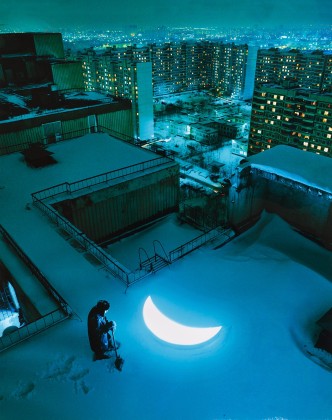
Every morning he buries the moon, 2003/2005. From the series “Private moon”
C-Print on photo paper
Artist Leonid Tishkov demands his works be removed from the exhibition “Dreaming Russia – Works from the Gazprombank Collection” at the Albertina Museum in Vienna, protesting against the persecution of Greenpeace activists who staged an action at the Prirazlomnaya platform of the “Gazprom Neft Shelf” oil company.
Below is Tishkov’s open letter to the Albertina Museum Director, originally published in Russian on colta.ru. Translated into English by Corina L. Apostol.
Dear Director
Dr. Klaus Albrecht Schröder
In early October, the exhibition “Deaming Russia / Russian Contemporary Art from the Gazprombank collection” opens at the Albertina Museum in Vienna. The exhibition includes works from my photographic series “Private Moon” (2003/2005), one of which is even featured on the invitation to the exhibition opening on October 11th.
In this photograph, I am standing on the snow-covered rooftop of my studio in Moscow together with the object “Private Moon.” I am there alone with the moon, while people go on living in all the houses around. And they, just like me, are not indifferent to the fate of our planet Earth. Therefore, I decided to join the voices of intelligent people all over the world and demand to end the persecution of Greenpeace activists who acted in defense of the Arctic.
The Prirazlomnaya oil platform in the Barents Sea is owned by Gazprom. When an oil spill happens, a great misfortune will befall upon the Arctic’s fragile environment, and ultimately this affects every person on Earth.
Without my knowledge, the series “Private Moon” was sold from a private collection to the Gazprombank collection. While the bank has the right to own these works, it cannot display them publicly or use reproductions without my permission.
Therefore, I am writing to you as the director of the Albertina Museum to ask you to remove my works from the “Dreaming Russia” exhibition in sign of protest against the persecution of the Greenpeace crew on the Arctic Sunrise vessel and against Gazprom’s oil drilling in the Arctic.
Respectfully,
Leonid Tishkov , artist
__________________________________________________________________________
A team of Greenpeace International activists abandoned an occupation of Gazprom’s Prirazlomnaya oil platform after complaining of being bombarded by ice-cold water and metal objects.
Six activists, including Greenpeace International executive director Kumi Naidoo, scaled the side of the giant platform in the Pechora Sea in a speedboat-born raid early Friday morning.
The group used a giant slingshot to pass a string, then rope over a foothold on the platform before using climbing equipment to ascend to a position halfway up the platform’s side, a video of the action posted on YouTube showed.
The activists said they had brought enough food and clothes to last for “days,” but by 9 p.m. the activists decided to withdraw.
“Not just hosed water, but now metal being thrown by Gazprom crew at our activists; we’re coming down,” Naidoo’s Twitter feed announced Friday evening.
Greenpeace said Sunday that “multiple pieces of sharp, rusted jagged pieces of metal were thrown at the activists from above,” as well as a single “large heavy metal object” on a mooring rope that was directed at one of the groups of climbers. Greenpeace said it had recovered several of the metal fragments as evidence.
Speaking earlier on Friday morning by satellite phone from his position in a flimsy tent on the side of the rig, Naidoo said the platform’s crew had “mostly been friendly — they’ve been talking to us, asking why we are here and so on.”
But that later changed. “Intercepted radio from platform: Strict orders to leave us alone ’til tomorrow, but make life as uncomfortable as possible, i.e. lots of water,” Naidoo tweeted from his position next to the platform.
Gazprom Neft Shelf, which operates the platform, insisted that the Greenpeace action had not halted work on the platform, which is still undergoing preparations to begin drilling.
“Later in the day, after the waterbombing, when some of our activists were experiencing symptoms of hyperthermia, they said we could come up and they would be detained overnight until the authorities arrived. However, the workers on the platform have no authority to detain our activists, and given the situation, with the intense waterbombing and metal shrapnel being thrown at them from the deck above, our activists did not feel safe going on the platform without the Coast Guard or other authorities present,” Naidoo said by telephone from the Arctic Sunrise on Sunday night.
The company would not comment on the activists’ claims of having been bombarded by metal objects and fire hoses.
The Arctic Sunrise, the vessel from which the raid was launched, remained in the vicinity of the rig and was “monitoring what Gazprom is doing” as of Sunday night, Greenpeace said. The organization would not comment on future plans other than to say that its fight to save the Arctic would continue.
The Moscow Times
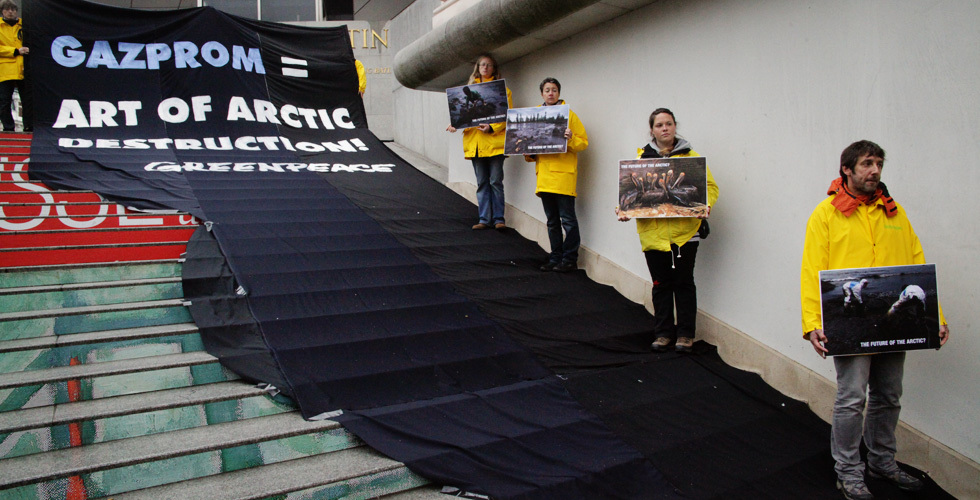
Protest Action against the Gazprom exhibition in Vienna © Herwig Höller
Open Letter to Boris Groys and Maria Lind, Invited Curators of ARSENALE 2014 (Kyiv, Ukraine)
UPDATE
Boris Groys pulls out of the Kyiv Biennale Discussion Platform (via Baibakov Art Projects who translated his letter to Natalya Zabolotna, Arsenale Director)
Dear Natalya,
As I made clear in our interview, it seems possible to participate in this project only if I feel comfortable with it. Unfortunately, I do not feel comfortable with the 2nd Kyiv Biennale, as I have the increasingly sense that the Ukrainian art scene is entirely focused on its own internal problems. Under these conditions, I do not see much possibility in organizing a serious, international discussion platform. First and foremost, I think it would be annoying to the invited participants, as I am certain that they will be listened to or understood, only pressed to respond to the conversations going on within the Ukraine.
For this reason, with this letter I relieve myself of the duties of organizing the Discussion Platform for the 2nd Kyiv Biennale and hereby annul the contract that we have signed.
I regret that I have had to take this course of action. This decision does not mean that I subscribe to the call to boycott the Biennale. On the contrary, I consider this call to be incorrect and harmful to art systems. I am grateful for the invitation and for the good faith that you have shown towards me. I simply do not see for myself how it is possible to organize this platform in Kiev in a way that I deem in accordance with my expectations for a responsible and rational debate.
With regards,
Boris Groys
___________________________________________________________________________
//EN
We, the undersigned, are calling you to join us in the boycott of Mystetskyi Arsenal and all of its affiliate organizations that began in July 2013 in response to the situation surrounding the exhibition “Great and Grand.”
By organizing this exhibition, Mystetskyi Arsenal revealed itself to be an ideologized, pro-regime institution, as well as an instrument for imitating cultural processes. Such activity does not correspond to the challenges of today’s world and thus does not create space for contemporary art.
Proclaiming the exhibition “Great and Grand” a “project of self-awareness and true lesson in national pride in Ukrainian culture,” Mystetskyi Arsenal is creating a precedent for uncritical and simplistic treatment of both the historical narrative and current problems, presenting culture as an attractive object working for the fusion of state and church, which in this instance is encroaching even on artistic space.
The censorship of Volodymyr Kuznetsov’s work “Koliivshchyna: Judgment Day” and the exclusion of Vasyl Tsagolov’s painting “Molotov Cocktail” from the exhibition revealed the curatorial and organizational ineptitude of those who work for Mystetskyi Arsenal. On the eve before the exhibition opening, director N. Zabolotna ordered that Kuznetsov’s mural be covered in black paint, calling this action her “own performance,” enacted to punish “certain artists for their impudence.”
This act of censorship has also been detrimental to the international reputation of Mystetskyi Arsenal and has raised doubts about the possibility of holding significant international contemporary art exhibitions within its walls.
A state institution cannot serve the caprices and phobias of the authorities; it should represent the critical and discursive knowledge produced by art. However, any critical discourse authorized by Arsenal in the current situation is discredited from the outset. Anyone who has the right to speak during ARSENALE 2014 upholds the stifling of every dissenting voice – both before and after the event.
Collaboration with the institution Mystetskyi Arsenal in its current state is impossible.
Since the publication of the Open Letter from the Art Workers’ Self-defense Initiative to the Ukrainian and International Art Community on July 31, there has been no response to its demands from Mystetskyi Arsenal.
Therefore, we reiterate that this boycott of Mystetskyi Arsenal will last until the institution:
–declares the principles that underlie the activity of Mystetskyi Arsenal as an Institution;
–legalizes relations between the Institution and artists;
–publicly acknowledges the situation surrounding the works of Tsagolov and Kuznetsov as, respectively, an act of censorship and censorship and vandalism;
–publicly guarantees that similar acts of censorship will not be repeated in the future.
In light of the above-mentioned events, we maintain that art is capable of resisting increasing religious fundamentalism and any kind of fundamentalism. We insist on the autonomy of the state art institution, which must not be utilized by any official, religious, ideological or commercial forces.
Art Workers’ Self-defense Initiative (Ініціатива Самозахисту Трудящих Мистецтва)
You can sign the petition here: http://www.ipetitions.com/petition/boycott_mystetskyi_arsenal/
___________________________________________________________________________
//UK
Відкритий лист до Марії Лінд та Бориса Гройса, запрошених кураторів ARSENALE 2014 (Київ, Україна)
Ми, що підписалися нижче, закликаємо Вас приєднатися до бойкоту Мистецького Арсеналу та всіх його структур, що розпочався в липні 2013 року у відповідь на ситуацію довкола виставки «Велике і величне».
Організовуючи подібну виставку, Мистецький Арсенал виявив себе як провладна ідеологізована установа та інструмент імітації культурного процесу. Така діяльність не відповідає викликам сучасного світу, а отже, не створює простору для сучасного мистецтва.
Проголошуючи виставку “Велике і Величне” “проектом-самоусвідомленням і справжнім уроком національної гордості за українську культуру”, Мистецький Арсенал створює прецедент некритичного та поблажливого ставлення як до історичного наративу, так і до сучасних проблем, презентуючи українську культуру як принадливий об’єкт, працюючи на злипання держави та церкви, яка в цьому випадку зазіхає ще й на мистецький простір.
Цензурування роботи Володимира Кузнецова “Коліївщина. Страшний суд” та вилученння з експозиції картини Василя Цаголова “Коктейль Молотова” унаочнили кураторську та організаторську неспроможність працівників Мистецького Арсеналу.
У переддень відкриття виставки директор Наталя Заболотна наказала замалювати картину Кузнєцова чорною фарбою, називаючи цю акцію «своїм власним перформансом» з метою покарати «певних митців за їхню зухвалість».
Акт цензури також згубно вплинув і на міжнародну репутацію Мистецького Арсеналу та поставив під сумнів можливість проведення в його стінах вагомих міжнародних виставок сучасного мистецтва.
Державна інституція не може обслуговувати примхи та фобії можновладців, вона має репрезентувати критичне і дискусійне знання, яке виробляє актуальне мистецтво. У даній ситуації знецінюється будь-яке, і особливо критичне, висловлювання на території Арсеналу. Кожен, хто матиме право голосу на бієнале, легітимує нівеляцію голосів інших – до і після події.
Співпраця з інституцією Мистецький Арсенал в її теперішньому стані неможлива.
З моменту публікації відкритого листа Ініціативи самозахисту трудящих мистецтва до української та міжнародної мистецької спільноти від 31 липня 2013 року Мистецький Арсенал не дав жодної відповіді на поставлені вимоги.
Отже, ми повторюємо, що цей бойкот Мистецького Арсеналу триватиме до тих пір, доки ця установа не:
-проголосить принципи діяльності Мистецького Арсеналу як Інституції;
-легалізує відносини Інституції з художниками;
– публічно визнає ситуацію з роботами Цаголова та Кузнецова відповідно актами цензури та цензури і вандалізму;
-публічно гарантує неповторення у майбутньому подібних актів цензури.
У контексті вищезазначених подій ми заявляємо про здатність мистецтва протистояти зростанню релігійного фундаменталізму та фундаменталізму як такого. Ми наголошуємо на автономії державної інституції, яка не може бути використана жодним офіціозним, релігійним, ідеологічним, комерційним угрупованням.
Ініціатива Самозахисту Трудящих Мистецтва
Підписати лист можна тут: http://www.ipetitions.com/petition/boycott_mystetskyi_arsenal/
 ArtLeaks